Kirjahaku
Etsi kirjoja tekijän nimen, kirjan nimen tai ISBN:n perusteella.
1000 tulosta hakusanalla David Jason
...the possibility of experiencing eternal consciousness; finally being able to know your self; hearing your inner guide's voice; attaining to heavenly infinite life and knowledge - these on the one hand. And on the other...: a handful of supernaturally talented individuals run everything; a conspiracy with global reach; withheld knowledge of advanced science; a plot to steal consciousness from us; alien visitors who have made a home for themselves; rewritten and falsified history; ancient creation myths are actually true These are Icke's themes. An attractive and mad collection of ideas, for sure. And yet there is something about them or concealed in them which is right for these days. What is it which makes Icke so impressive at the same time as his writing is - mostly - so improbable?

An Analysis of Henry David Thoraeu's Civil Disobedience
Mano Toth; Jason Xidias
Macat International Limited
2017
nidottu
In Civil Disobedience, Henry David Thoreau looks at old issues in new ways, asking: is there ever a time when individuals should actively oppose their government and its justice system?After a thorough review of the evidence, Thoreau comes to the conclusion that opposition is legitimate whenever government actions or institutions are unacceptable to an individual’s conscience. What is particularly interesting is that Thoreau’s creative mind took him deeper into the argument, as he concluded that this legitimate opposition really wasn’t enough. In Thoreau’s opinion, anyone who believed something to be wrong had a duty to resist it actively.These ideas were completely at odds with the prevailing opinions of the day – that it was the duty of every citizen to support the state. Thoreau connected ideas and notions in a novel manner and went against the tide, generating new hypotheses so that people could see matters in a new light. It is a mark of the success of his creative thinking that his views are now considered mainstream, and that his arguments are still deployed in defence of the principle of civil disobedience.
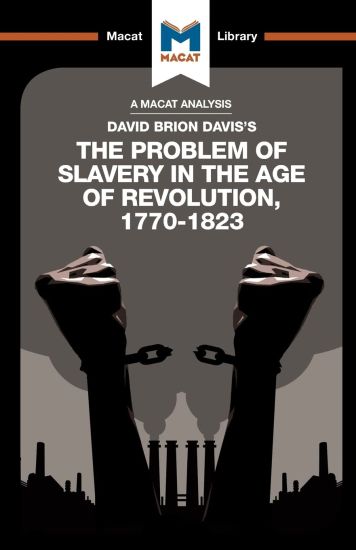
An Analysis of David Brion Davis's The Problem of Slavery in the Age of Revolution, 1770-1823
Duncan Money; Jason Xidas
Macat International Limited
2017
nidottu
How was it possible for opponents of slavery to be so vocal in opposing the practice, when they were so accepting of the economic exploitation of workers in western factories – many of which were owned by prominent abolitionists? David Brion Davis's The Problem of Slavery in the Age of Revolution, 1770-1823, uses the critical thinking skill of analysis to break down the various arguments that were used to condemn one set of controversial practices, and examine those that were used to defend another. His study allows us to see clear differences in reasoning and to test the assumptions made by each argument in turn. The result is an eye-opening explanation that makes it clear exactly how contemporaries resolved this apparent dichotomy – one that allows us to judge whether the opponents of slavery were clear-eyed idealists, or simply deployers of arguments that pandered to their own base economic interests.
An Analysis of David Brion Davis's The Problem of Slavery in the Age of Revolution, 1770-1823
Duncan Money; Jason Xidas
Macat International Limited
2017
sidottu
How was it possible for opponents of slavery to be so vocal in opposing the practice, when they were so accepting of the economic exploitation of workers in western factories – many of which were owned by prominent abolitionists? David Brion Davis's The Problem of Slavery in the Age of Revolution, 1770-1823, uses the critical thinking skill of analysis to break down the various arguments that were used to condemn one set of controversial practices, and examine those that were used to defend another. His study allows us to see clear differences in reasoning and to test the assumptions made by each argument in turn. The result is an eye-opening explanation that makes it clear exactly how contemporaries resolved this apparent dichotomy – one that allows us to judge whether the opponents of slavery were clear-eyed idealists, or simply deployers of arguments that pandered to their own base economic interests.
An Analysis of Henry David Thoraeu's Civil Disobedience
Mano Toth; Jason Xidias
Macat International Limited
2017
sidottu
In Civil Disobedience, Henry David Thoreau looks at old issues in new ways, asking: is there ever a time when individuals should actively oppose their government and its justice system?After a thorough review of the evidence, Thoreau comes to the conclusion that opposition is legitimate whenever government actions or institutions are unacceptable to an individual’s conscience. What is particularly interesting is that Thoreau’s creative mind took him deeper into the argument, as he concluded that this legitimate opposition really wasn’t enough. In Thoreau’s opinion, anyone who believed something to be wrong had a duty to resist it actively.These ideas were completely at odds with the prevailing opinions of the day – that it was the duty of every citizen to support the state. Thoreau connected ideas and notions in a novel manner and went against the tide, generating new hypotheses so that people could see matters in a new light. It is a mark of the success of his creative thinking that his views are now considered mainstream, and that his arguments are still deployed in defence of the principle of civil disobedience.
Michael Moore Is A Big Fat Stupid White Man
David Hardy; Clarke Jason
HARPERCOLLINS PUBLISHERS INC
2005
pokkari
Watching Michael Moore in action--passing off manipulating facts in Bowling for Columbine, spinning statistics in Stupid White Men and Dude, Where's My Country?, shamelessly grandstanding at the Academy Awards, and epitomizing the hypocrisy he's made a king's fortune railing against--has spurred authors David T. Hardy and Jason Clarke to take action into their own hands. In Michael Moore Is a Big Fat Stupid White Man, Hardy and Clarke dish it back hard to the fervent prophet of the far left, turning a careful eye on Moore's use of camera tricks and publicity ploys to present his own version of the truth.Postwar documentarians gave us the documentary, Rob Reiner gave us the mockumentary, and Moore initiated a third genre, the crockumentary.How, they ask, does Moore pull off a proletarian, man-of-the-people image so at odds with his lifestyle as a fabulously wealthy Manhattanite? And how large of an impact do his incendiary, ill-founded polemics have on the growing community that follows him with near-religious devotion? Loaded with well-researched, solidly reasoned arguments, and laced with irreverent wit, Michael Moore Is a Big Fat Stupid White Man fires back at one of the left's biggest targets--politically and literally.
It Doesn't Have to Be Crazy at Work
Fried Jason; Hansson David Heinemeier
HarperBusiness
2018
sidottu
In this timely manifesto, the authors of the New York Times bestseller Rework broadly reject the prevailing notion that long hours, aggressive hustle, and "whatever it takes" are required to run a successful business today.In Rework, Jason Fried and David Heinemeier Hansson introduced a new path to working effectively. Now, they build on their message with a bold, iconoclastic strategy for creating the ideal company culture—what they call "the calm company." Their approach directly attack the chaos, anxiety, and stress that plagues millions of workplaces and hampers billions of workers every day.Long hours, an excessive workload, and a lack of sleep have become a badge of honor for modern professionals. But it should be a mark of stupidity, the authors argue. Sadly, this isn’t just a problem for large organizations—individuals, contractors, and solopreneurs are burning themselves out the same way. The answer to better productivity isn’t more hours—it’s less waste and fewer things that induce distraction and persistent stress.It’s time to stop celebrating Crazy, and start celebrating Calm, Fried and Hansson assert.Fried and Hansson have the proof to back up their argument. "Calm" has been the cornerstone of their company’s culture since Basecamp began twenty years ago. Destined to become the management guide for the next generation, It Doesn't Have to Be Crazy at Work is a practical and inspiring distillation of their insights and experiences. It isn’t a book telling you what to do. It’s a book showing you what they’ve done—and how any manager or executive no matter the industry or size of the company, can do it too.
From the founders of the trailblazing software company 37signals, here is a different kind of business book - one that explores a new reality.
For too long our lives have been dominated by the 'under one roof' Industrial Revolution model of work. The technology to work remotely and to avoid the daily grind of commuting and meetings has finally come of age, and bestselling authors Jason Fried and David Heinemeier Hansson are the masters of making it work at tech company 37signals.
Online news sites play an ever-pervasive role in the daily gathering and flow of political information. Media has always played an intermediary role in the way that citizens receive and process news, but, with the speed of information transmission, the segmentation of news sources, and the rise of citizen journalism, issues of authority, audience, and even the definition of "news " have shifted and become blurred. News on the Internet synthesizes research on developing and current patterns of online news provision with the literature on traditional, offline media to create a conceptual map for understanding the way that public affairs and news are presented and consumed on the internet. Tewksbury and Rittenberg look at the dual role of the internet as a source of authoritative news and as a vehicle for citizens in contemporary democracies to create and share political information. Throughout, they address the tension between the benefits of internet news provision, specifically increased citizen engagement, and the negative, perhaps counterintuitive, effects: the fragmentation of knowledge and polarization of opinion in contemporary democracies. News on the Internet focuses on these points of conflict and contradiction in the online news environment and offers conclusions and predictions for how these phenomena will develop in the future.
Inspired by the humanist and Catholic martyr Thomas More, David Albertson and Jason Blakely imagine a new politics of hope In Thomas More’s Utopia, a traveler from the New World delivers a shocking message: on a lost island beyond the horizon, people live far better lives than in Europe. A leading intellectual of his day, More was murdered by Henry VIII in 1535 for refusing to sign a loyalty oath, but his utopian vision inspired some of the most consequential movements in the modern world. In their provocative manifesto, David Albertson and Jason Blakely retrieve More’s insights and apply them to our moment. Amid the decline of liberalism and the rise of authoritarianism, Albertson and Blakely resist the dystopian fears taking root in the twenty-first century. Utopian politics, they argue, can help us break free of today’s entrenched polarities and recast what is possible. They return to the “virtuoso dreamers,” ranging from Plato and Saint Augustine to Dorothy Day and Martin Luther King, Jr., who faced dire circumstances yet were buoyed by indestructible hopes. Channeling More’s spirit of experimentation, creativity, and levity, their utopianism is invested in making new worlds—the most serious kind of play. Social reality, they remind us, has an irreducible imaginative component. Inviting us to dream more boldly, this book offers a radical alternative to the ecological, political, and spiritual crises that plague our world.
Executive's Guide to Solvency II
David Buckham; Jason Wahl; Stuart Rose
John Wiley Sons Inc
2010
sidottu
A straightforward guide to the evolution, benefits, and implementation of Solvency II Providing a guide to the evolution, practice, benefits, and implementation of Solvency II, Executive's Guide to Solvency II deftly covers this major European regulation which ensures that insurers can meet their risk–based liabilities over a one–year period to a 99.5% certainty. Part of the Wiley and SAS Business series, this book will guide you through Solvency II, especially if you need to understand the subtleties of Solvency II and risk–based capital in basic business language. Among the topics covered in this essential book are: Background to Solvency IILearning from the Basel ApproachThe Economic Balance SheetInternal ModelsPeople, Process, and TechnologyBusiness Benefits of Solvency II Executive's Guide to Solvency II has as its aim an explanation for executives, practitioners, consultants, and others interested in the Solvency II process and the implications thereof, to understand how and why the directive originated, what its goals are, and what some of the complexities are. There is an emphasis on what in practice should be leveraged upon to achieve implementation, specifically data, processes, and systems, as well as recognition of the close alignment demanded between actuaries, the risk department, IT, and the business itself.
A provocative case for the inherently political nature of languageIn The Politics of Language, David Beaver and Jason Stanley present a radical new approach to the theory of meaning, offering an account of communication in which political and social identity, affect, and shared practices play as important a role as information. This new view of language, they argue, has dramatic consequences for free speech, democracy, and a range of other areas in which speech plays a central role.Drawing on a wealth of disciplines, The Politics of Language argues that the function of speech—whether in dialogue, larger group interactions, or mass communication—is to attune people to something, be it a shared reality, emotion, or identity. Reconceptualizing the central ideas of pragmatics and semantics, Beaver and Stanley apply their account to a range of phenomena that defy standard frameworks in linguistics and philosophy of language—from dog whistles and covert persuasion to echo chambers and genocidal speech. The authors use their framework to show that speech is inevitably political because all communication is imbued with the resonances of particular ideologies and their normative perspectives on reality.At a time when democracy is under attack, authoritarianism is on the rise, and diversity and equality are being demanded, The Politics of Language offers a powerful new vision of the language of politics, ideology, and protest.
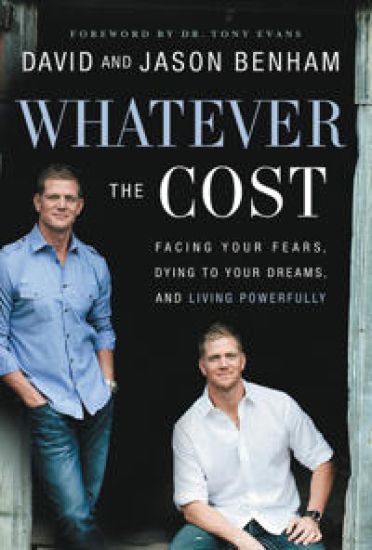
Are You Ready to Live With a Full-Throttle Faith?This trade paper edition follows the story of entrepreneurial twin brothers, David and Jason Benham, from their formative years in professional baseball to their rise as owners of a multi-million dollar business empire to securing an HGTV reality series. It’s a journey where the brothers learned how they must die to their dreams not just once, but twice—as they walked away from professional baseball careers and later as their television series was stripped away from them. These experiences helped them realize that the key to powerful living is found when we die to our dreams and face our fears, and choose to live powerfully through it all. The biblical principles they implemented to guide their lives are what give us the courage to stand for what is right.The book will expand on principles such as:Be a Fountain to Others and not a DrainProduce More in Value than You ReceiveWork to Your Ability and not Your PayBreathe Life into All SituationsHold to a Standard of Disciplined LivingFind Your Greatest Blessings on the Other Side of Your Greatest Fears
Twin brothers David and Jason Benham grew up with big dreams of baseball and an even bigger trust in God. Though they attended a small high school with no baseball field, turned down a professional offer so they could attend college together, and faced more than one missed pitch and injuries, they kept dreaming, praying together on the field, and believing in God’s provision for their lives.David and Jason’s journey, from Little League to college to professional baseball and beyond, reminds us that even when we don’t know what God is up to, He’s putting together the pieces of our life’s puzzle and executing the plans He has for each of us.Miracle in Shreveport tells the story of a family’s love, the power of prayer, and a game that is truly all-American. It is also the story of brotherhood staying strong, despite the threat of comparison in a profession committed to competition. Most of all, it is the story of being faithful in small steps, honoring God in the process, and trusting His hand in our lives. In this book, the Benhams call us to remember that when we follow God’s dream for us, we find it is better than we could have ever dreamed for ourselves.
A Brief History of Liberty
David Schmidtz; Jason Brennan
Wiley-Blackwell (an imprint of John Wiley Sons Ltd)
2010
nidottu
Through a fusion of philosophical, social scientific, and historical methods, A Brief History of Liberty provides a comprehensive, philosophically-informed portrait of the elusive nature of one of our most cherished ideals. Offers a succinct yet thorough survey of personal freedomExplores the true meaning of liberty, drawing philosophical lessons about liberty from historyConsiders the writings of key historical figures from Socrates and Erasmus to Hobbes, Locke, Marx, and Adam SmithCombines philosophical rigor with social scientific analysisArgues that liberty refers to a range of related but specific ideas rather than limiting the concept to one definition
SQL Server T-SQL Recipes
David Dye; Jason Brimhall; Timothy Roberts; Wayne Sheffield; Joseph Sack; Jonathan Gennick
APress
2015
nidottu
SQL Server T-SQL Recipes is an example-based guide to the Transact-SQL language that is at the core of SQL Server. This edition has been lightly updated for SQL Server 2014 and provides ready-to-implement solutions to common programming and database administration tasks. Learn to create databases, create in-memory tables and stored procedures, insert and update data, generate reports, secure your data, and more. Tasks and their solutions are broken down into a problem/solution format that is quick and easy to read so that you can get the job done fast when the pressure is on. Solutions in this book are divided into chapters by problem domain. Each chapter is a collection of solutions around a single facet of the language such as writing queries, managing indexes, error handling, and query performance. Each solution is presented code-first, giving you a working code example to copy from and implement immediately in your own environment. Following each example is an in-depth description of how and why the given solution works. Tradeoffs and alternative approaches are also discussed.Focused on solutions: Look up what you need to do. Learn how to do it. Do it.Current: Lightly updated for SQL Server 2014Comprehensive: Covers all common T-SQL problem domains
Acclaimed YUM! Brands CEO and author of the New York Times best-selling leadership book, Taking People With You, David Novak, teams up with Jason Goldsmith, the coach to some of the world’s best PGA golf stars, to bring you groundbreaking lessons on personal growth and professional development. TAKE CHARGE OF YOU teaches you the secrets to self-coaching. Everyone could use a good coach to help them reach their full potential. Unfortunately, there just aren’t enough good ones to go around, and the ones that exist are often too expensive or sought-after for most of us to even consider hiring them. But that doesn’t mean you should go without! Your life is too important to leave your personal growth and professional development up to chance. Take Charge of You helps you define for yourself what you want out of life and give yourself what you need to succeed. Written by two highly successful coaches from the worlds of business and professional sports, this book provides a straightforward process that will guide you on your self-coached journey to success, including: Getting into a coaching mindsetUsing all 5 senses to spark your brainVisualizing successThe practice of neutralityThe action of belief, and more Chock full of stories, exercises, tips, and questions to ask yourself to spark insight, it’s designed to provide not just the knowledge you need, but tools you can use to create real, lasting change so you can lead a more fulfilling and successful life—now and well into the future.