Kirjojen hintavertailu. Mukana 11 244 527 kirjaa ja 12 kauppaa.

Kirjahaku

Etsi kirjoja tekijän nimen, kirjan nimen tai ISBN:n perusteella.

1000 tulosta hakusanalla David M Pack

The End of Engagement

The End of Engagement

David M. McCourt

OXFORD UNIVERSITY PRESS INC
2024
nidottu
After the Cold War, America's leaders hoped Russia and China could be integrated into the rules-based international order and might even become more like the West. By the late 2010s, their optimism was dead. In The End of Engagement, David M. McCourt traces the intense personal, professional, and policy struggles over China and Russia in U.S. foreign policy since 1989. Drawing on 200 original interviews with America's China and Russia experts--from former policymakers and diplomats to prominent think tankers and academics--McCourt chronicles the rise and recent fall of "engagement" with Beijing and Moscow. While there are numerous explanations for why America moved away from engagement with China and Russia in the last decade, McCourt shows that none consider how important foreign policy knowledge communities have been in impacting policy. Adopting a unique, sociological perspective, this book offers an intimate look into the world of America's national security experts as they have struggled to make sense of changes in China and Russia and the remaining question of what comes next.

Out of the Ballpark

Out of the Ballpark

David M. Henkin

OXFORD UNIVERSITY PRESS INC
2026
sidottu
From America's Pastime to a global phenomenon--the life of the spectacular game as it is played and celebrated in communities around the world All over the world, masses of people watch, follow, document, and obsess over baseball. Everything remarkable about the impact of baseball derives from the game's history and cultural status as events that draw people together in these ways. Understanding baseball as a cultural phenomenon is therefore less a matter of mastering the vocabulary of the game or merely recollecting its iconic stadiums, players, and stats. While all those details compel insiders and inspire fans, baseball's peculiar and persistent appeal can only be understood by adopting a wider lens. It requires reckoning with the history of structured competition. The classic backyard game of catch between a father and son draws meaning from its associations with the organized sport and its history. The challenge lies less in finding one perfect spot to look, but rather in identifying the many different places where baseball has accumulated significance. Out of the Ballpark reconsiders the character, meaning, and delights of the game by exploring both baseball's unusual features and the sport's many resonances with other aspects of modern life. To this end, it abandons several assumptions and mythologies that underlie most approaches to histories of baseball: that it is unique among sports and fundamentally different from other kinds of entertainment; that it is specific to the United States; that it has changed fundamentally in recent years; and that the keys to understanding it lie primarily in examining what happens on the field of play. Instead, David M. Henkin moves across time and space to examine baseball's history since the nineteenth century and beyond US borders. He takes readers inside the structures of clubs and leagues, interprets the sacred scripture of rulebooks, and illuminates some of baseball's rites and rituals that are often associated with honor and manhood. He charts baseball's significance along the routes of American and Japanese imperial expansion and the shifting maps of race and ethnicity in the US. Baseball is found at negotiating tables that pit capital against labor and in pivotal moments in the history of mass media. Here, we are shown how baseball might offer a complex and capacious space for thinking about such things as spectatorship, success, community, order, and contingency in the modern world.
Bloch, Schoenberg, and Bernstein

Bloch, Schoenberg, and Bernstein

David M. Schiller

Oxford University Press
2003
sidottu
David Schiller's study of three works of Jewish music - Ernest Bloch's 'Sacred Service' (1933), Arnold Schoenberg's 'A Survivor from Warsaw' (1947), and Leonard Bernstein's 'Kaddish' (1963) - reveals how, in the mid-twentieth century, the problem of assimilation was acutely felt as the unfinished business of European Jewry, at a time when American Jewry was creating its own distinctive culture (albeit with European roots). He shows how the business of 'assimilating Jewish music' is as much a process audiences themselves engage in when they listen to Jewish music as it is something critics and musicologists do when they write about it. He further asserts that this process of assimilation is performed by the music itself - that Jewish music assimilates into the Western tradition of art music when it appears in the form of concert genres like the oratorio, cantata, and symphony. In rethinking the Jewish works of Bloch, Schoenberg, and Bernstein as part of the legacy of assimilation, David Schiller sheds new light on an important aspect of their cultural and aesthetic achievements.
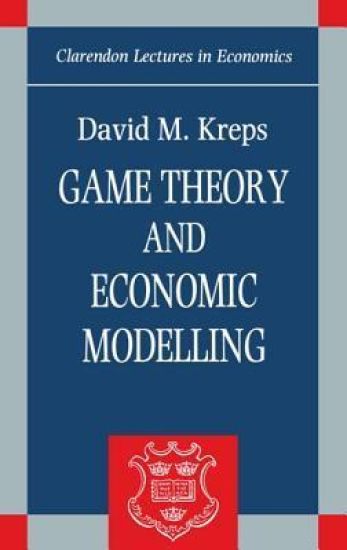
Game Theory and Economic Modelling

Game Theory and Economic Modelling

David M. Kreps

Clarendon Press
1990
nidottu
Over the past two decades, academic economics has undergone a mild revolution in methodology. The language, concepts and techniques of noncooperative game theory have become central to the discipline. This book provides the reader with some basic concepts from noncooperative theory, and then goes on to explore the strengths, weaknesses, and future of the theory as a tool of economic modelling and analysis. The central theses are that noncooperative game theory has been a remarkably popular tool in economics over the past decade because it allows analysts to capture essential features of dynamic competition and competition where some parties have proprietary information. The theory is weakest in providing a sense of when it - and equilibrium analysis in particular - can be applied and what to do when equilibrium analysis is inappropriate. Many of these weaknesses can be addressed by the consideration of individuals who are boundedly rational and learn imperfectly from the past. Written in a non-technical style and working by analogy, the book, first given as part of the Clarendon Lectures in Economics, is readily accessible to a broad audience and will be of interest to economists and students alike. Knowledge of game theory is not required as the concepts are developed as the book progresses.
Fundamental Processes in Ecology

Fundamental Processes in Ecology

David M. Wilkinson

Oxford University Press
2006
sidottu
Fundamental Processes in Ecology presents a way to study ecosystems that is not yet available in ecology textbooks but is resonant with current thinking in the emerging fields of geobiology and Earth System Science. It provides an alternative, process-based classification of ecology and proposes a truly planetary view of ecological science. To achieve this, it asks (and endeavours to answer) the question, "what are the fundamental ecological processes which would be found on any planet with Earth-like, carbon based, life?" The author demonstrates how the idea of fundamental ecological processes can be developed at the systems level, specifically their involvement in control and feedback mechanisms. This approach allows us to reconsider basic ecological ideas such as energy flow, guilds, trade-offs, carbon cycling and photosynthesis; and to put these in a global context. In doing so, the book puts a much stronger emphasis on microorganisms than has traditionally been the case. The integration of Earth System Science with ecology is vitally important if ecological science is to successfully contribute to the massive problems and future challenges associated with global change. Although the approach is heavily influenced by Lovelock's Gaia hypothesis, this is not a popular science book about Gaian theory. Instead it is written as an accessible text for graduate student seminar courses and researchers in the fields of ecology, earth system science, evolutionary biology, palaeontology, history of life, astrobiology, geology and physical geography.
Spectral Analysis of Musical Sounds with Emphasis on the Piano
This book addresses the analysis of musical sounds from the viewpoint of someone at the intersection between physicists, engineers, piano technicians, and musicians. The study is structured into three parts. The reader is introduced to a variety of waves and a variety of ways of presenting, visualizing, and analyzing them in the first part. A tutorial on the tools used throughout the book accompanies this introduction. The mathematics behind the tools is left to the appendices. Part Two provides a graphical survey of the classical areas of acoustics that pertain to musical instruments: vibrating strings, bars, membranes, and plates. Part Three is devotedalmost exclusively to the piano. Several two- and three-dimensional graphical tools are introduced to study various characteristics of pianos: individual notes and interactions among them, the missing fundamental, inharmonicity, tuning visualization, the different distribution of harmonic power for thevarious zones of the piano keyboard, and potential uses for quality control. These techniques are also briefly applied to other musical instruments studied in earlier parts of the book.For physicists and engineers there are appendices to cover the mathematics lurking beneath the numerous graphs and a brief introduction to Matlab (R) which was used to generate these graphs. A website accompanying the book (https://sites.google.com/site/analysisofsoundsandvibrations/) contains:- Matlab (R) scripts- mp3 files of sounds- references to YouTube videos - and up-to-date results of recent studies
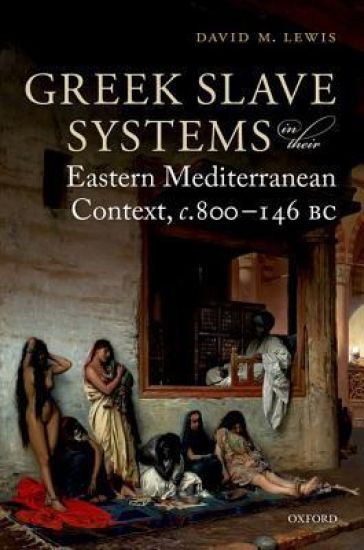
Greek Slave Systems in their Eastern Mediterranean Context, c.800-146 BC
The orthodox view of slavery in the ancient Mediterranean holds that Greece and Rome were its only 'genuine slave societies', that is, societies in which slave labour contributed significantly to the economy and underpinned the wealth of elites. Other societies, traditionally labelled 'societies with slaves', are thought to have made little use of slave labour and therefore have been largely ignored in recent scholarship. This volume presents a radically different view of the ancient Eastern Mediterranean world, showing that elite exploitation of slave labour in Greece and the Near East shared some fundamental similarities, although the degree of elite dependence on slaves varied from region to region. Whilst slavery was indeed particularly highly developed in Greece and Rome, it was also economically entrenched in Carthage, and played a not insignificant role in the affairs of elites in Israel, Assyria, Babylonia, and Persia. The differing degrees to which Eastern Mediterranean elites exploited slave labour represents the outcome of a complex interplay between cultural, economic, political, geographical, and demographic factors. Proceeding on a regional basis, this book tracks the ways in which local conditions shaped a wide variety of Greek and Near Eastern slave systems, and how the legal architecture of slavery in individual regions was altered and adapted to accommodate these needs. The result is a nuanced exploration of the economic underpinnings of Greek elite culture that sets its reliance on slavery within a broader historical context and sheds light on the complex circumstances from which it emerged.
The Acceptance of Party Unity in Parliamentary Democracies

The Acceptance of Party Unity in Parliamentary Democracies

David M. Willumsen

Oxford University Press
2017
sidottu
Despite the central role of policy preferences in the subsequent behaviour of legislators, preferences at the level of the individual legislator have been almost entirely neglected in the study of parliaments and legislative behaviour. The main reason for this is the difficulty of obtaining measures of legislator preferences that are not based on their behaviour. This book explores direct measures of policy preferences through parliamentary surveys. Building on this, the book develops measures of policy incentives of legislators to dissent from their parliamentary parties, and demonstrates that preference similarity amongst legislators explains a very substantial proportion of party unity, yet cannot explain all of it. Through a quantitative analysis of the attitudes of legislators to the demands of party unity and what drives these attitudes, the book argues that the reason for the difference between observed unity and the levels of unity which can be explained by preference similarity among legislators, is the conscious acceptance by MPs that the long-term benefits of belonging to a united party (such as increased influence on legislation, lower transaction costs and better chances of gaining office) outweigh the short-terms benefits of always voting for their ideal policy outcome. The volume reinforces this argument through the analysis of both open-ended survey questions as well as survey questions on the costs and benefits of belonging to a political party in a legislature.
The Eusebians

The Eusebians

David M. Gwynn

Oxford University Press
2006
sidottu
A historical and theological re-evaluation of the polemical writings of Athanasius of Alexandria (bishop 328-73), who would become known to later Christian generations as a saint and a champion of orthodoxy, and as the defender of the original Nicene Creed of 325 against the `Arian heresy'. For much of his own lifetime, however, Athanasius was an extremely controversial figure, and his writings, although highly influential on modern interpretations of the fourth-century Church and the so-called `Arian Controversy', display bias and distortion. David M. Gwynn examines Athanasius' polemic in detail, and in particular his construction of those he condemns as `Arian' as a single `heretical party', 'the Eusebians'. Gwynn argues that Athanasius' image of the Church polarized between his own `orthodoxy' and the `Arianism' of the `Eusebians' is a polemical construct, which has seriously impaired our knowledge of the development of Christianity in the crucial period in which the Later Roman Empire became ever increasingly a Christian empire.
Athanasius of Alexandria

Athanasius of Alexandria

David M. Gwynn

Oxford University Press
2012
nidottu
Athanasius of Alexandria (c.295-373) is one of the greatest and most controversial figures of early Christian history. His life spanned the period of fundamental change for the Roman Empire and the Christian Church that followed the conversion of Constantine the Great, the first Christian Roman emperor. A bishop and theologian, an ascetic and a pastoral father, Athanasius played a central role in shaping Christianity in these crucial formative years. As bishop of Alexandria (328-73) he fought to unite the divided Egyptian Church and inspired admiration and opposition alike from fellow bishops and the emperor Constantine and his successors. Athanasius attended the first ecumenical Council of Nicaea summoned by Constantine in 325 and as a theologian would be remembered as the defender of the original Nicene Creed against the 'Arian' heresy. He was also a champion of the ascetic movement that transformed Christianity, a patron of monks and virgins and the author of numerous ascetic works including the famous Life of Antony. All these elements played their part in Athanasius' vocation as a pastoral father, responsible for the physical and spiritual wellbeing of his congregations. This book offers the first study in English to draw together these diverse yet inseparable roles that defined Athanasius' life and the influence that he exerted on subsequent Christian tradition. The presentation is accessible to both specialists and non-specialists and is illuminated throughout by extensive quotation from Athanasius' many writings, for it is through his own words that we may best approach this remarkable man.
Athanasius of Alexandria

Athanasius of Alexandria

David M. Gwynn

Oxford University Press
2012
sidottu
Athanasius of Alexandria (c.295-373) is one of the greatest and most controversial figures of early Christian history. His life spanned the period of fundamental change for the Roman Empire and the Christian Church that followed the conversion of Constantine the Great, the first Christian Roman emperor. A bishop and theologian, an ascetic and a pastoral father, Athanasius played a central role in shaping Christianity in these crucial formative years. As bishop of Alexandria (328-73) he fought to unite the divided Egyptian Church and inspired admiration and opposition alike from fellow bishops and the emperor Constantine and his successors. Athanasius attended the first ecumenical Council of Nicaea summoned by Constantine in 325 and as a theologian would be remembered as the defender of the original Nicene Creed against the 'Arian' heresy. He was also a champion of the ascetic movement that transformed Christianity, a patron of monks and virgins and the author of numerous ascetic works including the famous Life of Antony. All these elements played their part in Athanasius' vocation as a pastoral father, responsible for the physical and spiritual wellbeing of his congregations. This book offers the first study in English to draw together these diverse yet inseparable roles that defined Athanasius' life and the influence that he exerted on subsequent Christian tradition. The presentation is accessible to both specialists and non-specialists and is illuminated throughout by extensive quotation from Athanasius' many writings, for it is through his own words that we may best approach this remarkable man.
Fundamental Processes in Ecology

Fundamental Processes in Ecology

David M. Wilkinson

Oxford University Press
2007
nidottu
Fundamental Processes in Ecology presents a way to study ecosystems that is not yet available in ecology textbooks but is resonant with current thinking in the emerging fields of geobiology and Earth System Science. It provides an alternative, process-based classification of ecology and proposes a truly planetary view of ecological science. To achieve this, it asks (and endeavours to answer) the question, "what are the fundamental ecological processes which would be found on any planet with Earth-like, carbon based, life?" The author demonstrates how the idea of fundamental ecological processes can be developed at the systems level, specifically their involvement in control and feedback mechanisms. This approach allows us to reconsider basic ecological ideas such as energy flow, guilds, trade-offs, carbon cycling and photosynthesis; and to put these in a global context. In doing so, the book puts a much stronger emphasis on microorganisms than has traditionally been the case. The integration of Earth System Science with ecology is vitally important if ecological science is to successfully contribute to the massive problems and future challenges associated with global change. Although the approach is heavily influenced by Lovelock's Gaia hypothesis, this is not a popular science book about Gaian theory. Instead it is written as an accessible text for graduate student seminar courses and researchers in the fields of ecology, earth system science, evolutionary biology, palaeontology, history of life, astrobiology, geology and physical geography.
The International Struggle Over Iraq

The International Struggle Over Iraq

David M. Malone

Oxford University Press
2007
nidottu
Iraq has dominated international headlines in recent years, but its controversial role in international affairs goes back much further. The key arena for these power politics over Iraq has been the United Nations Security Council. Spanning the last quarter century,The International Struggle over Iraq examines the impact the United Nations Security Council has had on Iraq - and Iraq's impact on the Security Council. The story is a fascinating one. Beginning in 1980, in the crucible of the Iran-Iraq War, the Council found a common voice as a peacemaker after the divisions of the cold war. That peacemaking role was cemented when a UN-mandated force expelled Iraqi forces from Kuwait in 1991, offering a glimpse of a new role for the UN in the 'New World Order'. But unilateralism soon set in, as the Security Council struggled under the weight and bureaucratic demands of its changing identity. The Security Council gradually abandoned its traditional political and military tools for the legal-regulatory approach, but was unable to bridge the gap between those who believed allegations of Iraqi possession of weapons of mass destruction and those who didn't. Growing paralysis led eventually to deadlock in the Council in 2002, with the result that it was sidelined during the 2003 Coalition invasion. This relegation, when combined with the loss of some of its best and brightest in a massive truck bomb in Iraq later that year, precipitated a deep crisis of confidence. The future role of the UN Security Council has now, once again, become uncertain. The paperback edition contains a substantial new preface covering recent developments. Drawing on the author's unparalleled access to UN insiders, this volume offers radical new insights into one of the most persistent crises in international affairs, and the different roles the world's central peace-making forum has played in it.
Representing Europe's Citizens?

Representing Europe's Citizens?

David M. Farrell; Roger Scully

Oxford University Press
2007
sidottu
The past 15 years have seen declining public support for European integration, and widespread suggestions that a legitimacy crisis faces the European Union (EU). Many in the EU have believed that this problem could be effectively tackled by vesting greater powers in the European Parliament (EP), the Union's only directly-elected institution. The central argument of this book is that, while considerable efforts have been made to increase the status of the EP, it is in crucial respects a failure as a representative body. This failure is grounded in the manner in which the parliament is elected. The electoral systems used for EP elections in many EU countries are, we argue, actively obstructive of Europe's voters being represented in the way that they are most likely to respond positively towards. While the behaviour of EP members is shaped strongly by the electoral systems under which they are elected (which vary across the 25 member-states of the EU), the electoral systems currently in place push most of them to behave in ways contrary to what citizens desire. Drawing on public opinion data, surveys of MEPs and considerable qualitative interview evidence, we show that the failure of parliamentary representation in the EU has a strong foundation in electoral institutions.
The Ultimate Rule of Law

The Ultimate Rule of Law

David M. Beatty

Oxford University Press
2005
nidottu
The Ultimate Rule of Law addresses the age-old tension between law and politics by examining whether the personal beliefs of judges come into play in adjudicating on issues of religious freedom, sex discrimination, and social and economic rights. Decisions by the Supreme Courts of India, Japan, Canada, the United States, Ireland, Israel, the Constitutional Courts of Germany, Hungary, South Africa, and the European Court of Human Rights on such controversial issues as government funding of religious schools, abortion, same sex marriages, women in the military, and rights to basic shelter and life saving medical treatment are evaluated and compared. Beatty develops a radical alternative to the conventional view that in deciding these cases judges engage in an essentially interpretative, and thus subjective act, relying ultimately on their personal beliefs and political opinions. His analysis shows that it is possible to apply an impartial and objective method of judicial review, based on the principle of proportionality, which acts as an ultimate rule of law and is fully compatible with the ideals of democracy and popular sovereignty. Controversially, Beatty concludes that although this method of judicial review originated in the United States, American judges generally appear to be far less inclined to this conception of constitutional adjudication than their counterparts in Europe, Africa, and Asia.
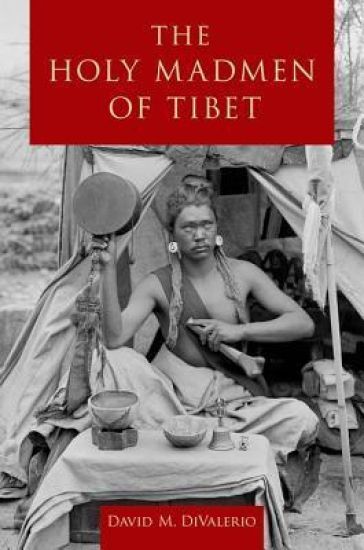
The Holy Madmen of Tibet

The Holy Madmen of Tibet

David M. DiValerio

Oxford University Press Inc
2015
sidottu
Over the course of the last millennium in Tibet, some tantric yogins have taken on norm-overturning modes of behavior, including provoking others to violence, publicly consuming filth, having sex, and dressing in human remains. While these individuals were called "mad," their apparent mental unwellness was not seen as resulting from any unfortunate circumstance, but symptomatic of having achieved a higher state of existence through religious practice. This book is the first comprehensive study of these "holy madmen," who have captured the imaginations of Tibetans and Westerners alike. Focusing on the lives and works of three "holy madmen" from the fifteenth century - the Madman of Tsang (Tsangnyon Heruka, or Sangye Gyeltsen, 1452-1507, and author of The Life of Milarepa), the Madman of U (Unyon Kungpa Sangpo, 1458-1532), and the Madman of the Drukpa Kagyu (Drukpa Kunle, 1455-1529). DiValerio shows how literary representations of these madmen came to play a role in the formation of sectarian identities and the historical mythologies of various sects. DiValerio also conveys a well-rounded understanding of the human beings behind these colorful personas by looking at the trajectories of their lives, their religious practices and their literary works, all in their due historical context. In the process he ranges from lesser-known tantric practices to central Tibetan politics to the nature of sainthood, and the "holy madmen" emerge as self-aware and purposeful individuals who were anything but crazy.
The Holy Madmen of Tibet

The Holy Madmen of Tibet

David M. DiValerio

Oxford University Press Inc
2015
nidottu
Over the course of the last millennium in Tibet, some tantric yogins have taken on norm-overturning modes of behavior, including provoking others to violence, publicly consuming filth, having sex, and dressing in human remains. While these individuals were called "mad," their apparent mental unwellness was not seen as resulting from any unfortunate circumstance, but symptomatic of having achieved a higher state of existence through religious practice. This book is the first comprehensive study of these "holy madmen," who have captured the imaginations of Tibetans and Westerners alike. Focusing on the lives and works of three "holy madmen" from the fifteenth century - the Madman of Tsang (Tsangnyon Heruka, or Sangye Gyeltsen, 1452-1507, and author of The Life of Milarepa), the Madman of U (Unyon Kungpa Sangpo, 1458-1532), and the Madman of the Drukpa Kagyu (Drukpa Kunle, 1455-1529). DiValerio shows how literary representations of these madmen came to play a role in the formation of sectarian identities and the historical mythologies of various sects. DiValerio also conveys a well-rounded understanding of the human beings behind these colorful personas by looking at the trajectories of their lives, their religious practices and their literary works, all in their due historical context. In the process he ranges from lesser-known tantric practices to central Tibetan politics to the nature of sainthood, and the "holy madmen" emerge as self-aware and purposeful individuals who were anything but crazy.
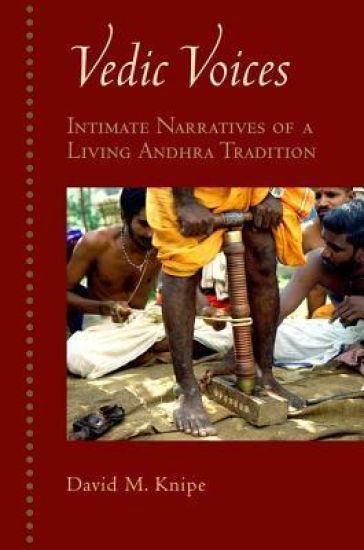
Vedic Voices

Vedic Voices

David M. Knipe

Oxford University Press Inc
2015
sidottu
For countless generations families have lived in isolated communities in the Godavari Delta of coastal Andhra Pradesh, learning and reciting their legacy of Vedas, performing daily offerings and occasional sacrifices. They are the virtually unrecognized survivors of a 3,700-year-old heritage, the last in India who perform the ancient animal and soma sacrifices according to Vedic tradition. In Vedic Voices, David M. Knipe offers for the first time, an opportunity for them to speak about their lives, ancestral lineages, personal choices as pandits, wives, children, and ways of coping with an avalanche of changes in modern India. He presents a study of four generations of ten families, from those born at the outset of the twentieth century down to their great-grandsons who are just beginning, at the age of seven, the task of memorizing their Veda, the Taittiriya Samhita, a feat that will require eight to twelve years of daily recitations. After successful examinations these young men will reside with the Veda family girls they married as children years before, take their places in the oral transmission of a three-thousand-year Vedic heritage, teach the Taittiriya collection of texts to their own sons, and undertake with their wives the major and minor sacrifices performed by their ancestors for some three millennia. Coastal Andhra, famed for bountiful rice and coconut plantations, has received scant attention from historians of religion and anthropologists despite a wealth of cultural traditions. Vedic Voices describes in captivating prose the geography, cultural history, pilgrimage traditions, and celebrated persons of the region. Here unfolds a remarkable story of Vedic pandits and their wives, one scarcely known in India and not at all to the outside world.
Vedic Voices

Vedic Voices

David M. Knipe

Oxford University Press Inc
2015
nidottu
For countless generations families have lived in isolated communities in the Godavari Delta of coastal Andhra Pradesh, learning and reciting their legacy of Vedas, performing daily offerings and occasional sacrifices. They are the virtually unrecognized survivors of a 3,700-year-old heritage, the last in India who perform the ancient animal and soma sacrifices according to Vedic tradition. In Vedic Voices, David M. Knipe offers for the first time, an opportunity for them to speak about their lives, ancestral lineages, personal choices as pandits, wives, children, and ways of coping with an avalanche of changes in modern India. He presents a study of four generations of ten families, from those born at the outset of the twentieth century down to their great-grandsons who are just beginning, at the age of seven, the task of memorizing their Veda, the Taittiriya Samhita, a feat that will require eight to twelve years of daily recitations. After successful examinations these young men will reside with the Veda family girls they married as children years before, take their places in the oral transmission of a three-thousand-year Vedic heritage, teach the Taittiriya collection of texts to their own sons, and undertake with their wives the major and minor sacrifices performed by their ancestors for some three millennia. Coastal Andhra, famed for bountiful rice and coconut plantations, has received scant attention from historians of religion and anthropologists despite a wealth of cultural traditions. Vedic Voices describes in captivating prose the geography, cultural history, pilgrimage traditions, and celebrated persons of the region. Here unfolds a remarkable story of Vedic pandits and their wives, one scarcely known in India and not at all to the outside world.
Does the Elephant Dance?

Does the Elephant Dance?

David M. Malone

Oxford University Press
2011
sidottu
India today looms large globally, where it hardly loomed at all twenty years ago. It is likely to be a key global actor throughout the twenty-first century and could well emerge soon as one of the top five global powers. Does the Elephant Dance? seeks to survey the main features of Indian foreign policy. It identifies elements of Indian history relevant to the topic; examines the role therein of domestic politics and internal and external security challenges, and of domestic and international economic factors; and in successive chapters delves into the specifics of India's policy within its South Asian neighbourhood, and with respect to China, the USA, West Asia (the Middle East), East Asia, Europe and Russia, and multilateral diplomacy. It also touches on Indian ties to Africa and Latin America and the Caribbean. India's "soft power", the role of migration in its policy, and other cross-cutting issues are analyzed, as is the role and approach of several categories of foreign policy actors in India. Substantive conclusions close out the volume, and touch, inter alia, on policies India may want or need to change in its quest for international stature.