

Kirjahaku
Etsi kirjoja tekijän nimen, kirjan nimen tai ISBN:n perusteella.
1000 tulosta hakusanalla Denis Janz

Denis and His American Trunk
Theresa Maloney Schoen
Createspace Independent Publishing Platform
2017
nidottu

Denis Dent; a novel By: Ernest W. Hornung, illustrated By: Harrison Fisher (July 27, 1875 or 1877 - January 19, 1934) was an American illustra
Harrison Fisher; Ernest W. Hornung
Createspace Independent Publishing Platform
2017
nidottu
Ernest William Hornung (7 June 1866 - 22 March 1921) was an English author and poet known for writing the A. J. Raffles series of stories about a gentleman thief in late 19th-century London. Hornung was educated at Uppingham School; as a result of poor health he left the school in December 1883 to travel to Sydney, where he stayed for two years. He drew on his Australian experiences as a background when he began writing, initially short stories and later novels. In 1898 he wrote "In the Chains of Crime", which introduced Raffles and his sidekick, Bunny Manders; the characters were based partly on his friends Oscar Wilde and his lover, Lord Alfred Douglas, and also on the characters of Sherlock Holmes and Dr. Watson, created by his brother-in-law, Arthur Conan Doyle. The series of Raffles short stories were collected for sale in book form in 1899, and two further books of Raffles short stories followed, as well as a poorly received novel. Aside from his Raffles stories, Hornung was a prodigious writer of fiction, publishing numerous books from 1890, with A Bride from the Bush to his 1914 novel The Crime Doctor. The First World War brought an end to Hornung's fictional output. His son, Oscar, was killed at the Second Battle of Ypres in July 1915. Hornung joined the YMCA, initially in England, then in France, where he helped run a canteen and library. He published two collections of poetry during the war, and then, afterwards, one further volume of verse and an account of his time spent in France, Notes of a Camp-Follower on the Western Front. Hornung's fragile constitution was further weakened by the stress of his war work. To aid his recuperation, he and his wife visited the south of France in 1921. He fell ill from influenza on the journey, and died on 22 March 1921, aged 54. Although much of Hornung's work has fallen into obscurity, his Raffles stories continued to be popular, and have formed numerous film and television adaptations. Hornung's stories dealt with a wider range of themes than crime: he examined scientific and medical developments, guilt, class and the unequal role played by women in society. Two threads that run through a sizeable proportion of his books are Australia and cricket; the latter was also a lifelong passion. Harrison Fisher (July 27, 1875 or 1877 - January 19, 1934) was an American illustrator.

Official photographer to music legend David Bowie, Denis O'Regan presents a personal edit from his unrivalled collection of photographs. Accompanying Bowie on two world tours and enjoying a decades-long relationship with the star, no one photographed Bowie more than Denis O'Regan. As Bowie himself once remarked, 'Denis, Rock 'n' Roll is in your blood'. From the door of Olympic Studios, where Bowie recorded Diamond Dogs in 1974, to live stadium shows in the 1990s, Denis's full archive is at last opened and many unseen images revealed for the first time. David Bowie by Denis O’Regan tells Bowie's musical story in pictures, with O'Regan's own words relaying his experience of documenting that incredible journey. Author of the hugely successful Ricochet: David Bowie 1983 (Particular Books, 2018), O'Regan has toured with the biggest stars from The Rolling Stones and Queen to Pink Floyd and Duran Duran, to name a few. But it is his photographs of David Bowie, taken over two decades at over 200 concerts worldwide, that he is best known for. David Bowie the showman and David behind-the scenes, O'Regan has captured it all in this showcase of one of the world's most talented performers.

Official photographer to music legend David Bowie, Denis O'Regan presents a personal edit from his unrivalled collection of photographs. Accompanying Bowie on two world tours and enjoying a decades-long relationship with the star, no one photographed Bowie more than Denis O'Regan. As Bowie himself once remarked, 'Denis, Rock 'n' Roll is in your blood'. From the door of Olympic Studios, where Bowie recorded Diamond Dogs in 1974, to live stadium shows in the 1990s, Denis's full archive is at last opened and many unseen images revealed for the first time. With a foreword by guitarist Carlos Alomar, who collaborated with Bowie throughout his career, David Bowie by Denis O’Regan tells Bowie's musical story in pictures with O'Regan's own words relaying his experience of documenting that incredible journey. Author of the hugely successful Ricochet: David Bowie 1983 (Particular Books, 2018), O'Regan has toured with the biggest stars from The Rolling Stones and Queen to Pink Floyd and Duran Duran, to name a few. But it is his photographs of David Bowie, taken over two decades at over 200 concerts worldwide, that he is best known for. David Bowie the showman and David behind-the scenes, O'Regan has captured it all in this showcase of one of the world's most talented performers.

This is the first biography of Denis Johnston, barrister, theatre director, film-maker, pioneering television producer, war correspondent, essayist and celebrated playwright. Johnston was of Ulster Presbyterian stock, born into Edwardian Dublin, where he was briefly held hostage in his family home at Lansdowne Road during the 1916 Rising. Son of a Supreme Court judge, he was schooled at St Andrew’s in Dublin, in Edinburgh and Christ’s College, Cambridge, and at Harvard University. He made the name of the Gate Theatre in 1929 with his astonishing first play The Old Lady Says ‘No!’, created the radio epic ‘Lillibulero’ for the BBC in Belfast, and earned an OBE for his war reporting from North Africa, Yugoslavia and Buchenwald. In 1950 he decamped to New York and taught for many years at colleges in Massachusetts, founding the Poets’ Theatre in Boston. An Irishman of wide horizons and wit, and a prodigal dissenter, his multi-faceted life illuminates the cultural history of the past century. He was turbulently married to the actresses Shelah Richards and Betty Chancellor, and had four children, among them the novelist Jennifer Johnston. In this masterly biography, Adams draws upon Johnston’s copious and intimate diaries, letters and uncompleted autobiography deposited in Trinity College, Dublin, cataloguing the ‘untidy museum’ of his subject’s past. The result is an enthralling narrative of the extraordinary secret life of a complex, self-doubting individual, which brings new light to bear on one of the twentieth century’s most original Irish writers.
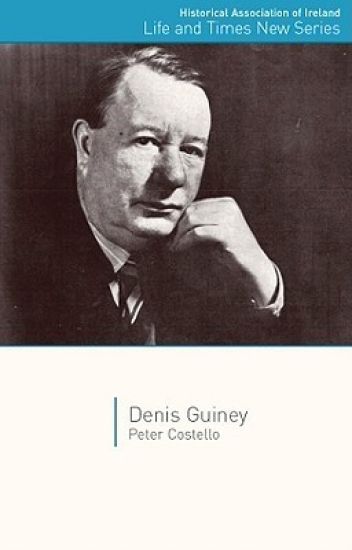
Denis Guiney (1893-1967) was one of the most remarkable Irishmen of his generation, who exerted through his business career a significant influence on the development of the economy and lifestyle of modern Ireland. As a draper, he rose from working in small country shops to become the owner of one of the country's biggest enterprises, the largest private company then in Ireland, the successor to part of a commercial empire created by a series of earlier Irish entrepreneurs, which he transformed to serve the ever-increasing and ever-changing needs of the population of a new kind of Ireland. He is one of those whose lives have materially contributed to the creation of the country's modern prosperity. Many talked airily of a 'New Ireland'. Denis Guiney helped create it.
Denis Diderot 'Rameau's Nephew' - 'Le Neveu de Rameau'
Open Book Publishers
2016
pokkari
Denis Diderot 'Rameau's Nephew' - 'Le Neveu de Rameau'
Open Book Publishers
2016
sidottu

Denis Edwards In His Own Words
ATF Press
2020
pokkari

Denis Edwards In His Own Words
ATF Press
2020
sidottu



Beatus Vir (Denis the Carthusian's Commentary on the Psalms)
Denis The Carthusian
Arouca Press
2020
pokkari
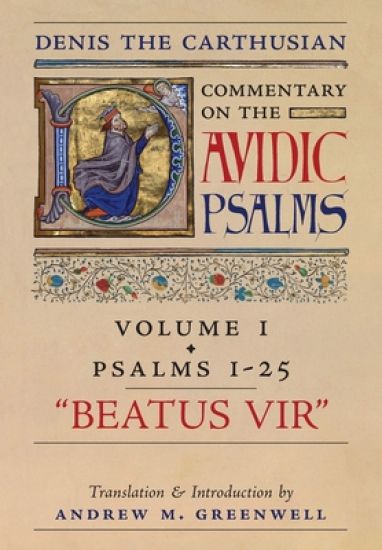
Beatus Vir (Denis the Carthusian's Commentary on the Psalms)
Denis The Carthusian
Arouca Press
2020
sidottu
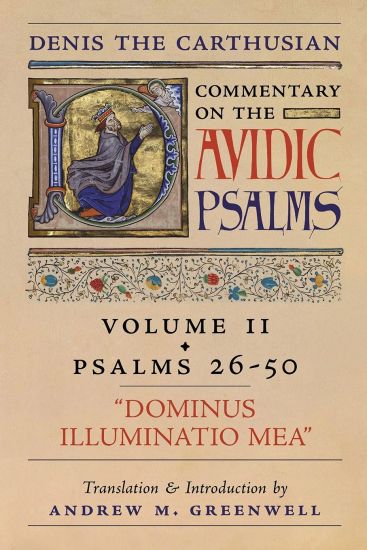
Dominus Illuminatio Mea (Denis the Carthusian's Commentary on the Psalms)
Denis The Carthusian
Arouca Press
2021
pokkari
Dominus Illuminatio Mea is the second of six planned volumes translating Denis the Carthusian's (1402-1471) extensive Commentary on the Psalms. This second volume contains Denis's Commentary of Psalms 26 through 50. This translation is the first ever translation of the work into English since Denis wrote it in the 1430s. Of more than mere historical or scholarly interest, this translation is aimed at a larger Catholic audience. It is accompanied by footnotes designed to supplement Denis's text and explain or amplify on biblical, dogmatic, Thomistic, scholastic, catechetical, or historical matters raised in Denis's text with which the ordinary reader may not be familiar. Reading Denis's Commentary will expose the reader to that which Pope Benedict XVI called for in the post-synodal Exhortation Verbum Domini, namely, that the faithful rediscover the unity of Scripture and its different senses-the literal, the allegorical, the moral, and the anagogical. Reading Denis's Commentary on the Psalms with its use of the "analogy of Scripture" and its extensive application of the different senses of the Psalms is a perfect way to rediscover this richness of interpretation that has been largely lost. It will allow the reader to "re-read the Scriptures" in the light of Scripture's unity and its spiritual, plenary sense as Pope Benedict XVI urged.
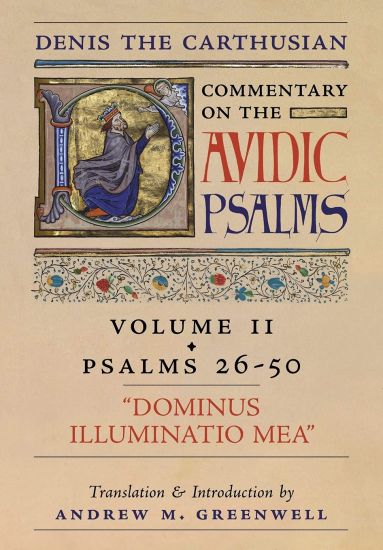
Dominus Illuminatio Mea (Denis the Carthusian's Commentary on the Psalms)
Denis The Carthusian
Arouca Press
2021
sidottu
Dominus Illuminatio Mea is the second of six planned volumes translating Denis the Carthusian's (1402-1471) extensive Commentary on the Psalms. This second volume contains Denis's Commentary of Psalms 26 through 50. This translation is the first ever translation of the work into English since Denis wrote it in the 1430s. Of more than mere historical or scholarly interest, this translation is aimed at a larger Catholic audience. It is accompanied by footnotes designed to supplement Denis's text and explain or amplify on biblical, dogmatic, Thomistic, scholastic, catechetical, or historical matters raised in Denis's text with which the ordinary reader may not be familiar. Reading Denis's Commentary will expose the reader to that which Pope Benedict XVI called for in the post-synodal Exhortation Verbum Domini, namely, that the faithful rediscover the unity of Scripture and its different senses-the literal, the allegorical, the moral, and the anagogical. Reading Denis's Commentary on the Psalms with its use of the "analogy of Scripture" and its extensive application of the different senses of the Psalms is a perfect way to rediscover this richness of interpretation that has been largely lost. It will allow the reader to "re-read the Scriptures" in the light of Scripture's unity and its spiritual, plenary sense as Pope Benedict XVI urged.
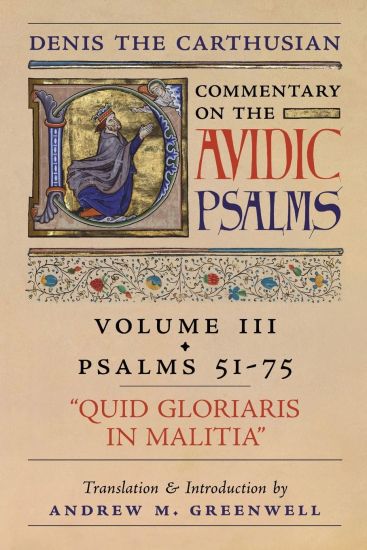
Quid Gloriaris Militia (Denis the Carthusian's Commentary on the Psalms)
Denis The Carthusian
Arouca Press
2022
pokkari
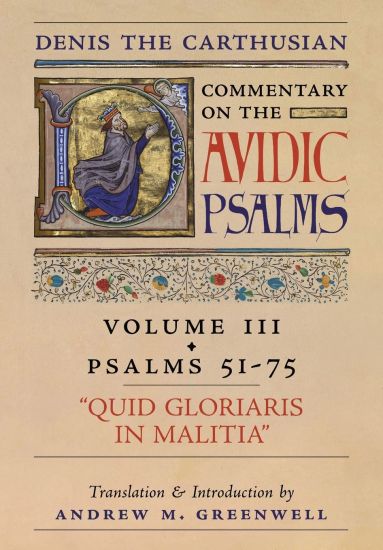
QUI GLORIARIS IN MALITIA, the third of six anticipated volumes translating Denis the Carthusian's (1402-1471) entire Commentary on the Psalms, contains Denis's lively commentary of Psalms 51 through 75. By interpreting the Psalms with a robust Christocentric point of view, and by combining with it the revelation of the one Christ who has spoken through the prophets and who is revealed in the Gospels, Denis often gives us new insight into the mind of Christ. Though never neglecting the literal or historical underlay of the Psalms, Denis teases out for the reader the allegorical, tropological, and anagogical senses of the Psalms, thus providing great spiritual fodder for reflection, meditation, and contemplation of God, sublime and blessed. For Denis, both praying and living the Psalms is a central staple of the Christian conversatio or manner of life; therefore, he constantly insists that the inner heart of man must align itself with the spoken word. The translated Commentary is supplemented by Denis's own copious references to Scripture, but it also includes extensive footnotes that guide a reader who might be unfamiliar with historical, cosmological, biblical, theological, doctrinal, or moral issues raised by Denis in his Commentary. Not long ago, a common refrain among academics was, "He who read Denis, leaves nothing unread." It might also be said that he who does not read Denis's Commentary on the Psalms leaves the Psalms unread. This first-ever English translation of Denis's Commentary on the Psalms makes the riches of his thought, long-too long-neglected, available to a wider audience.
Quid Gloriaris Militia (Denis the Carthusian's Commentary on the Psalms)
Denis The Carthusian
Arouca Press
2022
sidottu
QUI GLORIARIS IN MALITIA, the third of six anticipated volumes translating Denis the Carthusian's (1402-1471) entire Commentary on the Psalms, contains Denis's lively commentary of Psalms 51 through 75. By interpreting the Psalms with a robust Christocentric point of view, and by combining with it the revelation of the one Christ who has spoken through the prophets and who is revealed in the Gospels, Denis often gives us new insight into the mind of Christ. Though never neglecting the literal or historical underlay of the Psalms, Denis teases out for the reader the allegorical, tropological, and anagogical senses of the Psalms, thus providing great spiritual fodder for reflection, meditation, and contemplation of God, sublime and blessed. For Denis, both praying and living the Psalms is a central staple of the Christian conversatio or manner of life; therefore, he constantly insists that the inner heart of man must align itself with the spoken word. The translated Commentary is supplemented by Denis's own copious references to Scripture, but it also includes extensive footnotes that guide a reader who might be unfamiliar with historical, cosmological, biblical, theological, doctrinal, or moral issues raised by Denis in his Commentary. Not long ago, a common refrain among academics was, "He who read Denis, leaves nothing unread." It might also be said that he who does not read Denis's Commentary on the Psalms leaves the Psalms unread. This first-ever English translation of Denis's Commentary on the Psalms makes the riches of his thought, long-too long-neglected, available to a wider audience.