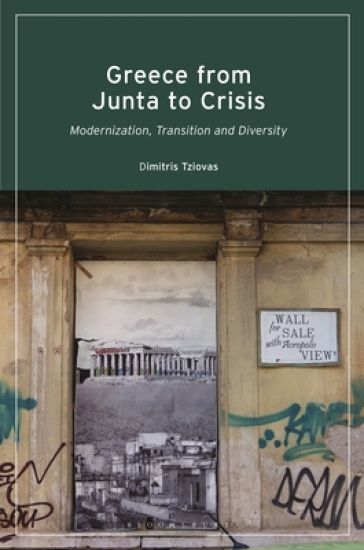
Winner of the 2021 European Society of Modern Greek Studies Book PrizeShortlisted for the 2022 Runciman AwardThe recent economic crisis in Greece has triggered national self-reflection and prompted a re-examination of the political and cultural developments in the country since 1974. While many other books have investigated the politics and economics of this transition, this study turns its attention to the cultural aspects of post-dictatorship Greece. By problematizing the notion of modernization, it analyzes socio-cultural trends in the years between the fall of the junta and the economic crisis, highlighting the growing diversity and cultural ambivalence of Greek society. With its focus on issues such as identity, antiquity, religion, language, literature, media, cinema, youth, gender and sexuality, this study is one of the first to examine cultural trends in Greece over the last fifty years. Aiming for a more nuanced understanding of recent history, the study offers a fresh perspective on current problems.
`This thoughtful and original critique of integration theories is a most welcome addition to the literature on the EU. Dimitris Chryssochoou's perceptive and thought-provoking analysis offers many original insights and will be a valuable reference tool for those interested in contemporary Europe' - Glenda G Rosenthal, Columbia University
`This thoughtful and original critique of integration theories is a most welcome addition to the literature on the EU. Dimitris Chryssochoou's perceptive and thought-provoking analysis offers many original insights and will be a valuable reference tool for those interested in contemporary Europe' - Glenda G Rosenthal, Columbia University
The newest volume in the Comparative Charting of Social Change series highlights the main elements of demographic, social, political, and economic development in Greece during the period 1960-2000. Based on a systematic analysis of available information and data, this volume provides an overview of Greece's socio-economic profile, which changed significantly during the studied period. The collapse of the dictatorship in 1974 and Greece's entry into the European Union (EU) in 1980 have led to a consolidation of democratic institutions and the improvement of living standards. During the 1960s and 1970s the country experienced high rates of economic development and relatively low unemployment rates. However, this increase in economic development has slowed since the early 1980s and the unemployment rate has risen, particularly among young people. Consistent with recent social trends in other Western societies, Greek society has become more tolerant and permissive, with more diverse and flexible moral norms. However, the prevailing family model remains traditional and the Greek Orthodox Church continues to have a strong influence on many aspects of Greek society, including social, political, and cultural life. The organization of work also follows traditional patterns, despite the introduction of new and flexible forms of employment. Female participation in the labour market remains relatively low, despite legislation and regulations that promote equality of opportunities between the sexes. Consistent with recent social trends in other Western societies, Greece's population is aging and the birth rate has stabilized at a relatively low level. Contributors include Ioannis Antonopoulos, Dimitri Economou (University of Thessalia), Evi Fagadaki, Thomas Maloutas (University of Thessalia), Alberto Martinelli, Ioannis Myrizakis, Theodore Papadogonas, Apostolos g. Papadopoulos (University of Ioannina), Roy Panagiotopoulou, Apostolis Rafailidis (economist), Paris Tsartas (University of Aegean), Kostas Yannakopoulos. Elisabeth Allison, Dionisis Balourdos, Nikos Bouzas, Kaliroi Daskalaki, Amalia Frangiskou, Emmy Fronimou, Panayiotis Kafetzis, Roxanne Kaftantzoglou, John Kallas, Chrysa Kappi, Maria Ketsetzopoulou, Helene Kovani, Evdokia Manologlou, Joannis Micheloyiannakis, Aliki Mouriki, Panagiota Papadopoulou, Ioanna Papathanassiou, Christos Papatheodorou, Marina Petronoti, Nikos Sarris, Theoni Stathopoulou, Hara Stratoudaki, Haris Symeonidou, Maria Thanopoulou, Olga Tsakirides, Joanna Tsiganou, Christina Varouxi, Efi Venizelou, and Ersi Zacopoulou are all researchers at the National Centre for Social Research (EKKE).
Physics-Based Deformable Models presents a systematic physics-based framework for modeling rigid, articulated, and deformable objects, their interactions with the physical world, and the estimate of their shape and motion from visual data. This book presents a large variety of methods and associated experiments in computer vision, graphics and medical imaging that help the reader better to understand the presented material. In addition, special emphasis has been given to the development of techniques with interactive or close to real-time performance. Physics-Based Deformable Models is suitable as a secondary text for graduate level courses in Computer Graphics, Computational Physics, Computer Vision, Medical Imaging, and Biomedical Engineering. In addition, this book is appropriate as a reference for researchers and practitioners in the above-mentioned fields.
Located on the southern-most tip of the Balkan peninsula in Europe's southeast, Greece is a small country of some 11 million people. And while few people have a longer history than the Greeks, Modern Greece is a fairly young country, having been founded in 1830. Greece has come a long way since then; it has been a client state, first of Britain and then of the United States, for much of its modern existence but now it has secured an equal place at the top tables of NATO and the EU. The Historical Dictionary of Modern Greece explores the modern history of this country through a chronology, an introductory essay, a bibliography, and hundreds of cross-referenced dictionary entries on important persons, places, events, and institutions, as well as on significant political, economic, social, and cultural aspects.
Located on the southern-most tip of the Balkan peninsula in Europe's southeast, Greece is a small country of some 11 million people. And while few people have a longer history than the Greeks, Modern Greece is a fairly young country, having been founded in 1830. Greece has come a long way since then; it has been a client state, first of Britain and then of the United States, for much of its modern existence but now it has secured an equal place at the top tables of NATO and the EU. The A to Z of Modern Greece explores the modern history of this country through a chronology, an introductory essay, a bibliography, and hundreds of cross-referenced dictionary entries on important persons, places, events, and institutions, as well as on significant political, economic, social, and cultural aspects.
In Paradoxes of Emancipation, Dimitris Soudias traces the formation of political subjectivity in times of crisis, by attending to the 2011 occupation of Syntagma Square in Athens: the heart of the Greek anti-austerity movement. Soudias conceives of the Syntagma Square occupation as a lens through which we can critically engage with broader theoretical and political issues about the crumbling promises of the capitalist imaginary, the epistemic "spirit" of neoliberal rationalities, the spatialized practices of navigating precarity and uncertainty, and the prospects for a radically better tomorrow.By challenging both the romanticization of anti-austerity activism and the reduction of neoliberalism to mere free market thinking, Soudias reveals that the relationship between political subject formation and emancipation in neoliberalism is utterly paradoxical: in their effort to overcome neoliberal rationalities, individuals also partly stabilize them. Interweaving the stories and insights of activists with light-touch sociology, geography, and political theory, this book makes bold claims about the future of emancipation by envisioning an "alter-neoliberal critique." In so doing, Paradoxes of Emancipation presents an illuminating inquiry into how our experiences with capitalist crises lead to profound reevaluations of ourselves in ways that challenge our expectations of the future.
In Paradoxes of Emancipation, Dimitris Soudias traces the formation of political subjectivity in times of crisis, by attending to the 2011 occupation of Syntagma Square in Athens: the heart of the Greek anti-austerity movement. Soudias conceives of the Syntagma Square occupation as a lens through which we can critically engage with broader theoretical and political issues about the crumbling promises of the capitalist imaginary, the epistemic "spirit" of neoliberal rationalities, the spatialized practices of navigating precarity and uncertainty, and the prospects for a radically better tomorrow.By challenging both the romanticization of anti-austerity activism and the reduction of neoliberalism to mere free market thinking, Soudias reveals that the relationship between political subject formation and emancipation in neoliberalism is utterly paradoxical: in their effort to overcome neoliberal rationalities, individuals also partly stabilize them. Interweaving the stories and insights of activists with light-touch sociology, geography, and political theory, this book makes bold claims about the future of emancipation by envisioning an "alter-neoliberal critique." In so doing, Paradoxes of Emancipation presents an illuminating inquiry into how our experiences with capitalist crises lead to profound reevaluations of ourselves in ways that challenge our expectations of the future.
The Doppelgänger or Double presents literature as the "double" of philosophy. There are historical reasons for this. The genesis of the Doppelgänger is literature's response to the philosophical focus on subjectivity. The Doppelgänger was coined by the German author Jean Paul in 1796 as a critique of Idealism's assertion of subjective autonomy, individuality and human agency. This critique prefigures post-War extrapolations of the subject as decentred. From this perspective, the Doppelgänger has a "family resemblance" to current conceptualizations of subjectivity. It becomes the emblematic subject of modernity. This is the first significant study on the Doppelgänger's influence on philosophical thought. The Doppelgänger emerges as a hidden and unexplored element both in conceptions of subjectivity and in philosophy's relation to literature. Vardoulakis demonstrates this by employing the Doppelgänger to read literature philosophically and to read philosophy as literature. The Doppelgänger then appears instrumental in the self-conception of both literature and philosophy.
The Doppelgänger or Double presents literature as the "double" of philosophy. There are historical reasons for this. The genesis of the Doppelgänger is literature's response to the philosophical focus on subjectivity. The Doppelgänger was coined by the German author Jean Paul in 1796 as a critique of Idealism's assertion of subjective autonomy, individuality and human agency. This critique prefigures post-War extrapolations of the subject as decentred. From this perspective, the Doppelgänger has a "family resemblance" to current conceptualizations of subjectivity. It becomes the emblematic subject of modernity. This is the first significant study on the Doppelgänger's influence on philosophical thought. The Doppelgänger emerges as a hidden and unexplored element both in conceptions of subjectivity and in philosophy's relation to literature. Vardoulakis demonstrates this by employing the Doppelgänger to read literature philosophically and to read philosophy as literature. The Doppelgänger then appears instrumental in the self-conception of both literature and philosophy.
In this new book, Dimitris Vardoulakis asks how it is possible to think of a politics that is not commensurate with sovereignty. For such a politics, he argues, sovereignty is defined not in terms of the exception but as the different ways in which violence is justified. Vardoulakis shows how it is possible to deconstruct the various justifications of violence. Such dejustifications can take place only by presupposing an other to sovereignty, which Vardoulakis identifies with radical democracy. In doing so, Sovereignty and Its Other puts forward both a novel critique of sovereignty and an original philosophical theory of democratic practice.
In this new book, Dimitris Vardoulakis asks how it is possible to think of a politics that is not commensurate with sovereignty. For such a politics, he argues, sovereignty is defined not in terms of the exception but as the different ways in which violence is justified. Vardoulakis shows how it is possible to deconstruct the various justifications of violence. Such dejustifications can take place only by presupposing an other to sovereignty, which Vardoulakis identifies with radical democracy. In doing so, Sovereignty and Its Other puts forward both a novel critique of sovereignty and an original philosophical theory of democratic practice.
This book critiques the relation between sovereignty and democracy. Across nine theses, Vardoulakis argues that sovereignty asserts its power by establishing exclusions: the sovereign excluding other citizens from power and excludes refugees and immigrants from citizenship. Within this structure, to resist sovereignty is to reproduce the logic of exclusion characteristic of sovereignty. In contrast to this "ruse of sovereignty," Vardoulakis proposes an alternative model for political change. He argues that democracy can be understood as the structure of power that does not rely on exclusions and whose relation to sovereignty is marked not by exclusion but of incessant agonism. The term stasis, which refers both to the state and to revolution against it, offers a tension that helps to show how the democratic imperative is presupposed by the logic of sovereignty, and how agonism is more primary than exclusion. In elaborating this ancient but only recently recovered concept of stasis, Vardoulakis illustrates the radical potential of democracy to move beyond the logic of exclusion and the ruse of sovereignty.
This book critiques the relation between sovereignty and democracy. Across nine theses, Vardoulakis argues that sovereignty asserts its power by establishing exclusions: the sovereign excluding other citizens from power and excludes refugees and immigrants from citizenship. Within this structure, to resist sovereignty is to reproduce the logic of exclusion characteristic of sovereignty. In contrast to this "ruse of sovereignty," Vardoulakis proposes an alternative model for political change. He argues that democracy can be understood as the structure of power that does not rely on exclusions and whose relation to sovereignty is marked not by exclusion but of incessant agonism. The term stasis, which refers both to the state and to revolution against it, offers a tension that helps to show how the democratic imperative is presupposed by the logic of sovereignty, and how agonism is more primary than exclusion. In elaborating this ancient but only recently recovered concept of stasis, Vardoulakis illustrates the radical potential of democracy to move beyond the logic of exclusion and the ruse of sovereignty.
This book challenges the established conceptual and historical paradigm in Anglo-American film studies that perceives European cinema as essentially 'high art.' Through a study of the specific contexts in which popular European films are produced, distributed and exhibited, the book proposes new analytical and critical frameworks for their study. Films analyzed in the book include Cinema Paradiso, Mediterraneo, Bhaji on the Beach, Until the End of the World, Underground, and Jam=n Jam=n.
Although it is one of the most dynamic and controversial areas of Greek culture, Greek modernism has received little scholarly attention as a literary and cultural phenomenon. A wide variety of competing, often clashing discourses and approaches characterize the study of Greek modernism. In this landmark volume, scholars from three continents provide a framework in which developments in prose, poetry, and drama can be studied together. The contributors seek to redefine the contours of Greek modernism, to reassess its impact on Greek culture, to explore the fringes of the movement. Special attention is paid to the role of the avant-garde in Greece and the emergence of postmodern trends in Greek culture. Greek Modernism and Beyond is valuable reading for students and scholars of Greek and European literature.
Organizations enjoy two kinds of strategic advantages. One is transitory: being in the right place with the right products at the right time. The other comes from having first class management and instituting processes that mobilize an organization, keeping in ahead of the competition. Which would you like to count on for your organization's success?Integrating ERP, CRM, Supply Chain Management, and Smart Materials explores how to create business opportunities and reap savings by:Restructuring and updating of ERP and CRM software as it integrates supply chain management and delivers new killer applications Evolving opportunities that will develop from the implementation of smart materials, automatic identification, classification systems, and quality assurance projects Auditing the implementation, operation, and maintenance of ERP and CRM software as well as the corrective action taken on the basis of resultsInternet commerce, online supply chain, and advances in technology - all available at increasingly lower costs - make systems of the past obsolete. However, just as new technology creates new opportunities, it can also create unforeseen consequences. By binding a wealth of interdependent issues between the covers of one book, Integrating ERP, CRM, Supply Chain Management, and Smart Materials gives you the tools you need to create proprietary, high value-added solutions.
Successful management teams can identify the cost and return derived from the implementation of new technology, and they can properly apply the technology toward gaining a competitive advantage. IT and business managers alike need a resource that enables them to prepare for future operating conditions, identify beneficial solutions, and use high technology to achieve organizational goals. The Real-Time Enterprise analyzes the forward-looking implementation of IT within a business, focusing on how careful planning can improve efficiency while reducing costs. The book includes case studies that emphasize how the most profitable uses of technology are now the real-time response to customer requirements, and the accumulation of knowledge about markets and business partners. Divided into four parts, the text begins by explaining how advanced information technology is a moving target, and why companies that want to benefit from it must set priorities and move quickly. Part II covers many recent developments in IT and its implementation, including smart dust and straight through processing (STP). Part III is made up of case studies that address specific application areas, including credit institutions, treasury operations, risk management, and approaches to replace office automation. The book concludes by exploring a series of prerequisites made necessary by advanced applications. The Real-Time Enterprise provides a perspective on the deployment of strategic information technology, covering guidelines, advanced applications, and practical examples. It delivers a much-needed upgrade of knowledge and skills for IT professionals seeking to progress beyond traditional implementations.
Manufacturing Databases and Computer Integrated Systems is the first book to probe the problems and solutions presented by the diversity of databases within the manufacturing industry. The author examines these heterogeneous databases at both the macro (national/international) level and micro (intracompany and intercompany) level. This book is the result of an extensive international research project that involved 87 leading organizations. Manufacturing Databases and Computer Integrated Systems presents the compelling argument for using computers as database integrators, a concept beyond the obvious applications of number crunching and data storage. The book addresses several different areas of manufacturing technology, including product policies in manufacturing, fuzzy controls in plant operations, concurrent engineering, practical applications for expert systems, organizational prerequisites in manufacturing, heterogenous database environments, the benefits of object-oriented databases, and the requirements for virtual database integration. Manufacturing Databases and Computer Integrated Systems also presents case studies, including the TRW solution applied in Operation Desert Storm, Project CRONUS by BBN, the Intelligent Database Assistant (IDA) by GTE, General Motor's DATAPLEX solution, and Project Carnot by the Microelectronics and Computer Development Corporation (MCC). The book is a "must" for computer and database technologists, engineers, and senior management at most companies worldwide.