Kirjojen hintavertailu. Mukana 12 390 323 kirjaa ja 12 kauppaa.

Kirjahaku

Etsi kirjoja tekijän nimen, kirjan nimen tai ISBN:n perusteella.

1000 tulosta hakusanalla Donald M. Harrison

Escape Fire

Escape Fire

Donald M. Berwick

Jossey-Bass Inc.,U.S.
2003
sidottu
Spanning a decade (1992-2002), these speeches echo the theme that our health care system needs fundamental change and a revolutionary new design. Throughout the book, Berwick identifies innovations and ideas from a number of surprising sources— a girls' soccer team, a sinking ship, and the safety standards at NASA. Escape Fire takes its title from the 1949 Mann Gulch tragedy in which thirteen young firefighters were trapped in a wildfire on a Montana hillside. The firefighter's leader, Wag Dodge, devised a creative solution for avoiding the encroaching fire. He burned a patch of grass and lay down in the middle of the scorched earth. His team refused to join him, and most perished in the fire. Dodge survived. Berwick applies the lessons learned from the catastrophe to our ailing health care system— we must not let ingrained processes obstruct life-saving innovation. Not content to simply define the problems with our flawed system, Berwick outlines new designs and suggests practical tools for change: name the problem, build on success, take leaps of faith, look outside of the medical field, set aims, understand systems, make action lists, and¾the most fundamental of all— never lose sight of the patient as the central figure.

Tennessee Families

Tennessee Families

Donald M Hehir

Heritage Books
2013
pokkari
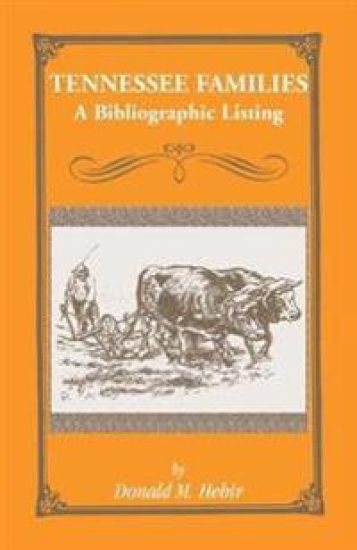
With over 1,500 Tennessean surnames, Mr. Hehir provides, in one source, a comprehensive listing of all printed Tennessean genealogies and family histories that have made their way into major library collections across the U.S. The author researched library listings and catalogs covering many genealogical libraries, including the Library of Congress, the National Genealogical Society Library and the Library of the Daughters of the American Revolution, along with historical association libraries from Massachusetts to California. Many of the books deal with multiple families, some with non-Tennessee roots. Arranged for ease of use, the entries are presented alphabetically according to surname, with a cross-reference index to family and secondary names to help researchers find surnames that would otherwise remain buried within the text. No genealogist working with Tennessee families should be without this time-saving volume. The author has also added an appendix with helpful hints on "Accessing the Library of Congress records via the internet."
"Getting by"

"Getting by"

Donald M. Nonini

Cornell University Press
2015
sidottu
How do class, ethnicity, gender, and politics interact? In what ways do they constitute everyday life among ethnic minorities? In "Getting By," Donald M. Nonini draws on three decades of research in the region of Penang state in northern West Malaysia, mainly in the city of Bukit Mertajam, to provide an ethnographic and historical account of the cultural politics of class conflict and state formation among Malaysians of Chinese descent. Countering triumphalist accounts of the capitalist Chinese diaspora in Southeast Asia, Nonini shows that the Chinese of Penang (as elsewhere) are riven by deep class divisions and that class issues and identities are omnipresent in everyday life. Nor are the common features of "Chinese culture" in Malaysia manifestations of some unchanging cultural essence. Rather, his long immersion in the city shows, they are the results of an interaction between Chinese-Malaysian practices in daily life and the processes of state formation—in particular, the ways in which Kuala Lumpur has defined different categories of citizens. Nonini's ethnography is based on semistructured interviews; participant observation of events, informal gatherings, and meetings; a commercial census; intensive reading of Chinese-language and English-language newspapers; the study of local Chinese-language sources; contemporary government archives; and numerous exchanges with residents.
"Getting by"

"Getting by"

Donald M. Nonini

Cornell University Press
2015
pokkari
How do class, ethnicity, gender, and politics interact? In what ways do they constitute everyday life among ethnic minorities? In "Getting By," Donald M. Nonini draws on three decades of research in the region of Penang state in northern West Malaysia, mainly in the city of Bukit Mertajam, to provide an ethnographic and historical account of the cultural politics of class conflict and state formation among Malaysians of Chinese descent. Countering triumphalist accounts of the capitalist Chinese diaspora in Southeast Asia, Nonini shows that the Chinese of Penang (as elsewhere) are riven by deep class divisions and that class issues and identities are omnipresent in everyday life. Nor are the common features of "Chinese culture" in Malaysia manifestations of some unchanging cultural essence. Rather, his long immersion in the city shows, they are the results of an interaction between Chinese-Malaysian practices in daily life and the processes of state formation—in particular, the ways in which Kuala Lumpur has defined different categories of citizens. Nonini's ethnography is based on semistructured interviews; participant observation of events, informal gatherings, and meetings; a commercial census; intensive reading of Chinese-language and English-language newspapers; the study of local Chinese-language sources; contemporary government archives; and numerous exchanges with residents.
A Short Season

A Short Season

Donald M. Morehead; Ann Morehead

Bison Books
1998
pokkari
A Short Season is Don Morehead's bittersweet story of growing up on a Montana ranch during the 1940s. In 1941 his parents eagerly took up residence on a ten-thousand-acre sheep ranch in northern Montana. The entire family was soon caught up in the natural rhythm and grueling work of ranch life, meeting those challenges with energy, patience, and humor. The driving force behind the ranch and family was the father, Bill Morehead, the "hub around which activity spun." Don especially was drawn into his father's world, rarely leaving his side, and becoming known as his "small partner." When his father died suddenly in 1948, Don was left with lingering, irreducible grief and loneliness. Replete with marvelous details of ranching life, Don Morehead's story is also a sobering and moving meditation on childhood and the special relationship that can develop between father and son. Morehead returns us to the quiet surprises of the first short season with our parents and helps us better understand the inevitable sadness of moving on.
In Search of Buddy Bolden

In Search of Buddy Bolden

Donald M. Marquis

Louisiana State University Press
2005
nidottu
The beginnings of jazz and the story of Charles ""Buddy"" Bolden (1877- 1931) are inextricably intertwined. Just after the turn of the century, New Orleanians could often hear Bolden's powerful horn from the city's parks and through dance hall windows. Despite his lack of formal training, his unique style- both musical and personal- made him the first ""king"" of New Orleans jazz and the inspiration for such later jazz greats as King Oliver, Kid Ory, and Louis Armstrong. For years the legend of Buddy Bolden was overshadowed by myths about his music, his reckless lifestyle, and his mental instability. In Search of Buddy Bolden overlays the myths with the substance of reality. Interviews with those who knew Bolden and an extensive array of primary sources enliven and inform Donald M. Marquis's absorbing portrait of the brief but brilliant career of the first man of jazz. This paperback edition includes a new preface and appendix relating events and discoveries that have occurred since the book's original publication in 1978.
Leadership for Rural Schools

Leadership for Rural Schools

Donald M. Chalker

Rowman Littlefield Education
2002
nidottu
More than 50% of America's schools today exist in rural settings. This book addresses the distinctiveness of rural school leaders, identifies issues encountered by administrators, faculty, and students, and concludes by proposing new standards for rural schools in general and their leaders. This book will be of special interest to everyone involved in the operation of a rural school district.
Hitler's Shadow War

Hitler's Shadow War

Donald M. McKale

Cooper Square Publishers Inc.,U.S.
2002
sidottu
In Hitler's Shadow War, World War II scholar Donald McKale contends that Hitler's persecution and murder of the Jews, Slavs, and other groups was his primary effort during the war, not the conquest of Europe. According to McKale, Hitler and the Nazi leadership used the military campaigns of the war as a cover for a genocidal program that centered around the Final Solution. Hitler continued to commit extensive manpower and materials to this 'shadow war' even when Germany was losing the battles of the war's closing years. McKale explores the origins of the anti-Semitism that spread like wildfire through Germany before and during the Nazis' rise to power, and the failure of the Allies to perceive and stop the Holocaust even as they were defeating the Germans in combat.
The Foundations of Vacuum Coating Technology

The Foundations of Vacuum Coating Technology

Donald M. Mattox; D. M. Mattox

William Andrew Publishing
2003
nidottu
The Foundations of Vacuum Coating Technology is a concise review of the developments that have led to the wide variety of applications of this technology. This book is a must have for materials scientists and engineers working with vacuum coating in the invention of new technologies or applications in all industries. With over 370 references, this is an excellent starting point for those who don't want to reinvent the wheel. In particular, the book is a valuable reference for those interested in researching proposed or existing patents. This unique book provides a starting point for more in-depth surveys of past and recent work in all aspects of vacuum coating. The author uses his extensive knowledge of the subject to draw comparisons and place the information into the proper context. This is particularly important for the patent literature where the terminology does not always match industry jargon. A section of acronyms for vacuum coating and glossary of terms at the end of the book are critical additions to the information every reader needs.
Handbook of Physical Vapor Deposition (PVD) Processing

Handbook of Physical Vapor Deposition (PVD) Processing

Donald M. Mattox

William Andrew Publishing
2010
sidottu
This updated version of the popular handbook further explains all aspects of physical vapor deposition (PVD) process technology from the characterizing and preparing the substrate material, through deposition processing and film characterization, to post-deposition processing. The emphasis of the new edition remains on the aspects of the process flow that are critical to economical deposition of films that can meet the required performance specifications, with additional information to support the original material. The book covers subjects seldom treated in the literature: substrate characterization, adhesion, cleaning and the processing. The book also covers the widely discussed subjects of vacuum technology and the fundamentals of individual deposition processes. However, the author uniquely relates these topics to the practical issues that arise in PVD processing, such as contamination control and film growth effects, which are also rarely discussed in the literature. In bringing these subjects together in one book, the reader can understand the interrelationship between various aspects of the film deposition processing and the resulting film properties. The author draws upon his long experience with developing PVD processes and troubleshooting the processes in the manufacturing environment, to provide useful hints for not only avoiding problems, but also for solving problems when they arise. He uses actual experiences, called "war stories", to emphasize certain points. Special formatting of the text allows a reader who is already knowledgeable in the subject to scan through a section and find discussions that are of particular interest. The author has tried to make the subject index as useful as possible so that the reader can rapidly go to sections of particular interest. Extensive references allow the reader to pursue subjects in greater detail if desired. The book is intended to be both an introduction for those who are new to the field and a valuable resource to those already in the field. The discussion of transferring technology between R&D and manufacturing provided in Appendix 1, will be of special interest to the manager or engineer responsible for moving a PVD product and process from R&D into production. Appendix 2 has an extensive listing of periodical publications and professional societies that relate to PVD processing. The extensive Glossary of Terms and Acronyms provided in Appendix 3 will be of particular use to students and to those not fully conversant with the terminology of PVD processing or with the English language.
English Words From Latin And Greek Elements

English Words From Latin And Greek Elements

Donald M. Ayers; Thomas D. Worthen; R. L. Cherry

University of Arizona Press
1986
nidottu
Since 1965, Donald Ayers' English Words from Latin and Greek Elements has helped thousands of students to a broader vocabulary by showing them how to recognize classical roots in modern English words. Its second edition, published in 1986, has confirmed that vocabulary is best taught by root, not rote. The importance of learning classical word roots is already acknowledged by vocabulary texts that devote chapters to them.Why a whole book based on this approach? Ayers' text exposes students to a wider range of roots, introduces new English words in context sentences, and reinforces vocabulary through exercises. It promotes more practice with roots so that students learn to use them as tools in their everyday encounters with new words. English Words is written from the standpoint of English; it neither attempts to teach students Latin or Greek nor expects a knowledge of classical languages on the part of instructors. Its success has been demonstrated at both the secondary and college levels, and it can be used effectively with students in remedial or accelerated programs.An Instructor's Manual (gratis with adoption) and a Workbook are also available.
Piman Shamanism and Staying Sickness (Ká:cim Múmkidag)

Piman Shamanism and Staying Sickness (Ká:cim Múmkidag)

Donald M. Bahr; Juan Gregorio; David I. Lopez; Albert Alvarez

University of Arizona Press
2017
nidottu
Piman shamanism is based on the belief that morality and some forms of sickness are interrelated. The shaman, or medicine man, has a dual role in the Piman Indian culture. He is the guardian of the Pimans’ health and their consciousness of cultural identity. This definitive study of shamanic theory and practice was developed through a four-person collaboration: three Tohono O’odham Indians—a shaman, a translator, and a trained linguist—and a non-Indian explicator. It provides an in-depth examination of the Piman philosophy of sickness as well as an introduction to the world view of an entire people. Using the most highly developed techniques of modern ethnolinguistics, anthropologist Bahr investigates the culturally based concept of staying sickness. He conducted extensive discussions in the Piman language with shaman Gregorio. The native informant theorized at length about the cause of staying sickness, the dúajida (divination), and ritual prayers. The translator and the linguist analyzed the content and style of Gregorio’s discussions. Texts in the Piman language of Gregorio’s discussions are included, as well as literal and idiomatic English translations. American Anthropologist cites “the infinite care with which each utterance has been analyzed” and “the richness of cultural expression captured in the texts themselves and in their explanation. To read Piman Shamanism and Staying Sickness is to become familiar with the unique properties of Piman thinking and modes of expression: abstract, elliptical, contracted, and yet filled with a rich and natural imagery.”The University of Arizona Press’s Century Collection employs the latest in digital technology to make previously out-of-print books from our notable backlist available once again. Enriching historical and cultural experiences for readers, this collection offers these volumes unaltered from their original publication and in affordable digital or paperback formats.
The Body in Late-Capitalist USA

The Body in Late-Capitalist USA

Donald M. Lowe

Duke University Press
1995
sidottu
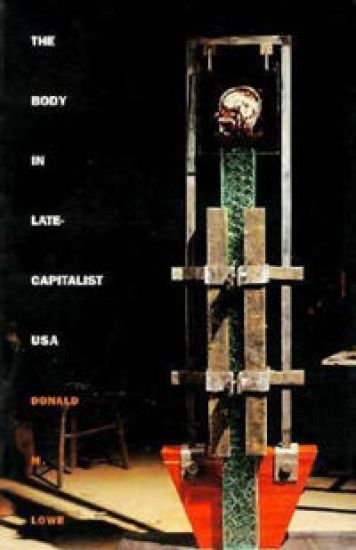
In The Body in Late-Capitalist USA, Donald M. Lowe explores the varied social practices that code and construct the body. Arguing that our bodily lives are shaped by a complex of daily and ongoing practices-how we work, what we buy and consume-Lowe contends that as a result of the commodification of these and other social practices in the late-twentieth century, what we often understand to be the needs of the body are in fact means for capital accumulation.Moving beyond studies of representations and images of the body, Lowe focuses on the intersection of body practices, language, and the Social to describe concretely the reality of a lived body. His strongly synthetic work brings together Marxist critique, semiotics, Foucaultian discourse analysis, and systems and communications theory to examine those practices that construct the body under late capitalism: habits of work and consumption, the ways we give birth and raise children, socialization, mental and physical healing, reconstructions and contestations of sexuality and gender. Lowe draws upon a wide range of sources, including government and labor studies and statistics, diagnostic and statistical manuals on mental illness, computer manuals, self-help books, and guides to work-related stress disorders, to illustrate the transformation of the body into a nexus of exchange value in postmodern society.
The Body in Late-Capitalist USA

The Body in Late-Capitalist USA

Donald M. Lowe

Duke University Press
1995
pokkari
In The Body in Late-Capitalist USA, Donald M. Lowe explores the varied social practices that code and construct the body. Arguing that our bodily lives are shaped by a complex of daily and ongoing practices-how we work, what we buy and consume-Lowe contends that as a result of the commodification of these and other social practices in the late-twentieth century, what we often understand to be the needs of the body are in fact means for capital accumulation.Moving beyond studies of representations and images of the body, Lowe focuses on the intersection of body practices, language, and the Social to describe concretely the reality of a lived body. His strongly synthetic work brings together Marxist critique, semiotics, Foucaultian discourse analysis, and systems and communications theory to examine those practices that construct the body under late capitalism: habits of work and consumption, the ways we give birth and raise children, socialization, mental and physical healing, reconstructions and contestations of sexuality and gender. Lowe draws upon a wide range of sources, including government and labor studies and statistics, diagnostic and statistical manuals on mental illness, computer manuals, self-help books, and guides to work-related stress disorders, to illustrate the transformation of the body into a nexus of exchange value in postmodern society.
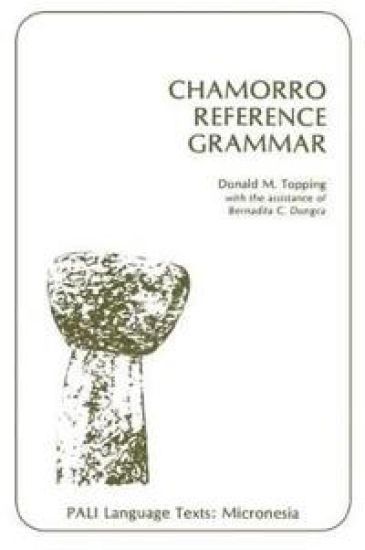
Chamorro Reference Grammar

Chamorro Reference Grammar

Donald M. Topping

University of Hawai'i Press
1980
nidottu
Chamorro Reference Grammar is a detailed description of the grammatical structure of the indigenous language of the Marian Islands. It is designed primarily as a reference work which will serve to give native speakers some insight into the complexities of their language and to encourage its use at a time when other languages are more prestigious.The book contains an introduction to Chamorro, and its developmental history and dialectal variations, and, with a minimum of technical linguistic terms, it treats phonology, morphology, and syntax. Notes to linguists and a glossary of linguistic terms are included
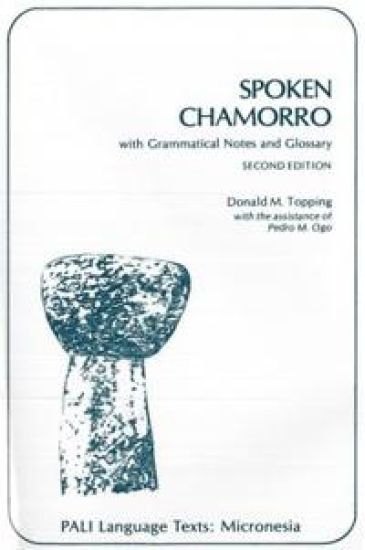
Spoken Chamorro

Spoken Chamorro

Donald M. Topping

University of Hawai'i Press
1980
nidottu
Spoken Chamorro is designed to enable the student to learn to speak and understand the Chamorro language the way native speakers do in their everyday activities. This second edition has been revised to incorporate the spelling conventions adopted by the Marianas Orthography Committee in January 1971, and suggestions made by teachers who have used the text in the classroom. The basic material in the text remains unchanged, the work of the author and Pedro M. Ogo, principal of Rota Elementary and High School, who is a native speaker of the language. As much as possible, the lessons exclude regionalisms, presenting the language as it is heard generally on Guam, Saipan, Rota, and elsewhere throughout the Mariana Islands.