Kirjojen hintavertailu. Mukana 12 379 106 kirjaa ja 12 kauppaa.

Kirjahaku

Etsi kirjoja tekijän nimen, kirjan nimen tai ISBN:n perusteella.

1000 tulosta hakusanalla Donald MacRae

Donald Trump in Historical Perspective
Donald Trump in Historical Perspective: Dead Precedents is a collection of chapters that utilizes the thinking of historians, philosophers, and political scientists to explore historical parallels to the presidency of Donald J. Trump, the 45th President of the United States of America.This collection provides an extensive analysis on the ways Trump’s impulsiveness, breaking of norms, and disregard for longstanding democratic pieties, caused him to represent a definitive end to the "American century," an era when American self-confidence, steadiness, and leadership, even in the face of titanic challenges, were almost universally taken for granted. Yet this book also argues how in the longer sweep of history, Trump is a familiar figure in the turbulent life of democracies. These in-depth chapters reveal the ways Trump represents the anti-institutionalist, the populist demagogue, the would-be authoritarian who exploits electoral and political vulnerabilities to gain and hold power. Through these detailed evaluations, these chapters suggest that Trump is not radically unique, but that democracies have produced many previous versions of the Trump phenomenon.This book is essential reading for scholars and students in political science, political theory, history, and leadership. This book is also noteworthy for readers interested in key developments in contemporary American democracy. One of its greatest appeals is its extensive look into leadership on an international scale, from Donald Trump’s global significance to various explorations of non-American leaders, and the comparisons that can be made.
Collected Poems of Donald Justice

Collected Poems of Donald Justice

Donald Justice

Knopf Publishing Group
2006
nidottu
A tribute to the Pulitzer Prize-winning poet's career features the writer's theme of classic American melancholy and includes such pieces as "Bus Stop," "Men at Forty," "Crossing Kansas by Train," and "The Small White Churches of the Small White Towns." Reprint. 10,000 first printing.
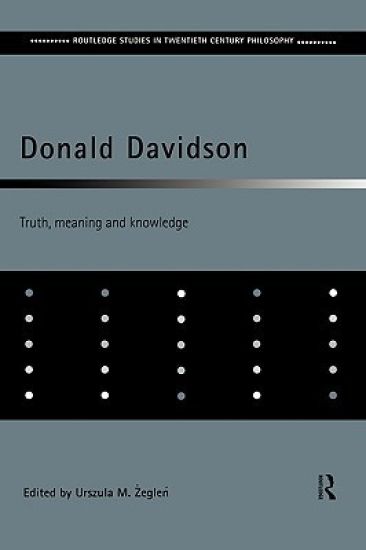
Donald Davidson
Donald Davidson has made enormous contributions to the philosophy of action, epistemology, semantics and philosophy of mind and today is recognized as one of the most important analytical philosophers of the late twentieth century.Donald Davidson: Truth, Meaning and Knowledge addresses* Davidson's writings on epistemology and theory of language with their implications of ontology and philosophy of mind* the central issue of whether truth is the ultimate goal of enquiry, challenged by contributions from Richard Rorty and Paul Horwich* Davidson's approach to semantics and applied linguistics as addressed by Kirk Ludwig, Gabriel Segal, Peter Pagin, Stephen Neale, Herman Cappelen and Ernie Lepore and Reinaldo Elugardo* Davidson's advances in the philosophy of mind in relation to the views of Williard V. Quine, John McDowell and Peter F. Strawson, in essays by Roger Gibson and Anita Avramides
Donald Davidson
Donald Davidson has made enormous contributions to the philosophy of action, epistemology, semantics and philosophy of mind and today is recognized as one of the most important analytical philosophers of the late twentieth century.Donald Davidson: Truth, Meaning and Knowledge addresses* Davidson's writings on epistemology and theory of language with their implications of ontology and philosophy of mind* the central issue of whether truth is the ultimate goal of enquiry, challenged by contributions from Richard Rorty and Paul Horwich* Davidson's approach to semantics and applied linguistics as addressed by Kirk Ludwig, Gabriel Segal, Peter Pagin, Stephen Neale, Herman Cappelen and Ernie Lepore and Reinaldo Elugardo* Davidson's advances in the philosophy of mind in relation to the views of Williard V. Quine, John McDowell and Peter F. Strawson, in essays by Roger Gibson and Anita Avramides
Donald Davidson: Life and Words
Donald Davidson (1917-2003) was one of the most prominent philosophers of the second half of the twentieth century. His thinking about language, mind, and epistemology has shaped the views of several generations of philosophers. This book brings together articles by a host of prominent philosophers to provide new interpretations of Davidson’s key ideas about meaning, language and thought.The book opens with short commemorative pieces by a wide range of people who knew Davidson well, giving us glimpses into the life of a great philosopher, a beloved husband and father, a colleague, teacher and friend. The chapter by Lepore and Ludwig and the ensuing heated debate with Frederick Stoutland on how to interpret Davidson demonstrate why Davidson’s legacy has become a disputed intellectual territory. The chapters by Kathrin Glüer, Peter Pagin, Barry Smith, James Higginbotham and William Child, all eminent philosophers of language, are prime examples of just one strand of this legacy, while the piece by Sophie Gibb gives us an opening to Davidson’s enormous contribution to philosophy of mind. Donald Davidson: Life and Words closes with a piece by Davidson himself, first published in 1995 in the International Journal of Philosophical Studies, where he brings together the various strands of his work in a Unified Theory of speech and action. This book comprises key articles first published in the International Journal of Philosophical Studies and previously unpublished commemorative pieces, and serves as a fitting dedication to the work and memory of a great philosopher.
Donald Winnicott Today
What in Winnicott’s theoretical matrix was truly revolutionary for psychoanalysis? In this book, the editor and contributors provide a rare in-depth analysis of his original work, and highlight the specifics of his contribution to the concept of early psychic development which revolutionised the theory and practice of psychoanalysis. Including re-publications of selected Winnicott papers to set the scene for the themes and explorations in subsequent chapters, the book examines how Winnicott expanded Freud’s work, and how his discourse with Melanie Klein sharpened his thought and clinical innovations. Divided into 3 sections, it covers: Introductory overviews on the evolution of Winnicott’s theoretical matrix Personal perspectives from eminent psychoanalysts on how Winnicott’s originality inspired their own work Further recent examinations and extensions including new findings from the archives Drawing on her own extensive knowledge of Winnicott and the expertise of the distinguished contributors, Jan Abram shows us how Winnicott’s contribution constitutes a major psychoanalytic advance to the concept of subjectivity. As such, it will be an inspiration to experienced psychoanalysts, psychotherapists and all those interested in human nature and emotional development.
Donald Winnicott Today
What in Winnicott’s theoretical matrix was truly revolutionary for psychoanalysis? In this book, the editor and contributors provide a rare in-depth analysis of his original work, and highlight the specifics of his contribution to the concept of early psychic development which revolutionised the theory and practice of psychoanalysis. Including re-publications of selected Winnicott papers to set the scene for the themes and explorations in subsequent chapters, the book examines how Winnicott expanded Freud’s work, and how his discourse with Melanie Klein sharpened his thought and clinical innovations. Divided into 3 sections, it covers: Introductory overviews on the evolution of Winnicott’s theoretical matrix Personal perspectives from eminent psychoanalysts on how Winnicott’s originality inspired their own work Further recent examinations and extensions including new findings from the archives Drawing on her own extensive knowledge of Winnicott and the expertise of the distinguished contributors, Jan Abram shows us how Winnicott’s contribution constitutes a major psychoanalytic advance to the concept of subjectivity. As such, it will be an inspiration to experienced psychoanalysts, psychotherapists and all those interested in human nature and emotional development.
Donald Davidson’s Triangulation Argument

Donald Davidson’s Triangulation Argument

Robert H. Myers; Claudine Verheggen

Routledge
2016
sidottu
According to many commentators, Davidson’s earlier work on philosophy of action and truth-theoretic semantics is the basis for his reputation, and his later forays into broader metaphysical and epistemological issues, and eventually into what became known as the triangulation argument, are much less successful. This book by two of his former students aims to change that perception. In Part One, Verheggen begins by providing an explanation and defense of the triangulation argument, then explores its implications for questions concerning semantic normativity and reductionism, the social character of language and thought, and skepticism about the external world. In Part Two, Myers considers what the argument can tell us about reasons for action, and whether it can overcome skeptical worries based on claims about the nature of motivation, the sources of normativity and the demands of morality. The book reveals Davidson’s later writings to be full of innovative and important ideas that deserve much more attention than they are currently receiving.
Donald Davidson: Life and Words
Donald Davidson (1917-2003) was one of the most prominent philosophers of the second half of the twentieth century. His thinking about language, mind, and epistemology has shaped the views of several generations of philosophers. This book brings together articles by a host of prominent philosophers to provide new interpretations of Davidson’s key ideas about meaning, language and thought.The book opens with short commemorative pieces by a wide range of people who knew Davidson well, giving us glimpses into the life of a great philosopher, a beloved husband and father, a colleague, teacher and friend. The chapter by Lepore and Ludwig and the ensuing heated debate with Frederick Stoutland on how to interpret Davidson demonstrate why Davidson’s legacy has become a disputed intellectual territory. The chapters by Kathrin Glüer, Peter Pagin, Barry Smith, James Higginbotham and William Child, all eminent philosophers of language, are prime examples of just one strand of this legacy, while the piece by Sophie Gibb gives us an opening to Davidson’s enormous contribution to philosophy of mind. Donald Davidson: Life and Words closes with a piece by Davidson himself, first published in 1995 in the International Journal of Philosophical Studies, where he brings together the various strands of his work in a Unified Theory of speech and action. This book comprises key articles first published in the International Journal of Philosophical Studies and previously unpublished commemorative pieces, and serves as a fitting dedication to the work and memory of a great philosopher.
Donald Trump Paper Doll Collectible Campaign Edition
Take a break from current political controversy and place a vote for fun This instant collector's item features a paper doll of Donald Trump, the businessman and television personality who is pulling out all the stops to earn the Republican party's 2016 presidential nomination. Fifteen outfits and accessories include a Trump University cap and gown, WWF wrestler garb, Miss Universe gown, carnival barker costume, and more. Includes a detailed biography.
Donald Davidson

Donald Davidson

Cambridge University Press
2003
sidottu
Donald Davidson has been one of the most influential figures in modern analytic philosophy and has made seminal contributions in a wide range of subjects: philosophy of language, philosophy of action, philosophy of mind, epistemology, metaphysics and the theory of rationality. His principal work, embodied in a series of landmark essays stretching over nearly 40 years, exhibits a unity rare among philosophers contributing on so many diverse fronts. Written by a distinguished team of philosophers, this volume includes chapters on truth and meaning, the philosophy of action, radical interpretation, philosophical psychology, knowledge of the external world, other minds and our own minds, and the implications of Davidson’s work for literary theory. This is the only comprehensive introduction to the full range of Davidson’s work, and as such it will be of particular value to advanced undergraduates, graduates and professionals in philosophy, psychology, linguistics, and literary theory.
Donald Campbell

Donald Campbell

David Tremayne

Transworld Publishers Ltd
2005
pokkari
The son of the legendary Sir Malcolm Campbell who was famous for being the ultimate record-breaker of the inter-war years - he broke the land speed record nine times and the water speed record four times with his Bluebird cars and boats - Donald Campbell was born to speed.
Donald MacKinnon's Theology

Donald MacKinnon's Theology

Andrew Bowyer

T. T.Clark Ltd
2019
sidottu
Andrew Bowyer presents the first comprehensive examination of Donald MacKinnon’s theology in relation to his moral philosophy. He offers an original and creative reading of MacKinnon’s methodology, and important insights into the key influences and core questions which stood at the heart of his work. Bowyer outlines MacKinnon’s contributions to Anglican theology in the aftermath of the Second World War, highlighting the “therapeutic” nature of his approach in as far as it combined a call for intense self-awareness with a commitment to moral realism.As one of the most influential Anglican theologians in the mid-twentieth century, MacKinnon’s writings reveal him as a restive and unsystematic thinker. However, Bowyer argues that a series of reoccurring questions – ‘obsessions’ might better honour the memory of MacKinnon’s temperament –appear throughout his work, relating to the tensions between the realism and idealism, the call to be “morally serious”, the nature of theological truth claims, and the perennially disruptive presence of Christ. Bowyer examines the key influences on MacKinnon’s thought, the centrality of Christology to his project, his engagement with literature and literary criticism, as well as his response to Wittgenstein’s later philosophy. This volume offers an appreciation of his contribution and a critique of his legacy.