Kirjojen hintavertailu. Mukana 11 342 296 kirjaa ja 12 kauppaa.

Kirjahaku

Etsi kirjoja tekijän nimen, kirjan nimen tai ISBN:n perusteella.

1000 tulosta hakusanalla Edward Beavan

Edward Thomas: Prose Writings: A Selected Edition
Autobiographies is the first volume in Edward Thomas: Prose Writings: A Selected Edition. It contains the autobiographical prose of one of the most respected British writers of the twentieth century, including the autobiographical story The Happy-Go-Lucky Morgans, the posthumously published 'autobiography' The Childhood of Edward Thomas, the essay 'How I Began', the previously unpublished 'Addenda to Autobiography', and a long section from 'Fiction' (also previously unpublished). In these works, all written between 1912 and 1914, Thomas provides a remarkable portrait of his childhood and teenage years in London, Wiltshire, and Wales. Writing this prose was a journey away from a troubled present back into earlier and happier experiences, but these unique autobiographies also have much in common with his other prose works. The complexity and brilliance of Thomas's autobiographical prose is discussed and revealed in a long introduction, by a detailed headnote at the start of each work, and by extensive annotation. Thomas's prose has never previously been given the scholarly attention that it receives here. Although Thomas's autobiographies are very accessible, and written with a longing for the simplicity of childhood, they are also intricately woven, using many quotations and allusions. The longest of the works, The Happy-Go-Lucky Morgans, is both his simplest prose work and his most complex. Indeed, Autobiographies contains some of Thomas's finest prose, written in the two years, and in some cases merely a few months, before his decision to start writing the poetry for which he is most, and greatly, esteemed. Edward Thomas: Prose Writings: A Selected Edition will appeal to those who know and admire his prose, as well as those who have never encountered it before, and show that Thomas's prose, not least his autobiographical prose, deserves to be much better known.
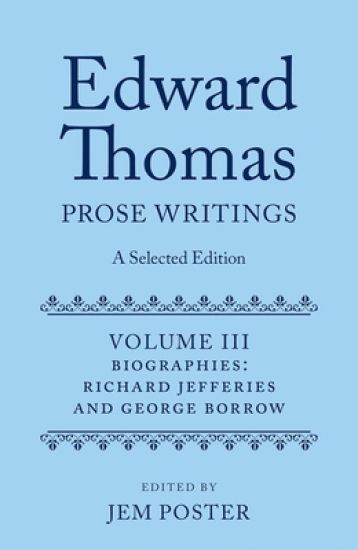
Edward Thomas: Prose Writings: A Selected Edition
Edward Thomas is an important figure in the English literary canon, a major twentieth-century poet, he was also one of England's most experienced and respected Edwardian and Georgian critics, and an observer of the countryside second to none. Although he died at the age of only 39, his prose output was massive and encompassed a range of genres: biography, autobiography, essays, reviews, fiction, nature books, travel writings, and anthologies. While Thomas's stature as a poet is widely appreciated, his prose works have yet to be given their critical due - in large part because scholarly editions have hitherto been lacking. Edward Thomas: Prose Writings: A Selected Edition shows that Thomas's prose deserves to be much better known, by literary scholars but also the general reading public. This six-volume edition establishes him as one of the most important prose writers in English, who contributed remarkable ideas and representations of the self and community, the landscape and ecology, literature and history, the spiritual and artistic life. It is the definitive edition of Thomas's prose and a significant scholarly resource for the twenty-first century. The third volume provides the annotated texts of two biographies by Thomas: Richard Jefferies: His Life and Work (1909) and George Borrow: The Man and His Books (1912). A detailed introduction addresses a range of matters relating to the subjects of these two biographies as well as to Thomas's approach to them. Among the topics discussed in relation to Jefferies are: the correspondences between Jefferies' life and Thomas's; the influence of Jefferies on Thomas's thought and writing, including such matters as mystical experience and the passage of time; Thomas's unwarranted anxieties about the quality of the biography; and the high standing of the biography in the century since its publication. Among the topics discussed in relation to Borrow are: Thomas's ambivalence towards his subject; the influence of Borrow on later attitudes to walking and the open air, particularly as these were expressed in literature; the popular and literary interest (again attributable in part to Borrow's influence) in Romani life; and the way in which Thomas's approach to the Borrow biography, with its emphasis on the value of impressions as distinct from facts, chimes with Modernist thinking about the nature of narrative. The edition's extensive notes provide further insights into the texts and their cultural context.
Edward Said

Edward Said

University of Chicago Press
2005
nidottu
In Edward Said: Continuing the Conversation, Edward Said's long-time friends and collaborators continue their dialogue with Said where they left off following his death in the fall of 2003. The essays, imagining and recalling the cadences of Said's conversation, take various forms, including elaborations on his ideas, applications of his thought to new problems, and recollections of the indescribable electricity that made conversation with him intense and memorable. This lively, personal tone is a direct result of editors Homi Bhabha and W. J. T. Mitchell urging contributors to write in the spirit of a conversation interrupted, a call on hold, a letter waiting for a reply, a question hanging in the air. This is a work of immense imaginative and intellectual force and compelling candor, honoring Said's legacy as an activist intellectual. This collection includes essays by Lila Abu-Lughod, Daniel Barenboim, Akeel Bilgrami, Paul Bove, Timothy Brennan, Noam Chomsky, Ranajit Guha, Harry Harootunian, Saree Makdisi, Aamir Mufti, Roger Owen, Gyan Prakash, Dan Rabinowitz, Jacqueline Rose, and Gayatri Spivak.
Selected Papers of Edward Shils

Selected Papers of Edward Shils

Edward Shils

University of Chicago Press
1980
sidottu
This third volume of the Selected Papers of Edward Shils brings together ten essays, three of which have never been published before and all the others of which have been completely revised and elaborated. They deal with the history of American and European sociology as an intellectual undertaking and as a means to the attainment of practical ends. Professor Shils's main themes are the influence of ethical and practical intentions on scholarly study in the social sciences, the autonomy of the intellectual tradition of sociology, and the significance of the institutional organization of sociological teaching and research.
Edward Echidna Learns to Describe

Edward Echidna Learns to Describe

Kj Zagabria

Tellwell Talent
2023
pokkari
Do you know the six skills used to describe? Edward Echidna is grumpy because he doesn't know the describing tools, and his teacher has given him a describing-your-backyard homework task. Can Grandpa Echidna help Edward learn to describe? Learn the six skills needed to describe, along with Edward.
Edward Echidna Learns to Describe

Edward Echidna Learns to Describe

Kj Zagabria

Tellwell Talent
2023
sidottu
Do you know the six skills used to describe? Edward Echidna is grumpy because he doesn't know the describing tools, and his teacher has given him a describing-your-backyard homework task. Can Grandpa Echidna help Edward learn to describe? Learn the six skills needed to describe, along with Edward.
Edward Seaga My Life & Leadership Volume 1

Edward Seaga My Life & Leadership Volume 1

Seaga Edward

Macmillan Education
2010
nidottu
Edward Seaga is one of the outstanding politicians of Jamaican history, certainly the most creative and controversial. His autobiography offers a unique insight into the emergence of modern Jamaica, a journey characterized by inspiring idealism, ideological intrigue, bold strategizing, violent conflict and a triumphant finale. The young protege of legendary National Hero and Leader of the Jamaica Labour Party, Alexander Bustamante, Harvard graduate Edward Seaga was drawn to the roots of Jamaican folk society as a live-in research student of the life of the poor in rural and inner-city communities. He rose dramatically through the political ranks to leadership of the JLP in 15 years after which he led the party for the next 30 years. As the youngest parliamentarian, he gave notice in his signature speech on the 'haves and have-nots', that his mission was to pull up the poor without pulling down the rich, because in a country with little wealth both capital and labour are mutually dependent in a symbiosis for success. This was Bustamante's underlying pragmatic philosophy too.In describing his own political journey Seaga gives a fascinating and enlightening commentary on Jamaica's modern history in unprecedented detail on the aspirations and achievements of governments over 50 years. His story gathers momentum as the country is ravaged by the ideological differences between the JLP and the opposing People's National Party, led by Michael Manley, culminating in the violence and terror of the 1976 State of Emergency. Volume 1 concludes dramatically with the JLP's return to power - and Edward Seaga elected as Prime Minister of Jamaica.
Edward Seaga My Life & Leadership Volume 2

Edward Seaga My Life & Leadership Volume 2

Seaga Edward

Macmillan Education
2010
nidottu
Edward Phillip George Seaga is one of the most outstanding Jamaican politicians - with a reputation for creativity, controversy and courage. His autobiography offers a unique insight into the emergence of modern Jamaica, a journey characterized by idealism and intrigue, conflict and triumph. The young protege of legendary National Hero, founder and leader of the Jamaica Labour Party, Sir Alexander Bustamante, Harvard graduate Edward Seaga was drawn to the roots of Jamaican folk society as a research student of the life of the poor in rural and inner-city communities. He rose dramatically through the political ranks to leadership of the JLP in 15 years, leading the party for the next 30 years. As the youngest parliamentarian, he gave notice in his signature speech on the 'haves and have-nots' that his mission was to pull up the poor without pulling down the rich - in a country with little wealth both capital and labour are mutually dependent for success. This was Bustamante's underlying pragmatic philosophy too. In 1980, the JLP stormed to election victory and Seaga became Prime Minister.His immediate task was to tackle the immense problems inherited from the Manley PNP government, a challenge that dominated Seaga's time in office. His detailed strategy for economic and social revival together with his analysis of the ongoing issues that confront Jamaica today provide the framework of this second volume of autobiography, closing with an absorbing account of Seaga's final years as leader of the JLP and the moving occasion of his farewell to the Parliament he served for so long.
Edward Bond: A Critical Study

Edward Bond: A Critical Study

P. Billingham

Palgrave Macmillan
2013
sidottu
This new study of one of Britain's greatest modern playwrights represents the first major, extended discussion of Edward Bond's work in over twenty years. The book combines rigorous and stimulating analysis and discussion of Bond's plays and ideas about drama and society. For the first time, there is also discussion of selected plays from his later, post-2000 period, including Innocence and Have I None, alongside explorations of widely studied plays such as Saved.
Edward Trencom's Nose

Edward Trencom's Nose

Giles Milton

Macmillan
2013
pokkari
Edward Trencom has bumbled through life, relying on his trusty nose to turn the family cheese shop into the most celebrated fromagerie in England. But his world is turned upside down when he stumbles across a crate of family papers. To his horror, Edward discovers that nine previous generations of his family have come to sticky ends because of their noses. When he investigates further, Edward finds himself caught up in a Byzantine riddle to which there is no obvious answer . . . Giles Milton’s deliciously comic debut novel is a mouth-watering blend of Louis de Bernieres, Tom Sharpe and P. G. Wodehouse with every page permeated by the pungent odour of cheese. 'The pong of ripe Limburger lingers impressively' - Observer 'Comic novels are difficult to write: any old halfwit can produce 400 pages of stinking high seriousness, but it takes a real wit to manage 400 pages of mild, fragrant good humour' Guardian
Edward the Confessor (Penguin Monarchs)
Edward the Confessor, the last great king of Anglo-Saxon England, canonized nearly 100 years after his death, is in part a figure of myths created in the late middle ages.In this revealing portrait of England's royal saint, David Woodman traces the course of Edward's twenty-four-year-long reign through the lens of contemporary sources, from the Anglo-Saxon Chronicle and the Vita AEdwardi Regis to the Bayeux Tapestry, to separate myth from history and uncover the complex politics of his life. He shows Edward to be a shrewd politician who, having endured a long period of exile from England in his youth, ascended the throne in 1042 and came to control a highly sophisticated and powerful administration.The twists and turns of Edward's reign are generally seen as a prelude to the Norman Conquest in 1066. Woodman explains clearly how events unfolded and personalities interacted but, unlike many, he shows a capable and impressive king at the centre of them.
Edward and Mark's Adventure

Edward and Mark's Adventure

James F Park

Lulu.com
2018
pokkari
The bright sunlight shone through Mark's green and white hooped curtains and filled his small room with hundreds of tiny green and white football shapes that always made him think of paradise because that's where his favourite football team played and where, one day, he hoped he'd be good enough to play for the Scottish champions and score the winning goal in The Champions League Final but not today because today was his school's sports day and that was something he wasn't looking forward to.
Edward Yang

Edward Yang

John Anderson

University of Illinois Press
2005
nidottu
Having largely given up on a career in film, Edward Yang had been working as a computer engineer for several years when he saw Herzog's Aguirre, Wrath of God. Inspired to return to film, Yang, along with a handful of other filmmakers, including the great Hou Hsiao-hsien, went on to found the Taiwanese New Wave of the early 1980s. Film critic John Anderson's Edward Yang offers a comprehensive overview of the work of the writer-director-already considered one of the most important filmmakers of the past twenty years-from his breakthrough feature That Day, on the Beach to the epic Yi-Yi. Rooted in questions about what it means to be Taiwanese, Yang's films reveal the complexity of life within the island's patchwork culture. Anderson identifies the key narrative strategies, formal devices, moral vision, and sociopolitical concerns shot through Yang's films. He explains what makes these films so distinctive by pinpointing the specific qualities of Yang's style and outlook.
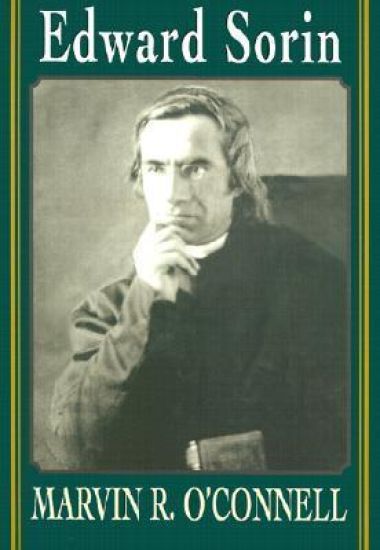
Edward Sorin

Edward Sorin

Marvin R. O'Connell

University of Notre Dame Press
2001
sidottu
This sweeping book offers the definitive account of the life and labors of Edward Sorin, founder of the University of Notre Dame. Born in the west of France in 1814, Sorin was ordained in 1838 and joined the newly founded Congregation of Holy Cross shortly thereafter. In 1841, Father Sorin, along with six Holy Cross brothers, was sent to establish a mission in Indiana. After a year's service in the Vincennes diocese's fledgling parochial schools, Sorin was offered a tract of land in the diocese's northernmost section—on the condition that a college be situated there. Father Sorin and his companions arrived at the lakeside property, located near the south bend of the St. Joseph River, in November 1842. The next year, the state of Indiana granted a charter to what Sorin proudly and reverently called the University of Notre Dame du Lac. In its early days, Father Sorin's "university" was composed of a few log shacks and a handful of half-educated brothers, only a few of whom could speak English. There was no money and hardly any students. But Father Sorin, by sheer willpower, was determined that his university would prosper. Basic to Father Sorin's success in this regard was his willingness to give free rein to gifted colleagues—men more intellectually sophisticated than himself—and his intuitive understanding of, and growing love for, the unique character of American culture. Edward Sorin is a lively, colorful history of the man who overcame great odds to found and grow one of the world's premier Catholic institutions of higher learning.
Edward L. Doheny

Edward L. Doheny

Dan LaBotz

Praeger Publishers Inc
1991
sidottu
If there had been a Life Styles of the Rich and Famous in the 1920s, the notorious oil tycoon Edward L. Doheny would surely have been featured. For at the peak of his powers, between 1904 and 1927, this L.A. hometown boy was one of the most important men of his times and, in fact, one of the richest and most powerful men in the world. As the first to discover oil in Los Angeles--which sparked an oil boom there--this multi-faceted entrepreneur profoundly influenced the growth of both Los Angeles and the state of California. Then, as one of its earliest developers, Doheny helped put Beverly Hills on the map. On an international scale, he established vast oil fields in Mexico and virtually controlled that country's oil industry. This petroleum state that Doheny created and ruled extended over Veracruz, Tamaulipas, and San Luis Patosi and was defended by a Doheny-financed army of 6,000 men. The oil baron's opposition to the various revolutionary governments is legendary and some historians believe that Doheny was responsible for the murder of Mexican President Carranza. Finally, Doheny played a major role in the Teapot Dome Scandal, the greatest political impropriety in U.S. history up to that time. Dan La Botz has taken this rich collection of material plus new information on Doheny's personal life and provided the first biography of a man who, for better or worse, left his mark on the nation's industrial and economic development. The ten-chapter biography integrates all Doheny's nefarious doings and gives a full account of his attempts to shape U.S. foreign policy. In addition to assessing Doheny's public life, the study reviews the causes of his son and his son's best friend's deaths. La Botz details how Doheny almost singlehandedly created the Fuel-oil Age by helping convert railroads from coal-burning to petroleum-burning engines and in the process opened up a huge market for petroleum as fuel. Edward L. Doheny, for the first time, gives a complete and accurate estimation of the oilman's part in the Teapot Dome Scandal, detailing how Doheny bribed his friend Albert Bacon Fall, a cabinet member of the U.S. Secretary of the Interior, and corrupted the highest levels of U.S. government in an attempt to control the U.S. Navy's oil reserve. As a biography, La Botz attempts to understand the major events of Doheny's personal life while concentrating on his role as economic and political leader. He also provides us with the history of the Doheny companies and a study of imperialism in its classical period. This in-depth biography will shed much light on the period for students and scholars of U.S. and Mexican history and will be read avidly by general readers interested in the growth of Los Angeles and the infancy of the oil industry.
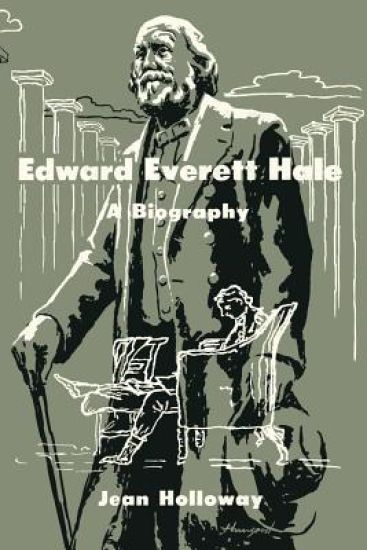
Edward Everett Hale

Edward Everett Hale

Jean Holloway

University of Texas Press
1965
pokkari
Edward Everett Hale is remembered by millions as the author of The Man Without a Country. This popular and gifted nineteenth-century writer was an outstanding and prolific contributor to the fields of journalism, fiction, essay, and history. He wrote more than 150 books and pamphlets (one novel sold more than a million copies in his lifetime) and was intimately associated with the publication of many of the early American journals, among them the North American Review, Atlantic Monthly, and Christian Examiner. He served as editor of Old and New and was a frequent contributor to the foremost newspapers and periodicals of his time. Yet the writings of this “journalist with a touch of genius” were only incidental to Hale’s Christian ministry in New England and in Washington, D.C., where he was for five years Chaplain of the Senate. His literary creed reflected that of his ministry, for Hale’s interpretation of the social gospel comprised an active concern with all phases of human affairs. Confidant of poets and editors, friend to diplomats and statesmen, Hale helped mold public opinions in economics, sociology, history, and politics through three-quarters of what he called “a most extraordinary century in history.” In recounting Hale’s life and times, Holloway vividly portrays this fascinating and often turbulent era.
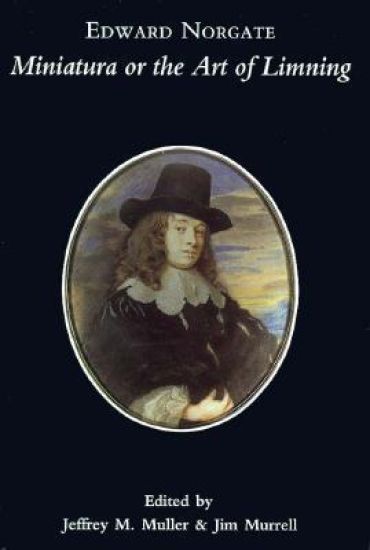
Edward Norgate

Edward Norgate

Edward Norgate

Yale University Press
1997
sidottu
Edward Norgate, aristocratic friend of Charles I and the Earl of Arundel, made his mark in seventeenth-century England as musician, herald, and courtier. He also wrote Miniatura, a widely circulated study of miniature painting in his era that serves today as both a guide to materials and techniques and a record of the artistic knowledge and taste of Charles' court. This new edition of Norgate's treatise, the first since 1919, introduces and fully annotates the text from technical and art historical perspectives, firmly establishing the prime importance of Norgate's work.The book provides a detailed account of Norgate's life and many interests, his readership, and his technique. The editors—a noted scholar of seventeenth-century art and an authority on the techniques and materials of miniature painting—closely examine Norgate's text and compare it with other contemporary treatises, placing his techniques in the context of the period. The treatise itself, first written in 1627-28 and then substantially revised in 1648, sets forth in great detail the methods of English miniaturists, from the composition and preparation of pigments and brushes to lighting in the studio. Norgate acknowledges indebtedness to Hilliard, comments on other artists' styles and techniques, and reveals through his own views the English aristocracy's interest in and assimilation of European artistic culture.Published for the Paul Mellon Center for Studies in British Art