Kirjojen hintavertailu. Mukana 12 390 323 kirjaa ja 12 kauppaa.

Kirjahaku

Etsi kirjoja tekijän nimen, kirjan nimen tai ISBN:n perusteella.

1000 tulosta hakusanalla Everett Phillips

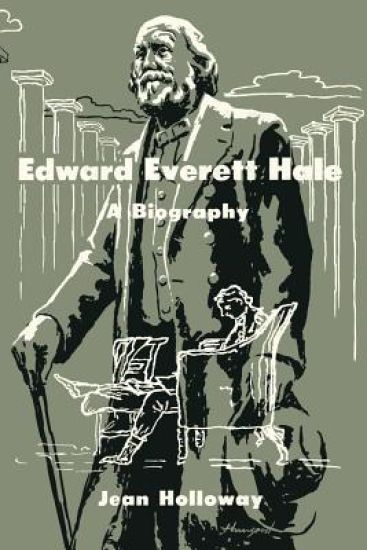
Edward Everett Hale

Edward Everett Hale

Jean Holloway

University of Texas Press
1965
pokkari
Edward Everett Hale is remembered by millions as the author of The Man Without a Country. This popular and gifted nineteenth-century writer was an outstanding and prolific contributor to the fields of journalism, fiction, essay, and history. He wrote more than 150 books and pamphlets (one novel sold more than a million copies in his lifetime) and was intimately associated with the publication of many of the early American journals, among them the North American Review, Atlantic Monthly, and Christian Examiner. He served as editor of Old and New and was a frequent contributor to the foremost newspapers and periodicals of his time. Yet the writings of this “journalist with a touch of genius” were only incidental to Hale’s Christian ministry in New England and in Washington, D.C., where he was for five years Chaplain of the Senate. His literary creed reflected that of his ministry, for Hale’s interpretation of the social gospel comprised an active concern with all phases of human affairs. Confidant of poets and editors, friend to diplomats and statesmen, Hale helped mold public opinions in economics, sociology, history, and politics through three-quarters of what he called “a most extraordinary century in history.” In recounting Hale’s life and times, Holloway vividly portrays this fascinating and often turbulent era.
Edward Everett

Edward Everett

Ronald Reid

Greenwood Press
1990
sidottu
If Edward Everett is remembered at all today, it is as the orator who gave the other speech at Gettysburg, Pennsylvania on November 19, 1863. Ironically, Everett's oration, which was given wide coverage in contemporary newspapers, was recognized as both epideictic and argumentative. Everett defended the Union cause, whereas Lincoln's speech was strictly ceremonial. A second irony that attends Everett's oratorical career is that his countrymen believed him to be one of the great orators of the time, the undisputed master of ceremonial address. In this first new study of Edward Everett's oratory, author Ronald Reid addresses the historical and oratorical paradoxes that have influenced perceptions of Everett's career. Reid reconstitutes the role of epideictic rhetoric in the United States from the end of the Revolutionary War to the eve of the Civil War and reinstates Everett in the pantheon of great American orators. He demonstrates why Everett fell into virtual obscurity and treats the reader to a penetrating analysis of the role of public persuasion in the United States during a critical period in its history. In Edward Everett: Unionist Orator Reid effectively restores Everett to his rightful rostrum in the unfolding national drama from the 1820s to the 1860s, providing a sweeping story of America's golden age of oratory in the process.The book opens with a discussion of the influence of Everett's eighteenth-century heritage on his desire to save the Union at all costs. The author shows how the seeds of Everett's Unionism were starting to sprout in his literary and theological speeches and writings, and how he developed the rhetorical methods that he would use throughout his career. Next, Reid deals with Everett's oratory during his years of service, first as a congressman and then as governor of Massachusetts. Here he discusses Everett's increasing concern about the divisiveness of the partisan and sectional causes he espoused. Chapters three and four deal with Everett's modification of his earlier Unionist strategies in an effort to deal with increasing sectionalism and preserve the United States. In conclusion, Reid reviews Everett's oratory, speculating about the role of epideictic oratory in general in maintaining, or failing to maintain, social unity. Sample speeches complete the work, which include a partial text of one of Everett's congressional speeches, a 4th of July oration, his Character of Washington, and a partial text of Everett's Gettysburg address.
The Everett Interpretation of Quantum Mechanics
Hugh Everett III was an American physicist best known for his many-worlds interpretation of quantum mechanics, which formed the basis of his PhD thesis at Princeton University in 1957. Although counterintuitive, Everett's revolutionary formulation of quantum mechanics offers the most direct solution to the infamous quantum measurement problem--that is, how and why the singular world of our experience emerges from the multiplicities of alternatives available in the quantum world. The many-worlds interpretation postulates the existence of multiple universes. Whenever a measurement-like interaction occurs, the universe branches into relative states, one for each possible outcome of the measurement, and the world in which we find ourselves is but one of these many, but equally real, possibilities. Everett's challenge to the orthodox interpretation of quantum mechanics was met with scorn from Niels Bohr and other leading physicists, and Everett subsequently abandoned academia to conduct military operations research. Today, however, Everett's formulation of quantum mechanics is widely recognized as one of the most controversial but promising physical theories of the last century. In this book, Jeffrey Barrett and Peter Byrne present the long and short versions of Everett's thesis along with a collection of his explanatory writings and correspondence. These primary source documents, many of them newly discovered and most unpublished until now, reveal how Everett's thinking evolved from his days as a graduate student to his untimely death in 1982. This definitive volume also features Barrett and Byrne's introductory essays, notes, and commentary that put Everett's extraordinary theory into historical and scientific perspective and discuss the puzzles that still remain.
Edward Everett Hale

Edward Everett Hale

JAI Press Inc.
2001
sidottu
Edward Everett Hale was a leading member of the institutionalist group at the University of Texas. More radical than his better known colleague, Clarence E. Ayres, Hale influenced many students - originally through his lectures rather than his publications, which were few in number. This collection assembles materials on Hale, unpublished writings by him, and sets of lecture notes from his courses.
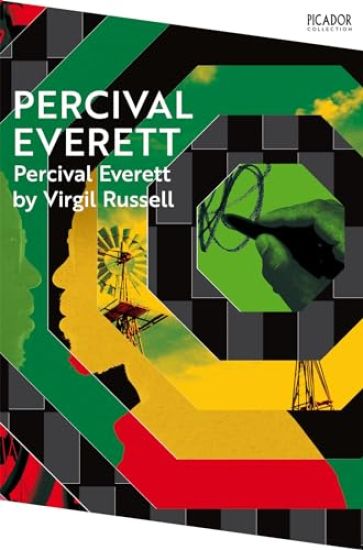
Percival Everett by Virgil Russell

Percival Everett by Virgil Russell

Percival Everett

PAN MACMILLAN
2024
pokkari
Finalist for the Los Angeles Times Book PrizeFinalist for the PEN / Faulkner Award for FictionPercival Everett by Virgil Russell is a story inside a story inside a story. A man visits his ageing father in a nursing home, where his father writes the novel he imagines his son would write. Or is it the novel that the son imagines his father would imagine, if he were to imagine the kind of novel the son would write?Not only is Percival Everett by Virgil Russell a powerful, compassionate meditation on old age and its humiliations, it is an ingenious culmination of Everett’s recurring preoccupations. All of his prior work, his metaphysical and philosophical enquiries, his investigations into the nature of narrative, have led to this masterful book.Part of the Picador Collection, a series celebrating fifty years of Picador books and showcasing the best of modern literature.Read Percival's Pulitzer Prize-winning novel James in paperback now.
The Essential David Everett Reader
David Everett wrote the way he played the piano -- for the sheer joy of entertaining. His stories are unfailingly funny. Everett's memoirs tell of growing up in east Texas during WWII, the military after Korea but before Viet Nam, gays at UT in the 50s, Winedale and Johnson City in the 60s, playing the piano behind the iron curtain in Europe, and much, much more. Diagnosed with Parkinson's at 45, Everett continued to enjoy life for another 28 years, first working on campus and then retiring to Mexico. This book tells in droll detail the story of the coming of age of a gay Texan, the pleasures and traumas of the 60s, the heroic struggles of an unrepentant iconoclast, beset with a degenerative disease, who faced the world with intelligence, sensitivity, and humor. This book is a song with many verses and a single underlying theme: art as a form of salvation, writing as a pure act of love.
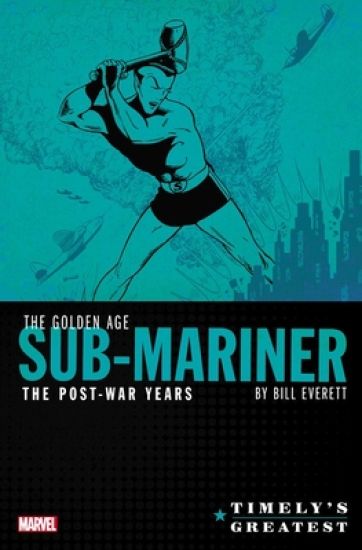
Timely's Greatest: The Golden Age Sub-mariner By Bill Everett - The Post-war Years Omnibus
Marvel proudly presents TIMELY'S GREATEST, a series of once-in-a-lifetime volumes presenting the greatest stories of the Golden Age, when Marvel was known as Timely Comics After his service in World War II, Bill Everett returned to the Sub-Mariner without missing a beat. In fact, Everett's art and storytelling was better than ever. Never before reprinted, his post-war Sub-Mariner and Namora tales are anarchic, energetic and utterly endearing This volume also features Everett's fan-favorite 1950s Sub-Mariner revival during Marvel's "Atlas Era." Alongside Namora, Princess Fen and intrepid love interest Betty Dean, Namor faces off against the nefarious Prince Byrrah, his own doppelganger, giant crocodiles and Communists aplenty These stories defi ne the Sub-Mariner in a way never captured in any comic series before or since COLLECTING: SUB-MARINER COMICS 21-24, 26-30, 32-42; NAMORA 1-3; MARVEL MYSTERY COMICS 84-86, 90-91; HUMAN TORCH 28, 30, 37-38; BLONDE PHANTOM 17; YOUNG MEN 24-28; MEN'S ADVENTURES 28
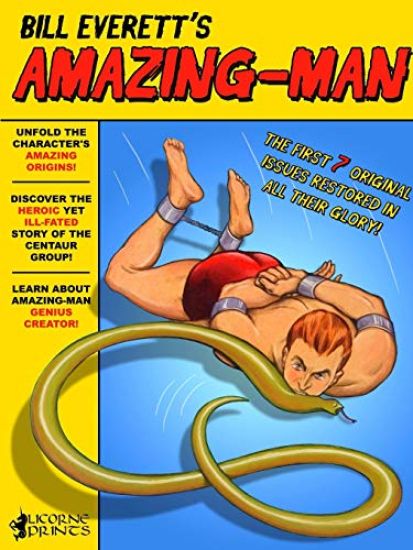
Bill Everett's Amazing Man

Bill Everett's Amazing Man

Bill Everett; Allen L. Kirby

Lulu.com
2016
nidottu
Reprint of fully restored Amazing-Man Comics #5-11 (1939-1940), with additional information about Bill Everett, the Centaur "Comic Group" and the actual copyright status of the comics. Created by Bill Everett at the very start of his career, John Aman, the Amazing-Man, was the leading hero of Centaur, one of the earliest Golden Age comic book publisher. An orphan raised by enlighted Tibetan monks to achieve ultra-manhood, he truly is John "a-man", an archetype of human perfection, whose powers are a personal achievement anybody could attain, if given the opportunity to reach its full potential. Neither an alien from another planet nor a mutant with a twisted genetic code, Amazing-man is a human being with a bright and a dark side, like any other...