Kirjojen hintavertailu. Mukana 11 244 527 kirjaa ja 12 kauppaa.

Kirjahaku

Etsi kirjoja tekijän nimen, kirjan nimen tai ISBN:n perusteella.

1000 tulosta hakusanalla Forest

Forest Development in Cold Climates

Forest Development in Cold Climates

Kluwer Academic/Plenum Publishers
1993
sidottu
As forests decline in temperate and tropical climates, highly-developed countries and those striving for greater economic and social benefits are beginning to utilize marginal forests of high-latitude and mountainous regions for resources to satisfy human needs. The benefits of marginal forests range from purely aesthetic to providing resources for producing many goods and services demanded by a growing world population. Increased demands for forest resources and amenities and recent warming of high­ latitude climates have generated interest in reforestation and afforestation of marginal habitats in cold regions. Afforestation of treeless landscapes improves the environment for human habitation and provides for land use and economic prosperity. Trees are frequently planted in cold climates to rehabilitate denuded sites, for the amenity of homes and villages, and for wind shelter, recreation, agroforestry, and industrial uses. In addition, forests in cold climates reduce the albedo of the earth's surface in winter, and in summer they are small but significant long-lived sinks for atmospheric carbon dioxide. Finally, growth and reproductive success of forests at their geographic limits are sensitive indices of climatic change. As efforts to adapt forests to cold climates increase, however, new afforestation problems arise and old ones intensify. Austral, northern, and altitudinal tree limits are determined by many different factors. Current hypotheses for high-latitude tree limits are based on low growing-season temperatures that inhibit plant development and reproduction.
Forest Trees

Forest Trees

National Academies Press
1991
sidottu
News reports concerning decline of the world's forests are becoming sadly familiar. Most losses are measured in square kilometers, but a more profound loss cannot be measured. As forests disappear, so do their genetic resources. The genes they possess can no longer aid in their adaptation to a changing environment, nor can they be used to develop improved varieties or products. This book assesses the status of the world's tree genetic resources and management efforts. Strategies for meeting future needs and alternatives to harvesting natural forests are presented. The book also outlines methods and technologies for management, evaluates activities now under way, and makes specific recommendations for a global strategy for forest management. Table of Contents Front Matter Executive Summary 1 World Forests 2 Multiple Uses of Forest Trees 3 Structure of Genetic Variation 4 Conservation and Management of Tree Genetic Resources 5 Institutions Involved in Managing Tree Genetic Resources 6 Organizing a Global System of Cooperation References Appendix A: Forest Tree Species Used in Breeding or Testing Activities Appendix B: Literature Survey of Threatened Provenances or Species Appendix C: Sources of Seed for Research Glossary Abbreviations Authors Index
Forest and Land Management in Imperial China
Although China is generally considered to have suffered continuous deforestation over most of its history, forests were protected or even planted and maintained for centuries in some places. This study identifies six such cases. It uses historical evidence to show that individuals and communities act to manage resources sustainably for a number of reasons including economic benefit, religious or symbolic purposes, and that sustainability of the management system depends on the form of control exerted over the resource.
Forest of Bowland & Ribblesdale, Pendle Hill, Clitheroe & Settle
OS Explorer is the Ordnance Survey's most detailed map and is recommended for anyone enjoying outdoor activities like walking, horse riding and off-road cycling. The OS Explorer range of OL maps now includes a digital version of the paper map, accessed through the OS smartphone app, OS Maps. Providing complete GB coverage the series details essential information such as youth hostels, pubs and visitor information as well as rights of way, permissive paths and bridleways.
Forest of Bowland & Ribblesdale, Pendle Hill, Clitheroe & Settle
OS Explorer is the Ordnance Survey's most detailed map and is recommended for anyone enjoying outdoor activities such as walking, horse riding and off-road cycling. The series provides complete GB coverage and can now be used in all weathers thanks to OS Explorer - Active, a tough, versatile version of OS Explorer. The OS Explorer Active range of OL maps now includes a digital version of the paper map, accessed through the OS smartphone app, OS Maps.
Forest Microbiology

Forest Microbiology

ELSEVIER SCIENCE TECHNOLOGY
2022
nidottu
Forest Microbiology, Volume Two: Forest Tree Health highlights a range of emerging microbial phytopathogens of forest trees, along with novel approaches for managing tree pests and diseases in a changing climate. The book provides an overview of selected microbial pathogens of forest trees, with an emphasis on their biology, lifecycle, spreading mechanisms, impact on affected tree species and current and prospective control strategies. At the same time, the impact of tree microbiomes on host fitness is discussed. Beneficial components of tree microbiota are presented, along with their functional role in tree nutrition, immunity and disease resistance. In addition, this volume addresses the many functions of microbial disease agents of trees including fungi, bacteria, viruses and phytoplasma. Strong emphasis is placed on the genetics, biochemistry, physiology, evolutionary biology and population dynamics of the microorganisms involved. This title is a key resource for foresters and forest pathology practitioners, as well as plant biologists.
Forest and Land Management in Imperial China
Although China is generally considered to have suffered continuous deforestation over most of its history, forests were protected or even planted and maintained for centuries in some places. This study identifies six such cases. It uses historical evidence to show that individuals and communities act to manage resources sustainably for a number of reasons including economic benefit, religious or symbolic purposes, and that sustainability of the management system depends on the form of control exerted over the resource.
Forest Of Memories

Forest Of Memories

Donald MacIntosh

Abacus
2008
nidottu
As a child, Donald MacIntosh's heroine was Mary Kingsley, a nineteenth century traveller who successfully took on the forbidding forests and swamps of West Africa. It was an adventure he was to follow for much of his adult life, spending thirty years as a forester in the so-called 'white man's grave'. MacIntosh, however, more than lived to tell his tales, which he does so here with characteristic gusto and relish.Here are stories of a somewhat salty nature, both in style and subject matter. In Africa, MacIntosh writes, the sea never sleeps and Forest of Memories is equally vibrant. As always, the tales are rich with characters and humour: Laval, the temperamental but highly successful fishing baboon; Jig-time Charlie, ladies' man and local footballing legend; and the beautiful Titi, who employed both feminine guile and cat droppings to win an international angling competition.As sharp and cutting as the teeth of the tigerfish, this latest collection finds Donald MacIntosh in splendidly wicked form once again.
Forest Queen

Forest Queen

Betsy Cornwell

Houghton Mifflin Books for Children
2020
nidottu
From a New York Times best-selling author, a fresh, female-centered take on the Robin Hood legend in which a young noblewoman, like the legendary hero, becomes an outlaw fighting for social justice. Perfect for fans of Marissa Meyer and Sarah J. Maas. When sixteen-year-old Silvie's brother takes over management of their family's vast estates, Silvie feels powerless to stop his abuse of the local commoners. Her dearest friend asks her to run away to the woods with him, and soon a host of other villagers join them. Together, they form their own community and fight to right the wrongs perpetrated by the king and his noblemen. Perfect for fans of fairy tale retellings or anyone who loves a strong female lead, this gorgeously written take on the Robin Hood tale goes beyond the original's focus on economic justice to explore love, gender, the healing power of nature, and what it means to be a family.
Forest Runes: Poems on Living and Hunting in the Mighty Natural Wilderness of North America
George Washington Sears tributes the great outdoors with a collection of poems chronicling life among nature in all its rugged glory.A committed outdoorsman, Sears was most at home among the trees and hills of America's wilderness. Each poem in this anthology chronicles a different aspect of life spent camping and living in the depths of nature, with only creatures for company. The author's affinity is plain to behold: he describes watching how a given animal behaves, how the weather unfolds amid the forest, how a camp feels like home, how overarching nature's majesty is.The invigorating aspect of being outdoors is admired by the author; the mountain air, tinged with the scents of trees, was thought to benefit health in the 19th century. Other aspects of the book recount movements of the era; temperence from alcohol, and conflicts with the Native Americans, are alluded to.
Forest Runes: Poems on Living and Hunting in the Mighty Natural Wilderness of North America (Hardcover)
George Washington Sears tributes the great outdoors with a collection of poems chronicling life among nature in all its rugged glory.A committed outdoorsman, Sears was most at home among the trees and hills of America's wilderness. Each poem in this anthology chronicles a different aspect of life spent camping and living in the depths of nature, with only creatures for company. The author's affinity is plain to behold: he describes watching how a given animal behaves, how the weather unfolds amid the forest, how a camp feels like home, how overarching nature's majesty is.The invigorating aspect of being outdoors is admired by the author; the mountain air, tinged with the scents of trees, was thought to benefit health in the 19th century. Other aspects of the book recount movements of the era; temperence from alcohol, and conflicts with the Native Americans, are alluded to.
Forest And Watershed Development And Conservation In Asia And The Pacific
Without the assistance of Sherry Bryson, PublicationsOfficer of the Institute, this book would never haveappeared in press. Her work in editing and shepherdingthe manuscripts through the •preparation for printing•phase was outstanding. The diligent work of HelenTakeuchi in proofing, typing, and organizing the chaptersis gratefully recognized. And to Marietta Mendoza, whosetyping efforts went beyond the call of duty, a vote ofthanks. The authors and editor are deeply appreciative ofthe contributions of these staff members.
Forest Tenure Reform in Asia and Africa
Forest tenure reforms are occurring in many developing countries around the world. These reforms typically include devolution of forest lands to local people and communities, which has attracted a great deal of attention and interest. While the nature and level of devolution vary by country, all have potentially important implications for resource allocation, local ecosystem services, livelihoods and climate change. This book helps students, researchers and professionals to understand the importance and implications of these reforms for local environmental quality, climate change, and the livelihoods of villagers, who are often poor. It is shown that local forest management can often be more successful than top-down management of common pool forest resources. The relationship of local forest tenure reform to the important climate change initiative REDD+ is also considered. The work includes a number of generic chapters and also detailed case studies from China, Ethiopia, Kenya, Nepal, Tanzania and Uganda. Using specific examples and a wide variety of disciplinary perspectives, including quantitative and qualitative analytical methods, the book provides an authoritative and critical picture of local forest reforms in light of the key challenges humanity faces today.
Forest Conservation and Sustainability in Indonesia
Despite carefully constructed conservation interventions, deforestation in Indonesia is not being stopped. This book identifies why large-scale international forest conservation has failed to reduce deforestation in Indonesia and considers why key stakeholders have not responded as expected to these conservation interventions. The book maps the history of deforestation in Indonesia in the context of global political economy, exploring the relationship between international trade, the interests and ideology behind global sustainability programmes and the failures of forest conservation in Indonesia. Global economic and political ideologies are shown to have profoundly shaped deforestation. The author argues that the same forces continue to prevent positive outcomes. Case study chapters analyse three major international programmes: Reducing Emissions from Deforestation and Forest Degradation (REDD+), the Norway-Indonesia bilateral partnership, and the Roundtable on Sustainable Palm Oil (RSPO) in Indonesia. The findings provide insight into the failures of global climate change policy and suggest how the book’s theoretical model can be used to analyse other complex environmental problems.The book is a useful reference for students of environmental science and policy, political theory, international relations, development and economics. It will also be of interest to forestry professionals and practitioners working in NGOs.
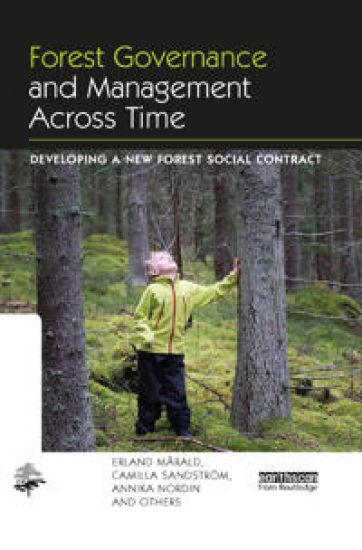
Forest Governance and Management Across Time

Forest Governance and Management Across Time

Erland Mårald; Camilla Sandstrom; Annika Nordin; and Others

Routledge
2019
nidottu
The influence of the past, and of the future on current-time tradeoffs in the forest arena are particularly relevant given the long-term successions in forest landscapes and the hundred years’ rotations in forestry. Historically established path dependencies and conflicts determine our present situation and delimit what is possible to achieve. Similarly, future trends and desires have a large influence on decision making. Nevertheless, decisions about forest governance and management are always made in the present – in the present-time appraisal of the developed situation, future alternatives and in negotiation between different perspectives, interests, and actors.This book explores historic and future outlooks as well as current tradeoffs and methods in forest governance and management. It emphasizes the generality and complexity with empirical data from Sweden and internationally. It first investigates, from a historical perspective, how previous forest policies and discourses have influenced current forest governance and management. Second, it considers methods to explore alternative forest futures and how the results from such investigations may influence the present. Third, it examines current methods of balancing tradeoffs in decision-making among ecosystem services. Based on the findings the authors develop an integrated approach – Reflexive Forestry – to support exchange of knowledge and understandings to enable capacity building and the establishment of common ground. Such societal agreements, or what the authors elaborate as forest social contracts, are sets of relational commitment between involved actors that may generate mutual action and a common directionality to meet contemporary challenges.
Forest Wildlife Ecology and Habitat Management
Across the continental United States, one can identify 20 distinct forest cover types. Most of these are to be found on federal lands managed by the U.S. Forest Service and Bureau of Land Management. Those responsible for the management of trees that form the 20 different cover types and the diversity of forest wildlife that reside in them must have a solid grounding in concepts of forest management, especially silviculture, as well as concepts of wildlife management, in order to integrate both as part of any effective natural resource management plan. Forest Wildlife Ecology and Habitat Management provides both foresters and wildlife biologists responsible for managing forest resources with an integrated understanding of the relationship between forests and wildlife. Based on David Patton’s 50 years of experience as a forester and wildlife biologist, the book shows readers how to look at forests as ecological systems and wildlife as part of the energy flow and nutrient cycling process within those systems. He offers readers a fundamental understanding of the natural processes that occur in a forest taking into consideration vegetation, water, and the natural effects of climate and time. He then provides a biological perspective on wildlife, discussing reproduction, behavior, feeding habits, and mobility. He also discusses the various influences on forests and wildlife by both natural and human-caused events. Covering those forest types included in the U.S. National Atlas, and associating over 1,100 wildlife species with 20 major forest types in 48 states, Professor Patton provides recommendations for ways to restore and maintain wildlife habitat by direct and indirect coordination. Towards this end, the author — Evaluates various approaches to integrate forestry and wildlife managementOffers a number of practical management strategies, emphasizing a progressive holistic approach