
Kirjahaku
Etsi kirjoja tekijän nimen, kirjan nimen tai ISBN:n perusteella.
1000 tulosta hakusanalla Frances Walter
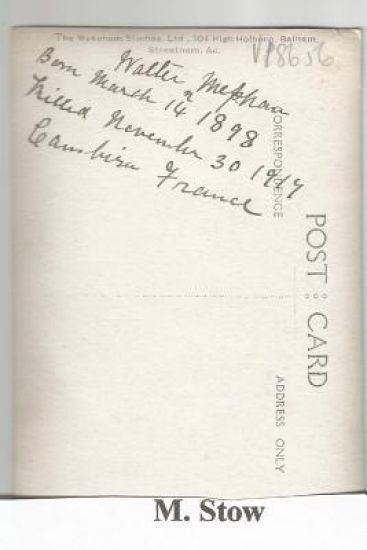
Walter Mepham: Born March 14th 1898, killed November 30th 1917, Cambrai, France.
M. Stow
Createspace Independent Publishing Platform
2014
nidottu
Somme. Cambrai. Harry Arthur, and Walter. Brothers in arms, as well as life.New with photo-pictures (permissions requested) and added postscript.Walter Mepham: born 14th March 1894 killed 30th November 1917 Cambrai France: The Battle of Cambrai 1917, and the life of Walter and his family. With references to the works and words of Conan Doyle, Bertrand Russell, and Winston Churchill, through the true lives of two brothers and their family in the First World War. Walter's family, from Napoleonic Times in Kent and Sussex, England, to London, and to France and to the Western Front, 1917.Walter and his brother Harry Arthur, along with their father Mark Henry Mepham, fought with 'the other ranks' the 'poor bloody infantry' and only Harry survived to tell this story; and through him, to continue their history to the present day.The first decades of the 21st century; a hundred years since the start of the first world war where Walter and his father were killed; two hundred years since the Napoleonic Wars split Europe in bloodshed; seventy since the end of the second world war, Walter, and his brother Harry's family survive.With his brother Harry Arthur, at the commencement of the new 21st century, the Cambrai Memorial at Louverval, remembrance is made.The title and subtitle of this book are taken from the back of the postcard pictured bearing Walter's image before joining-up in 1916, and at nineteen years old enough to be sent to the Western Front; killed Cambrai 30th November 1917.Born 14th March 1894 killed 30th November 1917, this is Walter, and Harry Arthur's re-imagined by their distant cousin, the author Malcolm Stow. This is not an ordinary story. What Walter did, to be killed for his family, and country, was not remarkable. What Harry, and their mother Caroline Mepham (nee Wells) conspired to do, was treason, treachery, a capital crime throughout the first world war: desertion from post. Refusal. Conscientious Objection, and then to abscond from the field of duty.What both brothers did was for their country was to save their family from extinction. Harry by surviving. Walter By dying. And then, by remaining alive The family story continued...From the Battles of Waterloo 1815 with Walter and Harry's great grandfather to Cambrai, 1917; then through family relationships to 2017 from the new battlegrounds of Europe and the World, recounted with personal credence, with a passion for lasting peace.New with photo-pictures (permissions requested) and added postscript.M.Stow 2016.

Rapport de Walter Shanly, I.C.: Sur l'aqueduc de la cité de Montréal suivi du rapport de James Francis ingénieur hydraulique de Lovell sur le même suj
Walter Shanly
Antigonos Verlag
2025
sidottu

The Library of the Late Walter Gillis ... Selections From the Library of Mr. Frederick Rider ... the Private Library of Mr. J. Francis Aylward
Inc Anderson Galleries
Hassell Street Press
2021
nidottu

Quentin Durward. By: Sir Walter Scott Bart.(VOLUME I, AND VOLUME II): With Introductory By: Andrew Lang ( illustrated ).France -- History L
Andrew Lang; Sir Walter Scott Bart
Createspace Independent Publishing Platform
2016
nidottu

The antiquary. By: Sir Walter Scott, edited By: Cavenagh, F. A. (Francis Alexander) 1884-1946: Historical novel (Waverley Novels)
Cavenagh F. a.; Walter Scott
Createspace Independent Publishing Platform
2017
nidottu
The Antiquary (1816) is a novel by Sir Walter Scott about several characters including an antiquary: an amateur historian, archaeologist and collector of items of dubious antiquity. Although he is the eponymous character, he is not necessarily the hero, as many of the characters around him undergo far more significant journeys or change. Instead, he provides a central figure (and location) for other more exciting characters and events - on which he provides a sardonic commentary. The book is written in the third person so the narrative does not remain with the antiquary. This is Scott's gothic novel, redolent with family secrets, stories of hidden treasure and hopeless love, with a mysterious, handsome, young man, benighted aristocracy and a night-time funeral procession to a ruined abbey. The romance and mystery is counterpoised by some of Scott's more down-to-earth characters, and grittily unromantic events. Scott wrote in an advertisement to the novel that his purpose in writing it, similar to that of his novels Waverley and Guy Mannering, was to document Scottish life and manners of a certain period, in this case the last decade of the 18th century. Scott included a glossary of Scottish terms as an appendix to the novel. At the opening of the story, Lovel meets Oldbuck while taking a coach from Edinburgh. Oldbuck, interested as he is in antiquities, has with him Gordon's Itinerarium, a book about Roman ruins. The book interests Lovel, to the surprise of Oldbuck and by their shared interest the two become friends. Oldbuck invites Lovel to come to Monkbarns and takes the opportunity of a willing listener to divulge his ancient knowledge. In the process of which, Oldbuck shows Lovel a plot of land he purchased at great cost where he found an inscription "A.D.L.L", which Oldbuck takes to mean "Agricola Dicavit Libens Lubens". Edie Ochiltree, the local beggar, disputes the antiquary's history, in one of the more amusing scenes of the story .Oldbuck decides to introduce Lovel to his good friend, Sir Arthur Wardour. When Sir Arthur arrives, Lovel meets Arthur's daughter, Isabella and the two realize they have seen each other before. Because Lovel is illegitimate, she knows her father would not approve of a marriage between them. When she sees Lovel standing in the road waiting to talk to her, she convinces her father to take the long way home, walking down to the beach. Luckily, Edie Ochiltree, having the insight that someone may be trapped on the beach not knowing that the tide was coming in, finds the Wardours and helps them escape the rising waters. Then, Lovel appears and gets them to relative safety, huddling on the side of a rocky cliff. Finally, Oldbuck arrives with men and ropes to pull the four up over the cliff to safety.A while later, Oldbuck takes Lovel, the Wardours, his niece and nephew, Douster-swivel and a priest to the ancient ruins of Saint Ruth on Sir Arthur's property. While exploring the property, they discuss an ancient treasure that they believe to be buried at the ruins. Captain M'Intyre dominates Isabella's attention, which she leaves in favor of Lovel's to the dismay of M'Intyre. M'Intyre, angered at this slight, discovers that Lovel is in the military, but realizes he knows of no one named Lovel in his division and calls him out upon the topic. They agree to a duel and return to the scene to fight for their individual honor.... Sir Walter Scott, 1st Baronet, FRSE (15 August 1771 - 21 September 1832) was a Scottish historical novelist, playwright and poet with many contemporary readers in Europe, Australia, and North America.... Cavenagh, F. A. (Francis Alexander) 1884-1946...

Advice to a Son: Precepts of Lord Burghley, Sir Walter Raleigh, and Francis Osborne
Louis B. Wright
Literary Licensing, LLC
2011
sidottu
""Advice To A Son: Precepts Of Lord Burghley, Sir Walter Raleigh, And Francis Osborne"" is a book written by Louis B. Wright. The book is a collection of letters and advice from three influential figures in English history: Lord Burghley, Sir Walter Raleigh, and Francis Osborne. The book is intended to provide guidance and wisdom to young men as they navigate their way through life. The precepts contained within the book cover a wide range of topics, including education, career, relationships, and personal conduct. The book is written in a clear and concise style, making it accessible to readers of all ages and backgrounds. Overall, ""Advice To A Son"" is a valuable resource for anyone looking to gain insight into the thoughts and beliefs of some of the most important figures in English history.This scarce antiquarian book is a facsimile reprint of the old original and may contain some imperfections such as library marks and notations. Because we believe this work is culturally important, we have made it available as part of our commitment for protecting, preserving, and promoting the world's literature in affordable, high quality, modern editions, that are true to their original work.

Advice to a Son: Precepts of Lord Burghley, Sir Walter Raleigh, and Francis Osborne
Louis B. Wright
Literary Licensing, LLC
2011
nidottu

OEuvres complètes de Lord Byron, traduction nouvelle, d'après la dernière édition de Londres. Avec les notes et commentaires de Sir Walter Scott, Thomas Moore, Francis Jeffrey, etc. Précédées de l'histoire ... TOME TROISIEME
Benjamin Laroche; Egerton Brydges
British Library, Historical Print Editions
2011
pokkari

Francis Bacon, a Bibliography of His Works and of Baconiana to the Year 1750: Supplement
Reginald Walter Gibson
Hassell Street Press
2021
sidottu

Francis Bacon, a Bibliography of His Works and of Baconiana to the Year 1750: Supplement
Reginald Walter Gibson
Hassell Street Press
2021
nidottu

The turn of the 20th century was a golden era in France. It was an age of peace, prosperity, and progress after a series of bruising wars and turmoil within the French Republic, culminating in the Franco-Prussian War, which had ended in 1871. From the ruins of conflict, the Belle Époque brought joie de vivre flourish, a boom in art, design, industry, technology, gastronomy, education, travel, entertainment, and nightlife.Through some 800 vintage photographs, postcards, posters, and photochromes from the extensive archives of Marc Walter and Photovintagefrance, France 1900 follows up on TASCHEN’s best-selling vintage photographic collections Italy 1900, The Grand Tour, and America 1900 to provide a precious record of France in all its turn-of-the-century glory. With the photochrome technique used in many of the images restoring the past to vivid color, we enjoy a bristling close, bittersweet, encounter with this hopeful age: the brave, stony splendor of the Mont Saint-Michel; the icy peaks of Chamonix; and the honey light of the Côte d’Azur.With an introduction, six essays, and detailed commentary by Sabine Arqué exploring the stories behind the pictures, this is an unrivalled portrait of a nation on the cusp of the century and of its poignant exuberance before the paroxysm of the First World War. While paying tribute to the precious Belle Époque, crushed by the traumas of history, it also celebrates the unwavering allure of La Belle France, its beauty, culture, traditions, and legendary romance.

Between the Franco-Prussian War and WWI, France in the 1900s was a gilded moment of peace and prosperity. The authors Sabine Arqué and Marc Walter curate this collection of vintage photographs, postcards, posters, and photochromes. From the Paris World’s Fair to the honey light of the Côte d’Azur, it’s a glimpse into an era of rose-tinted optimism.

In this remarkable study by the late Francis Pound, author of the landmark Invention of New Zealand, we are introduced to the making of a New Zealand modernist – tracing the work of Gordon Walters (1919–1995) from student charcoal sketches in the 1930s to the revelation of the mature Koru works at the 1966 New Vision Gallery exhibition in Auckland. Pound follows Walters through steps and missteps, explorations and diversions, travel in Aotearoa and overseas, as the artist discovers new forms, invents others and discards many more. Pound looks hard at the paint, the brushes, the rulers, the scrapbooks, to reveal an artist at work. And, resolutely internationalist like the artist, the author provides not only astute insights into Walters’ art, but also a guide to the elements and ideas that informed the work – notably, Maori and Pacific art, surrealism, Mondrian, De Stijl, the Bauhaus and Euro-American abstraction, conceptual art and minimalism. With Francis Pound accompanying us through the work as guide, critic, wit and enthusiast, Gordon Walters is an extraordinary journey into twentieth-century art.



Walter McDougall offers an original analysis of Versailles diplomacy from the standpoint of the power that had the most direct interest and took the first initiatives in the search for a solution to the German problem. The author's new view of the struggle for execution or revision of the Versailles treaty holds sober implications for assessment of the political origins of international anarchy during the 1930s and European integration in the 1950s. He shows that the Treaty of Versailles was unenforceable, and that the French postwar government, far from enjoying predominance in Europe, suffered from financial crisis and economic and political inferiority to Germany. Versailles was thus the "Boche" peace, and the only path to a stable Europe seemed to lie through permanent restriction of German economic and political unity. Originally published in 1978. The Princeton Legacy Library uses the latest print-on-demand technology to again make available previously out-of-print books from the distinguished backlist of Princeton University Press. These editions preserve the original texts of these important books while presenting them in durable paperback and hardcover editions. The goal of the Princeton Legacy Library is to vastly increase access to the rich scholarly heritage found in the thousands of books published by Princeton University Press since its founding in 1905.

Walter McDougall offers an original analysis of Versailles diplomacy from the standpoint of the power that had the most direct interest and took the first initiatives in the search for a solution to the German problem. The author's new view of the struggle for execution or revision of the Versailles treaty holds sober implications for assessment of the political origins of international anarchy during the 1930s and European integration in the 1950s. He shows that the Treaty of Versailles was unenforceable, and that the French postwar government, far from enjoying predominance in Europe, suffered from financial crisis and economic and political inferiority to Germany. Versailles was thus the "Boche" peace, and the only path to a stable Europe seemed to lie through permanent restriction of German economic and political unity. Originally published in 1978. The Princeton Legacy Library uses the latest print-on-demand technology to again make available previously out-of-print books from the distinguished backlist of Princeton University Press. These editions preserve the original texts of these important books while presenting them in durable paperback and hardcover editions. The goal of the Princeton Legacy Library is to vastly increase access to the rich scholarly heritage found in the thousands of books published by Princeton University Press since its founding in 1905.

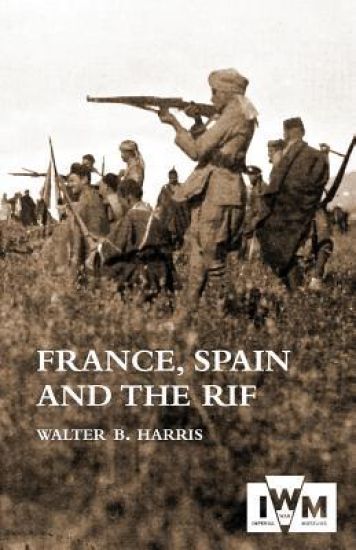
FRANCE, SPAIN AND THE RIF(Rif War, also called the Second Moroccan War 1922-26)
Walter B Harris
Naval Military Press
2014
pokkari