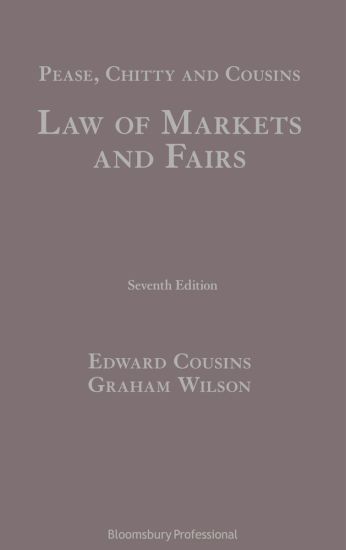
Containing in-depth commentary and analysis on the history of market and fair rights together with current developments in the law relating to franchise and statutory markets in the UK, this is the leading authority covering this complex area of law in the UK. Concentrating on certain aspects of practice and procedure, it provides practical guidance for local government and land law practitioners in the UK and Ireland, local authorities and private market officers. Offering legal analysis of all relevant UK and European legislation and case law, coverage includes: - practice and procedure in relation to rival markets and car boot sales by use of the tort of disturbance- UK regulation and control by means of byelaws, street trading and the laws relating to pedlars, tolls and stallage, and highway obstruction - the law of markets, fairs and street trading in the Republic of IrelandThis new edition also provides a practical toolkit of model byelaws and precedents for market officers and local authorities as well as analysis of EU implications post Brexit.This title is included in Bloomsbury Professional's Local Government Law online service.

In this new work, two leading political scientists reassess the shifting fortunes of the Whitehall model of governance - and find it wanting. As we prepare to enter the twenty-first century, it has become clear that the model now has much less currency abroad as well as in the UK. The neo-liberal assaults of Thatcherism and the political drift of the Major years has meant that whereas, previously, 'Whitehall' symbolized a synergy between the political leadership and the permanent bureaucracy, it now evokes images of executive disarray and the subservience of career civil servants to the (often faddish) will of their political masters.
William's bond with his mother and his church kept him anchored to the small community, but over time the community would flounder, its numbers dwindle, and its homes fall to make way for new roads drawn up by white city planners. But James and his family stayed.
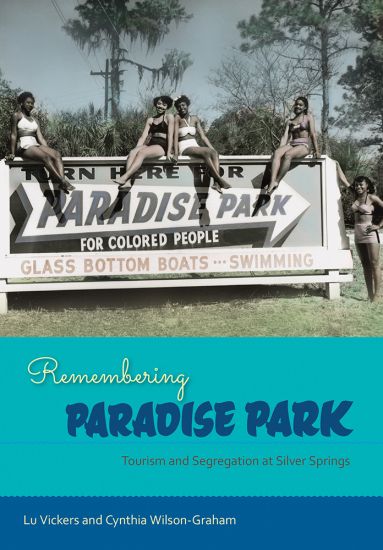
Paradise Park was the ""colored only"" counterpart to Silver Springs, a central Florida tourist attraction famous for its crystal-clear water and glass bottom boats. From 1949 to 1969, boats passed each other on the Silver River - blacks on one side, whites on the other. Though the patrons of both parks shared the same river, they never crossed the invisible line in the water.Full of vivid photographs, vintage advertisements, and interviews with employees and patrons, Remembering Paradise Park portrays a place of delight and leisure during the painful era of Jim Crow. Racial violence was at its height in Florida - the famous Groveland rape case happened right as Paradise Park opened - and many African Americans saw the park as a safe place for families. It was a popular vacation spot for the area's strong black community, which outnumbered the white community as early as the Civil War and had become one of the most cohesive and prosperous black populations in the South.This book compares the park to other tourist destinations set aside for African Americans in the state and across the country. Though Silver Springs was Florida's only attraction to operate a parallel facility for African Americans, Paradise Park has been just a whisper in the story of Florida tourism until now.
This work has been selected by scholars as being culturally important and is part of the knowledge base of civilization as we know it.This work is in the public domain in the United States of America, and possibly other nations. Within the United States, you may freely copy and distribute this work, as no entity (individual or corporate) has a copyright on the body of the work.Scholars believe, and we concur, that this work is important enough to be preserved, reproduced, and made generally available to the public. To ensure a quality reading experience, this work has been proofread and republished using a format that seamlessly blends the original graphical elements with text in an easy-to-read typeface.We appreciate your support of the preservation process, and thank you for being an important part of keeping this knowledge alive and relevant.
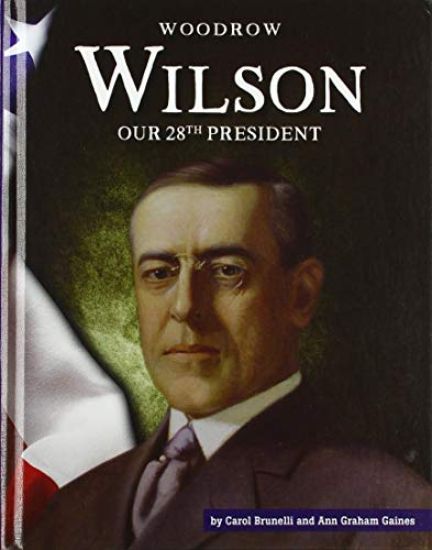
A thorough, illustrated biography discussing the childhood, career, family, and term of Woodrow Wilson, twenty-eighth president of the United States. Includes a table of contents, time line, phonetic glossary, sources for further research, an index, and detailed captions and sidebars to aid in comprehension.
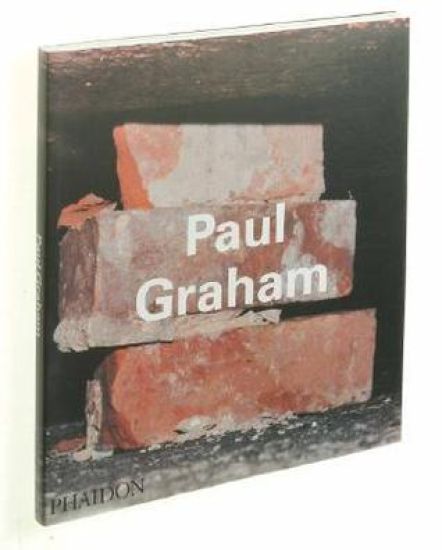
The ecstatic face of a disco dancer in Berlin; a rural panorama in Derry, where a country road has been made into a Pollock-like canvas of red, white and blue; an ashtray, framed by a lacy spray of blood in a Barcelona toilet. Paul Graham uses and abuses classic genres of photography - the portrait, the landscape, the still life - to map a cultural topography. His jewel-like colours and unsettling compositions reveal how social relations and political trauma are inscribed in the everyday. This book brings together for the first time all of Graham's successive series, from his journey along the A1 in Britain to intimate studies of Japan. Graham's work has been celebrated in exhibitions around the world, including The Museum of Modern Art, New York, and Tate Britain, London.Art historian Andrew Wilson has written extensively on contemporary European art and is the author of Gustav Metzger: Damaged Nature, Auto-Destructive Art. He charts the development of Graham's most significant series as defined by the journeys the artist has taken, weaving relations between an emerging aesthetic and the specifics of time and place. In the Interview, Paul Graham speaks with British artist Gillian Wearing, internationally renowned for her photographs and videos that explore the imaginary worlds of ordinary people. Focusing on a triptych from the New Europe series is the celebrated American writer Carol Squiers, Senior Editor at American Photo magazine and editor of The Critical Image: Essays on Contemporary Photography. In juxtaposition with this work, Graham has chosen texts by Japanese authors Kazuo Ishiguro and Haruki Murakami. A series of notes by the artist and an interview with Lewis Baltz provide further insight.
The major study in this investigation was one of growth and form, carried out to evaluate differences in growth rates and body proportions between landlocked Lake Ontario and the anadromous Atlantic alewives. Particular attention was also given to the nature of the annual mortality that is characteristic of P. pseudoharengus in Lake Ontario.
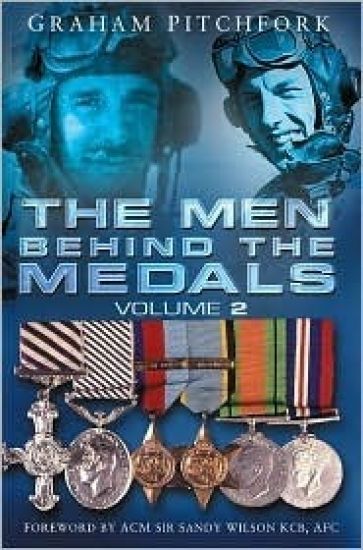
Using medal groups as a starting point, chosen for their unique combinations of gallantry and campaign awards, Graham Pitchfork reviews the fascinating flying careers of 20 Allied airmen who flew combat operations during World War II, across a wide cross-section of operational roles, theatres, aircraft types and aircrew categories. They include a Wellington bomber gunner who was shot down on the first thousand-bomber raid and evaded capture through Spain; a Beaufighter pilot on anti-shipping operations over the Aegean Sea; a Battle of Britain Hurricane pilot who later flew from Java and escaped to Ceylon in the face of the Japanese advance; and a Wellington navigator who took part in air drops to Yugoslav and Greek partisans, including a night field landing outside Warsaw behind enemy lines. Each chapter is accompanied by photographs of the subject, relevant aircraft types and operational activities in which the subject was involved, plus rare "action" shots. There are examples of flying gallantry awards such as the DSO, DFC, AFC, DFM and AFM, as well as numerous foreign gallantry awards like the Polish Cross of Valour and Belgian Croix de Guerre.
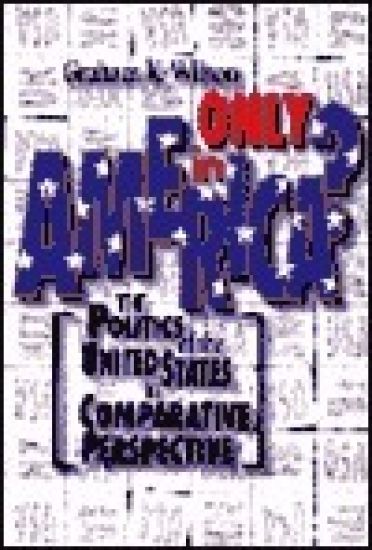
An English political scientist transplanted to America examines the question of American exceptionalism. Is the politics of the U.S. really all that different from politics in other advanced industrial democracies? Does America have more in common with other modern democracies than with its own past? To answer these questions, Graham K. Wilson selects several major areas of comparison: the size and scope of government, the nature of beliefs about politics and government, subjects of political debate, patterns of public policy, and the character of political institutions. Refuting the traditional theory of path dependency, Wilson's conclusions challenge the reader to question popular beliefs about American politics and consider new interpretations of international political experience.
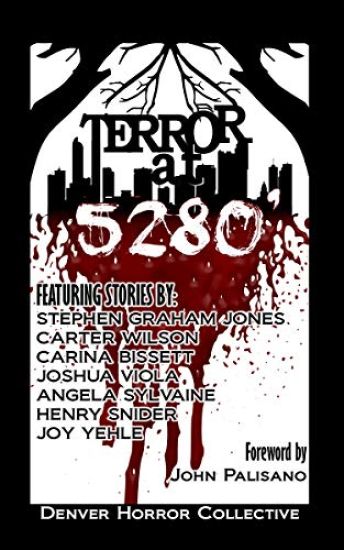
A neighborhood won't let its residents forget the past. One taste draws two lovers into a nightmarish addiction. A harsh winter forces strange creatures down from the mountains.At sea level, where it's safe, things like this can't happen. But when you're sky high in Denver, Colorado, anything goes...including your sanity.Beware of Terror at 5280', a horror fiction anthology featuring dark tales set in and around Denver and the Front Range of the Rocky Mountains, penned exclusively by local authors.Terror at 5280' is a Denver Post Bestseller and winner of the Fiction Anthology category (and finalist for Horror Fiction) in The 2020 Best Book Awards from American Book Fest.Edited by: Josh Schlossberg, Gary Robbe, Melinda Bezdek, Bobby Crew, Desi D, Lisa Mavroudis, Thomas C. Mavroudis, and Jeamus Wilkes.TABLE OF CONTENTSPreface - Denver Horror Collective Foreword - John Palisano The Depths - Matthew Lyons Laffing Sal - Lindsay King-Miller This Was Always Going to Happen - Stephen Graham Jones Electric Stalker - Rebecca S.W. Bates Gaze with Undimmed Eyes and the World Drops Dead - Carina Bissett Grave Mistake - Joshua Viola & Carter Wilson There is Something Up There - Joy Yehle Scrape - Gary Robbe The Copper Door Karma Jar - Cindra Spencer Block 12 - Thomas C. Mavroudis A Place for Cady - Melinda Bezdek Taste - Henry Snider Chronic Cold - Josh Schlossberg The Dead Spot - Angela Sylvaine The Ghosts of Cheesman Park - Grace Horton Old Golden Road - Jay Seate If I Shall Wake - Desi D The Blue Lady - Sean Murphy Mountain Lovers - Bobby Crew Left Behind - P.L. McMillan Deep Veins - Travis Heermann That Time Maggie Ghosted Me - Jeamus Wilkes Last Words: Cannibal Kings and Queens - Larry Berry