

Kirjahaku
Etsi kirjoja tekijän nimen, kirjan nimen tai ISBN:n perusteella.
1000 tulosta hakusanalla H Gerald Starnes
Concealing-coloration in the animal kingdom; an exposition of the laws of disguise through color and pattern
Gerald H Thayer
Alpha Edition
2019
pokkari
Geometry, Language and Strategy is a way of looking at game theory or strategic decision-making from a scientific perspective, using standard equations from the fields of engineering and physics. To better approximate reality, it extends game theory beyond the two-player set piece.The book begins where former game theory literature ends — with multi-person games on a world stage. It encompasses many of the variables encountered in strategic planning, using mathematics borrowed from physics and engineering, rather than the economic models which have not proven to be good in predicting reality.
Geometry, Language And Strategy: The Dynamics Of Decision Processes - Volume 2
Gerald H Thomas
World Scientific Publishing Co Pte Ltd
2016
sidottu
The first volume, Geometry, Language and Strategy, extended the concepts of Game Theory, replacing static equilibrium with a deterministic dynamic theory. The first volume opened up many applications that were only briefly touched on. To study the consequences of the deterministic approach in contrast to standard Bayesian approaches, the richness of applications, requires an engineering foundation and discipline, which this volume supplies. It provides a richer list of applications, such as the Prisoner's Dilemma, which extends the resonant behavior of Vol. 1 to more general time-dependent and transient behaviors.

Introduction to the High Temperature Oxidation of Metals
Neil Birks; Gerald H. Meier; Frederick S. Pettit
Cambridge University Press
2006
sidottu
A straightforward treatment describing the oxidation processes of metals and alloys at elevated temperatures. This 2006 second edition retains the fundamental theory but incorporates advances made in understanding degradation phenomena. The first half provides an authoritative introduction to the basic principles, covering thermodynamics and mechanisms of high temperature corrosion of metals and alloys. The latter half extends the discussion to oxidation processes in complex systems, from reactions in mixed environments to protective techniques, including coatings and atmosphere control. The authors provide a logical and expert treatment of the subject, producing a revised edition that will be a comprehensive guide to material scientists and engineers requiring an understanding of this elementary process.
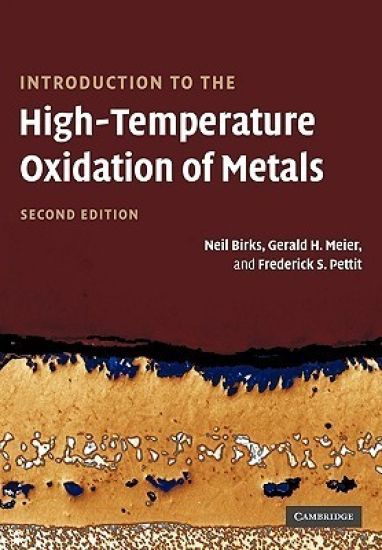
Introduction to the High Temperature Oxidation of Metals
Neil Birks; Gerald H. Meier; Frederick S. Pettit
Cambridge University Press
2009
pokkari
A straightforward treatment describing the oxidation processes of metals and alloys at elevated temperatures. This 2006 second edition retains the fundamental theory but incorporates advances made in understanding degradation phenomena. The first half provides an authoritative introduction to the basic principles, covering thermodynamics and mechanisms of high temperature corrosion of metals and alloys. The latter half extends the discussion to oxidation processes in complex systems, from reactions in mixed environments to protective techniques, including coatings and atmosphere control. The authors provide a logical and expert treatment of the subject, producing a revised edition that will be a comprehensive guide to material scientists and engineers requiring an understanding of this elementary process.
In his address to the Communist Party in 1986, Mikhail Gorbachev blamed the Party for the disastrous state of his country. Within five years, the Party had been outlawed, he had been deposed, the Soviet Union had disintegrated, and its economy was in chaos. It is within this framework that the freely debated proposals to change a system of education inherited in 1917 from Czarist Russia are re-examined. During the Communist regime ideology had prevented realistic reform to the system. Under glasnost, open debate was encouraged for the first time. This book reveals the course taken by these debates and the conflicts between the personalities involved. Competing groups formulated new concepts of education. New child-centered aims were to replace those associated with the creation of a New Soviet Man. New school types and curriculums would allow pupils to specialize in either the sciences or the humanities. History teaching was to be liberalized, religious studies allowed and scientific materialism downgraded. Private and religious schools could be set up for the first time since 1917. Educational institutions could charge for a range of services, and major educational changes were agreed upon. The authors analyze these changes in light of an enormous amount of literature. In discussions with leading members of the Party (before its demise); educationalists, principals and teachers, and local authorities, the authors gained a comprehensive view of the policies before the collapse of the Soviet Union and after. But has the system changed? The authors, who have been visiting Soviet and Russian schools for more than 30 years, examine substantive changes in schools that previously had seemed old-fashioned and analyze Gorbachev's educational legacy.
Emotional Problems of Living: Avoiding the Neurotic Pattern, third edition
O. Spurgeon English; Gerald H. J. Pearson
W. W. Norton Company
1976
nidottu
Representations of Groups
Bruce N. (EDT) Allison; Gerald H. (EDT) Cliff
Amer Mathematical Society
1995
pokkari

Geologic, Hydrologic, and Geochemical Concepts and Techniques in Overburden Characterization for Mined-land Reclamation
Stephen R Moran; John a Cherry; Gerald H Groenewold
Palala Press
2018
pokkari
This work has been selected by scholars as being culturally important, and is part of the knowledge base of civilization as we know it. This work was reproduced from the original artifact, and remains as true to the original work as possible. Therefore, you will see the original copyright references, library stamps (as most of these works have been housed in our most important libraries around the world), and other notations in the work.This work is in the public domain in the United States of America, and possibly other nations. Within the United States, you may freely copy and distribute this work, as no entity (individual or corporate) has a copyright on the body of the work.As a reproduction of a historical artifact, this work may contain missing or blurred pages, poor pictures, errant marks, etc. Scholars believe, and we concur, that this work is important enough to be preserved, reproduced, and made generally available to the public. We appreciate your support of the preservation process, and thank you for being an important part of keeping this knowledge alive and relevant.
The Flaming Spirit: Meditations and Prayers of William L. Sullivan
William L. Sullivan; Max F. Daskam; Gerald H. Kennedy
Literary Licensing, LLC
2011
nidottu

A history of British mammals (Volume II) Land Mammals
Gerald E H Barrett-Hamilton
Alpha Edition
2020
pokkari


S.H.I.E.L.D. By Hickman & Weaver Omnibus Gerald Parel Cover
Jonathan Hickman
MARVEL COMICS
2025
sidottu

H.E.R.O. - Dark Research: H.E.R.O.
Kevin Gerald Rau
Createspace Independent Publishing Platform
2011
nidottu
H.E.R.O. - Horde: H.E.R.O.
Kevin Gerald Rau
Createspace Independent Publishing Platform
2012
nidottu

H.E.R.O. - Paragon: H.E.R.O.
Kevin Gerald Rau
Createspace Independent Publishing Platform
2012
nidottu