Kirjojen hintavertailu. Mukana 11 244 527 kirjaa ja 12 kauppaa.

Kirjahaku

Etsi kirjoja tekijän nimen, kirjan nimen tai ISBN:n perusteella.

1000 tulosta hakusanalla Herman Bernstein

Herman the Helper

Herman the Helper

Robert Kraus

Aladdin Paperbacks
1987
nidottu
Herman the Helper about an octopus that is always willing to assist anyone who needs his help. Old or young, friend or enemy, Herman the octopus is here to provide aid to those in need--no matter who they are. Herman the Helper is ready to guide kids on a path of empathy and compassion.
Orphan Trains and Their Precious Cargo: The Life's Work of Reverend Herman D. Clarke
By the mid-1800s, the street corners of New York City were home to several thousand homeless, abandoned and orphaned children. These poor unfortunates were destined to lie a life of crime or prostitution - creating a tremendous drain on city resources and society in general. Although some found refuge in orphanages and sanitariums, these facilities were ill-suited for the care of these children and lacked the resources to provide for more than a handful at a time. Those that remained on the street often turned to theft and burglary, or even prostitution as a means of survival, compounding the city's already rampant crime problem. Clearly a solution was needed for the good of both New York City and its orphan population. Relief came with the establishment of the Children's Aid Society in 1853 by one Charles Loring Brace. Brace was a theologian and a reformer whose answer to New York's orphan problem was a practice known simply as "placing out." The society would gather likely orphans and send them west by train in groups of anywhere from six to one hundred individuals, stopping at predetermined destinations where it was known foster homes were available. The American West was at this time in critical need of laborers in both agriculture and industry, and many families were eager to provide foster homes to a child who was willing to work. Children would be periodically checked on by an agent of the society and were required to write the society at least twice a year describing their experiences. As with any foster care system, placing out could be a hit-or-miss affair-many children would bounce from home to home and some were returned to New York as undesirables. There were many success stories however, with orphans finding supportive homes and loving foster families. Some were actually adopted into the families with which they were placed. All faced the challenge of a new life in unfamiliar surroundings, without the comfort of friends, relatives and siblings left behind. The orphan trains of the Children's Aid Society ran until 1929, and this text presents the story of one of its agents- the Rev. Mr. Herman Clarke. Rev. Clarke entered the employ of the Society in 1900, and was a tireless devotee to the children entrusted to his care. His ministry was in Dodge Center, Minnesota, and he was later placed in charge of Children's Homes in Cincinnati, Ohio, and Battle Creek, Michigan. Over the years he would travel thousands of miles on the rails with his orphan charges, and received as many as two thousand letters a year from them. In the twilight of life, the reverend began to compile scrapbooks for his grandchildren detailing both the family's genealogy and his years spent working with the society. Six out of these seven scrapbooks have been discovered by the author and they form the basis of this history. Numerous photographs of orphans and their foster families, as well as facsimiles of advertisements published by the society, and a special section of orphan train poetry enrich this text.
Herman Miller

Herman Miller

Phaidon Press Ltd
2019
sidottu
'a company archive that is rich with material from and about the legendary figures who helped make Herman Miller a leader in postwar American design.' - Pilar Viladas, T Magazine A chronicle of the rich history of this innovative furniture company, from its founding in the early twentieth century to today For more than 100 years, Michigan-based Herman Miller has played a central role in the evolution of modern and contemporary design, producing timeless classics while creating a culture that has had a remarkable impact on the development of the design world. Ten chapters and thousands of illustrations tell the Herman Miller story as never before, documenting its defining moments and key leaders – making Herman Miller, A Way of Living an indispensable addition to the bookshelves of design-lovers around the globe.
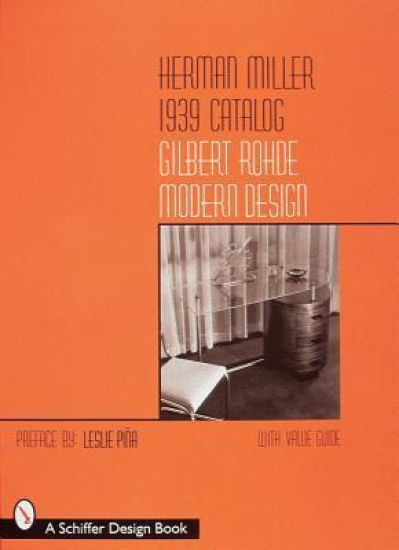
Herman Miller 1939 Catalog

Herman Miller 1939 Catalog

Leslie Piña

Schiffer Publishing Ltd
1998
sidottu
The Herman Miller Furniture Company was devoted to manufacturing period reproduction furniture until pioneer industrial designer Gilbert Rohde walked into their Grand Rapids showroom in 1930. A devout modernist, Rohde convinced D.J. De Pree to focus on modern furniture throughout the 1930s, and to produce exclusively modern furniture by the time Rohde died in 1944. This exact reprint of the 1939 product catalog from the Herman Miller Archives is an historic document showing hundreds of Art Deco and other classic modern furniture designs, all by Rohde. His use of exotic veneers, tubular steel, bentwood, and plastics was innovative and important in the evolution of modernism. With an added price guide, this catalog will be an invaluable tool for the researcher, collector, dealer, and museum curator.
Herman Miller

Herman Miller

Leslie Piña

Schiffer Publishing Ltd
1998
sidottu
Herman Miller has led in the modernization of the American home and workplace since Gilbert Rohde revolutionized the company with his Art Deco furniture in the 1930s. Interior installations (from the early days through the famous mid-century designs of George Nelson and Charles and Ray Eames and the textile designs of Alexander Girard, and up to the later accomplishments of a new generation of designers) are shown in more than 200 color and black and white vintage photos entirely from the Herman Miller Archives. With an extensive timeline of events and furniture design introductions, this visual record captures a fascinating portion of the evolution of modern interior design. Appendices of complete product catalog reprints of the Herman Miller Collections of 1950 and 1952 plus a value guide make this volume a must for researchers, preservationists, designers, and collectors of modern interior furnishings.
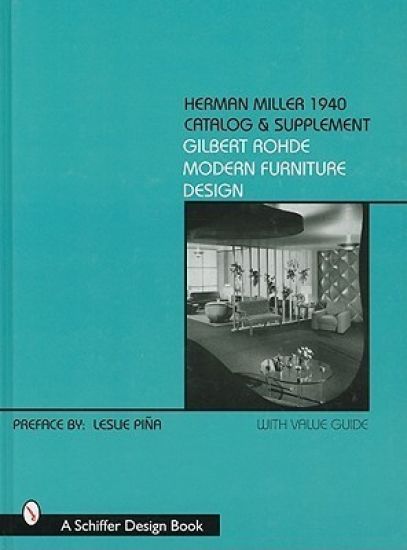
Herman Miller 1940 Catalog & Supplement

Herman Miller 1940 Catalog & Supplement

Leslie Piña

Schiffer Publishing Ltd
1998
sidottu
The Herman Miller Furniture Company was devoted to manufacturing period reproduction furniture until pioneer industrial designer Gilbert Rohde walked into their Grand Rapids showroom in 1930. A devout modernist, Rohde convinced D. J. De Pree to focus on modern furniture throughout the 1930s, and to produce exclusively modern furniture by the time Rohde died in 1944. This exact reprint of the 1940 product catalog and supplement from the Herman Miller Archives is an historic document showing hundreds of Art Deco and other classic modern furniture designs, all by Rohde. His use of exotic veneers, tubular steel, bentwood, and plastics was innovative and important in the evolution of modernism. His revolutionary modular seating and cabinets laid the foundation for mid-century design. More than 160 new items were added to the line in the short span of a year, and this catalog will complement rather than repeat the equally important 1939 catalog. With a current price guide, it will be an invaluable tool for the researcher, collector, dealer, and museum curator.
Herman Miller Office

Herman Miller Office

Leslie Piña

Schiffer Publishing Ltd
2002
sidottu
In this long-awaited new volume, classics by Herman Miller’s super-designers — Gilbert Rohde, Charles and Ray Eames, and George Nelson — are shown along with more recent office furniture designs. Furniture designs are described in detail and shown in color and black-and-white photographs, all from the Herman Miller archives. An essay on the history of the office, designer biographies, company chronology, appendix, bibliography, index, and value guide make this book essential for collectors, dealers, curators, designers, and other devotees of modernism. Herman Miller was the first American company to design and manufacture exclusively modern furniture. From the 1930s, Herman Miller has been a leader in modern design. The same company also led the office revolution and is a name synonymous with the best modern contract furniture. From Action Office I of the 1960s to the Aeron Chair of the late 1990s, Herman Miller has consistently introduced designs that have become classics that are being collected along with the residential icons of modernism.
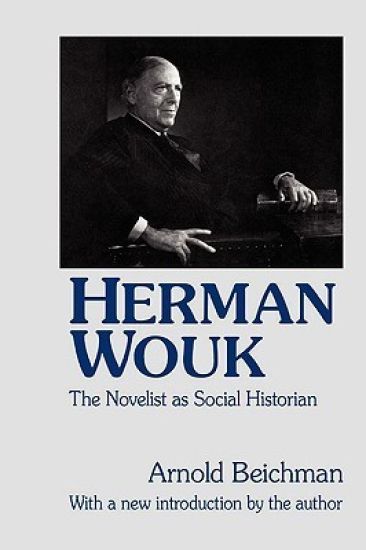
Herman Wouk

Herman Wouk

Arnold Beichman

Transaction Publishers
2004
nidottu
Arnold Beichman's comprehensive study of the writings of Herman Wouk, one of America's leading writers, shows how Wouk's plays and novels exemplify an extraordinary and often highly perceptive preoccupation with American society in war and in peace. Situating Wouk in the same literary tradition as Cervantes, Richardson, Balzac, and Dickens, Beichman demonstrates that Wouk's novels have strong plots, moralist outcomes, and active--essentially positive--characters. The new introduction serves to bring Wouk's work over the past two decades into the reckoning.Making extensive use of Wouk's personal papers and manuscripts as well as personal interviews with him, Beichman's focus is on the social and literary qualities of Wouk's work. In particular, he examines eight novels including War and Remembrance and The Winds of War; The Traitor, one of his three plays; and two moral tracts on Judaism. Wouk has written four more novels, including his latest, A Hole in Texas, his twelfth.Beichman portrays Wouk as one of the few living novelists concerned with virtue, and sees his work as against the mainstream of contemporary American novelists. These, he argues, have eschewed such elements of the traditional novel as invention, coincidences, surprises, suspense, and a moral perspective more presumed than examined.
Herman Melville

Herman Melville

Brett Zimmerman

McGill-Queen's University Press
1998
sidottu
This is a comprehensive examination of astronomy in Melville's works. In this text, Brett Zimmerman investigates Melville's knowledge and literary uses of astronomy, especially within the thematic contexts of Mardi, Clarel, and Billy Budd. Melville's passion for things astronomical is visible throughout his canon. Zimmerman places Melville's many astronomical citations within the thematic context of the works in which they appear and within the larger cultural and historical context of nineteenth-century studies. In addition he provides a comprehensive catalogue of every reference to astronomy, its practitioners, and related topics in Melville's works.
Herman "Baron" Lamm, the Father of Modern Bank Robbery
Former Prussian soldier Herman "Baron" Lamm (1890-1930) adapted his military training to a much less noble occupation after moving to America, developing a reputation as one of history's most brilliant and efficient bank robbers. Lamm's time fell between Butch Cassidy and John Dillinger's notorious careers, and Lamm never received the attention of the two famous gunslingers. This first full-length biography promotes Lamm from his supporting role, tracing his criminal exploits and his pioneering use of concepts like "casing" a bank and planning escape routes. Analysis of arrest records finds Lamm's genius as a criminal mastermind much overrated, and a detailed examination of the trial transcript of fellow gang members Walter Detrich and James Clark brings to life Lamm's spectacular downfall.
Herman Melville and the American Calling

Herman Melville and the American Calling

William V. Spanos

State University of New York Press
2008
sidottu
Argues that Herman Melville's later work anticipates the resurgence of an American exceptionalist ethos underpinning the U.S.-led global "war on terror."Oriented by the new Americanist perspective, this book constitutes a rereading of Herman Melville's most prominent fiction after Moby-Dick. In contrast to prior readings of this fiction, William V. Spanos's interpretation takes as its point of departure the theme of spectrality precipitated by the metaphor of orphanage-disaffiliation from the symbolic fatherland, on the one hand, and the myth of American exceptionalism on the other-that emerged as an abiding motif in Melville's creative imagination. This book voices an original argument about Melville's status as an "American" writer, and foregrounds Melville's remarkable anticipation and critique of the exceptionalism that continues to drive American policy in the post-9/11 era.
Herman Melville and the American Calling

Herman Melville and the American Calling

William V. Spanos

State University of New York Press
2009
pokkari
Argues that Herman Melville's later work anticipates the resurgence of an American exceptionalist ethos underpinning the U.S.-led global "war on terror."Oriented by the new Americanist perspective, this book constitutes a rereading of Herman Melville's most prominent fiction after Moby-Dick. In contrast to prior readings of this fiction, William V. Spanos's interpretation takes as its point of departure the theme of spectrality precipitated by the metaphor of orphanage-disaffiliation from the symbolic fatherland, on the one hand, and the myth of American exceptionalism on the other-that emerged as an abiding motif in Melville's creative imagination. This book voices an original argument about Melville's status as an "American" writer, and foregrounds Melville's remarkable anticipation and critique of the exceptionalism that continues to drive American policy in the post-9/11 era.
Herman Melville

Herman Melville

Hershel Parker

Johns Hopkins University Press
2005
pokkari
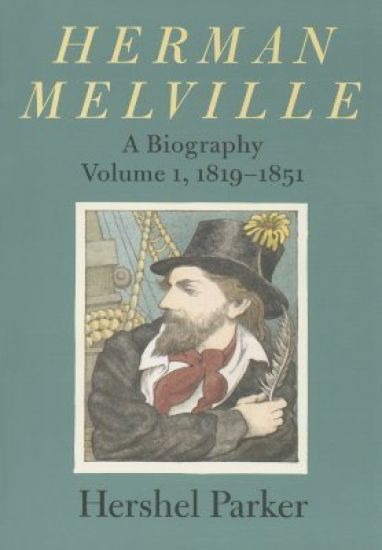
Having left most of Moby-Dick with a printer in 1851, Herman Melville lamented to Nathaniel Hawthorne that he would go down in history as a "man who lived among the cannibals!" Until his death in 1891, Melville was known as the author of Typee (1846) and Omoo (1847)-both semiautobiographical travel books, and literary sensations because of Melville's sensual description of the South Sea islanders. (A transatlantic furor raged over whether the books were fact or fiction.) His most famous character was Fayaway-not Captain Ahab, not the White Whale, not Bartleby, and definitely not Billy Budd, whose story remained unpublished until 1924. Herman Melville, 1819-1851 is the first of a two-volume project constituting the fullest biography of Melville ever published. Hershel Parker, co-editor of the Northwestern-Newberry Edition of The Writings of Herman Melville, reveals with extraordinary precision the twisted turmoil of Melville's life, beginning with his Manhattan boyhood where, surrounded by tokens of heroic ancestors, he witnessed his father's dissipation of two family fortunes. Having attended the best Manhattan boys' schools, Herman was withdrawn from classes at the Albany Academy at age 12, shortly after his father's death. Outwardly docile, inwardly rebellious, he worked where his family put him-in a bank, in his brother's fur store-until, at age 21, he escaped his responsibilities to his impoverished mother and his six siblings and sailed to the Pacific as a whaleman. A year and a half after his return, Melville was a famous author, thanks to the efforts of his older brother in finding publishers. Three years later he was married, the man of the family, a New Yorker-and still not equipped to do the responsible thing: write more books in the vein that had proven so popular. After the disappointing failure of Mardi, which he had hoped would prove him a literary genius, Melville wrote two more saleable books in four months-Redburn and White-Jacket. Early in 1850 he began work on Moby-Dick. Moving to a farmhouse in the Berkshires, he finished the book with majestic companions-Hawthorne a few miles to the south, and Mount Greylock looming to the north. Before he completed the book he made the most reckless gamble of his life, borrowing left and right (like his wastrel patrician father), sure that a book so great would outsell even Typee. Melville lovers have known Hershel Parker as a newsbringer-from the shocking false report headlined "Herman Melville Crazy" to the tantalizing title of Melville's lost novel, The Isle of the Cross. Carrying on the late Jay Leyda's The Melville Log, Parker in the last decade has transcribed thousands of new documents into what will be published as the multi-volume Leyda-Parker The New Melville Log. Now, exploring the psychological narrative implicit in that mass of documents, Parker recreates episode after episode that will prove stunningly new, even to Melvilleans.
Herman Melville

Herman Melville

Hershel Parker

Johns Hopkins University Press
2005
pokkari
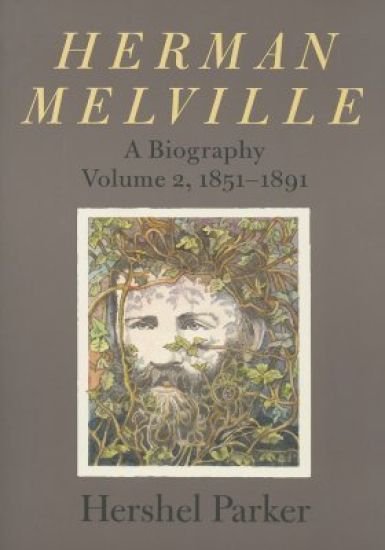
The first volume of Hershel Parker's definitive biography of Herman Melville-a finalist for the 1997 Pulitzer Prize-closed on a mid-November day in 1851. In the dining room of the Little Red Inn in Lenox, Massachusetts, Melville had just presented an inscribed copy of his new novel, Moby-Dick, to his intimate friend, Nathaniel Hawthorne, the man to whom the work was dedicated. "Take it all in all," Parker concluded, "this was the happiest day of Melville's life." Herman Melville: A Biography, Volume 2, 1851-1891 chronicles Melville's life in rich detail, from this ecstatic moment to his death, in obscurity, forty years later. Parker describes the malignity of reviewers and sheer bad luck that doomed Moby-Dick to failure (and its author to prolonged indebtedness), the savage reviews he received for his next book Pierre, and his inability to have the novel The Isle of the Cross-now lost-published at all. Melville turned to magazine fiction, writing the now-classic "Bartleby" and "Benito Cereno," and produced a final novel, The Confidence Man, a mordant satire of American optimism. Over his last three decades, while working as a customs inspector in Manhattan, Melville painstakingly remade himself as a poet, crafting the centennial epic Clarel, in which he sorted out his complex feelings for Hawthorne, and the masterful story "Billy Budd," originally written as a prose headnote to an unfinished poem. Through prodigious archival research into hundreds of family letters and diary entries, newly discovered newspaper articles, and marginalia from books that Melville owned, Parker vividly recreates the last four decades of Melville's life, episode after episode unknown to previous biographers. The concluding volume of Herman Melville: A Biography confirms Hershel Parker's position as the world's leading Melville scholar, demonstrating his unrivaled biographical, literary, and historical imagination and providing a rich new portrait of a great-and profoundly American-artist.
The Writings of Herman Melville, Vol. 15

The Writings of Herman Melville, Vol. 15

Herman Melville

Northwestern University Press
1989
nidottu
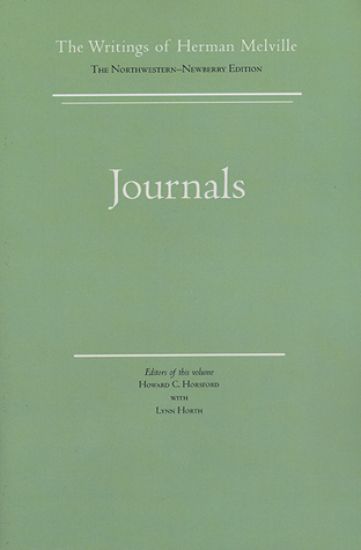
This volume presents Melville's three known journals. Unlike his contemporaries Emerson, Thoreau, and Hawthorne, Melville kept no habitual record of his days and thoughts; each of his three journals records his actions and observations on trips far from home. In this edition's Historical Note, Howard C. Horsford places each of the journals in the context of Melville's career, discusses its general character, and points out the later literary uses he made of it, notably in Moby-Dick, Clarel, and his magazine pieces.The editors supply full annotations of Melville's allusions and terse entries and an exhaustive index makes available the range of his acquaintance with people, places, and works of art. Also included are related documents, illustrations, maps, and many pages and passages reproduced from the journals. This scholarly edition aims to present a text as close to the author's intention as his difficult handwriting permits. It is an Approved Text of the Center for Editions of American Authors (Modern Language Association of America).