Kirjojen hintavertailu. Mukana 11 699 587 kirjaa ja 12 kauppaa.

Kirjahaku

Etsi kirjoja tekijän nimen, kirjan nimen tai ISBN:n perusteella.

1000 tulosta hakusanalla Hugh Wiley

Hugh Kingsmill

Hugh Kingsmill

Michael Holroyd

Faber Faber
2009
nidottu
Hugh Kingsmill should be better known. Here is a striking passage from Richard Ingrams' God's Apology. 'In Malcolm's (Muggeridge) study there was a row of books more thumbed and battered than the rest and a rather blurred photograph showing a man striding through a park, his arm swung forward, his air confident and jaunty. Malcolm called him Hughie. In his conversation he referred to him constantly, with great affection and in a manner quite unlike his usual rather disparaging one when talking of his friends. He seemed to be almost the only man in Malcolm's life of whom he had not a harsh word to say.' Hugh Kingsmill was a novelist, a biographer of note and a talker of outstanding verve and brilliance. He died in 1949 and to mark the sixtieth anniversary Faber Finds is reissuing Michael Holroyd's biography. It was Michael Holroyd's first book, originally published in 1964. 'A remarkably good book .' John Davenport, The Observer'It is a positive pleasure to recommend Michael Holroyd's splendid biography of this exceptional personality.' Kay Dick, BBC 'The World of Books''A well-written study of a laughing, witty, clearly lovable man behind whose wreathed smiles despair lurked.' Anthony Hern, Evening Standard 'An admirably balanced and complete portrait, the criticism fair, the likeness true . . . I congratulate the author on a remarkably good book.' Hesketh Pearson, in a letter' . . . impressively authoritative . . . entrancing and singularly profound.' William Gerhardie, The Spectator
Hugh MacDiarmid's Poetry and Politics of Place

Hugh MacDiarmid's Poetry and Politics of Place

Scott Lyall

Edinburgh University Press
2006
sidottu
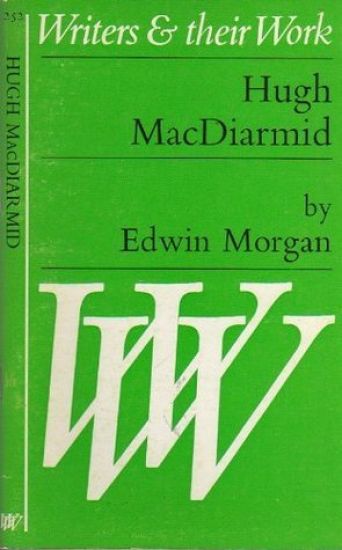
The only book on Hugh MacDiarmid currently in print, this study gives unique focus to the politics of one of modern Scotland's major cultural figures. By examining at length for the first time those places in Scotland that inspired MacDiarmid to produce his best poetry, it shows how the poet's politics evolved from his interaction with the nation, exploring how MacDiarmid discovered a hidden tradition of radical Scottish Republicanism through which he sought to imagine a new Scottish future. Adapting postcolonial theory, this book allows readers a fuller understanding not only of MacDiarmid's poetry and politics, but also of international modernism, and the social history of Scottish modernism. Key features * The first full length study to focus on MacDiarmid's politics * Analyses recently available government files from the National Archives showing that MacDiarmid was watched by the Security Services from 1931 to 1943. This has never appeared before in any book * Draws uniquely on Carcanet's multi-volume MacDiarmid 2000 series * The first critical book to use the 'Red Scotland' typescript in the National Library of Scotland and have access to the recently rediscovered poems collected as The Revolutionary Art of the Future (2003).
Hugh MacDiarmid

Hugh MacDiarmid

John Baglow

McGill-Queen's University Press
1987
sidottu
Baglow shows that this search for justification was a focus for MacDiarmid almost from the start, but that it was only with his development of "synthetic Scots" that he begin to grapple with it directly. While at first the idea of a Scottish essence seemed to promise the spiritual foundation MacDiarmid was seeking, as his poetry developed this idea became less important and he came to see poetry as an unrealizable ideal. This reading of MacDiarmid's poetry, relating it to the modernist movement, will be of value to readers interested in twentieth-century literature.
Hugh Culverhouse and the Tampa Bay Buccaneers

Hugh Culverhouse and the Tampa Bay Buccaneers

Denis M. Crawford

McFarland Co Inc
2011
pokkari
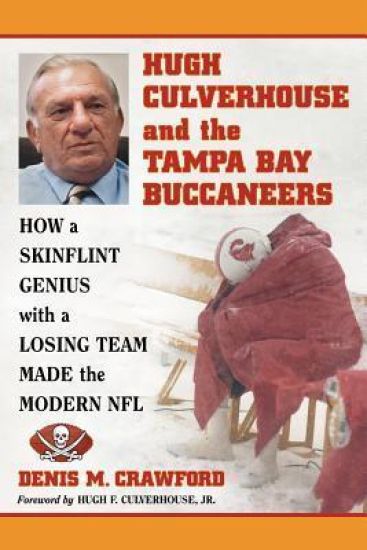
From 1976 until 1994, the Tampa Bay Buccaneers lost far more games than they won. The Bucs' status as a sporting punch line belied the fact that they were led by arguably the most important owner of that era. Known as the "Vice-Commissioner," Hugh F. Culverhouse, Sr., wielded his financial acumen as a weapon, keeping other NFL owners in line through the economic downturn of the 1980s, two work stoppages, and a multimillion dollar lawsuit from a rival league. Culverhouse's near-Dickensian frugality also led, directly and indirectly, to the Steve Young-Joe Montana quarterback controversy; Doug Williams' triumph in Super Bowl XXII; and the largest fourth-quarter collapse in NFL history. Over two dozen interviews with Culverhouse's allies and adversaries inform this thorough and balanced chronicle of the man and his team.
Hugh Lenox Scott, 1853-1934

Hugh Lenox Scott, 1853-1934

Armand S. La Potin

University of Oklahoma Press
2021
sidottu
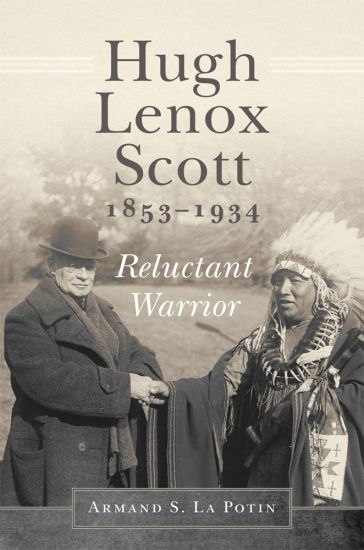
A newly minted second lieutenant fresh from West Point, Hugh Lenox Scott arrived on the northern Great Plains in the wake of the Little Bighorn debacle. The Seventh Cavalry was seeking to subdue the Plains tribes and confine them to reservations, and Scott adopted the role of negotiator and advocate for the Indian “adversaries.” He thus embarked on a career unique in the history of the U.S. military and the western frontier. Hugh Lenox Scott, 1853-1934: Reluctant Warrior is the first book to tell the full story of this unlikely, self-avowed “soldier of peace,” whose career, stretching from Little Bighorn until after World War I, reflected profound historical changes. The taste for adventure that drew Scott to the military also piqued his interest in the tenacity of Native cultures in an environment rife with danger and uncertainty. Armand S. La Potin describes how Scott embraced the lifeways of the Northern Plains peoples, making a study of their cultures, their symbols, and most notably, their use of an intertribal sign language to facilitate trade. Negotiating with dissident bands of Indians whose lands were threatened by Anglo settlers and commercial interests, he increasingly found himself advocating federal responsibility for tribal welfare and assuming the role of “Indian reformer.” La Potin makes clear that “reform” was understood within the context of Scott’s own culture, which scaled “civilization” to the so-called Anglo race. Accordingly, Scott promoted the “civilization” of Native Americans through assimilation into Anglo-American society-an approach he continued in his later interactions with the Moro Muslims of the southern Philippines, where he served as a military governor. Although he eventually rose to the rank of army chief of staff, over time Scott the peacemaker and Indian reformer saw his career stall as Native tribes ceased to be seen as a military threat and military merit was increasingly defined by battlefield experience. From these pages the picture emerges of an uncommon figure in American military history, at once at odds with and defined by his times.
Hugh Lenox Scott, 1853-1934

Hugh Lenox Scott, 1853-1934

Armand S. La Potin

UNIVERSITY OF OKLAHOMA PRESS
2023
nidottu
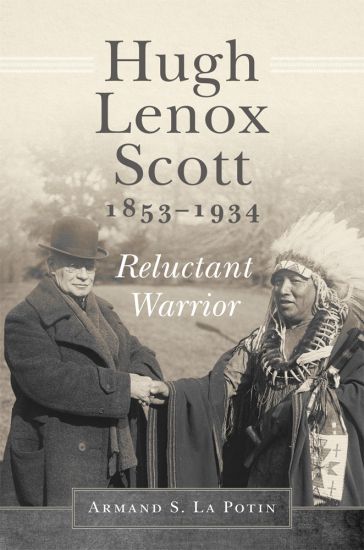
A newly minted second lieutenant fresh from West Point, Hugh Lenox Scott arrived on the northern Great Plains in the wake of the Little Bighorn debacle. The Seventh Cavalry was seeking to subdue the Plains tribes and confine them to reservations, and Scott adopted the role of negotiator and advocate for the Indian “adversaries.” He thus embarked on a career unique in the history of the U.S. military and the western frontier. Hugh Lenox Scott, 1853–1934: Reluctant Warrior is the first book to tell the full story of this unlikely, self-avowed “soldier of peace,” whose career, stretching from Little Bighorn until after World War I, reflected profound historical changes. The taste for adventure that drew Scott to the military also piqued his interest in the tenacity of Native cultures in an environment rife with danger and uncertainty. Armand S. La Potin describes how Scott embraced the lifeways of the Northern Plains peoples, making a study of their cultures, their symbols, and most notably, their use of an intertribal sign language to facilitate trade. Negotiating with dissident bands of Indians whose lands were threatened by Anglo settlers and commercial interests, he increasingly found himself advocating federal responsibility for tribal welfare and assuming the role of “Indian reformer.” La Potin makes clear that “reform” was understood within the context of Scott’s own culture, which scaled “civilization” to the so-called Anglo race. Accordingly, Scott promoted the “civilization” of Native Americans through assimilation into Anglo-American society—an approach he continued in his later interactions with the Moro Muslims of the southern Philippines, where he served as a military governor. Although he eventually rose to the rank of army chief of staff, over time Scott the peacemaker and Indian reformer saw his career stall as Native tribes ceased to be seen as a military threat and military merit was increasingly defined by battlefield experience. From these pages the picture emerges of an uncommon figure in American military history, at once at odds with and defined by his times.

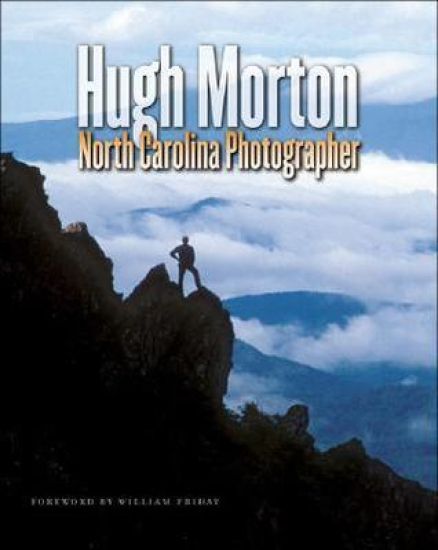
Hugh Morton, North Carolina Photographer

Hugh Morton, North Carolina Photographer

Morton Hugh

The University of North Carolina Press
2006
sidottu
Hugh Morton has seldom been seen in his adult life without a camera around his neck. Much to the benefit of his beloved home state, he has crisscrossed North Carolina, from highlands to lowlands, recording nearly every step along the way. While many of his photographs of the state's people, places, and events were collected in Hugh Morton's ""North Carolina"", this new book showcases a generous collection of his signature wildlife and nature photography and includes a few of the photographer's favorite pictures of people and events that were not included in the first volume. The scenic and nature photographs are organized geographically, from the mountains to the coast. Revealing Morton's curiosity about and love of the natural world, photographs feature woodland creatures, waterfalls, beaches, and more. Some images will be familiar to those who live or travel in North Carolina. Many of the photographs here have been recovered from deep within Morton's personal archive, bringing to print some long-hidden treasures. Consisting of 162 photographs, this collection is a rich and rewarding display of North Carolina's natural bounty as it has evolved before the eyes of one of the state's most popular photographers.
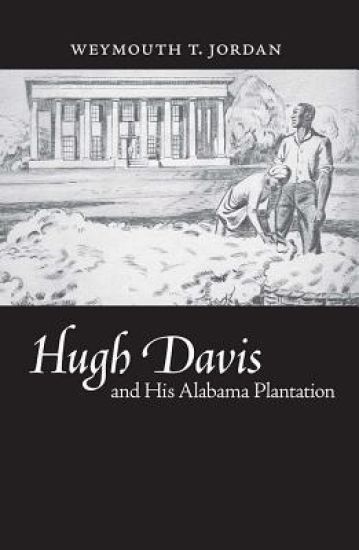
Hugh Davis and His Alabama Plantation

Hugh Davis and His Alabama Plantation

Weymouth Jordan

The University of Alabama Press
2004
nidottu
Ante-bellum Alabama: Town and Country was originally published in 1957 to give the reader insight into important facets of Alabama's antebellum history. Presented in the form of case studies from the pre-Civil War period, the book deals with a city, a town, a planter's family, rural social life, attitudes concerning race, and Alabama's early agricultural and industrial development. Antebellum Alabama's primary interest was agriculture; the chief crop was King Cotton; and most of her people were agriculturists. Her towns and cities came into existence for the express purpose of supplying the agricultural needs of the state and helping to process and distribute farm commodities. Similarly, Alabama's industrial development began with the manufacture of implements for farm use in response to the state's agricultural needs. Rural-agricultural influences dominated the American scene; and in this respect Alabama was typical of both her region and most of the United States. An urbanized-industrial America was for the most part still in the future, though not the too-far-distant-future.