Kirjojen hintavertailu. Mukana 11 244 527 kirjaa ja 12 kauppaa.

Kirjahaku

Etsi kirjoja tekijän nimen, kirjan nimen tai ISBN:n perusteella.

1000 tulosta hakusanalla Irina Levinskaya

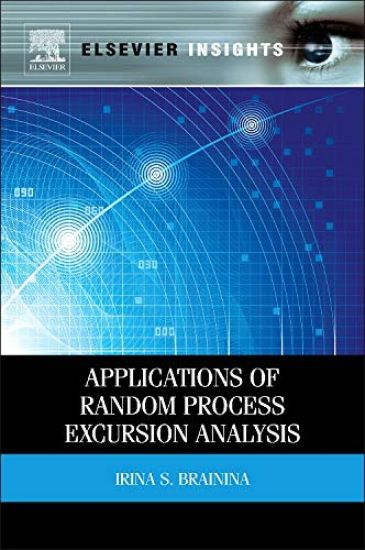
Applications of Random Process Excursion Analysis

Applications of Random Process Excursion Analysis

Irina S. Brainina

Elsevier Science Publishing Co Inc
2013
sidottu
This book addresses one of the key problems in signal processing, the problem of identifying statistical properties of excursions in a random process in order to simplify the theoretical analysis and make it suitable for engineering applications. Precise and approximate formulas are explained, which are relatively simple and can be used for engineering applications such as the design of devices which can overcome the high initial uncertainty of the self-training period. The information presented in the monograph can be used to implement adaptive signal processing devices capable of detecting or recognizing the wanted signals (with a priori unknown statistical properties) against the background noise. The applications presented can be used in a wide range of fields including medicine, radiolocation, telecommunications, surface quality control (flaw detection), image recognition, thermal noise analysis for the design of semiconductors, and calculation of excessive load in mechanics.

Understanding Cancer from a Systems Biology Point of View
Understanding Cancer from a Systems Biology Point of View: From Observation to Theory and Back starts with a basic question, why do we sometimes observe accelerated metastatic growth after resection of primary tumors? Next, it helps readers understand the systemic nature of cancer and how it affects treatment approaches and decisions. The book puts together aspects of cancer that many readers have most likely never combined, using unfamiliar, novel methods. It is a valuable resource for cancer researchers, cancer biologists, mathematicians and members of the biomedical field who are interested in applying systems biology methodologies for understanding and treating cancer.
Modeling Evolution of Heterogeneous Populations

Modeling Evolution of Heterogeneous Populations

Irina Kareva; Georgy Karev

Academic Press Inc
2019
nidottu
Modeling Evolution of Heterogeneous Populations: Theory and Applications describes, develops and provides applications of a method that allows incorporating population heterogeneity into systems of ordinary and discrete differential equations without significantly increasing system dimensionality. The method additionally allows making use of results of bifurcation analysis performed on simplified homogeneous systems, thereby building on the existing body of tools and knowledge and expanding applicability and predictive power of many mathematical models.
Discrete Contact Mechanics with Applications in Tribology

Discrete Contact Mechanics with Applications in Tribology

Irina Goryacheva; Yulia Makhovskaya

Elsevier Science Publishing Co Inc
2022
nidottu
Discrete Contact Mechanics with Applications in Tribology presents new solutions to contact problems for elastic and viscoelastic bodies in normal, sliding, and rolling contact, taking into account effects such as surface microgeometry, adhesion, fluid films, and viscous hysteresis in bulk material or surface layers. These solutions are applied to problems in tribology for modeling contact and friction of bodies with surface microgeometry (rough or textured). The book provides exact mathematical formulations for cases of discrete contact based on classical approaches of contact mechanics, allowing readers to study the influence of different parameters of surface microgeometry on contact characteristics and friction force.The book will help solve problems in modeling contact and friction interaction in cases of discrete character of contact interaction, mutual influence of individual contact spots in contact interaction of elastic and viscoelastic solids, calculating sliding and rolling friction forces as a result of adhesive and viscoelastic mechanisms of dissipation, and more.
Modification of Treaties by Subsequent Practice

Modification of Treaties by Subsequent Practice

Irina Buga

Oxford University Press
2018
sidottu
While treaties can be notoriously difficult to amend by formal means, they must nevertheless be adapted over time in order to remain useful. Herein lies the role of subsequent practice as a key tool for treaty change. Subsequent practice-a well-established means of treaty interpretation-sometimes diverges from the original treaty provision to such an extent that it can no longer be said to constitute an act of interpretation or application. Rather, it becomes, in effect, one of treaty modification. The modification of treaties by subsequent practice extends to all fields of international law, from the law of the sea, environmental law, and investment law, to human rights and humanitarian law. Such modifications can have significant practical consequences, from revising or creating new rights and obligations, to establishing new institutional mechanisms. Determining when and how treaty modification by subsequent practice occurs poses difficulty to legal scholars and dispute settlement bodies alike, and impacts States' expectations as to their treaty obligations. This significant yet underexplored process is the focus of this book. Modification of Treaties by Subsequent Practice proves that subsequent practice can-under carefully defined conditions that ensure strict accordance with the will of the treaty parties-alter, supplement, and terminate treaty provisions or even entire treaty frameworks. It can also generate customary law and fuel regime interaction. Ultimately, this book demonstrates the relevance and dynamism of the process of treaty modification by subsequent practice, emphasizing the need to deal with the issue head on, and explains-on a theoretical and practical level-how it can be identified and dealt with more consistently in the future. The book thus contributes to a deeper understanding of the process of treaty modification by subsequent practice and its continued role in striking the judicious balance between the stability of treaties on the one hand, and the organic evolution of the law on the other.
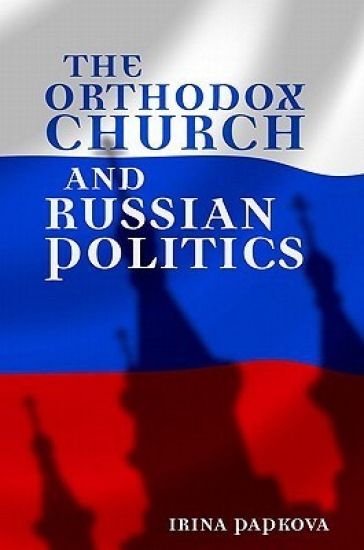
The Orthodox Church and Russian Politics

The Orthodox Church and Russian Politics

Irina Papkova

Oxford University Press Inc
2011
sidottu
This in-depth case study examines the Russian Orthodox Church's influence on federal-level policy in the Russian Federation since the fall of communism. By far more comprehensive than competing works, The Orthodox Church and Russian Politics is based on interviews, close readings of documents--including official state and ecclesiastical publications--and survey work conducted by the author. The analysis balances the Church as an institutional political actor with the government's response to Church demands. Papkova ultimately concludes that the reciprocal relationship between the Church and state is far weaker and less politically important than Western analysts usually believe. Papkova traces the Church's relative failure in mobilizing parishioners, influencing political parties, and lobbying the state, citing the 1997 law limiting religious freedoms as its only significant political win. She attributes much of this weakness to the informal division of the Church into liberal, traditionalist, and fundamentalist factions, which prevents it from presenting a unified front. Providing a fresh insight into the role of the Church in Post-Soviet Russia, the book speaks across disciplines to political science, sociology, anthropology, history, and religious studies.
Ibsen and the Irish Revival

Ibsen and the Irish Revival

Irina Ruppo Malone

Palgrave Macmillan
2010
sidottu
Ibsen and the Irish Revival examines Henrik Ibsen's influence on the Irish Revival and the reception of his plays in turn-of-the-twentieth-century Dublin. It highlights the international dimension of the Irish Literary Revival and offers new perspectives on W.B. Yeats, J.M. Synge, Lennox Robinson, James Joyce, George Moore and Sean O'Casey.
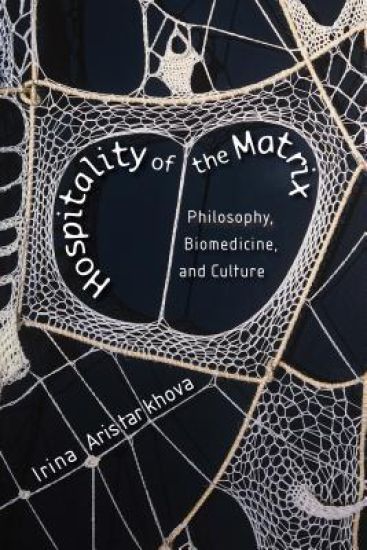
Hospitality of the Matrix

Hospitality of the Matrix

Irina Aristarkhova

Columbia University Press
2012
sidottu
The question "Where do we come from?" has fascinated philosophers, scientists, and artists for generations. This book reorients the question of the matrix as a place where everything comes from (chora, womb, incubator) by recasting it in terms of acts of "matrixial/maternal hospitality" producing space and matter of and for the other. Irina Aristarkhova theorizes such hospitality with the potential to go beyond tolerance in understanding self/other relations. Building on and critically evaluating a wide range of historical and contemporary scholarship, she applies this theoretical framework to the science, technology, and art of ectogenesis (artificial womb, neonatal incubators, and other types of generation outside of the maternal body) and proves the question "Can the machine nurse?" is critical when approaching and understanding the functional capacities and failures of incubating technologies, such as artificial placenta. Aristarkhova concludes with the science and art of male pregnancy, positioning the condition as a question of the hospitable man and newly defined fatherhood and its challenge to the conception of masculinity as unable to welcome the other.
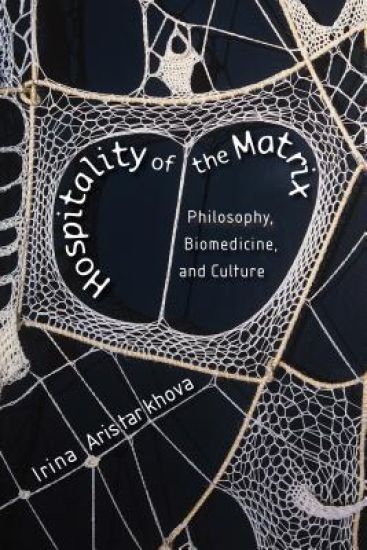
Hospitality of the Matrix

Hospitality of the Matrix

Irina Aristarkhova

Columbia University Press
2012
pokkari
The question "Where do we come from?" has fascinated philosophers, scientists, and artists for generations. This book reorients the question of the matrix as a place where everything comes from (chora, womb, incubator) by recasting it in terms of acts of "matrixial/maternal hospitality" producing space and matter of and for the other. Irina Aristarkhova theorizes such hospitality with the potential to go beyond tolerance in understanding self/other relations. Building on and critically evaluating a wide range of historical and contemporary scholarship, she applies this theoretical framework to the science, technology, and art of ectogenesis (artificial womb, neonatal incubators, and other types of generation outside of the maternal body) and proves the question "Can the machine nurse?" is critical when approaching and understanding the functional capacities and failures of incubating technologies, such as artificial placenta. Aristarkhova concludes with the science and art of male pregnancy, positioning the condition as a question of the hospitable man and newly defined fatherhood and its challenge to the conception of masculinity as unable to welcome the other.
Full Circle

Full Circle

Irina Dimitric

Lulu.com
2018
pokkari
Young Bogdan, a medical student at Graz University, finds himself conscripted into the Austro-Hungarian Army at the outbreak of WWI. Will he escape to neutral Switzerland to avoid having to fight against his own people? This is just one of the tough decisions he will have to make during the four years of war. In this memoir, the author invites her father to talk about his experiences as a young Serb patriot eager to put his life on the line for his people. His love of adventure takes him to Russia, where he witnesses the Revolution of 1917. The book is illustrated with photos of both personal and historic value.
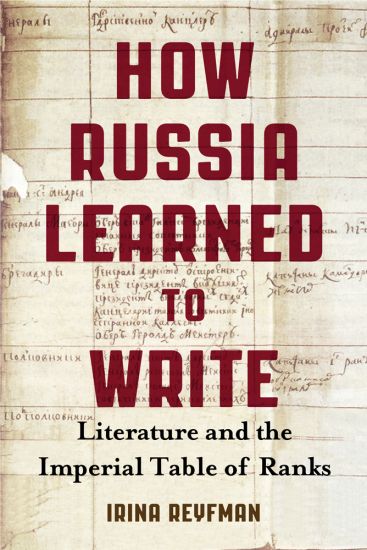
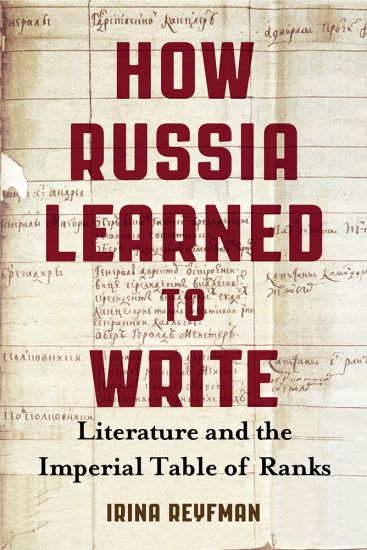
How Russia Learned to Write

How Russia Learned to Write

Irina Reyfman

University of Wisconsin Press
2016
sidottu
In the eighteenth century, as modern forms of literature began to emerge in Russia, most of the writers producing it were members of the nobility. But their literary pursuits competed with strictly enforced obligations to imperial state service. Unique to Russia was the Table of Ranks, introduced by Emperor Peter the Great in 1722. Noblesse oblige was not just a lofty principle; aristocrats were expected to serve in the military, civil service, or the court, and their status among peers depended on advancement in ranks.Irina Reyfman illuminates the surprisingly diverse effects of the Table of Ranks on writers, their work, and literary culture in Russia. From Sumarokov and Derzhavin in the eighteenth century through Pushkin, Gogol, Dostoevsky, and poets serving in the military in the nineteenth, state service affected the self-images of writers and the themes of their creative output. Reyfman also notes its effects on Russia’s atypical course in the professionalization and social status of literary work.
How Russia Learned to Write

How Russia Learned to Write

Irina Reyfman

University of Wisconsin Press
2021
nidottu
In the eighteenth century, as modern forms of literature began to emerge in Russia, most of the writers producing it were members of the nobility. But their literary pursuits competed with strictly enforced obligations to imperial state service. Unique to Russia was the Table of Ranks, introduced by Emperor Peter the Great in 1722. Noblesse oblige was not just a lofty principle; aristocrats were expected to serve in the military, civil service, or the court, and their status among peers depended on advancement in ranks.Irina Reyfman illuminates the surprisingly diverse effects of the Table of Ranks on writers, their work, and literary culture in Russia. From Sumarokov and Derzhavin in the eighteenth century through Pushkin, Gogol, Dostoevsky, and poets serving in the military in the nineteenth, state service affected the self-images of writers and the themes of their creative output. Reyfman also notes its effects on Russia's atypical course in the professionalization and social status of literary work.
Britannia and Muscovy

Britannia and Muscovy

Irina Zagarodnaya

Yale University Press
2006
sidottu
This superbly illustrated book accompanies an exhibition of thirty objects from the exceptional collection of English silver in the Moscow Kremlin Museums, where the world’s greatest surviving group of English sixteenth- and seventeenth-century silver is housed. Much of the silver from this period was melted down during the English Civil War, making the pieces at the Kremlin exceedingly rare and historically important.The silver items—a large water pot with snake-shaped handle and spout, a flat drinking cup, a magnificent flagon shaped like a leopard, and more—exemplify the developing ties between England and Russia. Some pieces were brought to Russia as diplomatic gifts, some were presented by English trading agents, while others were purchased for the Tsar’s Treasury. Setting these silver treasures in fuller context, the catalogue also features precious objects made by Russian craftsmen, a group of English firearms from the Kremlin collection, and portraits, engravings, books, and maps that illuminate the important diplomatic and commercial exchanges that were taking place between the two countries.In addition to essays by Kremlin curators Natalya Abramova, Elena Yablonskaya, and Irina Zagarodnaya, the catalogue will include writings by Paul Bushkovitch, Olga Dmitrieva, Philippa Glanville, Maija Jansson, and Edward Kasinec.Published in association with the Yale Center for British ArtExhibition Schedule:The Gilbert Collection, London (mid-October, 2006 – January 2007)Yale Center for British Art (May 25 – September 10, 2006)
Almanac Chayka 8

Almanac Chayka 8

Irina Chaykovskaya

Lulu.com
2019
pokkari
The Anthology "Seagull" Vol. 8, 2018 (Almanac Chayka) includes selected stories, articles, assays, and poems by over 63 authors from Russia, USA, Ukraine, Germany, France, England, Italy, and Israel. It gathers the best materials published in the online magazine Chayka between June and December 2018. Editor: Irina Chaykovskaya
Post-Soviet Armenia

Post-Soviet Armenia

Irina Ghaplanyan

Routledge
2019
nidottu
Following the collapse of the Soviet Union, Armenia has struggled to establish itself, with a faltering economy, emigration of the intelligentsia and the weakening of civil society. This book explores how a new national elite has emerged and how it has constructed a new national narrative to suit Armenia’s new circumstances. The book examines the importance of the Nagorno-Karabakh conflict with Azerbaijan, considers the impact of fraught relations with Turkey and the impact of relations with other neighbouring states including Russia, and discusses the poorly-developed role of the very large Armenian diaspora. Overall, the book provides a key overview to understanding the forces shaping all aspects of present-day Armenia.
Abstract Cauchy Problems

Abstract Cauchy Problems

Irina V. Melnikova; Alexei Filinkov

CRC Press
2019
nidottu
Although the theory of well-posed Cauchy problems is reasonably understood, ill-posed problems-involved in a numerous mathematical models in physics, engineering, and finance- can be approached in a variety of ways. Historically, there have been three major strategies for dealing with such problems: semigroup, abstract distribution, and regularization methods. Semigroup and distribution methods restore well-posedness, in a modern weak sense. Regularization methods provide approximate solutions to ill-posed problems. Although these approaches were extensively developed over the last decades by many researchers, nowhere could one find a comprehensive treatment of all three approaches. Abstract Cauchy Problems: Three Approaches provides an innovative, self-contained account of these methods and, furthermore, demonstrates and studies some of the profound connections between them. The authors discuss the application of different methods not only to the Cauchy problem that is not well-posed in the classical sense, but also to important generalizations: the Cauchy problem for inclusion and the Cauchy problem for second order equations. Accessible to nonspecialists and beginning graduate students, this volume brings together many different ideas to serve as a reference on modern methods for abstract linear evolution equations.
Biomarkers for Stress in Fish Embryos and Larvae
The present work evaluates the toxic effects of some environmental stressors on fish eggs and larvae and describes the biomarker responses of fish from locations with varying levels of pollution. Development of the main groups of biomarkers is discussed. The book demonstrates general trends and specific peculiarities of biomarker induction in early fish life and their association with the animal’s developmental stages. It addresses responses of fish eggs and larvae to pollution under experimental conditions and presents information obtained from in situ studies.Chapters describe xenobiotics accumulation, anoxia and hypoxia, increasing temperature, eutrophication, and other unfavorable environmental factors, including biotic and abiotic factors, and their impact on fish embryos. They also examine fluctuations in biomarker levels in fish eggs and larvae that have been impacted by climate changes and discuss possible scenarios, especially for fish population size, reproduction, growth, development and biodiversity.