Kirjahaku
Etsi kirjoja tekijän nimen, kirjan nimen tai ISBN:n perusteella.
1000 tulosta hakusanalla Irving P. Herman

A New York Times "Books for Summer Reading" selection Winner of the 2003 National Jewish Book Award for History By the time he died in 1993 at the age of 73, Irving Howe was one of the twentieth century's most important public thinkers. Deeply passionate, committed to social reform and secular Jewishness, ardently devoted to fiction and poetry, in love with baseball, music, and ballet, Howe wrote with such eloquence and lived with such conviction that his extraordinary work is now part of the canon of American social thought. In the first comprehensive biography of Howe's life, historian Gerald Sorin brings us close to this man who rose from Jewish immigrant poverty in the 1930s to become one of the most provocative intellectuals of our time. Known most widely for his award-winning book World of Our Fathers, a rich portrayal of the East European Jewish experience in New York, Howe also won acclaim for his prodigious output of illuminating essays on American culture and as an indefatigable promoter of democratic socialism as can be seen in the pages of Dissent, the journal he edited for nearly forty years. Deeply devoted to the ideal of democratic radicalism and true equality, Howe was constantly engaged in a struggle for decency and basic fairness in the face of social injustice. In the century of Auschwitz, the Gulag, and global inter-ethnic mass murder, it was difficult to sustain political certainties and take pride in one's humanity. To have lived a life of conviction and engagement in that era was a notable achievement. Irving Howe lived such a life and Gerald Sorin has done a masterful job of guiding us through it in all its passion and complexity.

A New York Times "Books for Summer Reading" selection Winner of the 2003 National Jewish Book Award for History By the time he died in 1993 at the age of 73, Irving Howe was one of the twentieth century's most important public thinkers. Deeply passionate, committed to social reform and secular Jewishness, ardently devoted to fiction and poetry, in love with baseball, music, and ballet, Howe wrote with such eloquence and lived with such conviction that his extraordinary work is now part of the canon of American social thought. In the first comprehensive biography of Howe's life, historian Gerald Sorin brings us close to this man who rose from Jewish immigrant poverty in the 1930s to become one of the most provocative intellectuals of our time. Known most widely for his award-winning book World of Our Fathers, a rich portrayal of the East European Jewish experience in New York, Howe also won acclaim for his prodigious output of illuminating essays on American culture and as an indefatigable promoter of democratic socialism as can be seen in the pages of Dissent, the journal he edited for nearly forty years. Deeply devoted to the ideal of democratic radicalism and true equality, Howe was constantly engaged in a struggle for decency and basic fairness in the face of social injustice. In the century of Auschwitz, the Gulag, and global inter-ethnic mass murder, it was difficult to sustain political certainties and take pride in one's humanity. To have lived a life of conviction and engagement in that era was a notable achievement. Irving Howe lived such a life and Gerald Sorin has done a masterful job of guiding us through it in all its passion and complexity.

Irving Harper
Skira Rizzoli
2013
sidottu
An intimate monograph of the professional and personal creations of a midcentury design legend. Irving Harper is the most famous designer you have never heard of. Working as an associate at the office of George Nelson in the 1950s and ’60s, Harper was responsible for such icons of midcentury design as the Marshmallow sofa, the Ball clock, and numerous Herman Miller textile designs. Harper’s unrecognized contribution to this seminal era of design, and his incredible paper sculptures (made in his spare time to "relieve stress"), are presented for the first time in this book. An essay by design critic Julie Lasky introduces Harper’s commercial design work, recognizable designs from graphics to domestic goods to furniture that are still coveted and appreciated today, designed for the offices of Raymond Loewy, George Nelson, and then his own studio Harper + George. The second part of the book documents Harper’s extensive paper sculptures, which have never been exhibited. More than three hundred works fill Harper’s house and barn in Rye, New York, where this array of fantastical people and animal sculptures was created from modest and inexpensive materials as diverse as spaghetti and toothpicks in addition to paper. Images of Harper’s home, filled with furniture and objects of his own design as well as his paper sculptures, offer a rare glimpse into a Modern design enthusiast’s paradise.Offering insight into an important era of American design as well as the prolific output of a creative mind, this book promises to be the first to recognize Irving Harper’s contribution to the field and will appeal to fans of Modern design.
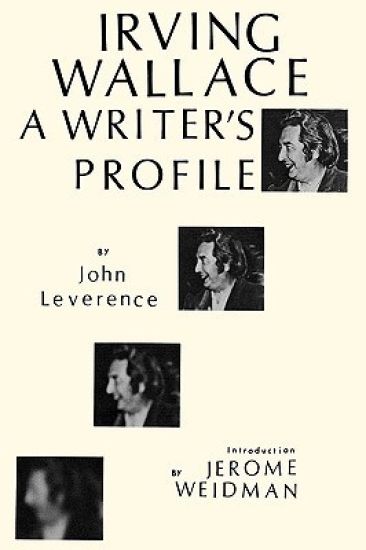
This profile of the man and the writer is an introduction to the personality behind The Chapman Report and The Fan Club. Through correspondence, diaries, manuscript annotations, interviews and other private sources, the profile reveals the man who began as a sports stringer for a Wisconsin newspaper and is now one of the world's most popular novelists.


This work has been selected by scholars as being culturally important and is part of the knowledge base of civilization as we know it.This work is in the public domain in the United States of America, and possibly other nations. Within the United States, you may freely copy and distribute this work, as no entity (individual or corporate) has a copyright on the body of the work.Scholars believe, and we concur, that this work is important enough to be preserved, reproduced, and made generally available to the public. To ensure a quality reading experience, this work has been proofread and republished using a format that seamlessly blends the original graphical elements with text in an easy-to-read typeface.We appreciate your support of the preservation process, and thank you for being an important part of keeping this knowledge alive and relevant.

This work has been selected by scholars as being culturally important and is part of the knowledge base of civilization as we know it.This work is in the public domain in the United States of America, and possibly other nations. Within the United States, you may freely copy and distribute this work, as no entity (individual or corporate) has a copyright on the body of the work.Scholars believe, and we concur, that this work is important enough to be preserved, reproduced, and made generally available to the public. To ensure a quality reading experience, this work has been proofread and republished using a format that seamlessly blends the original graphical elements with text in an easy-to-read typeface.We appreciate your support of the preservation process, and thank you for being an important part of keeping this knowledge alive and relevant.
This work has been selected by scholars as being culturally important and is part of the knowledge base of civilization as we know it.This work is in the public domain in the United States of America, and possibly other nations. Within the United States, you may freely copy and distribute this work, as no entity (individual or corporate) has a copyright on the body of the work.Scholars believe, and we concur, that this work is important enough to be preserved, reproduced, and made generally available to the public. To ensure a quality reading experience, this work has been proofread and republished using a format that seamlessly blends the original graphical elements with text in an easy-to-read typeface.We appreciate your support of the preservation process, and thank you for being an important part of keeping this knowledge alive and relevant.


Irving's Little Black Book: The Perfect Dating Companion for a Handsome Man Named Irving. A secret place for names, phone numbers, and addresses.
Wingman Publishing
Independently Published
2019
nidottu
Keep a record of all the girls that catch your eye

The Pianos I Have Known: The Autobiography Of Irving Fields
Irving Fields; Tony Sachs
Lulu.com
2012
nidottu

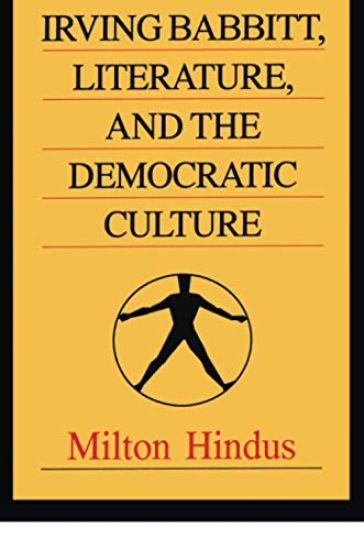
Irving Babbitt, Literature and the Democratic Culture
Routledge
2020
nidottu
This is a sustained inquiry into the thought of the influential scholar and critic Irving Babbitt (1865-1933), intellectual leader of the movement known as the New Humanism. Milton Hindus considers the subjects that most interested Babbitt: ethics, literature, education, and social and political conservatism in the United States. In their most general sense, his concerns were man and his nature as the root of all social order. For Babbitt, efforts to improve social conditions must begin and end with the individual human being.In rejecting notions that society is primarily responsible for moral deficiencies in the individual, or that the individual is bom good only to be corrupted by society, Babbitt places responsibility squarely with the individual. As Hindus shows, Babbitt sees human beings as a mixture of good and evil impulses, shaped by what he called "the inner check." Virtue is thus a result of self-discipline, reinforced and confirmed by habit.Babbitt's thinking, emphasizing as it does proven values and accepted wisdom, calls upon us to advance ourselves by rediscovery of the lessons of the past. Hindus demonstrates that Babbitt has much to offer us as we consider contemporary social and political issues. In contrast to those who emphasize avant-garde postures and fashionable ideologies, as well as those conservative followers of outdated theories and dead-end formulas, Babbitt's reinvigorating spirit inspires new insights.Although there have been a number of studies of Irving Babbitt and the New Humanism, Hindus is singular in his combination of detailed consideration of a number of Babbitt's books with his own essays on contemporary issues, approached in what Hindus calls a Babbitian spirit. Like Babbitt's own writings, this book is addressed to the general reader. It will be of particular importance to teachers of comparative literature and those interested in the connections between literature and social thought and philosophy.