The beautiful landscapes of J. W. Turner are considered to be part of the Romantic movement. Turner was an English painter who loved to paint outside and use natural light. He even painted in the rain In this introduction to Turner and his work, his life, techniques, and major pieces are discussed, including Interior of Salisbury Cathedral and Calias Pier. To conclude the book, an activity invites readers to create a work inspired by what they have learned about Turner throughout the book.
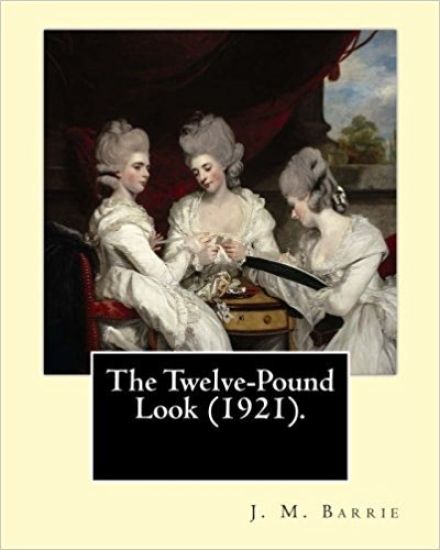
The Little White Bird is a British novel by J. M. Barrie, ranging in tone from fantasy and whimsy to social comedy with dark, aggressive undertones.It was published in November 1902, by Hodder & Stoughton in the UK and Scribner's in the US, although the latter had released it serially in the monthly Scribner's Magazine from August to November. The book attained prominence and longevity thanks to several chapters written in a softer tone than the rest of the book, which introduced the character and mythology of Peter Pan. In 1906, those chapters were published separately as a children's book, Peter Pan in Kensington Gardens.The Peter Pan story began as one chapter and grew to an "elaborate book-within-a-book" of more than one hundred pages during the four years Barrie worked on The Little White Bird. Plot summary: The story is set in several locations; the earlier chapters are set in the town of London, contemporaneous to the time of Barrie's writing, and involving some time travel of a few years, and other fantasy elements, while remaining within the London setting. The middle chapters that later became Peter Pan in Kensington Gardens are set in London's famous Kensington Gardens, introduced by the statement that "All perambulators lead to Kensington Gardens".The Kensington Gardens chapters include detailed descriptions of the features of the Gardens, along with fantasy names given to the locations by the story's characters, especially after "Lock-Out Time", described by Barrie as the time at the end of the day when the park gates are closed to the public, and the fairies and other magical inhabitants of the park can move about more freely than during the daylight, when they must hide from ordinary people.The third section of the book, following the Kensington Gardens chapters, are again set generally in London, though there are some short returns to the Gardens that are not part of the Peter Pan stories. In a two-page diversion in chapter 24, Barrie brings the story to Patagonia, and a journey by ship returning to England at the "white cliffs of Albion"...... Sir James Matthew Barrie, 1st Baronet, OM (9 May 1860 - 19 June 1937) was a Scottish novelist and playwright, best remembered today as the creator of Peter Pan. He was born and educated in Scotland but moved to London, where he wrote a number of successful novels and plays. There he met the Llewelyn Davies boys, who inspired him to write about a baby boy who has magical adventures in Kensington Gardens (included in The Little White Bird), then to write Peter Pan, or The Boy Who Wouldn't Grow Up, a "fairy play" about an ageless boy and an ordinary girl named Wendy who have adventures in the fantasy setting of Neverland. Although he continued to write successfully, Peter Pan overshadowed his other work, and is credited with popularising the name Wendy. Barrie unofficially adopted the Davies boys following the deaths of their parents. Barrie was made a baronet by George V on 14 June 1913, and a member of the Order of Merit in the 1922 New Year Honours. Before his death, he gave the rights to the Peter Pan works to Great Ormond Street Hospital for Children in London, which continues to benefit from them........
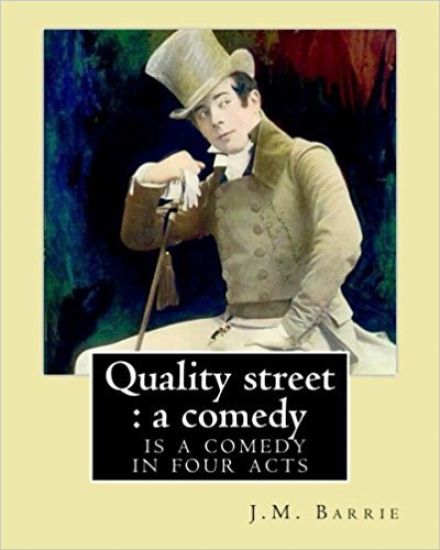
Quality Street is a comedy in four acts by J. M. Barrie, written before his more famous work Peter Pan. The story is about two sisters who start a school "for genteel children". The original Broadway production opened in 1901 and ran for only 64 performances. The show was then produced in London, where it was a hit, running for 459 performances. It was frequently revived until World War II....... Sir James Matthew Barrie, 1st Baronet, OM (9 May 1860 - 19 June 1937) was a Scottish novelist and playwright, best remembered today as the creator of Peter Pan. He was born and educated in Scotland but moved to London, where he wrote a number of successful novels and plays. There he met the Llewelyn Davies boys, who inspired him to write about a baby boy who has magical adventures in Kensington Gardens (included in The Little White Bird), then to write Peter Pan, or The Boy Who Wouldn't Grow Up, a "fairy play" about an ageless boy and an ordinary girl named Wendy who have adventures in the fantasy setting of Neverland. Although he continued to write successfully, Peter Pan overshadowed his other work, and is credited with popularising the name Wendy. Barrie unofficially adopted the Davies boys following the deaths of their parents. Barrie was made a baronet by George V on 14 June 1913, and a member of the Order of Merit in the 1922 New Year Honours. Before his death, he gave the rights to the Peter Pan works to Great Ormond Street Hospital for Children in London, which continues to benefit from them.
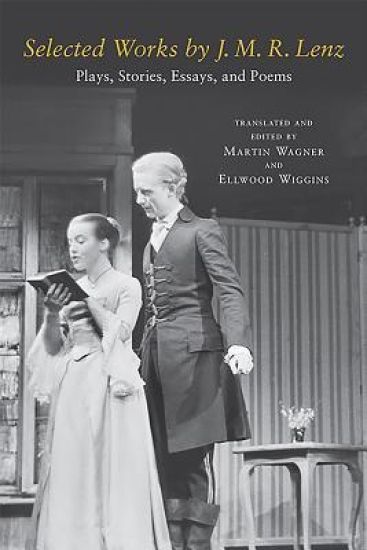
First representative English collection of the Sturm und Drang writer Lenz, suited for the classroom and anyone interested in German literature, the European Enlightenment, or the theory and practice of theater. Jakob Michael Reinhold Lenz (1751-1792) is, after Goethe, the most important writer of the German Sturm und Drang. Crucial in the reinvention of German literature through the reception of Shakespeare, his works contain a scathing critique of the ethical, political, and sexual regimes then prevailing in German and Eastern European territories. Both aesthetically and politically, Lenz strongly influenced later German writers - most notably Georg Büchner and Bertolt Brecht. In Germany, Lenz is still widely read and performed. Given his importance and lasting reception, it is surprising that many of his texts are not available in English. While his best-known dramas have been translated, many of his essays have not, and none of his stories or poems have been. This is especially astonishing given the growth of English-language Lenz scholarship over recent decades. This volume contains new - and, in many cases, first - English translations of Lenz's most important plays, stories, essays, and poems. It is the first representative English collection of Lenz's works. Providing reliable translations of Lenz's key writings and succinct glosses of historical and literary references, this book is a valuable resource for classroom use and for anyone interested in German literature, the European Enlightenment, or the theory and practice of theater. Martin Wagner is Assistant Professor of German at the University of Calgary. Ellwood Wiggins is Assistant Professor of German at the University of Washington.