Kirjojen hintavertailu. Mukana 12 458 065 kirjaa ja 12 kauppaa.

Kirjahaku

Etsi kirjoja tekijän nimen, kirjan nimen tai ISBN:n perusteella.

525 tulosta hakusanalla Jaakko Teppo

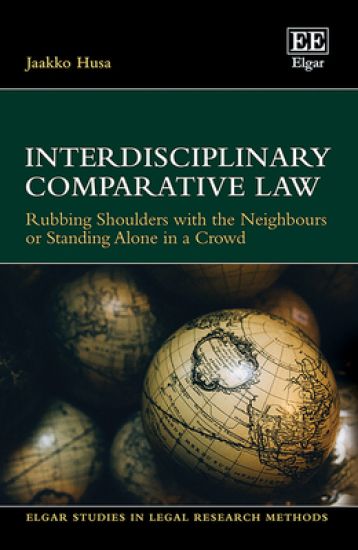
Interdisciplinary Comparative Law

Interdisciplinary Comparative Law

Jaakko Husa

EDWARD ELGAR PUBLISHING LTD
2022
sidottu
Comparative law scholars have long recognised the importance of looking beyond legal texts and incorporating interdisciplinary methods into the study of law, yet in practice such use of non-legal methods has remained modest. Interdisciplinary Comparative Law illuminates why the doctrinal approach to legal research has retained its strong position, offering a critical analysis of the difficulties of interdisciplinarity.Incisive and ambitious in scope, the book highlights why the comparative study of law benefits from employing the methods of other disciplines. Chapters explore the various ways in which different fields can learn from each other, taking a deep dive into the respective studies of legal history, linguistics, literature, economics, social theory, and international law. The result is a vibrant cross-section of the contrasts and parallels between the practices of law and other areas of research, demonstrating which are the easiest for comparatists to grasp and implement, and which present obstacles for the application of non-legal methods. This cutting-edge book is an essential read for advanced students and scholars of law and legal studies. Its diagnosis of interdisciplinarity as both a boon and bane in the study of law will be of especial interest to comparative law scholars.

The Constitution of Finland

The Constitution of Finland

Jaakko Husa

Hart Publishing
2010
nidottu
This book deals with the living Constitution of Finland, with an emphasis on constitutional history, culture, and practice. 'Culture' here refers to the cognitive long-term social or mental structure which makes it possible for politicians, civil servants, judges, and lawyers to grasp the constitutional environment in which they exist. Finland is a small modern, democratic Nordic country with a politically stable welfare system and a constitutional history dating back to the 1700s which contains remnants of Swedish rule, Russian rule, and the period of independence since 1917. It also contains several inner tensions: parliamentarism versus presidentialism, a high level of constitutionalism versus a virtual lack of constitutional judicial review, and a formally rigid but actually flexible constitution. The book offers a realistic but critical overview of the Finnish constitution, while also discussing fundamental questions about the very nature of constitution and constitutionalism. In addition, the constitutional effect of the EU and the European Convention on Human Rights are discussed and, where appropriate, a specific comparative dimension is added. The book is written in an uncomplicated manner and is aimed at those not familiar with the system, providing an introduction and first orientation without excessive detail. Each chapter concludes with a list of further reading and relevant websites.
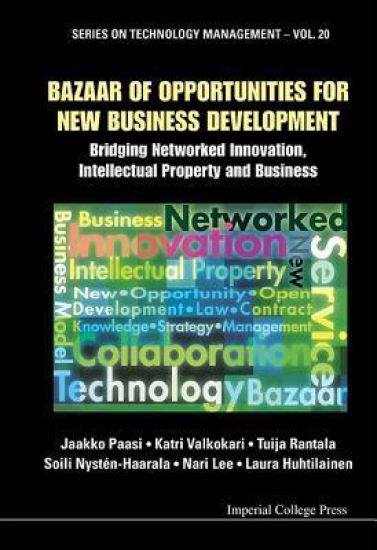
Bazaar Of Opportunities For New Business Development: Bridging Networked Innovation, Intellectual Property And Business

Bazaar Of Opportunities For New Business Development: Bridging Networked Innovation, Intellectual Property And Business

Jaakko Paasi; Katri Valkokari; Tuija Rantala; Soili Nysten-haarala; Nari Lee; Laura Huhtilainen

Imperial College Press
2012
sidottu
Bazaar of Opportunities for New Business Development goes beyond the paradigm of open innovation and underlines the variety of opportunities that firms may have in innovation and new business development with external actors. This book shows readers that firms can interact, innovate, and do business with different known and unknown actors, both formally and informally, and use different levels of openness within interorganizational innovation processes. External actors, however, also mean additional risks for the firm that they should manage. The subtitle of book, Bridging Networked Innovation, Intellectual Property and Business, addresses the guidance and perspectives that the book will provide in order to better prepare the reader for innovation with external actors.Bazaar of Opportunities has a multidisciplinary approach to the subject, bringing innovation, business, legal and network management perspectives together. The findings are based on state-of-the-art practices of innovative firms in Europe, empirical data collected through interviews and case studies. Through this multidisciplinary approach and the empirical findings, the reader may gain insight on how to be successful in open and networked innovation.
Workbook For Opening Innovation: Bridging Networked Business, Intellectual Property And Contracting

Workbook For Opening Innovation: Bridging Networked Business, Intellectual Property And Contracting

Jaakko Paasi; Katri Valkokari; Henri Hytonen; Laura Huhtilainen; Soili Nysten-haarala

Imperial College Press
2012
sidottu
Workbook for Opening Innovation — Bridging Networked Business, Intellectual Property and Contracting focuses on the implementation of phenomena, theories and ideas presented in the book Bazaar of Opportunities for New Business Development — Bridging Networked Innovation, Intellectual Property and Business. In these two books we go beyond the paradigm of open innovation and underline the variety of opportunities that firms may have in innovation and new business development with external actors.This workbook presents practical tools for managers to utilize so that they are better prepared for innovation with external actors and, accordingly, they can then successfully implement open and networked innovation in their business. The workbook includes a guide for collaboration within networked innovation and business, a guide for making IP strategy, and a guide for contracting (including checklists supporting the contracting).
The Subjective

The Subjective

Jaakko Saaristo

Catsoft Ltd
2020
pokkari
The Subjective is an existential linguistic study that aims to clarify the meaning of the subjective and objective domains of life and to ultimately understand why our world tends to disdain human subjectivity and remains fixated on the objective. It builds upon the work of Wittgenstein and Kierkegaard, highly original and subjective thinkers that are often revered yet considered mysterious in academic setting. The text strives to make these thinkers approachable by also non-professional philosophers, yet the focus remains on using the method of linguistic analysis for a complete scrutiny over what it means for something to be subjective or objective.Apart from the topic of subjectivity, other themes under scrutiny are meaning, ethics and morality, reason, logic, truth, religion and technology.The text being existential means that there is a conscious aim to look at problems from the full moral perspective of the individual subject, as opposed to being sterilized into questions of syntactic correctness. There is, however, an equally conscious aim to resist reducing problems into subjective opinions of the author; the common ground for inspecting the meaning of something is our shared human language that we need to approach from the perspective that words and expressions carry a meaning that ideally can be shared by anybody and everybody. The conception of meaning is firmly grounded on Wittgenstein's "meaning as use", as opposed to the common metaphysical worldview where words denote objects.The book is constructed in three parts that could be summarized as theory, analysis and politics.
The Subjective

The Subjective

Jaakko Saaristo

Catsoft Ltd
2020
sidottu
The Subjective is an existential linguistic study that aims to clarify the meaning of the subjective and objective domains of life and to ultimately understand why our world tends to disdain human subjectivity and remains fixated on the objective. It builds upon the work of Wittgenstein and Kierkegaard, highly original and subjective thinkers that are often revered yet considered mysterious in academic setting. The text strives to make these thinkers approachable by also non-professional philosophers, yet the focus remains on using the method of linguistic analysis for a complete scrutiny over what it means for something to be subjective or objective.Apart from the topic of subjectivity, other themes under scrutiny are meaning, ethics and morality, reason, logic, truth, religion and technology.The text being existential means that there is a conscious aim to look at problems from the full moral perspective of the individual subject, as opposed to being sterilized into questions of syntactic correctness. There is, however, an equally conscious aim to resist reducing problems into subjective opinions of the author; the common ground for inspecting the meaning of something is our shared human language that we need to approach from the perspective that words and expressions carry a meaning that ideally can be shared by anybody and everybody. The conception of meaning is firmly grounded on Wittgenstein's "meaning as use", as opposed to the common metaphysical worldview where words denote objects.The book is constructed in three parts that could be summarized as theory, analysis and politics.
"This Is My Reservation, I Belong Here"

"This Is My Reservation, I Belong Here"

Jaakko Puisto

Salish Kootenai College
2016
pokkari
In the 1950s, the Confederated Salish and Kootenai Tribes were high on the list of Indian tribes to be terminated as a tribal and Native community. Jaakko Puisto’s history describes the struggle of the Confederated Salish and Kootenai Tribes to avoid congressional termination of the Flathead Indian Reservation in western Montana. He tells of the debate within the tribes and their work to build political and public support. With the help of the Montana congressional delegation, the bill to terminate the reservation was defeated. Puisto compares the experience of the Confederated Salish and Kootenai Tribes with that of other tribes, such as the Klamath and the Menominee Indians, who were terminated in the 1950s. Termination proved to be a disaster for the tribes who experienced it. In the 1970s, the tribes again debated termination, but this time the push to terminate came from within the tribes. Puisto describes how the tribes decided against the termination proposals and then went on to assert their political and economic sovereignty. The tribes survived the challenges of the twentieth century to become important political and economic players in twenty-first-century Montana.
Why Dialogue Does Cure

Why Dialogue Does Cure

Jaakko Seikkula

Springer International Publishing AG
2025
sidottu
This book presents the core elements of Open Dialogue – an innovative system of mental health care initially developed in Western Lapland, Finland, and spread into about 40 countries – and explains why dialogic practice can be so effective in the treatment of difficult mental health crises. As Dr. Seikkula explains in this book, Open Dialogue is both a way of organizing psychiatric care and a form of dialogic psychotherapy. The basic idea behind Open Dialogue is that discussions with the client seeking help, their family and other social networks are open to all. Nothing about the client's care is discussed without his or her presence. In addition, the basic idea of Open Dialogue is that clinicians work together as a team, participating in all the therapy meetings where the problems that led to the client's need for help are discussed. Over the last couple of decades, the distance between the humanistic dialogical approach and conventional treatment has only increased. So, the aim of this book is to shorten this distance by describing in a concise way why dialogic practice can be so effective to treat challenging mental health conditions, such as psychosis. Dr. Seikkula explains why in dialogic practice it is possible to achieve a recovery that cannot be imagined in conventional psychiatry. In other words: why dialogue does cure. Why Dialogue Does Cure: Explaining What Makes Dialogue Unprecedentedly Effective in Difficult Crises will be a mandatory reference for clinical psychologists, psychiatrists, psychotherapists, occupational therapists, mental health nurses, social workers and all mental health professionals interested in learning about the nuts and bolts of the Open Dialogue approach and adopting a system of care that does not focus on eliminating the symptoms of the one in need for help, but on meeting the full human.
Nettverksdialoger

Nettverksdialoger

Jaakko Seikkula; Tom Erik Arnkil

Universitetsforlaget
2007
nidottu
Boken handler om møtets betydning. Møtene mellom klienten, klientens nettverk og de profesjonelle, i psykososialt arbeid. Forfatterne har forsket på og arbeidet med å utvikle nettverksdialoger gjennom et par tiår. Seikkula gjennom sitt arbeid i psykiatrien, og Arnkil gjennom studier av multiprofesjonelt arbeid med barn, pårørende og familier med sosialt relaterte problemer. I denne boken beskriver og analyserer de Åpne samtaler, en tilnærming utviklet av Seikkula og hans kolleger, samt Anticiperende samtaler (på norsk oversatt til Foregripende dialog) som er en tilnærming utviklet av Arnkil og hans kolleger.Forfatterne bruker sin egen erfaringer som grunnlag for mer generelle refleksjoner over dimensjonen eller mulighetene i samtaleformen. Forfatternes hovedpoeng er at med en mer ydmyk og dialogisk tilnærming blir den profesjonelle samtalen en helt annen. Ressursene i klientens sosiale nettverk aktiveres når de involverte blir hørt og lyttet til. På en fascinerende måte klarer de å beskrive hvordan man kan etablere og opprettholde dialogen i store kriser og krevende behandlingssituasjoner.I bokens siste del diskuteres hvordan forskningen aktivt kan bidra til å utvikle nettverksdialogene.Boken er aktuell for alle som utdanner seg eller arbeider innenfor psykisk helsearbeid, helse- og sosialtjenesten eller utdanningssektoren.