Kirjojen hintavertailu. Mukana 11 342 296 kirjaa ja 12 kauppaa.

Kirjahaku

Etsi kirjoja tekijän nimen, kirjan nimen tai ISBN:n perusteella.

1000 tulosta hakusanalla Jacques Derrida

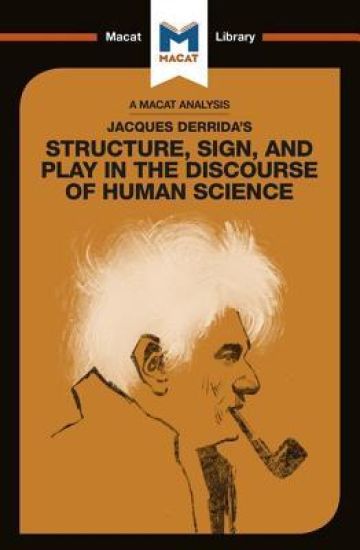
An Analysis of Jacques Derrida's Structure, Sign, and Play in the Discourse of the Human Sciences
Jacques Derrida’s Structure, Sign, and Play is one of the most controversial and influential philosophical texts of the 20th century. Delivered at a conference on structuralism at Johns Hopkins, the lecture took aim at the critical and philosophical fashions of the time and radically proposing a world in which meaning cannot be pinned down or traced to an origin, but instead is continuously shifting, fleeting, and open to play. Hailed by many as a watershed in philosophy and literary theory, Derrida’s lecture has shaped both disciplines. At once dense, brilliant, and humorous, it is a crucial read for anyone interested in questioning our natural assumptions about meaning in the world.
An Analysis of Jacques Derrida's Structure, Sign, and Play in the Discourse of the Human Sciences
Jacques Derrida’s Structure, Sign, and Play is one of the most controversial and influential philosophical texts of the 20th century. Delivered at a conference on structuralism at Johns Hopkins, the lecture took aim at the critical and philosophical fashions of the time and radically proposing a world in which meaning cannot be pinned down or traced to an origin, but instead is continuously shifting, fleeting, and open to play. Hailed by many as a watershed in philosophy and literary theory, Derrida’s lecture has shaped both disciplines. At once dense, brilliant, and humorous, it is a crucial read for anyone interested in questioning our natural assumptions about meaning in the world.
Soziologisch denken mit Jacques Derrida

Soziologisch denken mit Jacques Derrida

Martin Eldracher; Frank Meyhöfer

Springer Fachmedien Wiesbaden
2023
nidottu
Das Buch geht systematisch der Frage nach, wie das Denken Jacques Derridas für die soziologische Theoriebildung und Gesellschaftskritik fruchtbar gemacht werden kann. Dabei versucht es ersichtlich zu machen, wie Identitäten und Normen auf ihr ausgeschlossenes Anderes hin geöffnet werden können. Es richtet sich an interessierte Leser*innen der Soziologie, indem einerseits Derridas philosophische Denkbewegungen zur Sprache gebracht und andererseits ein soziologischer Übersetzungsprozess vollführt wird. Auf welch vielfältige Weise lässt sich innerhalb der Soziologie und auch der politischen Theorie an die Dekonstruktion anschließen? Eine Hierarchiekritik und eine Offenlegung geschlechtlich markierter Machtverhältnisse werden dabei ebenso eine Rolle spielen, wie eine dekonstruktive Befragung sozialer Gründungsszenen und eine soziologische Perspektivierung von Erfindung, Gabe und Gastfreundschaft. Soziologisch denken mit Jacques Derrida umfasst nicht den Entwurf einer wasserdichten Theorie, sondern eine Sensibilisierung für die Instabilität und Spannungen der sozialen Welt.
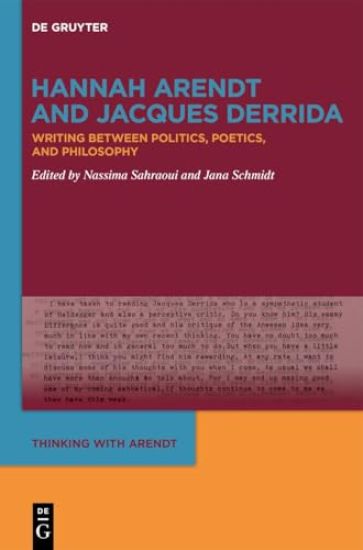
Hannah Arendt and Jacques Derrida
The collection Hannah Arendt and Jacques Derrida: Writing between Politics, Poetics, and Philosophy addresses the convergence of insight in the works of two of the most influential intellectuals of the 20th century. Both Arendt and Derrida have played a decisive role in reorienting the concerns and methods of philosophy, political theory, and literary studies in recent decades, with implications that extend across the humanities. This volume is the first collection of readings on the relationship between the two thinkers from an interdisciplinary perspective that encompasses political and critical theory, aesthetics, literary theory, and philosophy. It presents a wealth of approaches for thinking about the pressing ethical and political questions that their work raises. Despite notable differences in style, approach, frame of reference, and disciplinary background Arendt and Derrida share a common attempt to challenge the predominant methods and questions of philosophy in order to develop a radically new approach to politics, language, and textual interpretation. Today, the reception of Arendt’s thought has moved beyond political theory and expanded into other areas, including literary studies, while Derrida’s writings are reverberating in a growing number of disciplines and outside the academy in activism, art, and human rights discourse. As they disrupt the borders of their respective fields, surprising resonances as well as productive dissonances, begin to emerge in their re-reading of the concepts of sovereignty and democracy, justice and judgment, inheritance, the relations of law to violence, language and the “mother tongue,” metaphor, poetry and poetic writing, and the peculiar realm of the in-between. Most profoundly, the current volume argues, Derrida and Arendt’s respective philosophical projects cross paths in their shared effort to write, rewrite and deconstruct the political. This collection of essays proposes that reading Arendt and Derrida side by side is not only justified, but urgently needed because both thinkers open philosophy to its other and to the worldly realm of living, with the ultimate aim of rethinking what we mean by politics, language, and writing. In turning toward aesthetics and the imaginary, Arendt and Derrida seek to further modes of thinking—“difference-thinking,” “non-tyrannical thinking”—that are political precicely because they are plural. Together, the essays collected in Hannah Arendt and Jacques Derrida: Writing between Politics, Poetics, and Philosophy demonstrate that their as-yet-unwritten dialogue yields decisive ways of theorizing our present moment of global crisis and transformation. Joining together internationally renowned scholars as well as emerging researchers from all over the globe, including Peg Birmingham, Robert Eaglestone, Matthias Flatscher, Jennifer Gaffney, Bonnie Honig, Jen Hui Bon Hoa, James Martel, Nassima Sahraoui, Jana Schmidt, and Magdalena Zolkos, this volume offers a wide-ranging discussion of the intersections of Arendt and Derrida’s work.
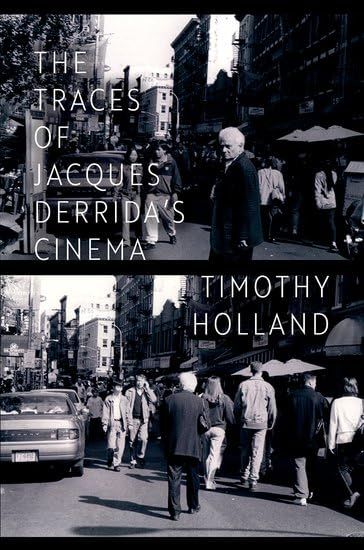
The Traces of Jacques Derrida's Cinema

The Traces of Jacques Derrida's Cinema

Timothy Holland

OXFORD UNIVERSITY PRESS INC
2024
sidottu
Situated at the intersection of film and media studies, literary theory, and continental philosophy, The Traces of Jacques Derrida's Cinema provides a trenchant account of the role of cinema in the oeuvre of one of the most influential philosophers of the twentieth century, Jacques Derrida (1930-2004). The book is animated by Derrida's self-confessed passion for the movies, his reluctance to write about film despite the range of his corpus, and the generative encounters arising between his legacy and the field of film and media studies as a result. Given the expanse of its references, interdisciplinarity, and consideration of Derrida's approach to the experience of both spectatorship and the act of being filmed, The Traces of Jacques Derrida's Cinema contributes to the ongoing close analyses of the philosopher's work while also providing a rigorous introduction to deconstruction. Author Timothy Holland interweaves historical and speculative modes of research and writing to articulate the peripheral-yet surprisingly crucial-place of the cinematic medium for Derrida and his philosophical enterprise. The outcome is a meticulously detailed survey of the centers and margins of Derrida's oeuvre that include forays into such terrain as: his notable appearances in films; an unrealized project on cinema and belief that Derrida proposed in a 2001 interview; the correspondences between the strategies of deconstruction and the traditions, homecomings, and wordplay of David Lynch's cinematic media; and the questions wedded to the future of film studies amid the vicissitudes of the modern, virtual university. Ultimately, Holland pursues the thinking activated by the flickering of Derrida's cinema-not only the absence and presence of film in Derrida's professional and personal life, but also the rigor of academic discourse and the pleasures of the movies, ghosts and technology, religious faith and scientific knowledge, and ruination and survival-as a critical chance for reflection.