Kirjojen hintavertailu. Mukana 12 390 323 kirjaa ja 12 kauppaa.

Kirjahaku

Etsi kirjoja tekijän nimen, kirjan nimen tai ISBN:n perusteella.

262 tulosta hakusanalla Jamgon Mipham

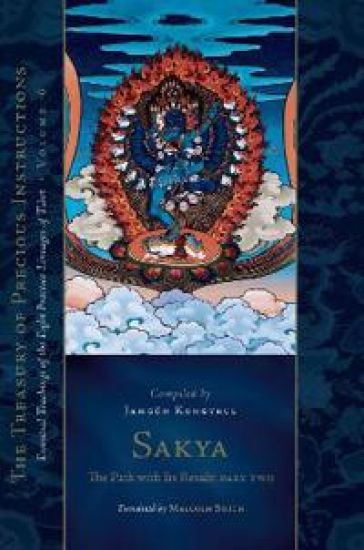
Sakya: The Path with Its Result, Part Two

Sakya: The Path with Its Result, Part Two

Malcolm Smith; Jamgon Kongtrul Lodro Taye

SHAMBHALA PUBLICATIONS INC
2023
sidottu
A collection of liturgical and instructional practice texts on the Eight Ancillary Path Cycles of the Sakya lineage of Tibetan Buddhism, compiled by one of Tibet's greatest Buddhist masters. The Treasury of Precious Instructions by Jamg n Kongtrul Lodr Taye, one of Tibet's greatest Buddhist masters, is a shining jewel of Tibetan literature, presenting essential teachings from the entire spectrum of practice lineages that existed in Tibet. In its eighteen volumes, Kongtrul brings together some of the most important texts on key topics of Buddhist thought and practice as well as authoring significant new sections of his own. Volumes in this series may be engaged as practice manuals while also preserving ancient teachings significant to the literature and history of world religions. Volume 6 of the series, Sakya: The Path with Its Result, Part Two, presents a selection of teachings and practices from the Eight Ancillary Path Cycles of the Sakya tradition of Tibetan Buddhism. The Sakya lineage derives from Virūpa, Dombi Heruka, and other Indian masters, or mahāsiddhas, and passes through Gayadhara and his Tibetan disciple Drokmi Lotsāwa Śākya Yeshe (992-1072). The practice tradition centers around the teaching and transmission of the Hevajra Tantra and its subsidiary texts. This second volume of Sakya texts contains oral instructions transmitted to Drokmi Lotsāwa by the early eleventh-century Indian masters, Ācārya Vīravajra, Mahāsiddha Amoghavajra, Paṇḍita Praj āgupta of Oḍḍiyāna, and Paṇḍita Gayadhara. These texts broaden our understanding of how mahāmudrā, the teaching on the nature of mind, is understood and practiced in the Sakya school.
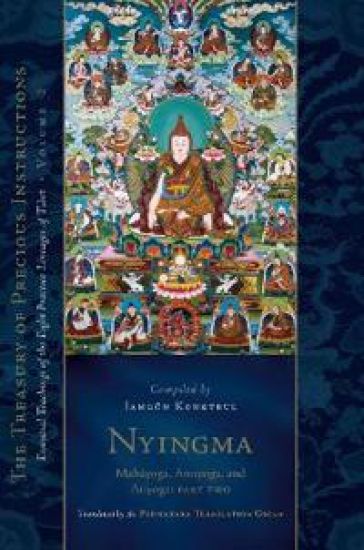
Nyingma: Mahayoga, Anuyoga, and Atiyoga, Part Two

Nyingma: Mahayoga, Anuyoga, and Atiyoga, Part Two

Padmakara Translation Group; Jamgon Kongtrul Lodro Taye

SHAMBHALA PUBLICATIONS INC
2024
sidottu
This collection of texts and commentaries from the Nyingma tradition of Tibetan Buddhism on Dzogchen, or Great Perfection teachings, which introduce us to our most basic nature--the clear and pristine awareness that is the nature of the mind. The Treasury of Precious Instructions, compiled by Jamg n Kongtrul Lodr Taye, one of Tibet's greatest Buddhist masters, is a shining jewel of Tibetan literature, presenting essential teachings from the entire spectrum of practice lineages that existed in Tibet. In its eighteen volumes, Kongtrul brings together some of the most important texts on key topics of Buddhist thought and practice as well as authoring significant new sections of his own. Teachings and practices of the Nyingma lineage, the first of the eight lineages, are presented in the first and second volumes of the series, the second one of which is translated here. These texts are all related to the three yogas: Mahāyoga, Anuyoga, and Atiyoga. The first Nyingma volume includes works that are representative of the first two yogas, while this volume focuses especially on those belonging to the "pith-instruction class," specifically those related to the unsurpassed secret section--the Heart Essence, or Nyingtik. According to the understanding of the Nyingma school, the most profound tenet of the Buddha's teachings is that within the mind of every being--as its bedrock, fundamental stratum, or element--lies the buddha nature. The teachings of this volume each present this essential tenet in a variety of ways and are composed by various Tibetan and Indian masters, including the Buddha, Garab Dorje, Ma juśrīmitra, Śrīsiṃha, J ānasūtra, Padmasambhava, Longchen Rabjam, and Jamgon Kongtrul Lodr Taye.
Jameon's Closet

Jameon's Closet

Shauna Havlina Lmft; Leanne Richter Lmft

Jameon's Closet
2018
nidottu
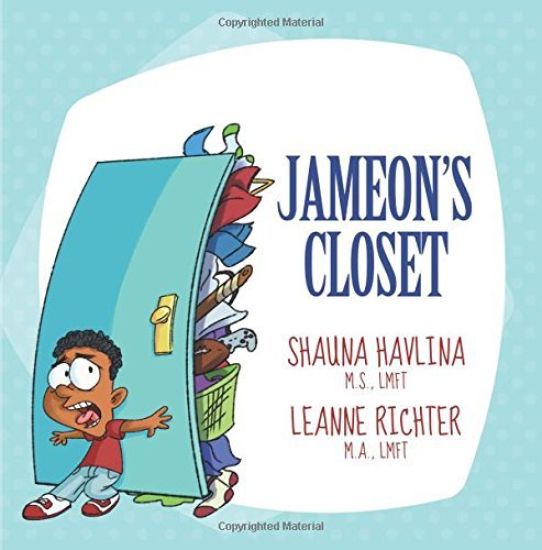
Jameon's Closet is a story written to help children acknowledge and respect their feelings...even the hard ones. It uses humor and everyday life to gently and non-threateningly expose children to the importance of appropriately expressing feelings. The clever use of the closet as a metaphor addresses a familiar and common experience many children have when confronted with overwhelming feelings. The authors invite children to engage in a process of cleaning as they go, little by little, which lends hope to an otherwise large goal. As children, and adults alike, embrace the important message of Jameon's Closet, we can expect maturity and well-being for all. Ceth Ashen, PhD Clinical Psychologist BOOK REVIEW https: //readersfavorite.com/book-review/jameons-closet Reviewed by Jack Magnus for Readers' Favorite Jameon's Closet is an educational children's picture book written by Shauna Havlina and Leanne Richter. Jameon is not sure how he's going to clean out that closet in his bedroom. If it were an ordinary closet, he'd have no problem, but he's frightened of even opening the door to look inside. You see, he's been putting dirty socks and t-shirts, empty candy wrappers and anything else he didn't want to put or throw away inside that closet. Jameon's bedroom always looked so neat and tidy that his grandma would actually let him have extra time to play his games, but eventually she found out about the closet. All those stinky socks and t-shirts, combined with the fact that he had no clean socks left at all, made her suspicious. Now she wants that closet cleaned out. She's going to make it a bit easier for Jameon though. Grandma knows a guy named Jon, who is pretty good at figuring out how to clean closets. Jon's a counselor, and he showed Jameon how they could fix that closet just a little bit at a time -- and it worked Richter and Havlina are licensed marriage and family therapists who've worked with traumatized kids and their families for over ten years. Their story, Jameon's Closet, provides kids and their caregivers with a helpful metaphor for helping kids release long suppressed feelings and emotions in slow, supportive and contained processes. The story explains to kids how storing up their memories and feelings is similar to Jameon's awful closet. The illustrations provided are bright, funny and lively, and they work perfectly with the upbeat and positive message of the story. Jameon's Closet is most highly recommended.
Jamón and Halal

Jamón and Halal

Christina Civantos

Michigan Publishing Services
2022
nidottu
Contemporary Spain reflects broader patterns of globalization and has been the site of tensions between nationalists and immigrants. This case study examines a rural town in Spain’s Andalucía in order to shed light on the workings of coexistence. The town of Órgiva’s diverse population includes hippies from across Europe, European converts to Sufi Islam, and immigrants from North Africa. Christina Civantos combines the analysis of written and visual cultural texts with oral narratives from residents. In this book, we see that although written and especially televisual narratives about the town highlight tolerance and multiculturalism, they mask tensions and power differentials. Toleration is an ongoing negotiation, and this book shows us how we can identify the points of contact that create robust, respect-based tolerance. “This is a book that is both a personal account and a rigorous academic study. It is a model for the kind of engaged humanistic work we are now beginning to see as a hallmark of the post-theory moment, and one that remembers the hard lessons of ethnographic fieldwork as well as the challenging foundational work from philosophically-tinged theory.” —Debra A. Castillo, Cornell University “Filled with rich descriptions and interwoven personal anecdotes of both Civantos and her interlocuters that complement scholarly analysis.” —Jessica R. Boll, Carroll University
Jamon Cordado

Jamon Cordado

Marc-Henri Lamande

Ardavena
2023
pokkari
"Par terre l'imperm able est gris. Je d cris clairement: j'aper ois une cravate, il fallait qu'il ait toute la panoplie. Oui, clairement, je me souviens de motifs agricoles sur cette cravate, des gerbes. Pas des tournesols non. Nous parlons une langue rudimentaire. Je repense l'escalade. B . "On reprend." Reprends. Tu reprends, il reprend. L'autre cr tin galonn jette violemment une chaise du commissariat sur le carrelage d'un autre commissariat, elle rebongicle droite et finit sa course au ralenti dans un cran d'ordinateur comme en on les civils. Il p te un plomb, l'autre cr tin." A-t-il recueilli, ou enlev , cet inconnu qui l'accompagne ? Est-il seul ? Que lui veut la police ? Que veut-il, lui, cet autre, muet, qui il joue mille com dies ? Du mal, peut- tre ? Ou le contraire ? S'agit-il de se venger, de se sauver, de s'affranchir du pass - du futur, peut- tre ? Audacieux par sa langue, sa construction, son propos, le bref r cit de Marc-Henri Lamande d range en m me temps qu'il fascine.
Jamon Iberico

Jamon Iberico

VDM Publishing House
2010
nidottu
Observera att förlaget som ger ut denna produkt baserar innehållet i sina produkter på fria källor som Wikipedia. Boken är med stor sannolikhet endast ett utdrag ur dessa informationskällor, alltså inte en vanlig bok i den bemärkelsen.
Jamon Serrano

Jamon Serrano

VDM Publishing House
2010
nidottu
Observera att förlaget som ger ut denna produkt baserar innehållet i sina produkter på fria källor som Wikipedia. Boken är med stor sannolikhet endast ett utdrag ur dessa informationskällor, alltså inte en vanlig bok i den bemärkelsen.
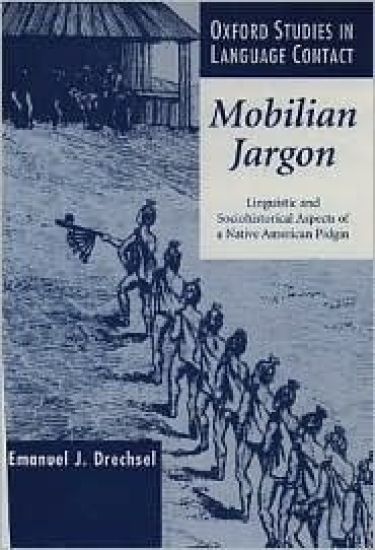
Mobilian Jargon

Mobilian Jargon

Emanuel J. Drechsel

Clarendon Press
1997
sidottu
The study of Native American languages has traditionally paid little attention to linguistic convergence, just as linguists focusing on language contact have often neglected Native American cases. Drawing both on fieldwork and on archival research Emanuel Drechsel presents a grammatical, sociolinguistic, and ethnohistorical study of Mobilian Jargon, a Muskogean-based American Indian pidgin of the Mississippi valley. Mobilian Jargon functioned as an interlingual medium of communication among linguistically diverse southeastern Native American groups, and in contact between these groups and non-Indians, from at least 1700 until the mid-twentieth century. It also served as a a sociolinguistic buffer, providing native peoples with some protection against outside intrusions. The linguistic and extralinguistic evidence points to a pre-Columbian origin, and a role as a lingua franca among mound-building paramount chiefdoms of the lower Mississippi valley. Because of its focus on a non-European based case, Drechsel's study questions the universality of some concepts developed in pidgin and creole linguistics. It also carries significant implications for the ethnology of Native American peoples, and for the history of North America, suggesting that Native American peoples have had a greater historical role than has been acknowledged hitherto.
The Jargon of Authenticity

The Jargon of Authenticity

Theodor Adorno

Routledge
2002
sidottu
Theodor Adorno was no stranger to controversy. In The Jargon of Authenticity he gives full expression to his hostility to the language employed by certain existentialist thinkers such as Martin Heidegger. With his customary alertness to the uses and abuses of language, he calls into question the jargon, or 'aura', as his colleague Walter Benjamin described it, which clouded existentialists' thought. He argued that its use undermined the very message for meaning and liberation that it sought to make authentic. Moreover, such language - claiming to address the issue of freedom - signally failed to reveal the lack of freedom inherent in the capitalist context in which it was written. Instead, along with the jargon of the advertising jingle, it attributed value to the satisfaction of immediate desire. Alerting his readers to the connection between ideology and language, Adorno's frank and open challenge to directness, and the avoidance of language that 'gives itself over either to the market, to balderdash, or to the predominating vulgarity', is as timely today as it ever has been.
The Jargon of Authenticity

The Jargon of Authenticity

Theodor Adorno

Routledge
2002
nidottu
Theodor Adorno was no stranger to controversy. In The Jargon of Authenticity he gives full expression to his hostility to the language employed by certain existentialist thinkers such as Martin Heidegger. With his customary alertness to the uses and abuses of language, he calls into question the jargon, or 'aura', as his colleague Walter Benjamin described it, which clouded existentialists' thought. He argued that its use undermined the very message for meaning and liberation that it sought to make authentic. Moreover, such language - claiming to address the issue of freedom - signally failed to reveal the lack of freedom inherent in the capitalist context in which it was written. Instead, along with the jargon of the advertising jingle, it attributed value to the satisfaction of immediate desire. Alerting his readers to the connection between ideology and language, Adorno's frank and open challenge to directness, and the avoidance of language that 'gives itself over either to the market, to balderdash, or to the predominating vulgarity', is as timely today as it ever has been.