
Kirjahaku
Etsi kirjoja tekijän nimen, kirjan nimen tai ISBN:n perusteella.
1000 tulosta hakusanalla Jason S. Nethercut


To Emma's Gravestone & other poems
Jason S. Price
Createspace Independent Publishing Platform
2013
nidottu

from the water's edge & other poems: a collection of poems
Jason S. Price
Createspace Independent Publishing Platform
2016
nidottu
"from the water's edge & other poems" is Belizean-American poet Jason S. Price's fifth book of poetry and it is a personal achievement because the poems render the heart bare. These poems are a collage, a multiple of voices and issues. For example, the poem "I Dream Through Slaves" is a faith rooted poem that comes from a legacy of pain: "Of slaves, I am its legacy - I dream through / Slaves because no matter how you oxidize / The green" haunts still; while the poem "Do Not Let Time" deals with time as purpose: "spend it, use it, work it in stride"; and the poem "A Space In My Skin" addresses the theme of longing, of missing. These themes and each of these poems, along with the others, speak a fundamental truth, a truth from experience, from observation, and most certainly, a truth from the heart. They are creative works of art that individually demands attention to style and rhythm; however, each poem is a reach, an insight and with a thoughtfulness that makes them not only works of art, but lessons of art. Lessons that speak to our lives, our common good, and with hopes for a more peaceful future. one tiny gracemay these few lines set you free -for a moment, a time or a periodfrom the lies your intuition feels -may these open lines let you seeyou are much more than just that -a pain, some hurts, that curse -may these tearful lines let you knowthere's a path that leads to freedom;there's a love that includes yourself -how meager, small, insignificanceyou may read between these lines -may this poem be the tiny grace you seek to gain your salvation -

There's an Alcoholic in the Family...and it's Me!!!: Support & Insight for the First 30 days in Recovery
Jason S. Whitehead
Createspace Independent Publishing Platform
2016
nidottu
That's me: 41, single, a football fanatic, and hiding behind sunglasses.As alcoholics we are good at hiding: our bottles, mistakes, heartaches, fears, and disease. AA tells us we need to hide behind a wall of anonymity. WHY? The answer is simple and unjust: society doesn't recognize we have a disease and that the cure is treatment-long-term, lifelong treatment. Instead we are misunderstood, labeled, judged, incarcerated, and outcast.We feel doomed to self-destruction, many times without the support of loved ones or friends. It's certainly not a road any of us would choose. We don't get up in the morning and determine "Today would be a great day to ruin my life, relationships, security, and career."Our only hope is support from those who understand, because they have walked this lonely, frightening, and oft discouraging road. I'm breaking anonymity, and speaking out about the horrors of our disease for two reasons. First, I want to encourage you, my fellow traveller, because there is hope; we can and do recover. Together let's find a way to join hands through these pages over the next thirty days and walk this thing out one day at a time. Secondly, I'm hopeful the day will come when we can be open and honest about our disease and receive the understanding and medical attention we need and deserve. I've met so many amazing men and women who suffer from alcoholism. We aren't a partying group; we are hurting. We need healing. We are, however, intelligent, creative, caring, loving, and tenderhearted men and women, husbands and wives, children and parents, grandparents, aunts and uncles; we are leaders and coworkers. We are of great value to our families and communities. Your first thirty days are just the beginning of a lifetime commitment; but they will be your hardest days. So reach deep. Make my commitment below, your commitment, and together let's take these first critical steps in this thing called recovery.


Quantitative Research Methods for Communication
Jason S. Wrench; Candice Thomas-Maddox; Virginia Peck Richmond
Oxford University Press Inc
2018
nidottu
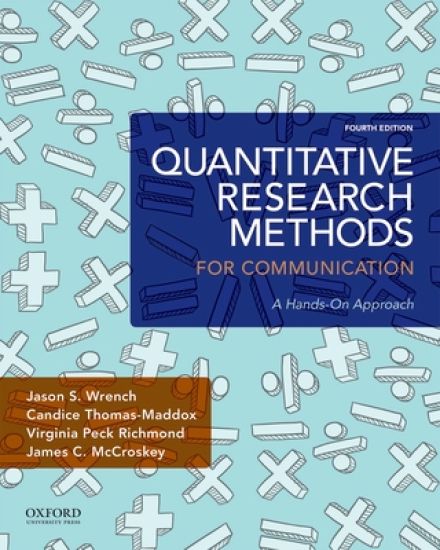
Quantitative Research Methods for Communication: A Hands-On Approach is a relevant and accessible guide to quantitative research. In clear, straightforward language, the authors encourage students to take an active, hands-on role in the learning process, giving them the tools they need to locate, conduct, collect and present their research. The authors use real communication studies and data sets to make communication research come alive for students. Students are not only introduced to new skills but also given the opportunity to immediately apply these skills in research scenarios. The text integrates helpful features throughout, including chapter objectives, case studies, data sheets, and key terms.

Ecosystem-Based Fisheries Management
Jason S. Link; Anthony R. Marshak
Oxford University Press
2021
sidottu
Ecosystem-based fishery management (EBFM) is rapidly becoming the default approach in global fisheries management. The clarity of what EBFM means is sharpening each year and there is now a real need to evaluate progress and assess the effectiveness and impacts. By examining a suite of over 90 indicators (including socioeconomic, governance, environmental forcing, major pressures, systems ecology, and fisheries criteria) for 9 major US fishery ecosystem jurisdictions, the authors systematically track the progress the country has made towards advancing EBFM and making it an operational reality. The assessment covers a wide range of data in both time (multiple decades) and space (from the tropics to the poles, representing over 10% of the world's ocean surface area). The authors view progress towards the implementation of EBFM as synonymous with improved management of living marine resources in general, and highlight the findings from a national perspective. Although US-centric, the lessons learned are directly applicable for all parts of the global ocean. Much work remains, but significant progress has already been made to better address many of the challenges facing the sustainable management of our living marine resources. This is an essential and accessible reference for all fisheries professionals who are currently practicing, or progressing towards, ecosystem-based fisheries management. It will also be of relevance and use to researchers, teachers, managers, and graduate students in marine ecology, fisheries biology, biological oceanography, global change biology, conservation biology, and marine resource management.

Co-operative Enterprise in Comparative Perspective
Jason S. Spicer
OXFORD UNIVERSITY PRESS INC
2024
sidottu
Co-operative enterprises, which are democratically owned and governed by their workers, customers, or suppliers, have long captured the imagination of activists and social scientists alike. In centering economic democracy and a collectivist-democratic logic, and in embodying a "third way" alternative to profit-maximizing corporations and state-owned enterprises, co-operatives offer the promise of a more sustainable and equitable economy. Despite extensive study of co-operatives' real and imagined benefits, we know little about the conditions under which they achieve the lasting scale needed to be a viable alternative and transform the economy. Under what conditions can co-operatives achieve such scale? And are such conditions present in the United States, where, despite repeated organizing efforts, co-operatives remain exceptionally rare at scale? Through a rigorous comparative-historical analysis of co-operative enterprises in different national contexts, this book seeks to answer these questions. Deploying two different variants of the new institutionalism, Spicer treats the United States as a central case of comparative failure, as contrasted to three rich democracies where the co-operative business model has been more successful: Finland, France, and New Zealand. The cause of co-operatives' comparative weakness in the United States is identified as reflecting the joint effect of economic liberalism and structural racism. Only in the United States did the co-operative face, in its initial development, two well-entrenched incumbents operating with competing ownership models: the investor-owned firm and the race-based chattel slavery system of ownership of people. Proponents of these two models acted to deprive the co-operative movement of resources, and undermined the solidarity at the co-operative business model's heart, splintering the American co-operative movement in the process. In subsequent waves of co-operative organizing, advocates have never fully succeeded in overcoming these initial obstacles, resulting in a different outcome in the United States, consistent with broader conceptions of the United States as a perennial outlier (i.e., ""American exceptionalism""). In contrast, in the successful cases, advocates were better able to leverage resources to animate a national solidarity and procure the necessary political and economic resources to achieve scale.

Prohibition Is Here to Stay focuses on the Reverend Edward S. Shumaker, a Methodist minister who for nearly twenty-five years led Indiana's influential chapter of the Anti Saloon League. Shumaker was one of the most powerful men in Indiana in the fight against demon rum, and his influence extended well beyond the boundaries of the state during the late nineteenth and early twentieth centuries. Jason Lantzer uses Shumaker's life and work to shed new light on the rise and fall of Prohibition and to better understand and appreciate the interplay of religion and politics in American culture. Drawing on Shumaker's personal papers as well as archival work, Lantzer argues that understanding the role of religious faith and in particular evangelical Protestantism is essential to understanding Prohibition. Shumaker's religious faith inspired his crusade against alcohol and his efforts to make the Indiana Anti Saloon League one of the strongest political pressure groups in the country. Lantzer argues that Edward Shumaker's life and the cause to which he devoted most of it were not aberrations but exemplars of central currents in American culture of the time. Lantzer also connects Shumaker and the prohibition movement in Indiana to larger issues of America's transition from a predominantly rural society to an urban culture, with the attendant fears of change, loss of values, the impact of industrialization, and foreign immigration.

Prohibition Is Here to Stay focuses on the Reverend Edward S. Shumaker, a Methodist minister who for nearly twenty-five years led Indiana's influential chapter of the Anti Saloon League. Shumaker was one of the most powerful men in Indiana in the fight against demon rum, and his influence extended well beyond the boundaries of the state during the late nineteenth and early twentieth centuries. Jason Lantzer uses Shumaker's life and work to shed new light on the rise and fall of Prohibition and to better understand and appreciate the interplay of religion and politics in American culture. Drawing on Shumaker's personal papers as well as archival work, Lantzer argues that understanding the role of religious faith and in particular evangelical Protestantism is essential to understanding Prohibition. Shumaker's religious faith inspired his crusade against alcohol and his efforts to make the Indiana Anti Saloon League one of the strongest political pressure groups in the country. Lantzer argues that Edward Shumaker's life and the cause to which he devoted most of it were not aberrations but exemplars of central currents in American culture of the time. Lantzer also connects Shumaker and the prohibition movement in Indiana to larger issues of America's transition from a predominantly rural society to an urban culture, with the attendant fears of change, loss of values, the impact of industrialization, and foreign immigration.

Designed for the pastor and Bible teacher, the Zondervan Exegetical Commentary on the Old Testament features today's top Old Testament scholars and brings together commentary features rarely gathered together in one volume. With careful discourse analysis and interpretation of the Hebrew text, the authors trace the flow of argument in each Old Testament book, showing that how a biblical author says something is just as important as what they say.Commentary on each passage follows a clear structure to help readers grasp the flow and meaning of the text:The Main Idea of the Passage: A one- or two-sentence summary of the key ideas the biblical author seeks to communicate.Literary Context: A brief discussion of the relationship of the specific text to the book as a whole and to its place within the broader argument.Translation and Exegetical Outline: Commentators provide their own translations of each text, formatted to highlight its discourse structure and accompanied by a coherent outline that reflects the flow and argument of the text.Structure and Literary Form: An overview of the literary structure and rhetorical style adopted by the biblical author, highlighting how these features contribute to the communication of the main idea of the passage.Explanation of the Text: A detailed commentary on the passage, paying particular attention to how the biblical authors select and arrange their materials and how they work with words, phrases, and syntax to communicate their messages.Canonical and Practical Significance: The commentary on each unit will conclude by building bridges between the world of the biblical author and other biblical authors and with reflections on the contribution made by this unit to the development of broader issues in biblical theology--particularly on how later Old Testament and New Testament authors have adapted and reused the motifs in question. The discussion also includes brief reflections on the significance of the message of the passage for readers today.The Zondervan Exegetical Commentary on the Old Testament series is the go-to resource for pastors and Bible teachers looking for deep but accessible study that equips them to connect the needs of Christians today with the biblical text.

Abstraction is one facet of intellectual functioning. The study of abstraction allows extremely valuable insights into human intelligence. While this monograph indicates that the ability to think abstractly declines slightly with age, there are a number of variables determining abstract thinking and its relation to intelligence over the life-span. This monograph defines abstraction from all angles of thought, contrasting it with high-order thinking and stereotyped thinking; it discusses and evaluates tests of abstract thinking; and it presents new findings in sociological and psychological research on abstraction.
An introduction reviews previous scholarship, and concludes that the cultic aspects of Judges 17-18 have not been examined in any depth. It then goes on to deal with the historical and redactional issues which previous scholars have found interesting. The issues of provenance and dating are then examined with the conclusion that the text was written down in the immediate aftermath of the Assyrian conquest of Dan in an attempt to preserve its sacred traditions. The text therefore reflects the self-understanding of the priests of Dan in the period immediately prior to its fall. The text of Judges 17-18 is then subjected to a rhetorical critical examination, followed by a more traditional form critical study. The next section is a comparison of similar cultic foundation stories from other cultures. Three major chapters examine the three major cultic issues raised by the text itself: images, priests and divination. Each chapter draws on evidence from the Hebrew Bible and its environment in an attempt to clarify the nature of the cult of Dan. Broadly, each chapter concludes that although there were some features peculiar to the cult reflected by Dan, in general, the Danite cult was not greatly different from that of its neighbours. A final chapter deals with what the text says about the tribe of Levi, with the conclusion that according to Judges 17-18, there was once a secular tribe of Levi. The conclusion draws a brief picture of cultic life in Dan in its final years.

Exploring one of the most controversial figures in recent evangelical theology, this book thoroughly examines core features of Stanley J. Grenz’s Trinitarian vision.

Exploring one of the most controversial figures in recent evangelical theology, this book thoroughly examines core features of Stanley J. Grenz’s Trinitarian vision.