

Kirjahaku
Etsi kirjoja tekijän nimen, kirjan nimen tai ISBN:n perusteella.
1000 tulosta hakusanalla Jennifer M. Small

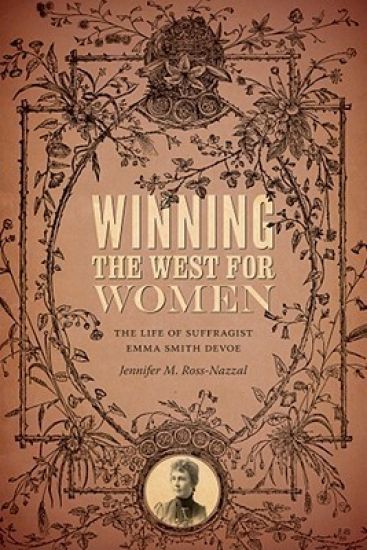
In 1856, in an opera house in Roseville, Illinois, Susan B. Anthony called for the supporters of woman suffrage to stand. The only person to rise was eight-year-old Emma Smith. And she continued to take a stand for the rest of her life. As a leader in the suffrage movement, Emma Smith DeVoe stumped across the country organizing for the cause, raising money, and helping make the West central to achieving the vote for women.DeVoe used her feminine style to great advantage in the campaign for the vote. Rather than promoting public rallies, she encouraged women to put their energies toward influencing the votes of their fathers, brothers, and husbands. Known as the still-hunt strategy, this approach was highly successful and helped win the vote for women in Washington State in 1910. Winning the West for Women demonstrates the importance of the West in the national suffrage movement. It reveals the central role played by the National Council of Women Voters, whose members were predominantly western women, in securing the passage of the Nineteenth Amendment.Winning the West for Women also tells a larger story of dissension and discord within the suffrage movement. Though ladylike in her courtship of male support for the cause, DeVoe often clashed with other activists who disagreed with her tactics or doubted her commitment to the movement. This fascinating biography describes the real experiences of women and their relationships as they struggled to win the right to vote.Watch the book trailer: https://www.youtube.com/watch?v=fPLnFiZBHug

In 1856, in an opera house in Roseville, Illinois, Susan B. Anthony called for the supporters of woman suffrage to stand. The only person to rise was eight-year-old Emma Smith. And she continued to take a stand for the rest of her life. As a leader in the suffrage movement, Emma Smith DeVoe stumped across the country organizing for the cause, raising money, and helping make the West central to achieving the vote for women.DeVoe used her feminine style to great advantage in the campaign for the vote. Rather than promoting public rallies, she encouraged women to put their energies toward influencing the votes of their fathers, brothers, and husbands. Known as the still-hunt strategy, this approach was highly successful and helped win the vote for women in Washington State in 1910. Winning the West for Women demonstrates the importance of the West in the national suffrage movement. It reveals the central role played by the National Council of Women Voters, whose members were predominantly western women, in securing the passage of the Nineteenth Amendment.Winning the West for Women also tells a larger story of dissension and discord within the suffrage movement. Though ladylike in her courtship of male support for the cause, DeVoe often clashed with other activists who disagreed with her tactics or doubted her commitment to the movement. This fascinating biography describes the real experiences of women and their relationships as they struggled to win the right to vote.Watch the book trailer: https://www.youtube.com/watch?v=fPLnFiZBHug

The author analyzes Durkheim's social theory from the standpoint of critical structuralism. She explores Durkheim's discussion of the relationship between the individual and society. She also addresses the question of Durkheim's understanding of the relationship between the subject and object of knowledge, and the relationship between truth and ideology.

Many contemporary concerns in higher education focus on the student experience of learning.With a larger and much more diverse intake than ever before, linked with a declining unit of resource, questions are being asked afresh around the purposes of higher education. Although much of the debate is currently focused on issues of student access and success, a simple input-output model of higher education is insufficient. This book turns this conversation on its head, by inserting a full consideration of student agency into the context of higher education.Working sociologically, it explores the influence of the social context on what the individual student achieves. The theoretical tenets of a social realist approach are laid out in detail in the book; the potential value of this approach is then illustrated by a case study of student learning in engineering education.Employing Margaret Archer’s social realist theory, an analysis of student narratives is used to work towards a realist understanding of the underlying mechanisms that constrain and enable student success.Building on this analysis, the book develops a novel set of proposals for potential ways forward in improving student learning in higher education.
Many contemporary concerns in higher education focus on the student experience of learning.With a larger and much more diverse intake than ever before, linked with a declining unit of resource, questions are being asked afresh around the purposes of higher education. Although much of the debate is currently focused on issues of student access and success, a simple input-output model of higher education is insufficient. This book turns this conversation on its head, by inserting a full consideration of student agency into the context of higher education.Working sociologically, it explores the influence of the social context on what the individual student achieves. The theoretical tenets of a social realist approach are laid out in detail in the book; the potential value of this approach is then illustrated by a case study of student learning in engineering education.Employing Margaret Archer’s social realist theory, an analysis of student narratives is used to work towards a realist understanding of the underlying mechanisms that constrain and enable student success.Building on this analysis, the book develops a novel set of proposals for potential ways forward in improving student learning in higher education.

The German Patient takes an original look at fascist constructions of health and illness, arguing that the idea of a healthy "national body"---propagated by the Nazis as justification for the brutal elimination of various unwanted populations---continued to shape post-1945 discussions about the state of national culture. Through an examination of literature, film, and popular media of the era, Jennifer M. Kapczynski demonstrates the ways in which postwar German thinkers inverted the illness metaphor, portraying fascism as a national malady and the nation as a body struggling to recover. Yet, in working to heal the German wounds of war and restore national vigor through the excising of "sick" elements, artists and writers often betrayed a troubling affinity for the very biopolitical rhetoric they were struggling against. Through its exploration of the discourse of collective illness, The German Patient tells a larger story about ideological continuities in pre- and post-1945 German culture.Jennifer M. Kapczynski is Assistant Professor of Germanic Languages and Literatures at Washington University in St. Louis. She is the coeditor of the anthology A New History of German Cinema.Cover art: From The Murderers Are Among Us (1946). Reprinted courtesy of the Deutsche Kinemathek."A highly evocative work of meticulous scholarship, Kapczynski's deftly argued German Patient advances the current revaluation of Germany's postwar reconstruction in wholly original and even exciting ways: its insights into discussions of collective sickness and health resonate well beyond postwar Germany."---Jaimey Fischer, University of California, Davis"The German Patient provides an important historical backdrop and a richly specific cultural context for thinking about German guilt and responsibility after Hitler. An eminently readable and engaging text."---Johannes von Moltke, University of Michigan"This is a polished, eloquently written, and highly informative study speaking to the most pressing debates in contemporary Germany. The German Patient will be essential reading for anyone interested in mass death, genocide, and memory."---Paul Lerner, University of Southern California

The German Patient takes an original look at fascist constructions of health and illness, arguing that the idea of a healthy "national body"---propagated by the Nazis as justification for the brutal elimination of various unwanted populations---continued to shape post-1945 discussions about the state of national culture. Through an examination of literature, film, and popular media of the era, Jennifer M. Kapczynski demonstrates the ways in which postwar German thinkers inverted the illness metaphor, portraying fascism as a national malady and the nation as a body struggling to recover. Yet, in working to heal the German wounds of war and restore national vigor through the excising of "sick" elements, artists and writers often betrayed a troubling affinity for the very biopolitical rhetoric they were struggling against. Through its exploration of the discourse of collective illness, The German Patient tells a larger story about ideological continuities in pre- and post-1945 German culture.Jennifer M. Kapczynski is Assistant Professor of Germanic Languages and Literatures at Washington University in St. Louis. She is the coeditor of the anthology A New History of German Cinema.Cover art: From The Murderers Are Among Us (1946). Reprinted courtesy of the Deutsche Kinemathek."A highly evocative work of meticulous scholarship, Kapczynski's deftly argued German Patient advances the current revaluation of Germany's postwar reconstruction in wholly original and even exciting ways: its insights into discussions of collective sickness and health resonate well beyond postwar Germany."---Jaimey Fischer, University of California, Davis"The German Patient provides an important historical backdrop and a richly specific cultural context for thinking about German guilt and responsibility after Hitler. An eminently readable and engaging text."---Johannes von Moltke, University of Michigan"This is a polished, eloquently written, and highly informative study speaking to the most pressing debates in contemporary Germany. The German Patient will be essential reading for anyone interested in mass death, genocide, and memory."---Paul Lerner, University of Southern California

Today, approximately half of all American states have lobbying offices in Washington, DC, where governors are also represented by their own national, partisan, and regional associations. Jennifer M. Jensen’s The Governors’ Lobbyists draws on quantitative data, archival research, and more than 100 in-depth interviews to detail the political development of this constellation of advocacy organizations since the early 20th century and investigate the current role of the governors’ lobbyists in the U.S. federal system. First, Jensen analyzes the critical ways in which state offices and governors’ associations promote their interests and, thus, complement other political safeguards of federalism. Next, she considers why, given their apparent power, governors engage lobbyists to serve as advocates and why governors have created both individual state offices and several associations for this advocacy work. Finally, using interest group theory to analyze both material and political costs and benefits, Jensen addresses the question of interest group variation: why, given the fairly clear material benefit a state draws from having a lobbying office in Washington, doesn’t every state have one? This assessment of lobbying efforts by state governments and governors reveals much about role and relative power of states within the U.S. federal system.

The Arts of Democratization
Jennifer M. Kapczynski; Caroline Kita
The University of Michigan Press
2022
sidottu
Scholars of democracy long looked to the Federal Republic of Germany as a notable “success story,” a model for how to transition from a violent, authoritarian regime to a peaceable nation of rights. Although this account has been contested since its inception, the narrative has proved resilient—and it is no surprise that the current moment of crisis that Western democracies are experiencing has provoked new interest in how democracies come to be. The Arts of Democratization: Styling Political Sensibilities in Postwar West Germany casts a fresh look at the early years of this fledgling democracy and draws attention to the broad range of ways democracy and the democratic subject were conceived and rendered at this time. These essays highlight the contradictory and competing impulses that ran through the project to democratize postwar society and cast a critical eye toward the internal biases that shaped the model of Western democracy. In so doing, the contributions probe critical questions that we continue to grapple with today. How did postwar thinkers understand what it meant to be democratic? Did they conceive of democratic subjectivity in terms of acts of participation, a set of beliefs or principles, or perhaps in terms of particular feelings or emotions? How did the work to define democracy and its subjects deploy notions of nation, race, and gender or sexuality? As this book demonstrates, the case of West Germany offers compelling ways to think more broadly about the emergence of democracy. The Arts of Democratization offers lessons that resonate with the current moment as we consider what interventions may be necessary to resuscitate democracy today.

"The Tactile Eye" expands on phenomenological analysis and film theory in its accessible and beautifully written exploration of the visceral connection between films and their viewers. Jennifer M. Barker argues that the experience of cinema can be understood as deeply tactile - a sensuous exchange between film and viewer that goes beyond the visual and aural, gets beneath the skin, and reverberates in the body. Barker combines analysis of embodiment and phenomenological film theory to provide an expansive description of cinematic tactility. She considers feminist experimental film, early cinema, animation, and horror, as well as classic, modernist, and postmodern cinema; films from ten national cinemas; and, work by Chuck Jones, Buster Keaton, the Quay Brothers, Satyajit Ray, Carolee Schneemann, and Tom Tykwer, among others.

In the first full-length scholarly study of the increasingly important phenomenon of digital diasporas, Jennifer M. Brinkerhoff examines how immigrants who still feel a connection to their country of origin use the internet. She argues that digital diasporas can ease security concerns in both the homeland and the host society, improve diaspora members' quality of life in the host society, and contribute to socio-economic development in the homeland. Drawing on case studies of nine digital diaspora organizations, Brinkerhoff's research supplies new empirical material regarding digital diasporas and their potential security and development impacts. She also explores their impact on identity negotiation, arguing that digital diasporas create communities and organizations that represent hybrid identities and encourage solidarity, identity, and material benefits among their members. The book also explores these communities' implications for policy and practice.

In the first full-length scholarly study of the increasingly important phenomenon of digital diasporas, Jennifer M. Brinkerhoff examines how immigrants who still feel a connection to their country of origin use the internet. She argues that digital diasporas can ease security concerns in both the homeland and the host society, improve diaspora members' quality of life in the host society, and contribute to socio-economic development in the homeland. Drawing on case studies of nine digital diaspora organizations, Brinkerhoff's research supplies new empirical material regarding digital diasporas and their potential security and development impacts. She also explores their impact on identity negotiation, arguing that digital diasporas create communities and organizations that represent hybrid identities and encourage solidarity, identity, and material benefits among their members. The book also explores these communities' implications for policy and practice.

In this essential overview of practical Quaker theology, Buck takes everyday issues in the Christian life and examines the particulars of how Quakers address those issues today. In doing so, this work extends the Quaker voice into the 21st century, converging Quaker tradition within our modern cultural context.Buck artfully integrates old ideas from Christian history into new movements of the Holy Spirit. In doing so, she examines the daily lives of Spirit-led Quakers, from eating habits to scriptural approaches, in order to evaluate effectively what it means to be an Evangelical Friend today.

In this essential overview of practical Quaker theology, Buck takes everyday issues in the Christian life and examines the particulars of how Quakers address those issues today. In doing so, this work extends the Quaker voice into the 21st century, converging Quaker tradition within our modern cultural context.Buck artfully integrates old ideas from Christian history into new movements of the Holy Spirit. In doing so, she examines the daily lives of Spirit-led Quakers, from eating habits to scriptural approaches, in order to evaluate effectively what it means to be an Evangelical Friend today.

FINALLY, a guide that makes creating a meal plan quick and easy. Save yourself time, energy and tantrums: Free yourself from staring in the fridge wondering what to make for dinner.Have healthy snacks already prepared to give kids between activities.Spend less time grocery shopping (and less money on Double Stuffed Oreos).Jenni Ward has developed a simple 4-step process to have you meal planning like a master in no time. No matter what your schedule looks like, you can make meal plans that fit your life and actually work for you. Plus, you will be making meals that your family loves. Adventures in Meal Planning helps you create a system that simplifies your busy life.No more...Continuously going out to eat because you don't have anything at homeGetting stuck making the same meal over and overScreaming temper tantrums at 4:30 because your children (or you...) are dying of starvationYour guide includes everything you need to meal plan for an entire year Get started on your adventure of having fun with food.



The Tales of Two Kitties: Book 2 The Mouse Bandit
Jennifer M. Hickenbottom
Jennifer Hickenbottom
2014
nidottu