Kirjojen hintavertailu. Mukana 12 426 139 kirjaa ja 12 kauppaa.

Kirjahaku

Etsi kirjoja tekijän nimen, kirjan nimen tai ISBN:n perusteella.

1000 tulosta hakusanalla Jon F. Nussbaum

Cohomology Rings of Finite Groups

Cohomology Rings of Finite Groups

Jon F. Carlson; L. Townsley; Luís Valero-Elizondo

Springer
2010
nidottu
Group cohomology has a rich history that goes back a century or more. Its origins are rooted in investigations of group theory and num­ ber theory, and it grew into an integral component of algebraic topology. In the last thirty years, group cohomology has developed a powerful con­ nection with finite group representations. Unlike the early applications which were primarily concerned with cohomology in low degrees, the in­ teractions with representation theory involve cohomology rings and the geometry of spectra over these rings. It is this connection to represen­ tation theory that we take as our primary motivation for this book. The book consists of two separate pieces. Chronologically, the first part was the computer calculations of the mod-2 cohomology rings of the groups whose orders divide 64. The ideas and the programs for the calculations were developed over the last 10 years. Several new features were added over the course of that time. We had originally planned to include only a brief introduction to the calculations. However, we were persuaded to produce a more substantial text that would include in greater detail the concepts that are the subject of the calculations and are the source of some of the motivating conjectures for the com­ putations. We have gathered together many of the results and ideas that are the focus of the calculations from throughout the mathematical literature.

Dream, Tremble, Fly: Slavery and Sacred Experience in the Revolutionary South
Religion and slavery created a central paradox in Southern history. Whereas thousands of white Southerners used Christianity to justify slavery and racism, some dissenters criticized slavery as unholy. Enslaved Black Southerners sought spiritual freedom through beliefs and practices from many traditions. Dream, Tremble, Fly explores the enchanted interior world of visions, prophecies, and sacred memories that enabled Southerners to challenge or survive slavery during the American War for Independence. At a time when 40 percent of Southerners were enslaved, revelation and revolution were joined. For one white Quaker in North Carolina, a startling dream forced him to alter his own enslaving ways and embrace the moral cleansing of abolition. In lowcountry Georgia, an enslaved Muslim's body trembled with the Holy Spirit, transcending the profane captivity of the body. And in Piedmont North Carolina, another enslaved man embarked on two parallel spirit journeys--one toward Christianity, the other in metaphysical return to Africa. Each recounted his experience in a unique way, and each story represents an experiment in reconstructing from bare archival fragments the inner sacred landscape of enslaved and other ordinary people, revealing the entwining of religion with slavery and the quest for freedom.
The Upper Kennebec Valley: Volume II

The Upper Kennebec Valley: Volume II

Jon F. Hall

Arcadia Publishing (SC)
1999
nidottu
The Upper Kennebec Valley is one of the most important gateways to Maine's Great North Woods and has, for over 200 years, attracted those who love the wilderness, lakes, mountains, and streams. The Upper Kennebec Valley Volume II begins, once again, at The Forks, where the East Branch of the Kennebec and the Dead River unite to form the Kennebec. The area has long been dominated by logging and tourism trades. Starting with the days of horses and oxen, when loggers and sports came to the woods by foot and wagon to the coming of the railroad and the automobile, we see the growth of these small towns and the hardworking loggers, daring river drivers, sport hunters and fishermen, and those who guided and hosted them. Early scenes of the daily lives of valley folk enjoying local parades, picnics, reunions, and sporting events come alive within these pages.
A Separate Canaan

A Separate Canaan

Sensbach Jon F.

The University of North Carolina Press
1998
nidottu
In colonial North Carolina, German-speaking settlers from the Moravian Church founded a religious refuge--an ideal society, they hoped, whose blueprint for daily life was the Bible and whose Chief Elder was Christ himself. As the community's demand for labor grew, the Moravian Brethren bought slaves to help operate their farms, shops, and industries. Moravians believed in the universalism of the gospel and baptized dozens of African Americans, who became full members of tightly knit Moravian congregations. For decades, white and black Brethren worked and worshiped together--though white Moravians never abandoned their belief that black slavery was ordained by God. Based on German church documents, including dozens of rare biographies of black Moravians, A Separate Canaan is the first full-length study of contact between people of German and African descent in early America. Exploring the fluidity of race in Revolutionary era America, it highlights the struggle of African Americans to secure their fragile place in a culture unwilling to give them full human rights. In the early nineteenth century, white Moravians forsook their spiritual inclusiveness, installing blacks in a separate church. Just as white Americans throughout the new republic rejected African American equality, the Moravian story illustrates the power of slavery and race to overwhelm other ideals. |The power of race to overwhelm other ideals is conveyed in this history of N.C.'s Moravian colonists and their slaves. They worked and worshiped together for decades, until the Moravians installed blacks in a separate church.
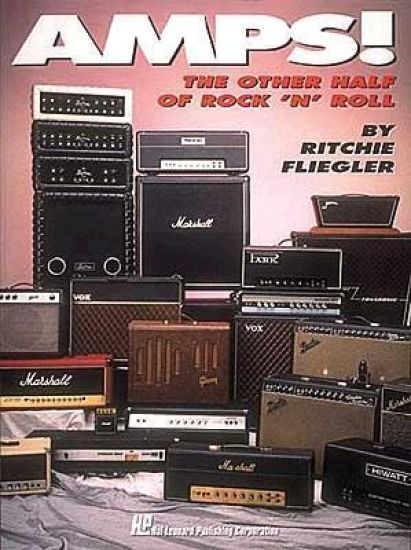
Amps!

Amps!

Ritchie Fliegler; Jon F. Eiche

Hal Leonard Corporation
1993
pokkari
(Book). Electric guitar players can choose from a library full of guitar books, but comparatively little has been written about the other 50% of the electric guitar: the amplifier. This book takes a giant step toward redressing the balance, providing the first overall view of amp-dom, including: how amps work, profiles of the major manufacturers, 'transistor dinosaurs' and their place in amp history, reissues vs. vintage amps, and troubleshooting. Terms are defined in the margin as they are introduced, and plenty of photos and diagrams illuminate the text.
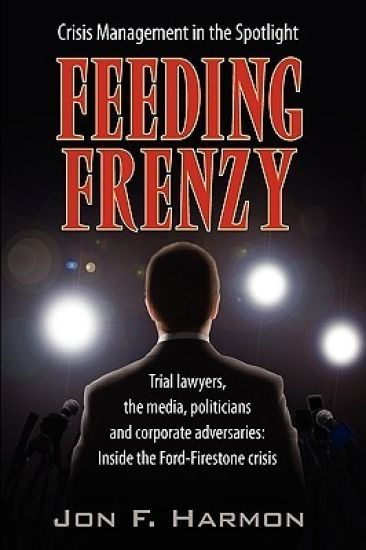
Feeding Frenzy

Feeding Frenzy

John Harmon; Jon F Harmon

Strategic Book Publishing Rights Agency, LLC
2009
sidottu
An inside look at crisis management in the 21st century, Feeding Frenzy tells the story of two companies at war with each other, and of the trial lawyers determined to keep the conflict on the front pages. The Ford-Firestone tire crisis was the biggest business story of 2000-2001. Deadly and mysterious rollover accidents of Ford Explorers with failing Firestone tires took a toll of more than 270 lives in the U.S. and at least 100 more in Venezuela and other hot-climate countries. In compelling narrative, Feeding Frenzy provides a richer case study than can be found in other books on crisis communications. The reader climbs into the front seat for an eventful ride with the Ford PR team, as the automaker tries to understand what's causing the maddening accidents. Firestone's recall of millions of tires does nothing to abate unprecedented scrutiny from international media, safety advocates and an angry U.S. Congress. All the while, trial lawyers are leaking a new inflammatory document virtually every day to journalists competing with one another to break the next big story in this epic crisis. Jon Harmon is a chief communications officer with experience in all facets of reputation management. Over a 23-year career at Ford Motor Company, Harmon served in numerous roles requiring adroit media relations. He was Ford's chief spokesman during national labor negotiations with the UAW, and for many of Ford's high-profile legal cases and safety issues. As head of public relations for Ford Truck, Harmon was thrust into defending the Ford Explorer throughout the epic Ford-Firestone tire crisis. Harmon is the author of the Force for Good Communications blog for "aspirational public relations" at www.forceforgoodcom.com.
Pop Wasteland # 3

Pop Wasteland # 3

Tim S. Allen; Jon F. Allen

Createspace Independent Publishing Platform
2017
nidottu
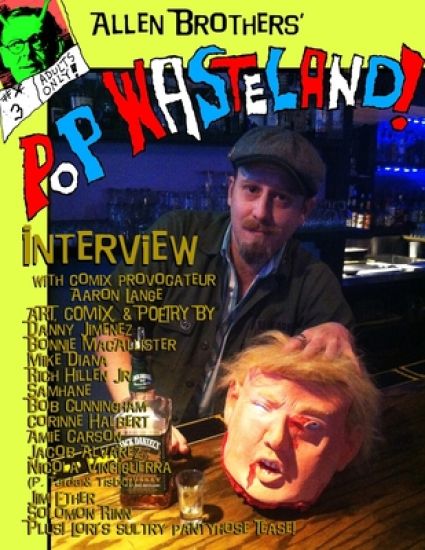
Interview with comix provocateur Aaron Lange. Also, comix, illustrations and writing by the Allen Brothers, Danny Jimenez, Bonnie Mac, Mike Diana, Rich Hillen Jr., Samhane, Bob Cunningham, Corinne Halbert, Amie Carson, Jacob Alvarez, Nicola Vinciguerra, Jim Ether, and Solomon Rinn. Plus Lori's sultry pantyhose tease.
Putting Students First

Putting Students First

Larry A. Braskamp; Lois Calian Trautvetter; Kelly Ward; Jon F. Wergin

Jossey-Bass Inc.,U.S.
2015
nidottu
In Putting Students First, the authors argue that colleges can and should invest in holistic student development by recognizing and building on the students’ search for purpose in life, intellectually, spiritually, and morally. Based on a study conducted at ten religiously-affiliated schools, the book urges all colleges to rethink their approach to teaching and advising the increasingly diverse students of today; their critical mission should be to prepare students to become ethically responsible and active contributors to society, as well as critical thinkers and skilled professionals. Putting Students First offers perspectives and recommendations in areas of holistic student development such as Understanding millennial college studentsThe role of faculty in defining cultureThe design and implementation of curriculumThe impact of cocurricular involvementFostering relationships with on-campus and off-campus communities By organizing the campus environment into “4Cs”—culture, curriculum, cocurriculum, and community—the authors create a conceptual framework for faculty, student affairs staff, and administrators to discuss, plan, and create college environments that effectively support the learning and development of students. Each chapter includes an introduction, evidence and analysis, a summary, and questions to help readers consider how to develop students holistically on their own campuses.
Inaccuracies in Children's Testimony

Inaccuracies in Children's Testimony

Letitia C Pallone; Jon'A F Meyer

Routledge Member of the Taylor and Francis Group
1997
sidottu
Inaccuracies in Children’s Testimony combines the literature on obedience to authority with that on suggestibility to create a third literature. This book examines children’s testimony from several perspectives and gives you insightful suggestions for increasing children’s abilities to testify accurately about traumatic things that have happened to them. In doing so, you’ll learn how to ensure that those who abuse or sexually exploit children are brought to justice while those falsely accused are adequately protected.How children are questioned to learn what they have witnessed is crucial due to the effects the questioning sessions may have on their testimonies--improper questioning may lead to inaccurate answers. This is just one of the many areas of children’s testimony covered in Inaccuracies in Children’s Testimony. In each of the chapters you’ll discover new ways for increasing the accuracy and dependability of children’s testimony as you read about:factors that affect children’s testimonies suggestibility--definition and research, including sources of suggestibility how obedience to authority can explain children’s behavior as witnesses children’s memory in the courtroom and what they are able to remember how children’s involvement in the courts can be problematic free versus prompted recall--which is more accurate and why the “worst” method is often used with children Milgram’s theory of obedience to authority tied to children as witnesses review of the literature on the effects of stress, prompting, and imagination on children’s recall ideas for future researchExperts in the field of legal testimony, legal personnel, child counselors, psychologists, social workers, and faculty and students of related courses will find Inaccuracies in Children’s Testimony an essential resource for understanding the importance of making the child victim/witness more believable and reliable.
Inaccuracies in Children's Testimony

Inaccuracies in Children's Testimony

Letitia C Pallone; Jon'A F Meyer

Routledge Member of the Taylor and Francis Group
1997
nidottu
Inaccuracies in Children’s Testimony combines the literature on obedience to authority with that on suggestibility to create a third literature. This book examines children’s testimony from several perspectives and gives you insightful suggestions for increasing children’s abilities to testify accurately about traumatic things that have happened to them. In doing so, you’ll learn how to ensure that those who abuse or sexually exploit children are brought to justice while those falsely accused are adequately protected.How children are questioned to learn what they have witnessed is crucial due to the effects the questioning sessions may have on their testimonies--improper questioning may lead to inaccurate answers. This is just one of the many areas of children’s testimony covered in Inaccuracies in Children’s Testimony. In each of the chapters you’ll discover new ways for increasing the accuracy and dependability of children’s testimony as you read about:factors that affect children’s testimonies suggestibility--definition and research, including sources of suggestibility how obedience to authority can explain children’s behavior as witnesses children’s memory in the courtroom and what they are able to remember how children’s involvement in the courts can be problematic free versus prompted recall--which is more accurate and why the “worst” method is often used with children Milgram’s theory of obedience to authority tied to children as witnesses review of the literature on the effects of stress, prompting, and imagination on children’s recall ideas for future researchExperts in the field of legal testimony, legal personnel, child counselors, psychologists, social workers, and faculty and students of related courses will find Inaccuracies in Children’s Testimony an essential resource for understanding the importance of making the child victim/witness more believable and reliable.
F# for Scientists

F# for Scientists

Jon Harrop; Don Syme

John Wiley Sons Inc
2008
sidottu
"This work strikes a balance between the pure functional aspects of F# and the object-oriented and imperative features that make it so useful in practice, enable .NET integration, and make large-scale data processing possible." —Thore Graepel, PhD, Researcher, Microsoft Research Ltd. Over the next five years, F# is expected to become one of the world's most popular functional programming languages for scientists of all disciplines working on the Windows platform. F# is free and, unlike MATLAB® and other software with numerical/scientific origins, is a full-fledged programming language. Developed in consultation with Don Syme of Microsoft Research Ltd.—who wrote the language—F# for Scientists explains and demonstrates the powerful features of this important new programming language. The book assumes no prior experience and guides the reader from the basics of computer programming to the implementation of state-of-the-art algorithms. F# for Scientists begins with coverage of introductory material in the areas of functional programming, .NET, and scientific computing, and goes on to explore: Program structure Optimization Data structures Libraries Numerical analysis Databases Input and output Interoperability Visualization Screenshots of development using Visual Studio are used to illustrate compilation, debugging, and interactive use, while complete examples of a few whole programs are included to give readers a complete view of F#'s capabilities. Written in a clear and concise style, F# for Scientists is well suited for researchers, scientists, and developers who want to program under the Windows platform. It also serves as an ideal supplemental text for advanced undergraduate and graduate students with a background in science or engineering.