
Kirjahaku
Etsi kirjoja tekijän nimen, kirjan nimen tai ISBN:n perusteella.
751 tulosta hakusanalla Jury Dimitrin

The jury trial is one of the formative elements of American government, vitally important even when Americans were still colonial subjects of Great Britain. When the founding generation enshrinedthe jury in the Constitution and Bill of Rights, they were not inventing something new, but protecting something old: one ofthe traditional and essential rights of all free men. Judgment by an “impartial jury” would henceforth put citizen panels at thevery heart of the American legal order. And yet at the dawn of the twenty-first century, juries resolve just two percent of the nation’slegal cases and critics warn that the jury is “vanishing” from both the criminal and civil courts. The jury’s critics point to sensational jury trials like those in the O. J. Simpson and Menendez cases, and conclude that the disappearance of the jury is no great loss. The jury’s defenders, from journeyman trial lawyers to members of the Supreme Court, take a different view, warning that the disappearance of the jury trial would be a profound loss.In The Jury in America, a work that deftly combines legal history, political analysis, and storytelling, Dennis Hale takes us to the very heart of this debate to show us what the American jury system was, what it has become, and what the changes in the jury system tell us about our common political and civic life. Because the jury is so old, continuously present in the life of the American republic, it can act as a mirror, reflecting the changes going on around it. And yet because the jury is embedded in the Constitution, it has held on to its original shape more stubbornly than almost any other element in the American regime. Looking back to juries at the time of America’s founding, and forward to the fraught and diminished juries of our day, Hale traces a transformation in our understanding of ideas about sedition, race relations, negligence, expertise, the responsibilities of citizenship, and what it means to be a citizen who is “good and true” and therefore suited to the difficult tasks of judgment. Criminal and civil trials and the jury decisions that result from them involve the most fundamental questions of right, and sogo to the core of what makes the nation what it is. In this light, in conclusion, Hale considers four controversial modern trialsfor what they can tell us about what a jury is, and about the fate of republican government in America today.
The Jury System
Ashgate Publishing Limited
2006
sidottu
This volume collects new, high-quality scholarship on the perennially controversial institution of trial by jury. The book provides accounts of the jury's historical development and contemporary use, as well as empirical work on jury selection, jury decision making and jury reform.
Reconstructing Jury Instructions in Homicide Offenses
Hisham M. Ramadan
University Press of America
2004
nidottu
Reconstructing Jury Instructions in Homicide Offenses offers critical analysis for jury instructions in the United States. Supported by court decisions, careful interpretation of the United States Constitution, and jurist's arguments, Hisham M. Ramadan thoroughly examines the mental elements in crime, the burden of proof in criminal trials, and the doctrine of reasonableness. In addition, the concepts of the knowledge element in the offense, the presumption of innocence and the reasonableness doctrine are re-examined as never before. Every issue discussed begins with a description of the historical and theoretical foundation of the concept and ends with a practical proposal for jury instruction reform. An in-depth analysis of fundamental legal issues, Reconstructing Jury Instructions translates highly theoretical work into a practical proposal for law reform.
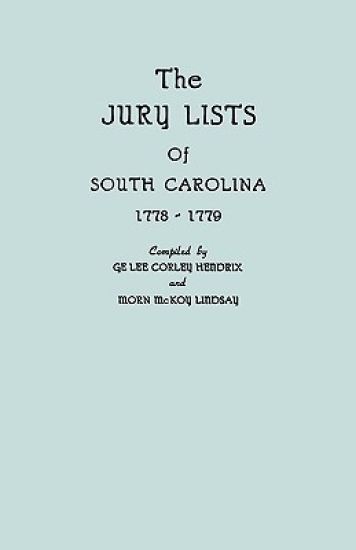
The Jury Lists of South Carolina, 1778-1779
Clearfield
2010
pokkari
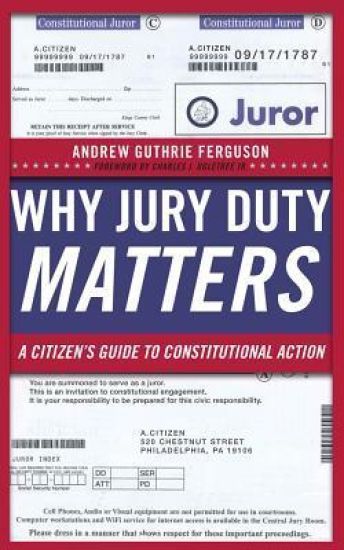
An argument for the constitutional responsibility to participate in jury duty It's easy to forget how important the jury really is to America. The right to be a juror is one of the fundamental rights guaranteed to all eligible citizens. The right to trial by jury helped spark the American Revolution, was quickly adopted at the Constitutional Convention, and is the only right that appears in both the Constitution and the Bill of Rights. But for most of us, a jury summons is an unwelcome inconvenience. Who has time for jury duty? We have things to do. In Why Jury Duty Matters, Andrew Guthrie Ferguson reminds us that whether we like it or not, we are all constitutional actors. Jury duty provides an opportunity to reflect on that constitutional responsibility. Combining American history, constitutional law, and personal experience, the book engages citizens in the deeper meaning of jury service. Interweaving constitutional principles into the actual jury experience, this book is a handbook for those Americans who want to enrich the jury experience. It seeks to reconnect ordinary citizens to the constitutional character of a nation by focusing on the important, and largely ignored, democratic lessons of the jury. Jury duty is a shared American tradition. It connects people across class and race, creates habits of focus and purpose, and teaches values of participation, equality, and deliberation. We know that juries are important for courts, but we don't know that jury service is important for democracy. This book inspires us to re-examine the jury experience and act on the constitutional principles that guide our country before, during, and after jury service.
An argument for the constitutional responsibility to participate in jury duty It's easy to forget how important the jury really is to America. The right to be a juror is one of the fundamental rights guaranteed to all eligible citizens. The right to trial by jury helped spark the American Revolution, was quickly adopted at the Constitutional Convention, and is the only right that appears in both the Constitution and the Bill of Rights. But for most of us, a jury summons is an unwelcome inconvenience. Who has time for jury duty? We have things to do. In Why Jury Duty Matters, Andrew Guthrie Ferguson reminds us that whether we like it or not, we are all constitutional actors. Jury duty provides an opportunity to reflect on that constitutional responsibility. Combining American history, constitutional law, and personal experience, the book engages citizens in the deeper meaning of jury service. Interweaving constitutional principles into the actual jury experience, this book is a handbook for those Americans who want to enrich the jury experience. It seeks to reconnect ordinary citizens to the constitutional character of a nation by focusing on the important, and largely ignored, democratic lessons of the jury. Jury duty is a shared American tradition. It connects people across class and race, creates habits of focus and purpose, and teaches values of participation, equality, and deliberation. We know that juries are important for courts, but we don't know that jury service is important for democracy. This book inspires us to re-examine the jury experience and act on the constitutional principles that guide our country before, during, and after jury service.
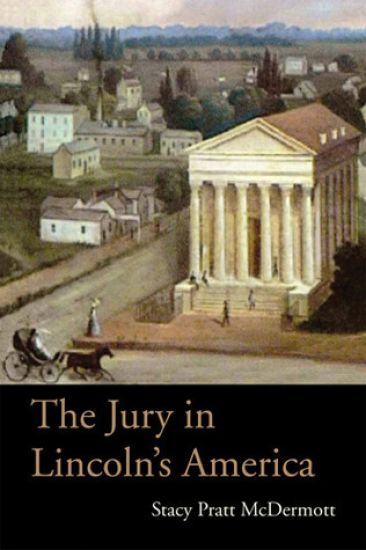
In the antebellum Midwest, Americans looked to the law, and specifically to the jury, to navigate the uncertain terrain of a rapidly changing society. During this formative era of American law, the jury served as the most visible connector between law and society. Through an analysis of the composition of grand and trial juries and an examination of their courtroom experiences, Stacy Pratt McDermott demonstrates how central the law was for people who lived in Abraham Lincoln's America. McDermott focuses on the status of the jury as a democratic institution as well as on the status of those who served as jurors. According to the 1860 census, the juries in Springfield and Sangamon County, Illinois, comprised an ethnically and racially diverse population of settlers from northern and southern states, representing both urban and rural mid-nineteenth-century America. It was in these counties that Lincoln developed his law practice, handling more than 5,200 cases in a legal career that spanned nearly twenty-five years. Drawing from a rich collection of legal records, docket books, county histories, and surviving newspapers, McDermott reveals the enormous power jurors wielded over the litigants and the character of their communities.
The Detective Team from The Librarian Checked Out is involved with another puzzle. Follow the Team as they pursue another mysterious puzzle to solve that will take you on an adventure.
Du Jury Criminel, Ses Origines, Son Recrutement, Son Fonctionnement
F. Valler
Hutson Street Press
2025
sidottu
Du Jury Criminel, Ses Origines, Son Recrutement, Son Fonctionnement
F Valler
Hutson Street Press
2025
pokkari
This book proposes using a ‘jury-centric approach’ for improving laws, practices, and procedures in jury trials. Courts assume that jurors in a criminal trial understand and apply the judge’s directions about the law. This assumption is based on jury verdicts and the courts’ observations of jurors and inferences about juror comprehension. Research reveals that the courts’ assumption about juror comprehension is fundamentally flawed. Addressing this problem is essential for fair trials. A jury-centric approach is evidence-informed and works within a fair trial framework. It asks what jurors need to understand the issues that they must determine. It also examines juror comprehension research and why judges and lawyers have often been sceptical about this research. The book illustrates and evaluates a jury-centric approach through three case studies involving structured decision-making aids, homicide laws, and misconceptions in sexual offence cases. The book proposes establishing an interdisciplinary Juries Advisory Council, drawing on judicial and legal expertise as well as expertise in jury research. The jury’s task is increasingly complicated. Reform is essential to help jurors understand their task and determine the issues on their legal and factual merits. The book will be a valuable resource for academics, researchers, policymakers, and students in the areas of Criminal Law, Courts, Human Rights Law, Psycholinguistics, and Organisational Psychology, and to judges and lawyers.
Police Jury Code of the Parish of East Feliciana, Louisiana
Gale Ecco, Making of Modern Law
2011
pokkari
Police Jury of Plaquemines Parish et al., Petitioners, V. United States. U.S. Supreme Court Transcript of Record with Supporting Pleadings
Leander H Perez; J Lee Rankin
Gale, U.S. Supreme Court Records
2011
pokkari