Kirjojen hintavertailu. Mukana 12 398 987 kirjaa ja 12 kauppaa.

Kirjahaku

Etsi kirjoja tekijän nimen, kirjan nimen tai ISBN:n perusteella.

1000 tulosta hakusanalla Kenyon Wright

Excavations by K.M. Kenyon in Jerusalem 1961–1967, Volume VI
In this volume the principal focus is on the presence/absence of the city walls on the east side of the city from the Iron Age onwards. The evidence for major walls and their structure from Iron Age II to the Byzantine periods in Sites S.II and R.II is described and substantial revisions suggested, as inter alia no evidence for the tenth century/Solomonic date in Site S.II as suggested by E. Mazar was uncovered. The strategic reasons for the location of the northern boundary of the earlier town is discussed in relation to evidence from Kenyon’s Site H. There is only sparse evidence for the PostExilic period in both areas. Parts of plastered basement rooms survived the destruction of AD 70. For the Roman period more evidence of the presence of the Roman army in the city is collated, including a possible watch tower, rare fragments of terra cottas and of fine imported South Gaulish pottery. Additionally John Hayes presents the catalogue of all the Late Roman fine wares from all remaining unpublished sites excavated by the Joint Expedition. Site S.II adds a little to the picture of the busy and extensive Byzantine city; and Site R.I provides a glimpse of extramural activities in the eighth/ninth centuries AD. A major contribution to the study of Ayyubid ceramics is provided by an assemblage from a large dump of the period. The analysis of iron working debris from Site L (the Armenian Garden) by Gethin and a reconsideration of the use of that area in Ayyubid and Mamluk times illustrates historical data, with ongoing activity in the late Ottoman period illustrated from Site S.II. The finds of the Ayyubid period were especially interesting for the insight provided into the lives of the inhabitants of the city.
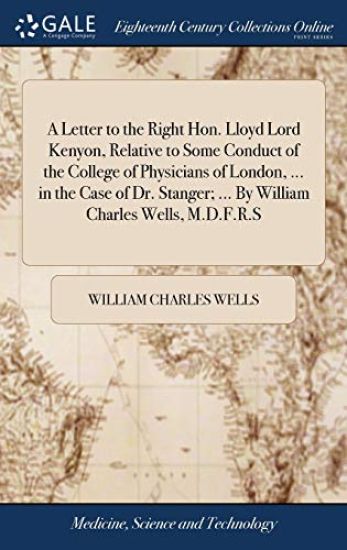
A Letter to the Right Hon. Lloyd Lord Kenyon, Relative to Some Conduct of the College of Physicians of London, ... in the Case of Dr. Stanger; ... By William Charles Wells, M.D.F.R.S
The 18th century was a wealth of knowledge, exploration and rapidly growing technology and expanding record-keeping made possible by advances in the printing press. In its determination to preserve the century of revolution, Gale initiated a revolution of its own: digitization of epic proportions to preserve these invaluable works in the largest archive of its kind. Now for the first time these high-quality digital copies of original 18th century manuscripts are available in print, making them highly accessible to libraries, undergraduate students, and independent scholars.Medical theory and practice of the 1700s developed rapidly, as is evidenced by the extensive collection, which includes descriptions of diseases, their conditions, and treatments. Books on science and technology, agriculture, military technology, natural philosophy, even cookbooks, are all contained here.++++The below data was compiled from various identification fields in the bibliographic record of this title. This data is provided as an additional tool in helping to insure edition identification: ++++British LibraryT009695London: printed by C. Whittingham, 1799. iv,136p.; 8
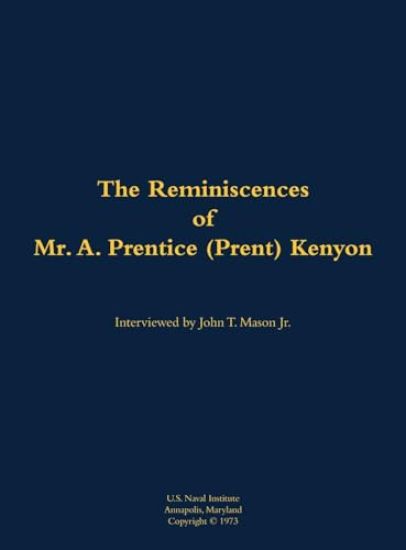
The Reminiscences of Mr. A. Prentice (Prent) Kenyon
Mr. Kenyon retired in 1973 after serving the Navy since 1941, first as an officer and later as a civil servant. In this memoir, he reviews the history of education and training in the Navy, organization within the Navy, transition from old to the current systems, some problems encountered along the way, tools of teaching, educational incentives, some officers who have been influential in the educational programs, and the future outlook for Navy education and training.
Adultery. Trial, in the Court of King's Bench, Before Lord Kenyon, and a Special Jury, Between Edward Dodwell, Esq. Plaintiff, and the Rev. Henry Bate Dudley, Defendant, for Crim. con. Second Edition
The 18th century was a wealth of knowledge, exploration and rapidly growing technology and expanding record-keeping made possible by advances in the printing press. In its determination to preserve the century of revolution, Gale initiated a revolution of its own: digitization of epic proportions to preserve these invaluable works in the largest archive of its kind. Now for the first time these high-quality digital copies of original 18th century manuscripts are available in print, making them highly accessible to libraries, undergraduate students, and independent scholars.This collection reveals the history of English common law and Empire law in a vastly changing world of British expansion. Dominating the legal field is the Commentaries of the Law of England by Sir William Blackstone, which first appeared in 1765. Reference works such as almanacs and catalogues continue to educate us by revealing the day-to-day workings of society.++++The below data was compiled from various identification fields in the bibliographic record of this title. This data is provided as an additional tool in helping to insure edition identification: ++++British LibraryT224207Half-title: 'Trial for adultery'.London: printed for H. D. Symonds, 1789. 4],44p.; 8
The Trial at Large of Sir Matthew White Ridley, Bart. ... for Criminal Conversation With the Wife of Mr William Brumwell, ... Before Lord Kenyon, at Guildhall, March 4th, 1793.
The 18th century was a wealth of knowledge, exploration and rapidly growing technology and expanding record-keeping made possible by advances in the printing press. In its determination to preserve the century of revolution, Gale initiated a revolution of its own: digitization of epic proportions to preserve these invaluable works in the largest archive of its kind. Now for the first time these high-quality digital copies of original 18th century manuscripts are available in print, making them highly accessible to libraries, undergraduate students, and independent scholars.This collection reveals the history of English common law and Empire law in a vastly changing world of British expansion. Dominating the legal field is the Commentaries of the Law of England by Sir William Blackstone, which first appeared in 1765. Reference works such as almanacs and catalogues continue to educate us by revealing the day-to-day workings of society.++++The below data was compiled from various identification fields in the bibliographic record of this title. This data is provided as an additional tool in helping to insure edition identification: ++++Harvard University Law LibraryN013757Newcastle: printed by and for Joseph Whitfield, and sold by him, and Mr. Wm. Richardson, London, 1793]. 48p.; 8
Trial for Adultery, in Westminster Hall, on Wednesday, December 9, 1789, Before Lord Kenyon, John Parslow, Esq. Plaintiff, and Francis William Sykes, Esq. Defendant, for Criminal Conversation With the Plaintiff's Wife A new Edition
The 18th century was a wealth of knowledge, exploration and rapidly growing technology and expanding record-keeping made possible by advances in the printing press. In its determination to preserve the century of revolution, Gale initiated a revolution of its own: digitization of epic proportions to preserve these invaluable works in the largest archive of its kind. Now for the first time these high-quality digital copies of original 18th century manuscripts are available in print, making them highly accessible to libraries, undergraduate students, and independent scholars.This collection reveals the history of English common law and Empire law in a vastly changing world of British expansion. Dominating the legal field is the Commentaries of the Law of England by Sir William Blackstone, which first appeared in 1765. Reference works such as almanacs and catalogues continue to educate us by revealing the day-to-day workings of society.++++The below data was compiled from various identification fields in the bibliographic record of this title. This data is provided as an additional tool in helping to insure edition identification: ++++British LibraryT002993With a half-title. Edition statement at head of title.London: printed for J. Ridgway, 1789. 4],55, 1]p.; 8