

Kirjahaku
Etsi kirjoja tekijän nimen, kirjan nimen tai ISBN:n perusteella.
1000 tulosta hakusanalla Lawrence J. Epstein




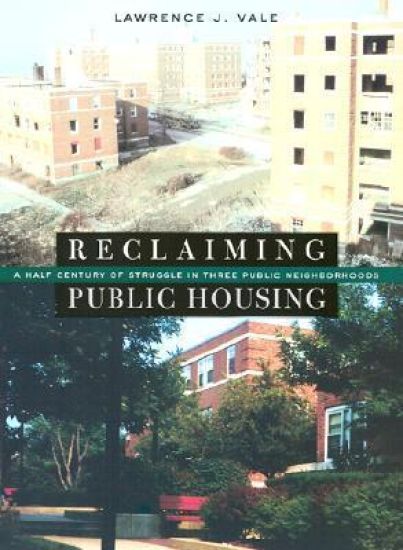
In Reclaiming Public Housing, Lawrence Vale explores the rise, fall, and redevelopment of three public housing projects in Boston. Vale looks at these projects from the perspectives of their low-income residents and assesses the contributions of the design professionals who helped to transform these once devastated places during the 1980s and 1990s. The three similarly designed projects were built at the same time under the same government program and experienced similar declines. Each received comparable funding for redevelopment, and each design team consisted of first-rate professionals who responded with similar "defensible space" redesign plans. Why, then, was one redevelopment effort a nationally touted success story, another only a mixed success, and the third a widely acknowledged failure? The book answers this key question by situating each effort in the context of specific neighborhood struggles. In each case, battles over race and poverty played out somewhat differently, yielding wildly different results.At a moment when local city officials throughout America are demolishing more than 100,000 units of low-income housing, this crucial book questions the conventional wisdom that all large public housing projects must be demolished and rebuilt as mixed-income neighborhoods.

From the almshouses of seventeenth-century Puritans to the massive housing projects of the mid-twentieth century, the struggle over housing assistance in the United States has exposed a deep-seated ambivalence about the place of the urban poor. Lawrence J. Vale's groundbreaking book is both a comprehensive institutional history of public housing in Boston and a broader examination of the nature and extent of public obligation to house socially and economically marginal Americans during the past 350 years. First, Vale highlights startling continuities both in the way housing assistance has been delivered to the American poor and in the policies used to reward the nonpoor. He traces the stormy history of the Boston Housing Authority, a saga of entrenched patronage and virulent racism tempered, and partially overcome, by the efforts of unyielding reformers. He explores the birth of public housing as a program intended to reward the upwardly mobile working poor, details its painful transformation into a system designed to cope with society's least advantaged, and questions current policy efforts aimed at returning to a system of rewards for responsible members of the working class. The troubled story of Boston public housing exposes the mixed motives and ideological complexity that have long characterized housing in America, from the Puritans to the projects.

The Teleology of Poetics in Medieval Kashmir
Lawrence J. McCrea
Harvard University Press
2009
sidottu
This book examines the revolution in Sanskrit poetics initiated by the ninth-century Kashmiri Anandavardhana. Anandavardhana replaced the formalist aesthetic of earlier poeticians with one stressing the unifunctionality of literary texts, arguing that all components of a work should subserve a single purpose—the communication of a single emotional mood (rasa). Attention was redirected from formal elements toward specific poems, viewed as aesthetically integrated wholes, thereby creating new literary critical possibilities.Anandavardhana’s model of textual coherence, along with many key analytic concepts, are rooted in the hermeneutic theory of the Mimamsakas (Vedic Exegetes). Like Anandavardhana, the Mimamsakas made the unifunctionality of texts their most basic interpretive principle.While Anandavardhana’s teleological approach to textual analysis gained rapid acceptance among the Kashmiri poeticians, another aspect of his theory became controversial. He argued that rasa, and certain other poetic meanings, cannot be conveyed by recognized semantic processes, and therefore postulated a new semantic function, dhvani (“suggestion”) to account for them. The controversy over this “suggestion” rapidly became the central topic in poetics, to the exclusion of teleologically based criticism. While dhvani ultimately gained universal acceptance among Sanskrit poeticians, the conflict over its existence, ironically, marginalized Anandavardhana’s preferred approach to poetic analysis.


Industrial Concentration and Economic Power in Pakistan
Lawrence J. White
Princeton University Press
2015
pokkari
Although observers of the Pakistani economy are well aware that a small number of family groups, popularly called "the twenty-two families," dominates the industrial structure of the country, the actual effects of this concentration of economic power on income distribution and on other areas of widespread social and political concern arc less well understood. In this important work, Lawrence J. White uses the concepts of industrial organization analysis to achieve an overall view of the problems stemming from the marked industrial concentration in Pakistan. After discussing the economic effects of industrial concentration as they apply generally to less developed countries, Professor White reviews the Pakistani experience, estimating the overall concentration of power that exists in manufacturing, banking, and insurance. Following an estimate of the extent of concentration in individual markets, he examines the origins of this concentration of power and analyzes its economic and noneconomic effects in Pakistan. The author concludes with a review of the policies that Pakistan has pursued in dealing with industrial concentration and suggests new courses of action for the future. Originally published in 1974. The Princeton Legacy Library uses the latest print-on-demand technology to again make available previously out-of-print books from the distinguished backlist of Princeton University Press. These editions preserve the original texts of these important books while presenting them in durable paperback and hardcover editions. The goal of the Princeton Legacy Library is to vastly increase access to the rich scholarly heritage found in the thousands of books published by Princeton University Press since its founding in 1905.
Industrial Concentration and Economic Power in Pakistan
Lawrence J. White
Princeton University Press
2016
sidottu
Although observers of the Pakistani economy are well aware that a small number of family groups, popularly called "the twenty-two families," dominates the industrial structure of the country, the actual effects of this concentration of economic power on income distribution and on other areas of widespread social and political concern arc less well understood. In this important work, Lawrence J. White uses the concepts of industrial organization analysis to achieve an overall view of the problems stemming from the marked industrial concentration in Pakistan. After discussing the economic effects of industrial concentration as they apply generally to less developed countries, Professor White reviews the Pakistani experience, estimating the overall concentration of power that exists in manufacturing, banking, and insurance. Following an estimate of the extent of concentration in individual markets, he examines the origins of this concentration of power and analyzes its economic and noneconomic effects in Pakistan. The author concludes with a review of the policies that Pakistan has pursued in dealing with industrial concentration and suggests new courses of action for the future. Originally published in 1974. The Princeton Legacy Library uses the latest print-on-demand technology to again make available previously out-of-print books from the distinguished backlist of Princeton University Press. These editions preserve the original texts of these important books while presenting them in durable paperback and hardcover editions. The goal of the Princeton Legacy Library is to vastly increase access to the rich scholarly heritage found in the thousands of books published by Princeton University Press since its founding in 1905.


Today's Technological progress is mankind's greatest achievement, but may lead to total destruction. Technological progress consumes more than it produces, it pursues its own ends not that of humanity's and cannot accelerate indefinitely on a planet with finite resources. Jacques Ellul noted " t]echnique (technology) has its limits. But when it has reached those limits, will anything exist outside them . . . is it (technological acceleration) not succeeding in undermining everything which is outside it?" (Ellul 1964, 85) Once technological limits are reached will anything be left? Transhumanists expect that technological acceleration will culminate by mid-century in an event they call the "Singularity" a technological Omega Point or convergence of human and artificial intelligence that will give rise to a god-like super computer (Artilect) which promises a century of progress in one hour.Despite apparent immediate gains, technology makes the human plight worse through exhaustion of resources and spiritual slavery. The Singularity will mark the end of technological progress as it reaches completion without redressing the spiritual problem inherent to the human condition. This means that all who step into the Singularity will enter a void, a digital black hole. The solution is as simple as the problem is sublime, step away from the edge of the abyss slowly.

Inside: The Early Years: A Young Catholic's Search for His Place in the Sun
Lawrence J. Fedewa
Richfield Press
2017
nidottu
From the Depression to the Cold War and the beginnings of the Vietnam War, young Larry Fedewa's early life was filled with excitement, tragedy and family drama. He sought refuge and purpose in the idealism and safety of a Catholic seminary only to see his ideals shattered by the priests he encountered. Not to be deterred, he chose to continue his quest for a saintly life in a Trappist monastery. But circumstances cause his detour to a summer trip through Europe, where his many adventures as a hitchhiking student, singer, clothes model and vagabond introduce him to a medley of beautiful girls and change his direction. What happens when he finally arrives at the monastery and its aftermath leads to more adventures back in the USA. The author is a political columnist and frequent guest on radio and television. He tells his story in simple prose and powerful poetry. Written at the time of the story, the poems reveal intimate insights into his feelings and innermost thoughts as events occur. This combination of prose and poetry provides a unique journey for the reader.