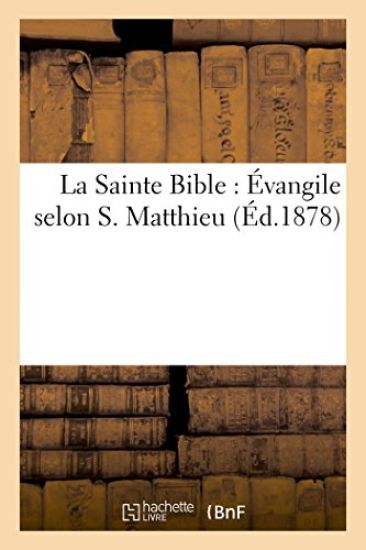
La Sainte Bible: texte de la Vulgate, traduction francaise en regard avec commentaires.... Evangile selon S. Matthieu / introduction critique, et commentaires par M. l'abbe L. Cl. Fillion, ...; traduction francaise par M. l'abbe Bayle, ...Date de l'edition originale: 1878" Bible (latin-francais). 1873-1911]"Ce livre est la reproduction fidele d'une oeuvre publiee avant 1920 et fait partie d'une collection de livres reimprimes a la demande editee par Hachette Livre, dans le cadre d'un partenariat avec la Bibliotheque nationale de France, offrant l'opportunite d'acceder a des ouvrages anciens et souvent rares issus des fonds patrimoniaux de la BnF.Les oeuvres faisant partie de cette collection ont ete numerisees par la BnF et sont presentes sur Gallica, sa bibliotheque numerique.En entreprenant de redonner vie a ces ouvrages au travers d'une collection de livres reimprimes a la demande, nous leur donnons la possibilite de rencontrer un public elargi et participons a la transmission de connaissances et de savoirs parfois difficilement accessibles.Nous avons cherche a concilier la reproduction fidele d'un livre ancien a partir de sa version numerisee avec le souci d'un confort de lecture optimal. Nous esperons que les ouvrages de cette nouvelle collection vous apporteront entiere satisfaction.Pour plus d'informations, rendez-vous sur www.hachettebnf.fr
Papartchu Dropa tt, prince des d tectives priv s, est disparu. Sans tre cliniquement mort, il est math matiquement D X C X D = DCD . Ayant men une enqu te internationale qui l'a conduit de Montr al Boston en passant par West Forks (Maine), notre h ros est disparu apr s avoir mis au jour un complot gigantesque vivant assujettir l'humanit par la bouffe. Il vient nous raconter l'histoire de sa disparition. Nous sommes ce que nous mangeons, affirme l'un des personnages de ce road movie sans le movie - ou, comme le dit si bien le proverbe cannibale: dis-moi qui tu manges, je te dirai qui tu es. M me si notre h ros se fera horriblement cuisiner par les m chants de l'histoire et que le roman comporte une infaillible recette de torture, La Mort aux dents N'EST PAS un livre de cuisine. Papartchu Dropa tt est d j l'auteur de plusieurs polars humoristiques qui se sont vendus plus de 10 000 exemplaires. propos des aventures de Papartchu Dropa tt: Son roman rotico-policier est plein d'humour... R ginald Martel, La Presse (il) poss de un v ritable g nie des jeux de mots et le talent d'inventer une criture originale, ennemie des clich s et amoureuse du sens qu b cois des expressions. Louis-Guy Lemieux, Le Soleil Un livre que je vous conseille bien fort de lire pour rire intelligemment... Fran ois Piazza, Le Dimanche Cette recette donne des livres souvent amusants. Et c'est ce qui se produit ici. Le lecteur n'a pas l'impression que l'auteur se prend trop au s rieux. Cette d sinvolture devient rare et c'est dommage. (...) Il y a dans cette attitude quelque chose de sain, qui rassure. Gilles R. Archambault, Le Canada fran ais D licieuse satire... Nathalie Petrowski, Le Devoir L'essentiel c'est qu'on ne s'ennuie pas une seconde. (...) Il y a trop de bonne sant psychologique (et physiologique) chez Papartchu Dropa tt pour ne pas reconna tre en lui cet humour bien qu b cois (...) auquel, crivain trop rare, l'enqu teur apporte sa contribution. R ginald Martel, La Presse Un livre d bordant d'humour, de jeux de mots et de rires. Le Quotidien Si vous ne connaissez pas encore notre aventurier-qu b cois-h ros Papartchu Dropa tt, laissez-moi vous dire que vous manquez quelque chose. Gilles Gemme, Le Canada fran ais (...) l'auteur jongle en virtuose avec les mots et les phrases. (...) L'auteur qui se cache derri re Papartchu Dropa tt ne peut se comparer quiconque. Sauf peut- tre Sol... Louis-Guy Lemieux, Le Soleil Comme le tout est bien agenc , c'est un livre formidablement distrayant qui, comme celui qui l'a pr c d , fait appel l'intelligence de son lecteur pour le faire rire, et ma foi, il y r ussit tr s bien Fran ois Piazza, Le DimanchPour en savoir plus sur l'auteur, voir la page qui lui est consacr e dans l'encyclop die Wikip dia: https: //fr.wikipedia.org/wiki/Fran%C3%A7ois-Marie_G%C3%A9rin
Winner of the 2025 Pulitzer Prize for Explanatory Reporting - A New York Times Book Review Editor's Choice "This is a book of radical empathy, crossing many borders--not just borders that separate nations, but also borders of form, borders of meaning, and borders of possibility. It is powerful and humane and deserves to find a wide, wandering readership."--Mohsin Hamid, author of Exit WestIn this extraordinary book, an acclaimed young war reporter chronicles a dangerous journey on the smuggler's road to Europe, accompanying his friend, an Afghan refugee, in search of a better future.In 2016, a young Afghan driver and translator named Omar makes the heart-wrenching choice to flee his war-torn country, saying goodbye to Laila, the love of his life, without knowing when they might be reunited again. He is one of millions of refugees who leave their homes that year.Matthieu Aikins, a journalist living in Kabul, decides to follow his friend. In order to do so, he must leave his own passport and identity behind to go underground on the refugee trail with Omar. Their odyssey across land and sea from Afghanistan to Europe brings them face to face with the people at heart of the migration crisis: smugglers, cops, activists, and the men, women and children fleeing war in search of a better life. As setbacks and dangers mount for the two friends, Matthieu is also drawn into the escape plans of Omar's entire family, including Maryam, the matriarch who has fought ferociously for her children's survival. Harrowing yet hopeful, this exceptional work brings into sharp focus one of the most contentious issues of our times. The Naked Don't Fear the Water is a tale of love and friendship across borders, and an inquiry into our shared journey in a divided world.
Winner of the 2025 Pulitzer Prize for Explanatory Reporting - A New York Times Book Review Editor's Choice "This is a book of radical empathy, crossing many borders--not just borders that separate nations, but also borders of form, borders of meaning, and borders of possibility. It is powerful and humane and deserves to find a wide, wandering readership."--Mohsin Hamid, author of Exit WestIn this extraordinary book, an acclaimed young war reporter chronicles a dangerous journey on the smuggler's road to Europe, accompanying his friend, an Afghan refugee, in search of a better future.In 2016, a young Afghan driver and translator named Omar makes the heart-wrenching choice to flee his war-torn country, saying goodbye to Laila, the love of his life, without knowing when they might be reunited again. He is one of millions of refugees who leave their homes that year.Matthieu Aikins, a journalist living in Kabul, decides to follow his friend. In order to do so, he must leave his own passport and identity behind to go underground on the refugee trail with Omar. Their odyssey across land and sea from Afghanistan to Europe brings them face to face with the people at heart of the migration crisis: smugglers, cops, activists, and the men, women and children fleeing war in search of a better life. As setbacks and dangers mount for the two friends, Matthieu is also drawn into the escape plans of Omar's entire family, including Maryam, the matriarch who has fought ferociously for her children's survival. Harrowing yet hopeful, this exceptional work brings into sharp focus one of the most contentious issues of our times. The Naked Don't Fear the Water is a tale of love and friendship across borders, and an inquiry into our shared journey in a divided world.
Marine geochemistry uses chemical elements and their isotopes to study how the ocean works in terms of ocean circulation, chemical composition, biological activity and atmospheric CO2 regulation. This rapidly growing field is at a crossroad for many disciplines (physical, chemical and biological oceanography, geology, climatology, ecology, etc.). It provides important quantitative answers to questions such as: What is the deep ocean mixing rate? How much atmospheric CO2 is pumped by the ocean? How fast are pollutants removed from the ocean? How do ecosystems react to anthropogenic pressure? This text gives a simple introduction to the concepts, the methods and the applications of marine geochemistry with a particular emphasis on isotopic tracers. Overall introducing a very large number of topics (physical oceanography, ocean chemistry, isotopes, gas exchange, modelling, biogeochemical cycles), with a balance of didactic and indepth information, it provides an outline and a complete course in marine geochemistry. Throughout, the book uses a hands-on approach with worked out exercises and problems (with answers provided at the end of the book), to help the students work through the concepts presented. A broad scale approach is take including ocean physics, marine biology, ocean-climate relations, remote sensing, pollutions and ecology, so that the reader acquires a global perspective of the ocean. It also includes new topics arising from ongoing research programs. This textbook is essential reading for students, scholars, researchers and other professionals.
Marine geochemistry uses chemical elements and their isotopes to study how the ocean works in terms of ocean circulation, chemical composition, biological activity and atmospheric CO2 regulation. This rapidly growing field is at a crossroad for many disciplines (physical, chemical and biological oceanography, geology, climatology, ecology, etc.). It provides important quantitative answers to questions such as: What is the deep ocean mixing rate? How much atmospheric CO2 is pumped by the ocean? How fast are pollutants removed from the ocean? How do ecosystems react to anthropogenic pressure? This text gives a simple introduction to the concepts, the methods and the applications of marine geochemistry with a particular emphasis on isotopic tracers. Overall introducing a very large number of topics (physical oceanography, ocean chemistry, isotopes, gas exchange, modelling, biogeochemical cycles), with a balance of didactic and indepth information, it provides an outline and a complete course in marine geochemistry. Throughout, the book uses a hands-on approach with worked out exercises and problems (with answers provided at the end of the book), to help the students work through the concepts presented. A broad scale approach is take including ocean physics, marine biology, ocean-climate relations, remote sensing, pollutions and ecology, so that the reader acquires a global perspective of the ocean. It also includes new topics arising from ongoing research programs. This textbook is essential reading for students, scholars, researchers and other professionals.
This is an open access title available under the terms of a CC BY-NC-ND 4.0 International licence. It is free to read at Oxford Scholarship Online and offered as a free PDF download from OUP and selected open access locations. Why did such highly abstract ideas as truth, knowledge, or justice become so important to us? What was the point of coming to think in these terms? In The Practical Origins of Ideas Matthieu Queloz presents a philosophical method designed to answer such questions: the method of pragmatic genealogy. Pragmatic genealogies are partly fictional, partly historical narratives exploring what might have driven us to develop certain ideas in order to discover what these do for us. The book uncovers an under-appreciated tradition of pragmatic genealogy which cuts across the analytic-continental divide, running from the state-of-nature stories of David Hume and the early genealogies of Friedrich Nietzsche to recent work in analytic philosophy by Edward Craig, Bernard Williams, and Miranda Fricker. However, these genealogies combine fictionalizing and historicizing in ways that even philosophers sympathetic to the use of state-of-nature fictions or real history have found puzzling. To make sense of why both fictionalizing and historicizing are called for, this book offers a systematic account of pragmatic genealogies as dynamic models serving to reverse-engineer the points of ideas in relation not only to near-universal human needs, but also to socio-historically situated needs. This allows the method to offer us explanation without reduction and to help us understand what led our ideas to shed the traces of their practical origins. Far from being normatively inert, moreover, pragmatic genealogy can affect the space of reasons, guiding attempts to improve our conceptual repertoire by helping us determine whether and when our ideas are worth having.
Philosophy strives to give us a firmer hold on our concepts. But what about their hold on us? Why place ourselves under the sway of a concept and grant it the authority to shape our thought and conduct? Another conceptualization would carry different implications. What makes one way of thinking better than another? The Ethics of Conceptualization develops a framework for concept appraisal. Its guiding idea is that to question the authority of concepts is to ask for reasons of a special kind: reasons for concept use, which tell us which concepts to adopt, adhere to, or abandon, thereby shoring up—or undercutting—the reasons for action and belief that guide our deliberations. Traditionally, reasons for concept use have been sought either in timeless rational foundations or in concepts' inherent virtues, such as precision and consistency. Against this, the book advances two main claims: that we find reasons for concept use in the conceptual needs we discover when we critically distance ourselves from a concept by viewing it from the autoethnographic stance; and that sometimes, concepts that conflict, or exhibit other vices such as vagueness or superficiality, are just what we need. By considering which concepts we need rather than which are absolutely best, we can reconcile ourselves to the contingency of our concepts, determine the proper place of efforts to tidy up thought, and adjudicate between competing conceptions of things—even things as contested as liberty or free will. A needs-based approach separates helpful clarification from hobbling tidy-mindedness, and authoritative definition from conceptual gerrymandering. This is an open access title available under the terms of a CC BY-NC-ND 4.0 International licence. It is free to read on the Oxford Academic platform and offered as a free PDF download from OUP and selected open access locations.
Why do great powers go to war? Why are non-violent, diplomatic options not prioritized? Nostalgic Virility as a Cause of War argues that world leaders react to status decline by going to war, guided by a nostalgic, virile understanding of what it means to be powerful. This nostalgic virility – a system of subjective beliefs about power, bravery, strength, morality, and health – acts as a filter through which leaders articulate glorified interpretations of history and assess their power and their country's status on the international stage.In this rigorous study of France, the United Kingdom, and the United States, Matthieu Grandpierron tests the theory of nostalgic virility against the two more common theoretical frameworks of realism and the diversionary theory of war. Consulting thousands of newly declassified government documents at the highest levels of decision making, Grandpierron examines three specific cases – the early years of the Indochina War (1945–47), the British reconquest of the Falklands in 1982, and the US invasion of Grenada in 1983 – convincingly contending that status-seeking behaviour and nostalgic virility are more relevant in explaining why a leader chooses war and conflict over non-violent, diplomatic options than the dominant frameworks.Looking to the recent past, Nostalgic Virility as a Cause of War considers how this new model can be applied to current conflicts – from the Russian war in Ukraine to Chinese actions in the South China Sea – and provides surprising ways of thinking about the relationship between power, decision makers, and causes of war.