Kirjojen hintavertailu. Mukana 12 390 323 kirjaa ja 12 kauppaa.

Kirjahaku

Etsi kirjoja tekijän nimen, kirjan nimen tai ISBN:n perusteella.

1000 tulosta hakusanalla Michael Terry

Key Concepts in Creative Industries

Key Concepts in Creative Industries

John Hartley; Jason Potts; Stuart Cunningham; Terry Flew; Michael Keane; John Banks

SAGE Publications Ltd
2012
sidottu
This guide to the emerging language of creative industries field is a valuable resource for researchers and students alike. Concise, extensively referenced, and accessible, this this is an exceptionally useful reference work. - Gauti Sigthorsson, Greenwich University "There could be no better guides to the conceptual map of the creative industries than John Hartley and his colleagues, pioneers in the field. This book is a clear, comprehensive and accessible tool-kit of ideas, concepts, questions and discussions which will be invaluable to students and practitioners alike. Key Concepts in Creative Industries is set to become the corner stone of an expanding and exciting field of study" - Chris Barker, University of Wollongong Creativity is an attribute of individual people, but also a feature of organizations like firms, cultural institutions and social networks. In the knowledge economy of today, creativity is of increasing value, for developing, emergent and advanced countries, and for competing cities. This book is the first to present an organized study of the key concepts that underlie and motivate the field of creative industries. Written by a world-leading team of experts, it presents readers with compact accounts of the history of terms, the debates and tensions associated with their usage, and examples of how they apply to the creative industries around the world. Crisp and relevant, this is an invaluable text for students of the creative industries across a range of disciplines, especially media, communication, economics, sociology, creative and performing arts and regional studies.
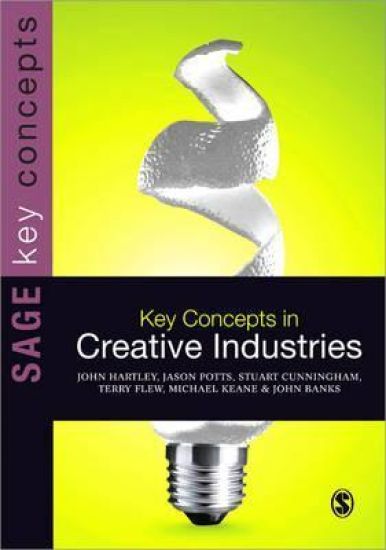
Key Concepts in Creative Industries

Key Concepts in Creative Industries

John Hartley; Jason Potts; Stuart Cunningham; Terry Flew; Michael Keane; John Banks

SAGE Publications Ltd
2012
nidottu
This guide to the emerging language of creative industries field is a valuable resource for researchers and students alike. Concise, extensively referenced, and accessible, this this is an exceptionally useful reference work. - Gauti Sigthorsson, Greenwich University "There could be no better guides to the conceptual map of the creative industries than John Hartley and his colleagues, pioneers in the field. This book is a clear, comprehensive and accessible tool-kit of ideas, concepts, questions and discussions which will be invaluable to students and practitioners alike. Key Concepts in Creative Industries is set to become the corner stone of an expanding and exciting field of study" - Chris Barker, University of Wollongong Creativity is an attribute of individual people, but also a feature of organizations like firms, cultural institutions and social networks. In the knowledge economy of today, creativity is of increasing value, for developing, emergent and advanced countries, and for competing cities. This book is the first to present an organized study of the key concepts that underlie and motivate the field of creative industries. Written by a world-leading team of experts, it presents readers with compact accounts of the history of terms, the debates and tensions associated with their usage, and examples of how they apply to the creative industries around the world. Crisp and relevant, this is an invaluable text for students of the creative industries across a range of disciplines, especially media, communication, economics, sociology, creative and performing arts and regional studies.
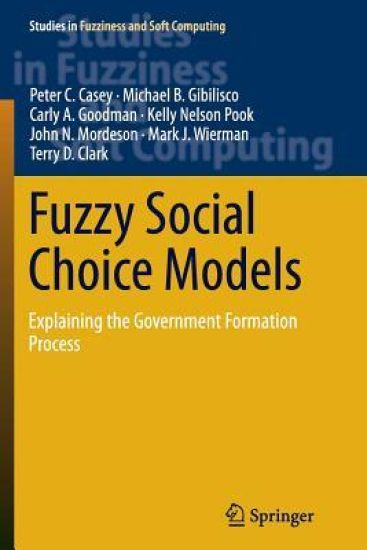
Fuzzy Social Choice Models

Fuzzy Social Choice Models

Peter C. Casey; Michael B. Gibilisco; Carly A. Goodman; Kelly Nelson Pook; John N. Mordeson; Mark J. Wierman; Terry D. Clark

Springer International Publishing AG
2014
sidottu
This book explores the extent to which fuzzy set logic can overcome some of the shortcomings of public choice theory, particularly its inability to provide adequate predictive power in empirical studies. Especially in the case of social preferences, public choice theory has failed to produce the set of alternatives from which collective choices are made. The book presents empirical findings achieved by the authors in their efforts to predict the outcome of government formation processes in European parliamentary and semi-presidential systems. Using data from the Comparative Manifesto Project (CMP), the authors propose a new approach that reinterprets error in the coding of CMP data as ambiguity in the actual political positions of parties on the policy dimensions being coded. The range of this error establishes parties’ fuzzy preferences. The set of possible outcomes in the process of government formation is then calculated on the basis of both the fuzzy Pareto set and the fuzzy maximal set, and the predictions are compared with those made by two conventional approaches as well as with the government that was actually formed. The comparison shows that, in most cases, the fuzzy approaches outperform their conventional counterparts.
Fuzzy Social Choice Models

Fuzzy Social Choice Models

Peter C. Casey; Michael B. Gibilisco; Carly A. Goodman; Kelly Nelson Pook; John N. Mordeson; Mark J. Wierman; Terry D. Clark

Springer International Publishing AG
2016
nidottu
This book explores the extent to which fuzzy set logic can overcome some of the shortcomings of public choice theory, particularly its inability to provide adequate predictive power in empirical studies. Especially in the case of social preferences, public choice theory has failed to produce the set of alternatives from which collective choices are made. The book presents empirical findings achieved by the authors in their efforts to predict the outcome of government formation processes in European parliamentary and semi-presidential systems. Using data from the Comparative Manifesto Project (CMP), the authors propose a new approach that reinterprets error in the coding of CMP data as ambiguity in the actual political positions of parties on the policy dimensions being coded. The range of this error establishes parties’ fuzzy preferences. The set of possible outcomes in the process of government formation is then calculated on the basis of both the fuzzy Pareto set and the fuzzy maximal set, and the predictions are compared with those made by two conventional approaches as well as with the government that was actually formed. The comparison shows that, in most cases, the fuzzy approaches outperform their conventional counterparts.
Single Subject Designs in Biomedicine

Single Subject Designs in Biomedicine

Janine E. Janosky; Shelley L. Leininger; Michael P. Hoerger; Terry M. Libkuman

Springer
2009
sidottu
Single Subject Designs in Biomedicine draws upon the rich history of single case research within the educational and behavioral research settings and extends the application to the field of biomedicine. Biomedical illustrations are used to demonstrate the processes of designing, implementing, and evaluating a single subject design. Strengths and limitations of various methodologies are presented, along with specific clinical areas of application in which these applications would be appropriate. Statistical and visual techniques for data analysis are also discussed. The breadth and depth of information provided is suitable for medical students in research oriented courses, primary care practitioners and medical specialists seeking to apply methods of evidence practice to improve patient care, and medical researchers who are expanding their methodological expertise to include single subject designs. Increasing awareness of the utility in the single subject design could enhance treatment approach and evaluation both in biomedical research and medical care settings.
Single Subject Designs in Biomedicine

Single Subject Designs in Biomedicine

Janine E. Janosky; Shelley L. Leininger; Michael P. Hoerger; Terry M. Libkuman

Springer
2014
nidottu
Single Subject Designs in Biomedicine draws upon the rich history of single case research within the educational and behavioral research settings and extends the application to the field of biomedicine. Biomedical illustrations are used to demonstrate the processes of designing, implementing, and evaluating a single subject design. Strengths and limitations of various methodologies are presented, along with specific clinical areas of application in which these applications would be appropriate. Statistical and visual techniques for data analysis are also discussed. The breadth and depth of information provided is suitable for medical students in research oriented courses, primary care practitioners and medical specialists seeking to apply methods of evidence practice to improve patient care, and medical researchers who are expanding their methodological expertise to include single subject designs. Increasing awareness of the utility in the single subject design could enhance treatment approach and evaluation both in biomedical research and medical care settings.
Evaluation of the New York City Police Department Firearm Training and Firearm-discharge Review Process

Evaluation of the New York City Police Department Firearm Training and Firearm-discharge Review Process

Bernard D. Rostker; Lawrence M. Hanser; William Michael Hix; Carl Jensen; Andrew R. Morral; Greg Ridgeway; Terry L. Schell

RAND
2008
pokkari
In January 2007, New York City Police Commissioner Raymond W. Kelly asked the RAND Corporation to examine the quality and completeness of the New York City Police Department's firearm-training program and identify potential improvements in it and in the police department's firearm-discharge review process. This monograph reports the observations, findings, and recommendations of that study.In January 2007, New York City Police Commissioner Raymond W. Kelly asked the RAND Corporation to examine his department's firearm training and firearm-discharge review. This monograph reports the authors' observations, findings, and recommendations.
Mental Health Stigma in the Military

Mental Health Stigma in the Military

Joie D. Acosta; Amariah Becker; Jennifer L. Cerully; Michael P. Fisher; Laurie T. Martin; Raffaele Vardavas; Mary Ellen Slaughter; Terry L. Schell

RAND
2014
pokkari
This report assesses the U.S. military s approach to reducing stigma for mental health disorders and their treatment, how well it is working, and how it might be improved. It presents priorities for program and policy development and research and evaluation to get service members the treatment they need as efficiently and effectively as possible."
Archipelago

Archipelago

Andrew McNellie; Norman Ackroyd; John Brannigan; Moya Cannon; Mark Cocker; Peter Davidson; Roger Deakin; Tim Dee; David Douglas; Douglas Dunn; Terry Eagleton; John Eifion Jones; John Elder; Rose Ferraby; Barbara Greg; Ivor Gurney; Alexandra Harris; Seamus Heaney; Geoffrey Hill; Sally Huband; Roger Hutchinson; Mick Imlah; Kathleen Jamie; John Kerrigan; Philip Lancaster; David Lea; Angela Leighton; Gwyneth Lewis; Michael Longley; James Macdonald Lockhart; Robert Macfarlane; Angus Macmillan; Derek Mahon; Gail McNeillie

The Lilliput Press Ltd
2021
nidottu
Archipelago is one of the most important and influential literary magazines of the last twenty years. Running to twelve editions, it was edited by Andrew McNeillie, with the assistance later of James McDonald Lockhart, and began as an attempt to reimagine the relationships between the islands of Ireland and Britain. Archipelago has brought together established and emerging artists in creative conversations that have transformed the study of islands, coasts and waterways. It journeys from the Shetlands to Cornwall, from the Aran Islands to the coast of Yorkshire, tracing the cultures of diverse zones through some of the best in contemporary writing about place and people. This collection gathers poetry, prose and visual art in clusters grouped around the Irish and British archipelago, with contributions from an array of significant artists. It includes newly commissioned work as well as an interview between Andrew McNeillie and Robert Macfarlane on the development of Archipelago across the years.
Elsinore: The City of Hate Conspiracy

Elsinore: The City of Hate Conspiracy

Blair Woodcock; Terry Michaels

Createspace Independent Publishing Platform
2017
nidottu
The Elsinore story is a noir based on actual events that took place in a small resort town in the late 1950's. During this time, Southern California had suffered one of its most devastating droughts in history. When spring levels dropped in Elsinore, fluoride percentages rose to an alarming high. Authorities responded quickly, issuing a state mandate to shut off Elsinore's cherished mineral water. This hurt Jewish-owned businesses that profited from spring water. Communist agitators living in Elsinore insisted that the water was safe, alleging a government conspiracy to drive Jews out of Elsinore. While under investigation for communist activity, these agitators organized a forceful movement, dominated the local newspaper and successfully overthrew every city seat. This positioned newly elected officials to take on the State and assume control of Elsinore's water. To further their cause, ringleaders solicited the help of KTLA reporter Pat Michaels. After "investigating" the Elsinore story, Michaels aired an hour-long television documentary entitled "City of Hate". The program was filled with numerous assertions that local water was shut off to "rid the town of Jews." After the broadcast was aired, state agents included Pat Michaels in their investigations. This led to multiple grand jury indictments against him, Elsinore's newly elected officials and the many accomplices responsible for fueling the Elsinore conflict. Leading up to Pat Michaels' involvement in the controversy, other headline stories he covered are unveiled; a few examples are the Soviet's launch of Sputnik I and Sputnik II, the capture of Soviet spy Rudolf Abel and the arrest of mobster Mickey Cohen. Michaels' version of the Cohen story soon had federal agents after him. They weren't the first, nor were they the last By the time Pat Michaels is submerged into the Elsinore story, he is widely recognized for standing on the wrong side of the issues. Aligning himself with members of the communist party in question did not help his reputation. Nor did it help Elsinore.
The SS Terra Nova (1884-1943)

The SS Terra Nova (1884-1943)

Michael C. Tarver

The History Press Ltd
2020
nidottu
SS Terra Nova was most famous for being the vessel to carry the ill-fated 1910 polar expedition led by Robert Falcon Scott, but the story of this memorable ship, built in wood to enable flexibility in the ice, continued until 1943, when she sank off Greenland. This newly designed and updated edition presents the definitive illustrated account of one of the classic polar exploration ships of the ‘heroic age’. Put together from accounts recorded by the men who sailed in her, it tells the sixty-year history of a ship built by a famous Scottish shipbuilding yard, in the nineteenth-century days of whaling and sealing before coal gas and electricity replaced animal oils.