ELLCO helps administrators, supervisors, and program directors gather the crucial data schools need to strengthen classroom quality and build better literacy programs, both by improving teacher development and comparing their practices with others.Originally published in 2002, ELLCO was developed to measure classroom environments and their effects on early literacy and language development in pre-K through third grade. To strengthen the usefulness of the tool and better address the differences in settings between pre-school and early elementary classrooms, the new edition is divided into 2 parts: pre-K and kindergarten through third grade. The tools for each age group are parallel in design and layout with the same scoring system and the same level of guidance for use and interpretation.The new tool now consists of only 2 elements, the Classroom Observation and Teacher Interview. This edition includes descriptors for all 5 scoring levels.The User's Guides provide more information on how to use and interpret the results, including guidelines for conducting classroom observations, limiting bias in scoring, scoring guidance, providing feedback, research use, and data collection tips. Additions include research-based practices for increasing reading fluency, phonemic awareness, phonics, vocabulary, and more.
Ellco helps administrators, supervisors, and program directors gather the crucial data schools need to strengthen classroom quality and build better literacy programs, both by improving teacher development and comparing their practices with others.Originally published in 2002, ""Ellco"" was developed to measure classroom environments and their effects on early literacy and language development in pre-K through third grade. To strengthen the usefulness of the tool and better address the differences in settings between pre-school and early elementary classrooms, the new edition is divided into 2 parts: pre-K and kindergarten through third grade. The tools for each age group are parallel in design and layout with the same scoring system and the same level of guidance for use and interpretation.The new tool now consists of only 2 elements, the Classroom Observation and Teacher Interview. This edition includes descriptors for all 5 scoring levels.The User's Guides provide more information on how to use and interpret the results, including guidelines for conducting classroom observations, limiting bias in scoring, scoring guidance, providing feedback, research use, and data collection tips. Additions include research-based practices for increasing reading fluency, phonemic awareness, phonics, vocabulary, and more.
For use with the Test of Integrated Language & Literacy Skills® (TILLS®) Examiner's Kit, the Examiner Record Form is used to record and score student responses to all 15 TILLS subtests. This form clearly describes materials needed, start rules, basal and ceiling rules, and information about allowable prompts and repetitions.One Examiner Record Form is required for each student who takes the TILLS. A pack of 25 forms is included in the TILLS Examiner's Kit, and additional forms can be purchased here. The Record Forms are sold in a pack of 25 and come bundled with a pack of 25 TILLS Student Response Forms.The TILLS Record Forms are part of the Test of Integrated Language & Literacy Skills® (TILLS®), the groundbreaking assessment professionals need to test listening, speaking, reading, and writing skills in students ages 6 - 18, and to assess the role of memory in how students perform. Reliable, valid, and comprehensive, TILLS will help you streamline assessment, monitor progress, and reach your ultimate goal: improving students' communication skills so they can succeed in school.TILLS is the only test that assesses both spoken and written language and shows how these skills relate to each other. You'll get a meaningful profile of skills for each learner, so you can be sure you understand a student's strengths and needs and aren't overlooking something crucial. Unlike most other tests, TILLS also provides diagnostic accuracy in "age bands" meaningful to the development of language and literacy skills, so you'll have the evidence base you need to determine if test scores reflect typical or impaired performance. And if you're an experienced clinician, you can finish TILLS in just 90 minutes or less—which means you'll spend less time testing and more time helping students and planning interventions.Here is a link to a video introducing TILLS: https://www.youtube.com/watch?v=rJh9qtkkLQs
For use with the Test of Integrated Language & Literacy Skills® (TILLS®) Examiner's Kit, the Technical Manual is your essential guide to the development of and data behind TILLS. It includes vital information on:test development and standardizationvalidity and reliability of TILLScontrol for biasnames and locations of test administrators who contributed data during the various phases of test developmentnames and affiliations of scientific experts, practicing clinicians, and parents of children with disabilities who contributed to the test design and formatA copy of the TILLS Technical Manual is included in the TILLS Examiner's Kit. The TILLS Technical Manual is part of the Test of Integrated Language & Literacy Skills® (TILLS®) the groundbreaking assessment professionals need to test listening, speaking, reading, and writing skills in students ages 6 - 18, and to assess the role of memory in how students perform. Reliable, valid, and comprehensive, TILLS will help you streamline assessment, monitor progress, and reach your ultimate goal: improving students' communication skills so they can succeed in school.TILLS is the only test that assesses both spoken and written language and shows how these skills relate to each other. You'll get a meaningful profile of skills for each learner, so you can be sure you understand a student's strengths and needs and aren't overlooking something crucial. Unlike most other tests, TILLS also provides diagnostic accuracy in "age bands" meaningful to the development of language and literacy skills, so you'll have the evidence base you need to determine if test scores reflect typical or impaired performance. And if you're an experienced clinician, you can finish TILLS in just 90 minutes or less—which means you'll spend less time testing and more time helping students and planning interventions.Here is a link to a video introducing TILLS: https://www.youtube.com/watch?v=rJh9qtkkLQs
For use with the Test of Integrated Language & Literacy Skills® (TILLS®) Examiner's Kit, the Student Response Form is a booklet students use to record their responses on the following four TILLS subtests:Nonword SpellingReading ComprehensionFollowing DirectionsWritten ExpressionOne Student Response Form is required for each student who takes the TILLS. A pack of 25 forms is included in the TILLS Examiner's Kit, and additional forms can be purchased here. They're sold in a pack of 25 and come bundled with a pack of 25 TILLS Record Forms. The TILLS Student Response Form is part of the Test of Integrated Language & Literacy Skills® (TILLS®) the groundbreaking assessment professionals need to test listening, speaking, reading, and writing skills in students ages 6 - 18, and to assess the role of memory in how students perform. Reliable, valid, and comprehensive, TILLS will help you streamline assessment, monitor progress, and reach your ultimate goal: improving students' communication skills so they can succeed in school.TILLS is the only test that assesses both spoken and written language and shows how these skills relate to each other. You'll get a meaningful profile of skills for each learner, so you can be sure you understand a student's strengths and needs and aren't overlooking something crucial. Unlike most other tests, TILLS also provides diagnostic accuracy in "age bands" meaningful to the development of language and literacy skills, so you'll have the evidence base you need to determine if test scores reflect typical or impaired performance. And if you're an experienced clinician, you can finish TILLS in just 90 minutes or less—which means you'll spend less time testing and more time helping students and planning interventions.Here is a link to a video introducing TILLS: https://www.youtube.com/watch?v=rJh9qtkkLQs
For use with the Test of Integrated Language & Literacy Skills® (TILLS®) Examiner's Kit, the TILLS Student Rating Scale can be completed by parents, teachers, and students. It's a simple one page checklist that helps identify students' strengths and weaknesses in language and literacy skills and other non language areas (though it's not a pragmatics checklist). Sold in a pack of 50, this scale is also included in the TILLS Examiner's Kit.The TILLS Student Rating Scale is part of the Test of Integrated Language & Literacy Skills® (TILLS®) the groundbreaking assessment professionals need to test listening, speaking, reading, and writing skills in students ages 6 - 18, and to assess the role of memory in how students perform. Reliable, valid, and comprehensive, TILLS will help you streamline assessment, monitor progress, and reach your ultimate goal: improving students' communication skills so they can succeed in school.TILLS is the only test that assesses both spoken and written language and shows how these skills relate to each other. You'll get a meaningful profile of skills for each learner, so you can be sure you understand a student's strengths and needs and aren't overlooking something crucial. Unlike most other tests, TILLS also provides diagnostic accuracy in "age bands" meaningful to the development of language and literacy skills, so you'll have the evidence base you need to determine if test scores reflect typical or impaired performance. And if you're an experienced clinician, you can finish TILLS in just 90 minutes or less—which means you'll spend less time testing and more time helping students and planning interventions.Here is a link to a video introducing TILLS: https://www.youtube.com/watch?v=rJh9qtkkLQs
For use with the Test of Integrated Language & Literacy Skills® (TILLS®) Examiner's Kit, The Examiner's Practice Workbook provides practice material for scoring several subtests, including the Written Expression subtest. One copy of the Practice Workbook is included in the TILLS Examiner's Kit. The TILLS Practice Workbook is part of the Test of Integrated Language & Literacy Skills® (TILLS®) the groundbreaking assessment professionals need to test listening, speaking, reading, and writing skills in students ages 6 - 18, and to assess the role of memory in how students perform. Reliable, valid, and comprehensive, TILLS will help you streamline assessment, monitor progress, and reach your ultimate goal: improving students' communication skills so they can succeed in school.TILLS is the only test that assesses both spoken and written language and shows how these skills relate to each other. You'll get a meaningful profile of skills for each learner, so you can be sure you understand a student's strengths and needs and aren't overlooking something crucial. Unlike most other tests, TILLS also provides diagnostic accuracy in "age bands" meaningful to the development of language and literacy skills, so you'll have the evidence base you need to determine if test scores reflect typical or impaired performance. And if you're an experienced clinician, you can finish TILLS in just 90 minutes or less—which means you'll spend less time testing and more time helping students and planning interventions.Here is a link to a video introducing TILLS: https://www.youtube.com/watch?v=rJh9qtkkLQs
A convenient laminated trifold that provides an overview of the test, basic instructions for test administration, summaries of the individual subtests, and scoring information. One Quick Start Guide is included in the TILLS Examiner's Kit, and additional copies are sold in packs of 5.TILLS™ is the groundbreaking assessment professionals need to test listening, speaking, reading, and writing skills in students aged 6 through 18, and to assess the role of memory in how students perform. TILLS™ is the only test that assesses both spoken and written language and shows how these skills relate to each other, developing a meaningful profile of skills for each learner, to help understand a student's strengths and needs.Reliable, valid, and comprehensive, TILLS™ will help professionals streamline assessment, monitor progress, and reach the ultimate goal of improving students' communication skills so they can succeed in school.TILLS is the only test that assesses both spoken and written language and shows how these skills relate to each other. You'll get a meaningful profile of skills for each learner, so you can be sure you understand a student's strengths and needs and aren't overlooking something crucial. Unlike most other tests, TILLS also provides diagnostic accuracy in "age bands" meaningful to the development of language and literacy skills, so you'll have the evidence base you need to determine if test scores reflect typical or impaired performance. And if you're an experienced clinician, you can finish TILLS in just 90 minutes or less—which means you'll spend less time testing and more time helping students and planning interventions.Here is a link to a video introducing TILLS: https://www.youtube.com/watch?v=rJh9qtkkLQs
The TILLS Forms Set contains a pack of 25 Examiner Record Forms and pack of 25 Student Response Forms. One Examiner Record Form and one Student Response Form is required for each student who takes the TILLS.The Examiner Record Form is used to record and score student responses to all 15 TILLS subtests. This form clearly describes materials needed, start rules, basal and ceiling rules, and information about allowable prompts and repetitions.The Student Response Form is a booklet students use to record their responses on the following four TILLS subtests:Nonword SpellingReading ComprehensionFollowing DirectionsWritten ExpressionThe TILLS Form Set is part of the Test of Integrated Language & Literacy Skills™ (TILLS™), the groundbreaking assessment professionals need to test listening, speaking, reading, and writing skills in students ages 6 —18, and to assess the role of memory in how students perform. Reliable, valid, and comprehensive, TILLS will help you streamline assessment, monitor progress, and reach your ultimate goal: improving students' communication skills so they can succeed in school.Here is a link to a video introducing TILLS: https://www.youtube.com/watch?v=rJh9qtkkLQs
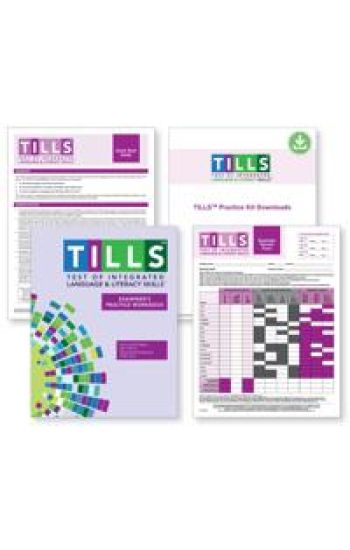
These convenient Practice Kits include the materials needed for training and practice sessions with the Test of Integrated Language & Literacy Skills (TILL), a test valid and reliable for assessing oral and written language skills in students ages 6 - 18 years. The TILLS Practice Kit gives you and your trainees access to essential materials for learning about TILLS and, in the process, about standardized testing in general. The TILLS Practice Kits are ideal for use in preservice higher education courses and inservice trainings. They can help you introduce TILLS to aspiring or experienced professionals and give them the practice they need to use TILLS and perform individualized assessment with confidence in future work settings. The TILLS Practice Kits are used to:Give trainees a complete overview of TILLS.Introduce the TILLS subtests and the three purposes of the assessment: identifying language & literacy disorders, documenting relative strengths and weaknesses, and tracking changes over time.Familiarize trainees with the 15 TILLS subtests. With the included Examiner's Practice Workbook, TILLS trainees will work through practice exercises for each subtest that prepare them for successful administration of the TILLS and other standardized tests.Provide concrete examples of standardized testing principles. Beyond testing with TILLS, the materials of the Practice Kit can be used to emphasize assessment principles in general, such as using start rules, establishing basals and ceilings, and using standardized instruction and scoring procedures with fidelity.Provide scoring practice. Using the Examiner's Practice Workbook and downloadable audio files, TILLS trainees will practice scoring and interpreting all subtests, with extra instructional material and practice examples for the Written Expression subtest.With this thorough introduction to a landmark language and literacy assessment, pre and inservice professionals will be ready to use TILLS to enhance their future work in schools, clinics, and private practice.KIT COMPONENTS: Note: Trainees each should purchase a Practice Kit for use in their coursework or TILLS training session. Instructors should have their own Practice Kit, and they may request a desk copy of the Examiner's Manual (as it is not included in the Practice Kit).Examiner's Practice Workbook: More than 100 pages of exercises on subtest administration, scoring TILLS, and interpreting results, plus a tutorial to help you master T unit division.Practice Kit Downloads: The audio files and normative data tables needed to complete the scoring of the exercises in the Examiner's Practice Workbook (downloaded with a special code that is provided to the purchaser).Examiner Record Form (pack of 3): Two forms to work through the exercises in the Workbook for students of different ages, plus an extra copy of the form for additional practice.Quick Start Guide: A laminated trifold quick reference guide to administration and scoring, perfect to take with you when using TILLS on the job and as a quick reference for trainees.Here is a link to a video introducing TILLS: https://www.youtube.com/watch?v=rJh9qtkkLQs
For many teachers of English language learners, the field of assessment is foreign territory. Assessment has its own culture, traditions, and terminology. This training guide is intended to help classroom teachers become more comfortable creating and using assessments. A Practical Guide to Assessing English Language Learners provides helpful insights into the practice and terminology of assessment. The text focuses on providing the cornerstones of good assessments—usefulness, validity, reliability, practicality, washback, authenticity, transparency, and security—and techniques for testing. It devotes a chapter to the assessment of each of the four main skill areas (reading, writing, listening, and speaking), and also covers placement testing, such as using TOEFL® and MELAB, diagnostic testing, evaluation, and instructional decision-making with regard to testing. Tips to improve students’ test-taking strategies are offered, and each chapter ends with a helpful list of Ten Things to Remember, as well as informative case studies featuring two teachers and their assessment decisions. Incorporating its own principles, A Practical Guide to Assessing English Language Learners opens with a short quiz for the reader called Are You Testwise? that quickly determines how each teacher will benefit from this indispensable guide.
To attract investment and tourists and to enhance the quality of life of their citizens, municipal authorities are paying considerable attention to the quality of the public domain of their cities – including their urban squares. Politicians find them good places for rallies. Children consider squares to be playgrounds, the elderly as places to catch-up with each other, and for many others squares are simply a place to pause for a moment.Urban Squares as Places, Links and Displays: Successes and Failures discusses how people experience squares and the nature of the people who use them. It presents a ‘typology of squares’ based on the dimensions of ownership, the square’s instrumental functions, and a series of their basic physical attributes including size, degree of enclosure, configuration and organization of the space within them and finally based on their aesthetic attributes – their meanings. Twenty case studies illustrate what works and what does not work in different cities around the world. It discusses the qualities of lively squares and quieter, more restorative places as well as what contributes to making urban squares less desirable as destinations for the general public. The book closes with the policy implications, stressing the importance and difficulties of designing good public places.Urban Squares offers how-to guidance along with a strong theoretical framework making it ideal for architects, city planners and landscape architects working on the design and upgrade of squares.
What's a vampire to do when he accidentally makes a baby? Hire a sexy nanny, of course.A vampire for centuries, Frederick is tired of living in shadows. To that end, he hires the best and brightest scientists to find a way to help him tolerate the sun without losing the benefits that come from being a master of the night.One of them succeeds. Frederick gets to feel the sun's rays on his skin without barbecuing. Is reminded of how it feels to be human.Only later, nine months to be exact, does he find out about the side effects. Now he's on the hunt for a nanny.And finds much more than help with diapers.This vampire is about to discover how it feels to fall in love-if his enemies don't eliminate him first.
The majority of people around the world live in multilingual societies, and so it follows that plurilingualism should be considered normal. This book proposes a flexible and adaptive framework for designing and implementing language learning environments and tasks, which will be useful for practitioners working in classrooms where many languages are already spoken. The authors begin by presenting a state-of-the-art review of current research on language learning, language teaching and multilingual language acquisition. This is followed by a qualitative review of 37 multilingual research projects, which are treated as case studies to inform the practical guidance that constitutes the remainder of the book. The information and practical framework contained within this book will be of interest to researchers, teachers and teacher educators.