

Kirjahaku
Etsi kirjoja tekijän nimen, kirjan nimen tai ISBN:n perusteella.
1000 tulosta hakusanalla Nicholas Muskovac

The story of Saint Nicholas comes to life in colorful, full-page illustrations and lively text for children ages 4 through 9. St. Nicholas was well-known for his joyful spirit of giving. He had a kind heart just like Jesus. Many Christmas traditions were inspired by this holy and loving saint. Author and long-time elementary educator Barbara Yoffie helps readers develop an understanding of saints as real-life heroes and heroines who live all around and inspire us to become more like Christ. Saint Nicholas is one of 6 saints in the Saints of Christmas set, part of the Saints and Me series.

Since its publication in 1932, Black Elk Speaks has moved countless readers to appreciate the American Indian world that it described. John Neihardt's popular narrative addressed the youth and early adulthood of Black Elk, an Oglala Sioux religious elder. Michael F. Steltenkamp now provides the first full interpretive biography of Black Elk, distilling in one volume what is known of this American Indian wisdom keeper whose life has helped guide others.Nicholas Black Elk: Medicine Man, Missionary, Mystic shows that the holy-man was not the dispirited traditionalist commonly depicted in literature, but a religious thinker whose outlook was positive and whose spirituality was not limited solely to traditional Lakota precepts. Combining in-depth biography with its cultural context, the author depicts a more complex Black Elk than has previously been known: a world traveler who participated in the Battle of the Little Bighorn yet lived through the beginning of the atomic age.Steltenkamp draws on published and unpublished material to examine closely the last fifty years of Black Elk's life - the period often overlooked by those who write and think of him only as a nineteenth-century figure. In the process, the author details not just Black Elk's life but also the creation of his life story by earlier writers, and its influence on the Indian revitalization movement of the late twentieth century.Nicholas Black Elk explores how a holy-man's diverse life experiences led to his synthesis of Native and Christian religious practice. The first book to follow Black Elk's lifelong spiritual journey - from medicine man to missionary and mystic - Steltenkamp's work provides a much-needed corrective to previous interpretations of this special man's life story. This biography will lead general readers and researchers alike to rediscover both the man and the rich cultural tradition of his people.

Nicholas of Cusa
Paulist Press International,U.S.
1997
nidottu
"English-speaking Christians owe Paulist Press an enormous debt of gratitude for their continuing efforts to help us gain a deeper appreciation of our spiritual heritage." Spiritual Life Nicholas of Cusa: Selected Spiritual Writings translated and introduced by H. Lawrence Bond preface by Morimichi Watanabe "This cloud, mist, darkness, or ignorance into which whoever seeks your face enters when one leaps beyond every knowledge and concept is such that below it your face cannot be found except veiled. But this very cloud reveals your face to be there beyond all veils…The denser, therefore, one knows the cloud to be the more one truly attains the invisible light in the cloud. I see, O Lord, that it is only in this way that the inaccessible light, the beauty, and the splendor of your face can be approached without veil." From De visione Dei, c. 6 Nicholas of Cusa (1401-1464) is often called the outstanding intellectual figure of the fifteenth century as well as the principal gatekeeper between medieval and modern philosophy. This volume gives fresh attention to the theological and mystical dimensions of his thought. The introduction casts new and exciting light on the development of Cusa's theology of spirituality. The book also provides for the first time in one volume an English translation of Cusa's basic mystical corpus: On Learned Ignorance; On the Hidden God; On Seeking God; On the Vision of God; and On the Summit of Contemplation. Another unique feature is the annotated glossary of key Cusan terms that accompanies the texts. Cusa's writings reveal a remarkable imaginative and gifted theologian who anticipated contemporary questions of ecumenicity and pluralism, empowerment and reconciliation, and tolerance and individuality. These translations particularly communicate to us his experience of a very large God that jostles us out of our parochialism. For all his intellectual power, he never closes his thought into a system. He is a significator and a conjecturer. He keeps pointing beyond his own words and beyond even his prized formulae and labels, including "learned ignorance" and "coincidence of opposites." He persistently brings theology to the edge of incomprehensibility, beyond both positive and negative ways, beyond even paradox and the coincidence of opposites, to the realm of the Purely Absolute and Infinite, to the contemplation of Possibility Itself. †
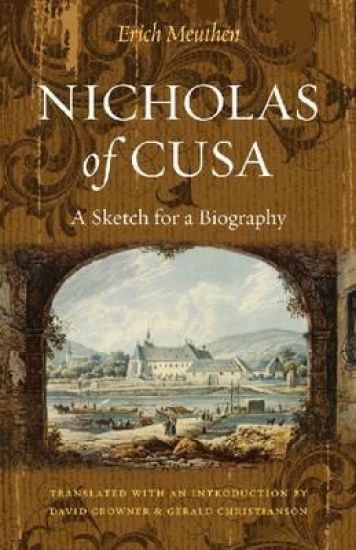
Nicholas of Cusa
The Catholic University of America Press
2010
nidottu
This translation of Erich Meuthen's well-known biography of Nicholas of Cusa presents the foremost summary of Cusanus's life and thought. From its original edition in 1964 through its seventh edition in 1992, Meuthen's sketch has found an appreciative audience. As Meuthen takes readers through Cusanus's life (1401-1464) they will be amazed that, in an age when writers set down every word with quill and ink, and one traversed every mile on land by foot or horse, Cusanus covered thousands of miles, maintained detailed administration of church affairs, rose in rank to cardinal, served as a papal legate, and still found time to write penetrating treatises such as The Catholic Concordance, Learned Ignorance, The Vision of God, and The Peace of Faith. While rendering Meuthen's language into smooth prose that still reflects his style and intent, the translators have added an introduction that describes the historical context for Cusanus. New also is a glossary of terms, as well as an updated bibliography of Cusanus research compiled by Hans Gerhard Senger, and a tribute to Meuthen by Morimichi Watanabe.
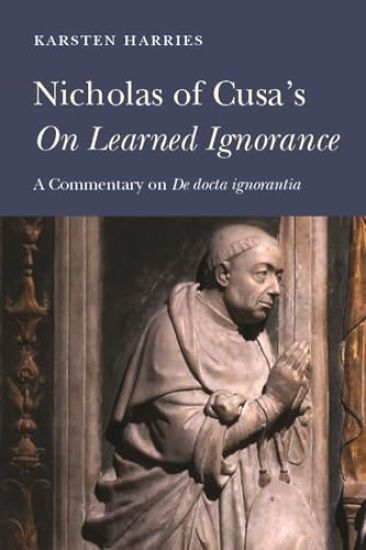
Nicholas of Cusa's "On Learned Ignorance
Karsten Harries
THE CATHOLIC UNIVERSITY OF AMERICA PRESS
2024
sidottu
This is the first commentary to have been written on Nicholas of Cusa's most famous work, On Learned Ignorance. This fact testifies to the difficulty of what has long been recognized to be the most significant philosophical text produced by the Renaissance. While there are many passages in the work that can be cited in support of Cassirer's celebration of Cusanus as the first modern philosopher, that judgment is challenged by the way his work is rooted in a faith and a tradition likely to strike us as thoroughly medieval. This commentary shows how closely the two are linked. Despite the many ways in which what the cardinal has to say belongs to a past that the progress of reason would seem to have left irrecoverably behind, it yet provides us with a continuing challenge. Key to On Learned Ignorance is the incommensurability of the infinite and the finite, of God and creation. Cusanus lets us recognize the essential transcendence of reality, so different from the ontology implied by Descartes' insistence on clear and distinct understanding, which has presided over the progress of science and has helped shape our world. What makes Cusanus' thought important is not the way it anticipates modernity, but the way it challenge often taken for granted presuppositions of our worldview, most importantly a distinctly modern self-assertion or self-elevation that has made our human reason the measure of reality. If it is impossible to deny the countless ways in which our science and technology have given us ever deeper insights into the mysteries of nature and improved our lives, it is equally impossible to deny that this very progress today endangers this fragile earth and the quality of our lives. Cusanus can help us preserve our humanity.

Servant of God Nicholas Black Elk (1863—1950) is popularly celebrated for his fascinating spiritual life. How could one man, one deeply spiritual man, serve as both a traditional Oglala Lakota medicine man and a Roman Catholic catechist and mystic? How did these two spiritual and cultural identities enrich his prayer life? How did his commitment to God, understood through his Lakota and Catholic communities, shape his understanding of how to be in the world? To fully understand the depth of Black Elk’s life-long spiritual quest requires a deep appreciation of his life story. He witnessed devastation on the battlefields of Little Bighorn and the Massacre at Wounded Knee, but also extravagance while performing for Queen Victoria as a member of “Buffalo Bill” Cody’s Wild West Show. Widowed by his first wife, he remarried and raised eight children. Black Elk’s spiritual visions granted him wisdom and healing insight beginning in his childhood, but he grew progressively physically blind in his adult years. These stories, and countless more, offer insight into this extraordinary man whose cause for canonization is now underway at the Vatican.

Perhaps best known for Rebel without a Cause, American filmmaker Nicholas Ray directed dozens of movies in the film noir genre, including In a Lonely Place, Johnny Guitar, and They Live by Night. Born in Galesville, Wisconsin, in 1911, Ray was an iconoclastic figure in film-an alcoholic, depressive, and compulsive gambler-who found himself increasingly blacklisted in Hollywood in the 1960s only to be heralded as the spiritual father to American cinema’s New Wave and one of America’s greatest rebel auteurs. From Martin Scorsese to Jean-Luc Godard and Jim Jarmusch, Ray’s influence can be seen throughout the work of some of the twentieth century’s greatest directors. In this authoritative biography, Bernard Eisenschitz leaves no stone unturned.
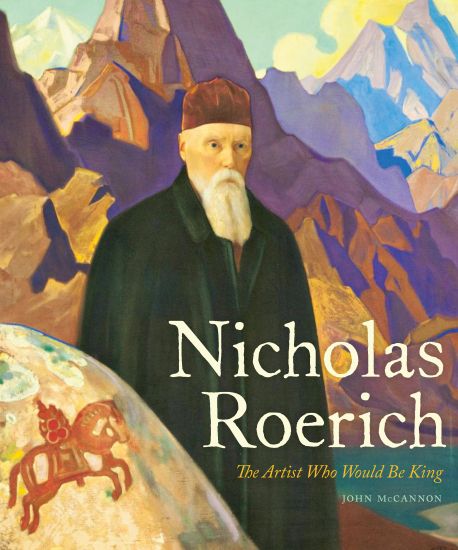
Russian painter, explorer, and mystic Nicholas Roerich (1874-1947) ranks as one of the twentieth century’s great enigmas. Despite mystery and scandal, he left a deep, if understudied, cultural imprint on Russia, Europe, India, and America. As a painter and set designer Roerich was a key figure in Russian art. He became a major player in Diaghilev’s Ballets Russes, and with Igor Stravinsky he cocreated The Rite of Spring, a landmark work in the emergence of artistic modernity. His art, his adventures, and his peace activism earned the friendship and admiration of such diverse luminaries as Albert Einstein, Eleanor Roosevelt, H. G. Wells, Jawaharlal Nehru, Raisa Gorbacheva, and H. P. Lovecraft. But the artist also had a darker side. Stravinsky once said of Roerich that “he ought to have been a mystic or a spy.” He was certainly the former and close enough to the latter to blur any distinction. His travels to Asia, supposedly motivated by artistic interests and archaeological research, were in fact covert attempts to create a pan-Buddhist state encompassing Siberia, Mongolia, and Tibet. His activities in America touched Franklin Delano Roosevelt’s cabinet with scandal and, behind the scenes, affected the course of three US presidential elections. In his lifetime, Roerich baffled foreign affairs ministries and intelligence services in half a dozen countries. He persuaded thousands that he was a humanitarian and divinely inspired thinker - but convinced just as many that he was a fraud or a madman. His story reads like an epic work of fiction and is all the more remarkable for being true. John McCannon’s engaging and scrupulously researched narrative moves beyond traditional perceptions of Roerich as a saint or a villain to show that he was, in many ways, both in equal measure.

Population, Poverty, Policy: Essential Essays from Nicholas Eberstadt
Nicholas Eberstadt
AEI PRESS
2018
nidottu
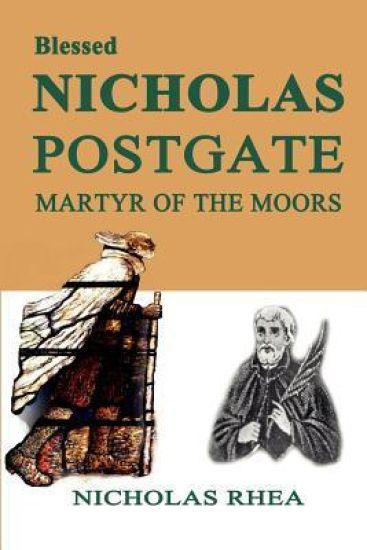

Nicholas Harpsfield and English Reformation Catholicism. The Charity of Unity
Jonathan Dean
GRACEWING
2023
pokkari
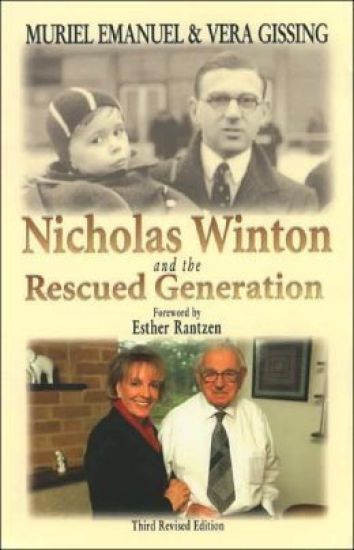
Nicholas Winton and the Rescued Generation
Muriel Emanuel; Vera Gissing; Esther Rantzen
Vallentine Mitchell Co Ltd
2001
nidottu
When Nicholas Winton met a friend in Prague in December 1938, he was shocked by the plight of thousands of refugees and Czech citizens desperate to flee from the advancing German army. A British organization had been set up to help the adults, but who would save the children? Winton felt he could not walk away. He set up a makeshift office and in just three weeks interviewed thousands of distraught parents who had the courage to part with their children and send them alone to England. Armed with their details and photos, he returned to London to convince the Home Office of the urgency of the situation. He knew he was working against time. His supreme efforts resulted in eight train-loads bringing 669, mainly Jewish, children to London. Winton has been a remarkable humanitarian all his life. After the war, wishing to be involved with the rehabilitation of Europe's refugees, he worked for international organizations. He retired early, settled in Maidenhead and devoted himself to charitable works for which he was honoured with the MBE in 1983. This is his story.
Nicholas Lanier (1588-1666) was not only the first person to hold the office of Master of the Music to King Charles I, he was also a practising painter, a friend of Rubens, Van Dyck and many other artists of his time, and one of the very first great art collectors and connoisseurs. He is especially remembered for the part he played in acquiring, on behalf of Charles I, the famous collection of paintings belonging to the Gonzaga family of Mantua. Many of these paintings still form an important part of the Royal Collection today. In this book the different strands of Lanier's colourful life are for the first time drawn together and presented in a single compelling narrative.

Nicholas Love's Mirror of the Blessed Life of Jesus Christ
University of Exeter Press
2005
sidottu
Nicholas Love's Mirror of the Blessed Life of Jesus Christ is an important work of late medieval English vernacular theology, and is made available here in a modern paperback "Reading Text" edition, complete with a short Introduction, explanatory notes and glossary, followed by a longer hardback: the "Full Critical Edition".The critical edition is not merely a revision of Michael Sargent's 1992 Garland best-text edition, now out of print, but a new and completely critical edition that uses the Garland volume only as its starting-point. Although based on the same manuscript, and containing much of the same introductory material, this edition includes the results of a complete collation of the 71 known surviving manuscripts and early prints. This collation demonstrates that the text exists in two separate authorial versions, of which the first, which incorporated a separate, independent translation of the Passion section, may not in the first instance have included the "Treatise on the Sacrament". The second version, on which the edition is based, is an authorial revision, undertaken, perhaps, after Love had met with Archbishop Arundel for approval of his text.The Introduction discusses the evidence for the process of composition of the text, and places Love's Mirror, properly, at the centre of current scholarly discussion of the development of vernacular theology in late medieval England and the consequences of Arundel's anti-Lollard Lambeth Constitutions.

Nicholas Love's Mirror of the Blessed Life of Jesus Christ
University of Exeter Press
2005
nidottu
Nicholas Love’s Mirror of the Blessed Life of Jesus Christ is a particularly important work of late medieval English vernacular theology: it is seen as a landmark in the history of the official campaign to control lay access to vernacular paramystical texts. It is made available here for the first time in a critical modern paperback edition, complete with a short introduction, explanatory notes and a glossary. The volume is not merely a revision of Michael Sargent’s 1992 Garland best-text edition, now out of print, but a new full critical edition that uses the Garland volume only as its starting-point. Although based on the same manuscript, this new edition includes the results of a complete collation of the 71 known surviving manuscripts and early prints.Nicholas Love’s Mirror was a Middle English translation of the pseudo-Bonaventuran Meditationes Vitae Christi. The Latin text, probably written at the end of the thirteenth century or the beginning of the fourteenth, was a popular book of devotions on the events of the life and passion of Christ characteristic of late-medieval Franciscan spirituality. The Introduction places Love's Mirror, properly, at the centre of current scholarly discussion of the development of vernacular theology in late medieval England.

This volume brings together Professor Cranz’s published studies on Nicholas of Cusa with a set of seven papers left unpublished at the time of his death. Their subjects are the speculative thought of Cusanus and his relationship with the broader themes of the Renaissance. Particular attention is given to patterns of development in Cusanus’ thought as he wrestled with problems of divine transcendence and the limits of human capacities. Overall, these studies also reveal Professor Cranz’s interest in the larger changes in Western modes of thought during the Middle Ages and the Renaissance, which define our ways of thinking as different from those of Antiquity.

The Indiana U. Press edition (1978) is cited in BCL3 . A scholarly biography that provides a view of Russian autocracy. Annotation copyright Book News, Inc. Portland, Or.
Nicholas I, Patriarch of Constantinople
L. G. Westerink
Dumbarton Oaks Research Library Collection
2025
nidottu