Kirjojen hintavertailu. Mukana 12 390 323 kirjaa ja 12 kauppaa.

Kirjahaku

Etsi kirjoja tekijän nimen, kirjan nimen tai ISBN:n perusteella.

1000 tulosta hakusanalla Peter E. Hamilton

The Psychology of Memory

The Psychology of Memory

Peter E. (EDT) Morris; Martin A. (EDT) Conway

New York University Press
1993
sidottu
This major new series reproduces an authoritative selection of the most significant articles in different areas of psychology. It focuses in particular on influential articles which are not found in other similar colelctions. Many of these articles are only available in specialized journals and therfore are not accessible in every library. This landmark series will make a contribution to scholarship and teaching in psychology. It will imorove access to important areas of literature which are difficult to locate, even in the archives of many libraries throughout the world. Important features in each book make the series an essential research and reference tool, including introductions written by the individual editors providing a lucid survey of difference branches of psychology. The pagination of the original articles has been deliberately retained to facilitate ease of reference. A comprehensive author and subject index guides the reader instantly to major and minor topics within the literature.This set presents the most important articles in the psychology of memory, divided into the following areas: The First Explorers Encoding Processes Retrieval Processes Context Sensory Memory Working Memory Semantic Memory Expanding Into New Areas The New Territories Expertise Implicit Memory Exploring Everyday Memory.Articles in these volumes have been drawn from various books and from the following journals: Neurology, Psychological Review, Verbal Learning and Verbal Behavior, Cognitive Psychology, Psychological Review, Journal of Experimental Psychology, Journal of General Psychology, American Psychologist, Perception and Psychophysics, British Journal of Psychology, Quarterly Journal of Experimental Psychology, Journal of Memory and Language, Journal of Neurology, Neurosurgery and Psychiatry, Neuropsychologia, Psychological Bulletin, Science, and Cognition.
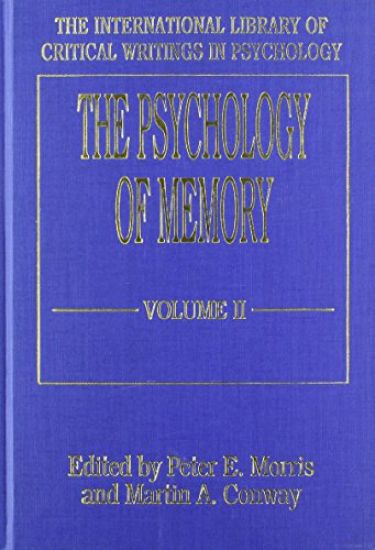
The Psychology of Memory

The Psychology of Memory

Peter E. (EDT) Morris; Martin A. (EDT) Conway

New York University Press
1993
sidottu
This major new series reproduces an authoritative selection of the most significant articles in different areas of psychology. It focuses in particular on influential articles which are not found in other similar colelctions. Many of these articles are only available in specialized journals and therfore are not accessible in every library. This landmark series will make a contribution to scholarship and teaching in psychology. It will imorove access to important areas of literature which are difficult to locate, even in the archives of many libraries throughout the world. Important features in each book make the series an essential research and reference tool, including introductions written by the individual editors providing a lucid survey of difference branches of psychology. The pagination of the original articles has been deliberately retained to facilitate ease of reference. A comprehensive author and subject index guides the reader instantly to major and minor topics within the literature.This set presents the most important articles in the psychology of memory, divided into the following areas: The First Explorers Encoding Processes Retrieval Processes Context Sensory Memory Working Memory Semantic Memory Expanding Into New Areas The New Territories Expertise Implicit Memory Exploring Everyday Memory.Articles in these volumes have been drawn from various books and from the following journals: Neurology, Psychological Review, Verbal Learning and Verbal Behavior, Cognitive Psychology, Psychological Review, Journal of Experimental Psychology, Journal of General Psychology, American Psychologist, Perception and Psychophysics, British Journal of Psychology, Quarterly Journal of Experimental Psychology, Journal of Memory and Language, Journal of Neurology, Neurosurgery and Psychiatry, Neuropsychologia, Psychological Bulletin, Science, and Cognition.
The Psychology of Memory

The Psychology of Memory

Peter E. Morris; Martin A. (EDT) Conway

New York University Press
1993
sidottu
This major new series reproduces an authoritative selection of the most significant articles in different areas of psychology. It focuses in particular on influential articles which are not found in other similar colelctions. Many of these articles are only available in specialized journals and therfore are not accessible in every library. This landmark series will make a contribution to scholarship and teaching in psychology. It will imorove access to important areas of literature which are difficult to locate, even in the archives of many libraries throughout the world. Important features in each book make the series an essential research and reference tool, including introductions written by the individual editors providing a lucid survey of difference branches of psychology. The pagination of the original articles has been deliberately retained to facilitate ease of reference. A comprehensive author and subject index guides the reader instantly to major and minor topics within the literature.This set presents the most important articles in the psychology of memory, divided into the following areas: The First Explorers Encoding Processes Retrieval Processes Context Sensory Memory Working Memory Semantic Memory Expanding Into New Areas The New Territories Expertise Implicit Memory Exploring Everyday Memory Articles in these volumes have been drawn from various books and from the following journals: Neurology, Psychological Review, Verbal Learning and Verbal Behavior, Cognitive Psychology, Psychological Review, Journal of Experimental Psychology, Journal of General Psychology, American Psychologist, Perception and Psychophysics, British Journal of Psychology, Quarterly Journal of Experimental Psychology, Journal of Memory and Language, Journal of Neurology, Neurosurgery and Psychiatry, Neuropsychologia, Psychological Bulletin, Science, and Cognition.
Conflict and Cooperation

Conflict and Cooperation

Peter E. Makari

Syracuse University Press
2007
sidottu
Egypt is considered the intellectual birthplace of the modern Islamic movements and is a center of contemporary Islamic thought and culture. It is also home to one of the oldest Christian populations in the world. In this book, Peter Makari considers the role of governmental and nongovernmental actors in conflict resolution and the promotion of positive Christian-Muslim relations in Egypt. He maintains that, prevailing opinions notwithstanding, the last quarter-century has witnessed a high level of interreligious cooperation and tolerance. Relying heavily on Arabic sources, Makari examines the rhetoric and actions of official governmental and religious institutions, as well as civil society actors. Combining empirical research with an informed theoretical perspective, this work offers a perspective seldom available to the English reader on questions of tolerance, citizenship, and civil society in this part of the Arab world.
Real, Recent, or Replica

Real, Recent, or Replica

Peter E. Siegel

The University of Alabama Press
2021
sidottu
Examines the largely unexplored topics in Caribbean archaeology of looting of heritage sites, fraudulent artifacts, and illicit trade of archaeological materials Real, Recent, or Replica: PrecolumbianCaribbean Heritage as Art, Commodity, and Inspiration is the first book-length study of its kind to highlight the increasing commodification of Caribbean Precolumbian heritage. Amerindian art, including 'TaÍno' art, has become highly coveted by collectors, spurring a prolific and increasingly sophisticated black market of forgeries, but also contemporary artistic engagement, openly appreciated as modern artworks taking inspiration from the past. The contributors to this volume contend with difficult subject matter including the continued looting of archaeological sites in the region, the seismic increase of forgeries, and the imbalance of power and economic relations between the producers and consumers of neo-Amerindian art. The case studies document the considerable time depth of forgeries in the region (since the late nineteenth century), address the policies put in place by Caribbean governments and institutions to safeguard national patrimony, and explore the impact looted and forged artefacts have on how museums and institutions collect and ultimately represent the Caribbean past to their audiences. Overall, the volume emphasizes the continued desire for the 'authentic' Precolumbian artifact, no matter the cost. It provides insights for archaeologists, museum professionals, art historians, and collectors to combat illegal trade and support communities in creating sustainable heritage industries.
Nonautonomous Dynamical Systems

Nonautonomous Dynamical Systems

Peter E. Kloeden; Martin Rasmussen

American Mathematical Society
2011
sidottu
The theory of nonautonomous dynamical systems in both of its formulations as processes and skew product flows is developed systematically in this book. The focus is on dissipative systems and nonautonomous attractors, in particular the recently introduced concept of pullback attractors. Linearization theory, invariant manifolds, Lyapunov functions, Morse decompositions and bifurcations for nonautonomous systems and set-valued generalizations are also considered as well as applications to numerical approximations, switching systems and synchronization. Parallels with corresponding theories of control and random dynamical systems are briefly sketched. With its clear and systematic exposition, many examples and exercises, as well as its interesting applications, this book can serve as a text at the beginning graduate level. It is also useful for those who wish to begin their own independent research in this rapidly developing area.
Irish Presbyterians and the Shaping of Western Pennsylvania, 1770-1830

Irish Presbyterians and the Shaping of Western Pennsylvania, 1770-1830

Peter E. Gilmore

University of Pittsburgh Press
2021
nidottu
Irish Presbyterians and the Shaping of Western Pennsylvania, 1770-1830 is a historical study examining the religious culture of Irish immigrants in the early years of America. Despite fractious relations among competing sects, many immigrants shared a vision of a renewed Ireland in which their versions of Presbyterianism could flourish free from the domination of landlords and established church. In the process, they created the institutional foundations for western Pennsylvanian Presbyterian churches. Rural Presbyterian Irish church elders emphasized community and ethnoreligious group solidarity in supervising congregants’ morality. Improved transportation and the greater reach of the market eliminated near-subsistence local economies and hastened the demise of religious traditions brought from Ireland. Gilmore contends that ritual and daily religious practice, as understood and carried out by migrant generations, were abandoned or altered by American-born generations in the context of major economic change.
Approaches to the Development of Moral Reasoning

Approaches to the Development of Moral Reasoning

Peter E. Langford

Psychology Press Ltd
1995
sidottu
The first part of the book offers a survey of current approaches to the development of moral reasoning: those of Freud, ego psychology, Piaget and Kohlberg. The approach of Kohlberg has been popular because he was able to give an impressive account of findings from the key method of interviews, the other crucial method being naturalistic observation of moral discourse. The accounts of interview evidence given by ego psychology and Piaget were less comprehensive and less impressive. Naturalistic studies have either been impressionistic or less detailed in their methods of analysis. The second part of the book argues that the impressive nature of Kohlberg's later evidence for his view that moral reasoning passes through a sequence of stages is in part illusory, because his theory predicts that specific types of reply will show specific developmental patterns. However, as data are always reported in terms of stages, which amalgamate very disparate types of reply, it is impossible to know whether the specific types of reply follow their predicted developmental courses or not. Reasons given for assigning given types of reply to a stage are also often doubtful. This leads to discussion of studies that have reported findings in terms of specific types of reply (weakly interpretive methods), as opposed to Kohlberg's stage-based and strongly interpretive methods. Findings from these disconfirm Kohlberg's theory at several crucial points. The second and third parts of the book also examine findings from non-Kohlbergian interviews and other methods, again advocating that weakly interpretive and largely descriptive presentation of findings is preferable to strongly interpretive techniques. It is argued that a wide variety of mechanisms suggested by the theories outlined in the first part of the book, as well as others drawn from general theories of personality development, are able to explain existing descriptive developmental findings. The task for the future is to assess the relative importance of these mechanisms.
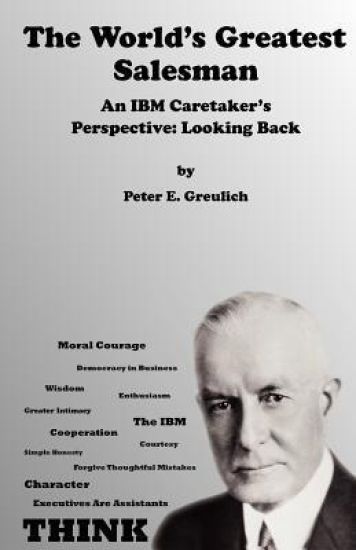
The World's Greatest Salesman

The World's Greatest Salesman

Peter E Greulich

Mbi Concepts Corporation
2011
pokkari
The New York Times and Time Magazine called Thomas J. Watson Sr., the founder of IBM, the "World's Greatest Salesman." Newsweek wrote that he was a philanthropist, where "none gained more from his beneficence than his own employees." President Eisenhower said he was a man "marked by a deep-seated concern for people."The World's Greatest Salesman is an IBM employee's perspective of Tom Watson Sr.'s leadership during the Great Depression, starting the day after Black Tuesday and ending three days before Christmas 1933, soon after the Depression's trough. In the midst of today's current economic turmoil, it is time to reexamine the thoughts, words and actions of IBM's founder. He set an example of great leadership during one of the darkest economic times in world history and led a good company to greatness in the 20th century.
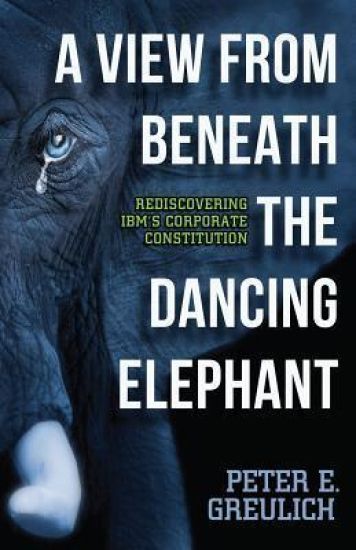
A View from Beneath the Dancing Elephant: Rediscovering IBM's Corporate Constitution
Many IBMers see Louis V. Gerstner as the savior of their company-indeed, Gerstner sees himself that way. Who Says Elephants Can't Dance? expresses this perspective quite well. What Gerstner never realized is that much of his success came from accidentally tapping into an eighty-year-old culture that he never understood. IBM's founders, the Watsons, created this culture in the 1910s, and then codified it in the 1950s with the creation of three Basic Beliefs: Respect, Service and Excellence.But today's IBM has lost its culture, its constitution and its way. Surely a century-old corporation is more than its founding words; but great leaders do not seek to abolish a people's constitution, rather they seek a return to its original intent.This book captures how that change occurred-a view from beneath the dancing elephant.
Theodore the Tadpole

Theodore the Tadpole

Peter E Sprangers

Peter Sprangers
2022
pokkari
Growing up and starting a new life can seem like an impossible task. As you get bigger, the world feels like it begins to shrink.Moving into the next adventure with gratitude for what came before helps us frame our world and our role in it.Theodore is scared at what comes next after his life as a tadpole, but all he needs is a little courage to help him move on.
Principles of Behavioral Economics

Principles of Behavioral Economics

Peter E. Earl

Cambridge University Press
2022
pokkari
This book is unique among modern contributions to behavioral economics in presenting a grand synthesis between the kind of behavioral economics popularized by Richard Thaler, earlier approaches such as those of the 1978 Nobel Laureate Herbert Simon, evolutionary psychology, and evolutionary economics from Veblen and Marshall through to neo-Schumpeterian thinking. The synthesis employs a complex adaptive systems approach to how people think, the lifestyles they build, and how new production technologies and products are gradually adopted and produce changes. Using a huge range of examples, it takes behavioral economics from its recent focus on 'nudging' consumers, to the behavior of firms and other organizations, the challenges of achieving structural change and transitioning to environmentally sustainable lifestyles, and instability of the financial system. This book will be of great interest to academics and graduate students who seek a broader view of what behavioral economics is and what it might become.