Kirjojen hintavertailu. Mukana 11 627 469 kirjaa ja 12 kauppaa.

Kirjahaku

Etsi kirjoja tekijän nimen, kirjan nimen tai ISBN:n perusteella.

1000 tulosta hakusanalla Peter J. Manning

Identity Theory

Identity Theory

Peter J. Burke; Jan E. Stets

OXFORD UNIVERSITY PRESS INC
2023
nidottu
The concept of identity has become widespread within the social and behavioral sciences, cutting across disciplines from psychiatry and psychology to political science and sociology. Introduced more than fifty years ago, identity theory is a social psychological theory that attempts to understand person's identities, their sources in interaction and society, their processes of operation, and their consequences for interaction and society from a sociological perspective. In this fully updated second edition of Identity Theory, Peter J. Burke and Jan E. Stets expand and refine their discussion of identity theory. Each chapter has been significantly revised and chapters have been added to address new theoretical developments and empirical research in the field. They cover identity characteristics, the processes and outcomes of identity verification, and the operation of identities to detail in particular the role of emotional, behavioral, and cognitive processes. In addition, Burke and Stets explore the multiple identities individuals hold from their multiple positions in society and organizations as well as the multiple identities activated by many people interacting in groups and organizations. Written in an accessible style, this revised edition of Identity Theory continues to make the full range of this powerful theory understandable to readers at all levels.
Duce: The Contradictions of Power: The Political Leadership of Benito Mussolini
Eighty years after the fall of Benito Mussolini, controversy remains about what his dictatorship represented. This reflects the different sides to the Duce's leadership: while adept at nurturing and enforcing his personal political power, Mussolini's lack of insight into the requirements of governance prevented him from converting this power into influence to achieve his goals. His efforts to maintain the support of Italy's conservative elites--economic, social and political--also created tensions with his radical Fascist ambitions, diminishing the momentum behind his regime. Mussolini is frequently portrayed as a charismatic leader, but his rule was secured principally by coercion, violence and a 'spoils system'. Nonetheless, his personality cult had significant popular appeal, even if based upon a political myth. This enabled him to consolidate his position and to dominate his Fascist colleagues--but at a price of over-centralized, dysfunctional decision-making. In this book, the first comprehensive English-language study of Mussolini in nearly two decades, Peter J. Williamson brings to life the contradictions within the Duce's leadership. Using a wide range of sources, Williamson reveals how these conflicts impeded the dictator's ambitions, leaving him increasingly frustrated, all while most Italians endured the severe privations of both failure and Fascism.
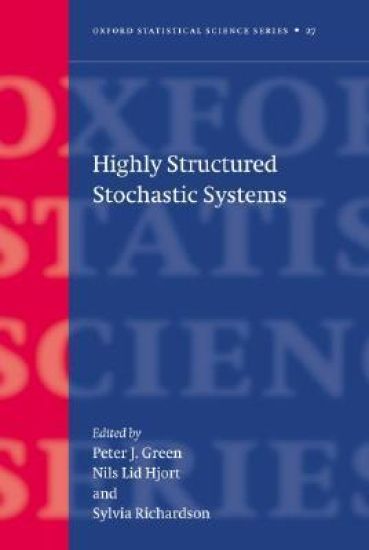
Highly Structured Stochastic Systems

Highly Structured Stochastic Systems

Peter J Green; Nils Lid Hjort; Sylvia Richardson

Oxford University Press
2003
sidottu
Highly Structured Stochastic Systems (HSSS) is a modern strategy for building statistical models for challenging real-world problems, for computing with them, and for interpreting the resulting inferences. Complexity is handled by working up from simple local assumptions in a coherent way, and that is the key to modelling, computation, inference and interpretation; the unifying framework is that of Bayesian hierarchical models. The aim of this book is to make recent developments in HSSS accessible to a general statistical audience. Graphical modelling and Markov chain Monte Carlo (MCMC) methodology are central to the field, and in this text they are covered in depth. The chapters on graphical modelling focus on causality and its interplay with time, the role of latent variables, and on some innovative applications. Those on Monte Carlo algorithms include discussion of the impact of recent theoretical work on the evaluation of performance in MCMC, extensions to variable dimension problems, and methods for dynamic problems based on particle filters. Coverage of these underlying methodologies is balanced by substantive areas of application - in the areas of spatial statistics (with epidemiological, ecological and image analysis applications) and biology (including infectious diseases, gene mapping and evolutionary genetics). The book concludes with two topics (model criticism and Bayesian nonparametrics) that seek to challenge the parametric assumptions that otherwise underlie most HSSS models. Altogether there are 15 topics in the book, and for each there is a substantial article by a leading author in the field, and two invited commentaries that complement, extend or discuss the main article, and should be read in parallel. All authors are distinguished researchers in the field, and were active participants in an international research programme on HSSS. This is the 27th volume in the Oxford Statistical Science Series, which includes texts and monographs covering many topics of current research interest in pure and applied statistics. These texts focus on topics that have been at the forefront of research interest for several years. Other books in the series include: J.Durbin and S.J.Koopman: Time series analysis by State Space Models; Peter J. Diggle, Patrick Heagerty, Kung-Yee Liang, Scott L. Zeger: Analysis of Longitudinal Data 2/e; J.K. Lindsey: Nonlinear Models in Medical Statistics; Peter J. Green, Nils L. Hjort & Sylvia Richardson: Highly Structured Stochastic Systems; Margaret S. Pepe: Statistical Evaluation of Medical Tests.
Discovering Evolutionary Ecology

Discovering Evolutionary Ecology

Peter J. Mayhew

Oxford University Press
2006
nidottu
Why are some kinds of organism species-rich and others species-poor? How do new species arise and why do some go extinct? Why do organisms grow and behave the way they do? This book provides an introduction to evolutionary ecology, the science that brings ecology and evolution together to help understand biological diversity. In a concise, readable format, Peter Mayhew covers the entire breadth of the subject, from life histories and the evolution of sex, to speciation and macroecology. Many emerging fields are also introduced, such as metabolic ecology, the evolution of population dynamics, and the evolution of global ecology. Discovering Evolutionary Ecology highlights the connections between these different subject areas, and for the first time paints a picture of a truly integrated field. It illustrates the research tools utilized, and demonstrates how advances in one area can spur on developments elsewhere when scientists combine evolutionary and ecological knowledge. To maximize accessibility, the book assumes only a basic knowledge of biology, includes a comprehensive glossary, and contains almost no maths. Each chapter provides suggestions for further reading, and there is also an extensive reference list. Ideal as an introduction to evolutionary ecology for undergraduates, this book will also interest established researchers, providing a broad and up-to-date context for their work.
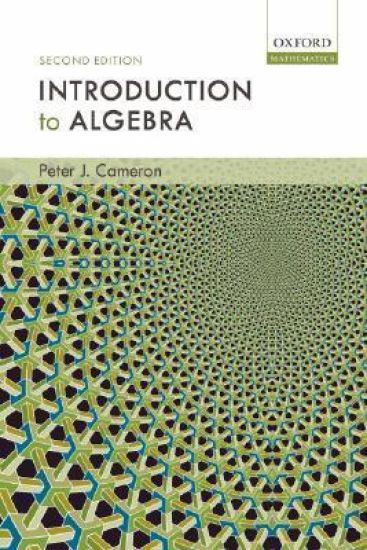
Introduction to Algebra

Introduction to Algebra

Peter J. Cameron

Oxford University Press
2007
nidottu
Developed to meet the needs of modern students, this Second Edition of the classic algebra text by Peter Cameron covers all the abstract algebra an undergraduate student is likely to need. Starting with an introductory overview of numbers, sets and functions, matrices, polynomials, and modular arithmetic, the text then introduces the most important algebraic structures: groups, rings and fields, and their properties. This is followed by coverage of vector spaces and modules with applications to abelian groups and canonical forms before returning to the construction of the number systems, including the existence of transcendental numbers. The final chapters take the reader further into the theory of groups, rings and fields, coding theory, and Galois theory. With over 300 exercises, and web-based solutions, this is an ideal introductory text for Year 1 and 2 undergraduate students in mathematics.
Introduction to Algebra

Introduction to Algebra

Peter J. Cameron

Oxford University Press
2007
sidottu
Developed to meet the needs of modern students, this Second Edition of the classic algebra text by Peter Cameron covers all the abstract algebra an undergraduate student is likely to need. Starting with an introductory overview of numbers, sets and functions, matrices, polynomials, and modular arithmetic, the text then introduces the most important algebraic structures: groups, rings and fields, and their properties. This is followed by coverage of vector spaces and modules with applications to abelian groups and canonical forms before returning to the construction of the number systems, including the existence of transcendental numbers. The final chapters take the reader further into the theory of groups, rings and fields, coding theory, and Galois theory. With over 300 exercises, and web-based solutions, this is an ideal introductory text for Year 1 and 2 undergraduate students in mathematics.
Discovering Evolutionary Ecology

Discovering Evolutionary Ecology

Peter J. Mayhew

Oxford University Press
2006
sidottu
Why are some kinds of organism species-rich and others species-poor? How do new species arise and why do some go extinct? Why do organisms grow and behave the way they do? This book provides an introduction to evolutionary ecology, the science that brings ecology and evolution together to help understand biological diversity. In a concise, readable format, Peter Mayhew covers the entire breadth of the subject, from life histories and the evolution of sex, to speciation and macroecology. Many emerging fields are also introduced, such as metabolic ecology, the evolution of population dynamics, and the evolution of global ecology. Discovering Evolutionary Ecology highlights the connections between these different subject areas, and for the first time paints a picture of a truly integrated field. It illustrates the research tools utilized, and demonstrates how advances in one area can spur on developments elsewhere when scientists combine evolutionary and ecological knowledge. To maximize accessibility, the book assumes only a basic knowledge of biology, includes a comprehensive glossary, and contains almost no maths. Each chapter provides suggestions for further reading, and there is also an extensive reference list. Ideal as an introduction to evolutionary ecology for undergraduates, this book will also interest established researchers, providing a broad and up-to-date context for their work.
Competition Law in China

Competition Law in China

Peter J. Wang; Sébastien J. Evrard; Yizhe Zhang; BaohuiNOSSUB Zhang

Oxford University Press
2014
nidottu
This work is the only bilingual (Chinese/English) compilation of all legal texts applicable to the area of competition law in China. It includes the Anti-Monopoly Law of the People's Republic of China (AML) as well as all other laws that have relevant provisions. It also incorporates the regulations issued by the State Council, the Ministry of Commerce (MOFCOM) and the National Development and Reform Commission (NRDC); judicial interpretations of the Supreme People's Court; as well as the 15 decisions MOFCOM has published so far.
The Biology of Mangroves and Seagrasses

The Biology of Mangroves and Seagrasses

Peter J. Hogarth

Oxford University Press
2015
sidottu
Mangroves and seagrasses form extensive and highly productive ecosystems that are both biologically diverse and economically valuable. This book, now in its third edition and fully updated throughout, continues to provide a current and comprehensive introduction to all aspects of the biology and ecology of mangroves and seagrasses. Using a global range of examples and case studies, it describes the unique adaptations of these plants to their exacting environments; the rich and diverse communities of organisms that depend on mangrove forests and seagrass meadows (including tree-climbing shrimps, synchronously flashing fireflies, and 'gardening' seacows); the links between mangrove, seagrass, and other habitats; and the evolution, biodiversity, and biogeography of mangroves and seagrasses. The economic value of mangroves and seagrasses is also discussed, including approaches to rational management of these vital resources and techniques for the restoration of degraded habitats. A final chapter, new to this edition, examines the potential effects of global climate change including sea level rise. As with other titles in the Biology of Habitats Series, particular emphasis is placed on the organisms that dominate these fascinating aquatic ecosystems although pollution, conservation, and experimental aspects are also considered. This accessible textbook assumes no previous knowledge of mangrove or seagrass ecology and is intended for senior undergraduate and graduate students, as well as professional ecologists, conservation practitioners, and resource managers.
The Biology of Mangroves and Seagrasses

The Biology of Mangroves and Seagrasses

Peter J. Hogarth

Oxford University Press
2015
nidottu
Mangroves and seagrasses form extensive and highly productive ecosystems that are both biologically diverse and economically valuable. This book, now in its third edition and fully updated throughout, continues to provide a current and comprehensive introduction to all aspects of the biology and ecology of mangroves and seagrasses. Using a global range of examples and case studies, it describes the unique adaptations of these plants to their exacting environments; the rich and diverse communities of organisms that depend on mangrove forests and seagrass meadows (including tree-climbing shrimps, synchronously flashing fireflies, and 'gardening' seacows); the links between mangrove, seagrass, and other habitats; and the evolution, biodiversity, and biogeography of mangroves and seagrasses. The economic value of mangroves and seagrasses is also discussed, including approaches to rational management of these vital resources and techniques for the restoration of degraded habitats. A final chapter, new to this edition, examines the potential effects of global climate change including sea level rise. As with other titles in the Biology of Habitats Series, particular emphasis is placed on the organisms that dominate these fascinating aquatic ecosystems although pollution, conservation, and experimental aspects are also considered. This accessible textbook assumes no previous knowledge of mangrove or seagrass ecology and is intended for senior undergraduate and graduate students, as well as professional ecologists, conservation practitioners, and resource managers.
Laughter and Power in the Twelfth Century

Laughter and Power in the Twelfth Century

Peter J. A. Jones

Oxford University Press
2019
sidottu
Towards the end of the twelfth century, powerful images of laughing kings and saints began to appear in texts circulating at the English royal court. At the same time, contemporaries began celebrating the wit, humour, and laughter of King Henry II (r.1154-89) and his martyred Archbishop of Canterbury, Saint Thomas Becket (d.1170). Taking a broad genealogical approach, Laughter and Power in the Twelfth Century traces the emergence of this powerful laughter through an immersive study of medieval intellectual, literary, social, religious, and political debates. Focusing on a cultural renaissance in England, the study situates laughter at the heart of the defining transformations of the second half of the 1100s. With an expansive survey of theological and literary texts, bringing a range of unedited manuscript material to light in the process, Peter J. A. Jones exposes how twelfth-century writers came to connect laughter with spiritual transcendence and justice, and how this connection gave humour a unique political and spiritual power in both text and action. Ultimately, Jones argues that England's popular images of laughing kings and saints effectively reinstated a sublime charismatic authority, something truly rebellious at a moment in history when bureaucracy and codification were first coming to dominate European political life.
Guarantee of Peace

Guarantee of Peace

Peter J. Yearwood

Oxford University Press
2009
sidottu
Peter Yearwood reconsiders the League of Nations, not as an attempt to realize an idea but as an element in the day-to-day conduct of Britain's foreign policy and domestic politics during the period 1914-25. He challenges the usual view that London reluctantly adopted the idea in response to pressure from Woodrow Wilson and from domestic public opinion, and that it was particularly wary of ideas of collective security. Instead he examines how London actively promoted the idea to manage Anglo-American relations in war and to provide the context for an enduring hegemonic partnership. The book breaks new ground in examining how London tried to use the League in the crises of the early 1920s: Armenia, Persia, Vilna, Upper Silesia, Albania, and Corfu. It shows how in the negotiations leading to the Draft Treaty of Mutual Assistance, the Geneva Protocol, and the Locarno accords, Robert Cecil, Ramsay MacDonald, and Austen Chamberlain tried to solve the Franco-German security question through the League. This involves a re-examination of how these leaders tried to use the League as an issue in British domestic politics and why it emerged as central to British foreign policy. Based on extensive, detailed archival research, this book provides a new and authoritative account of a largely misunderstood topic.
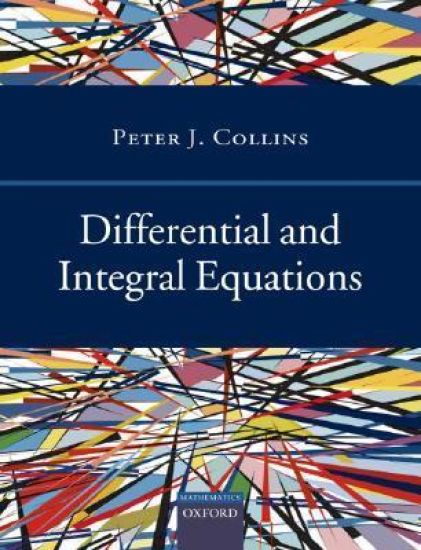
Differential and Integral Equations

Differential and Integral Equations

Peter J. Collins

Oxford University Press
2006
nidottu
Differential and integral equations involve important mathematical techniques, and as such will be encountered by mathematicians, and physical and social scientists, in their undergraduate courses. This text provides a clear, comprehensive guide to first- and second-order ordinary and partial differential equations, whilst introducing important and useful basic material on integral equations. Readers will encounter detailed discussion of the wave, heat and Laplace equations, of Green's functions and their application to the Sturm-Liouville equation, and how to use series solutions, transform methods and phase-plane analysis. The calculus of variations will take them further into the world of applied analysis. Providing a wealth of techniques, but yet satisfying the needs of the pure mathematician, and with numerous carefully worked examples and exercises, the text is ideal for any undergraduate with basic calculus to gain a thorough grounding in 'analysis for applications'.
Propertius, Greek Myth, and Virgil

Propertius, Greek Myth, and Virgil

Peter J. Heslin

Oxford University Press
2018
sidottu
This volume offers a strikingly innovative account of Propertius' relationship with Virgil, positing a keen rivalry between two of the greatest poets of Latin literature, contemporaries within the circle of Maecenas. It begins by examining all of the references to Greek mythology in Propertius' first book; these passages emerge as strongly intertextual in nature, providing a way for the poet to situate himself with respect to his predecessors, both Greek and Roman. More specifically, myth is also the medium of a sustained polemic with Virgil's Eclogues, published only a few years earlier. Virgil's response can be traced in the Georgics, and subsequently, in his second and third books, Propertius continued to use mythology and its relationship to contemporary events as a vehicle for literary polemic. This volume argues that their competition can be seen as exemplifying a revised model for how the poets within Maecenas' circle interacted and engaged with each other's work - a model based on rivalry rather than ideological adhesion or subversion - while also painting a revealing picture of how Virgil was viewed by a contemporary in the days before his death had canonized his work as an instant classic. In particular, its novel interpretation offers us a new understanding of Propertius, one of the foundational figures in Western love poetry, and how his frequent references to other poets, especially Gallus and Ennius, take on new meanings when interpreted as responses to Virgil's changing career.
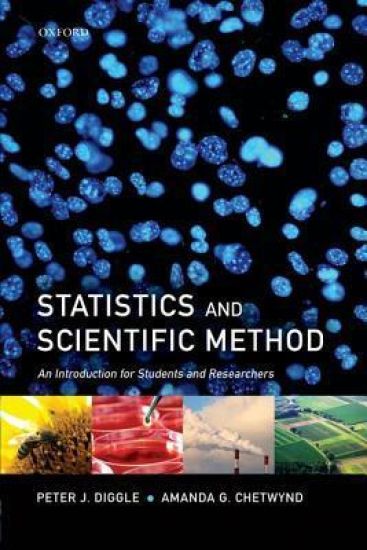
Statistics and Scientific Method

Statistics and Scientific Method

Peter J. Diggle; Amanda G. Chetwynd

Oxford University Press
2011
sidottu
Most introductory statistics text-books are written either in a highly mathematical style for an intended readership of mathematics undergraduate students, or in a recipe-book style for an intended audience of non-mathematically inclined undergraduate or postgraduate students, typically in a single discipline; hence, "statistics for biologists", "statistics for psychologists", and so on. An antidote to technique-oriented service courses, this book is different. It studiously avoids the recipe-book style and keeps algebraic details of specific statistical methods to the minimum extent necessary to understand the underlying concepts. Instead, the text aims to give the reader a clear understanding of how core statistical ideas of experimental design, modelling and data analysis are integral to the scientific method. Aimed primarily at beginning postgraduate students across a range of scientific disciplines (albeit with a bias towards the biological, environmental and health sciences), it therefore assumes some maturity of understanding of scientific method, but does not require any prior knowledge of statistics, or any mathematical knowledge beyond basic algebra and a willingness to come to terms with mathematical notation. Any statistical analysis of a realistically sized data-set requires the use of specially written computer software. An Appendix introduces the reader to our open-source software of choice, R, whilst the book's web-page includes downloadable data and R code that enables the reader to reproduce all of the analyses in the book and, with easy modifications, to adapt the code to analyse their own data if they wish. However, the book is not intended to be a textbook on statistical computing, and all of the material in the book can be understood without using either R or any other computer software.
Statistics and Scientific Method

Statistics and Scientific Method

Peter J. Diggle; Amanda G. Chetwynd

Oxford University Press
2011
nidottu
Most introductory statistics text-books are written either in a highly mathematical style for an intended readership of mathematics undergraduate students, or in a recipe-book style for an intended audience of non-mathematically inclined undergraduate or postgraduate students, typically in a single discipline; hence, "statistics for biologists", "statistics for psychologists", and so on. An antidote to technique-oriented service courses, this book is different. It studiously avoids the recipe-book style and keeps algebraic details of specific statistical methods to the minimum extent necessary to understand the underlying concepts. Instead, the text aims to give the reader a clear understanding of how core statistical ideas of experimental design, modelling and data analysis are integral to the scientific method. Aimed primarily at beginning postgraduate students across a range of scientific disciplines (albeit with a bias towards the biological, environmental and health sciences), it therefore assumes some maturity of understanding of scientific method, but does not require any prior knowledge of statistics, or any mathematical knowledge beyond basic algebra and a willingness to come to terms with mathematical notation. Any statistical analysis of a realistically sized data-set requires the use of specially written computer software. An Appendix introduces the reader to our open-source software of choice, R, whilst the book's web-page includes downloadable data and R code that enables the reader to reproduce all of the analyses in the book and, with easy modifications, to adapt the code to analyse their own data if they wish. However, the book is not intended to be a textbook on statistical computing, and all of the material in the book can be understood without using either R or any other computer software.
Digitized

Digitized

Peter J. Bentley

Oxford University Press
2013
nidottu
There's a hidden science that affects every part of your life. You are fluent in its terminology of email, WiFi, social networking, and encryption. You use its results when you make a telephone call, access the Internet, use any factory-produced product, or travel in any modern car. The discipline is so new that some prefer to call it a branch of engineering or mathematics. But it is so powerful and world-changing that you would be hard-pressed to find a single human being on the planet unaffected by its achievements. The science of computers enables the supply and creation of power, food, water, medicine, transport, money, communication, entertainment, and most goods in shops. It has transformed societies with the Internet, the digitization of information, mobile phone networks and GPS technologies. Here, Peter J. Bentley explores how this young discipline grew from its theoretical conception by pioneers such as Turing, through its growth spurts in the Internet, its difficult adolescent stage where the promises of AI were never achieved and dot-com bubble burst, to its current stage as a (semi)mature field, now capable of remarkable achievements. Charting the successes and failures of computer science through the years, Bentley discusses what innovations may change our world in the future.
Digitized

Digitized

Peter J. Bentley

Oxford University Press
2012
sidottu
There's a hidden science that affects every part of your life. You are fluent in its terminology of email, WiFi, social networking, and encryption. You use its results when you make a telephone call, access the Internet, use any factory-produced product, or travel in any modern car. The discipline is so new that some prefer to call it a branch of engineering or mathematics. But it is so powerful and world-changing that you would be hard-pressed to find a single human being on the planet unaffected by its achievements. The science of computers enables the supply and creation of power, food, water, medicine, transport, money, communication, entertainment, and most goods in shops. It has transformed societies with the Internet, the digitization of information, mobile phone networks and GPS technologies. Here, Peter J. Bentley explores how this young discipline grew from its theoretical conception by pioneers such as Turing, through its growth spurts in the Internet, its difficult adolescent stage where the promises of AI were never achieved and dot-com bubble burst, to its current stage as a (semi)mature field, now capable of remarkable achievements. Charting the successes and failures of computer science through the years, Bentley discusses what innovations may change our world in the future.
Predestination

Predestination

Peter J. Thuesen

Oxford University Press Inc
2011
nidottu
Winner of the Christianity Today 2010 Book Award for History/Biography, and praised in Christian Century as "witty...erudite...masterful," this groundbreaking history, the first of its kind, shows that far from being only about the age-old riddle of divine sovereignty versus human free will, the debate over predestination is inseparable from other central Christian beliefs and practices--the efficacy of the sacraments, the existence of purgatory and hell, the extent of God's providential involvement in human affairs--and has fueled theological conflicts across denominations for centuries. Peter Thuesen reexamines not only familiar predestinarians such as the New England Puritans and many later Baptists and Presbyterians, but also non-Calvinists such as Catholics and Lutherans, and shows how even contemporary megachurches preach a "purpose-driven" outlook that owes much to the doctrine of predestination. For anyone wanting a fuller understanding of religion in America, Predestination offers both historical context on a doctrine that reaches back 1,600 years and a fresh perspective on today's denominational landscape.
The New York State Constitution, Second Edition

The New York State Constitution, Second Edition

Peter J. Galie; Christopher Bopst

Oxford University Press Inc
2012
sidottu
This fully updated new edition of The New York State Constitution provides an outstanding constitutional and historical account of the state's governing charter. In addition to an overview of New York's constitutional history, it provides an in-depth, section-by-section analysis of the entire constitution, detailing the many significant changes that have been made since its initial drafting. This treatment, along with a table of cases, index, and bibliography provides an unsurpassed reference guide for students, scholars, and practitioners of New York's constitution. The New York State Constitution provides ready access to material that will help scholars, judges, lawyers, students and the general public to understand the historical background to the New York Constitution, the intent of the framers, and the evolution and current meaning of its provisions. The Oxford Commentaries on the State Constitutions of the United States is an important series that reflects a renewed international interest in constitutional history and provides expert insight into each of the 50 state constitutions. Each volume in this innovative series contains a historical overview of the state's constitutional development, a section-by-section analysis of its current constitution, and a comprehensive guide to further research. Under the expert editorship of Professor G. Alan Tarr, Director of the Center on State Constitutional Studies at Rutgers University, this series provides essential reference tools for understanding state constitutional law. Books in the series can be purchased individually or as part of a complete set, giving readers unmatched access to these important political documents.