Kirjojen hintavertailu. Mukana 11 699 587 kirjaa ja 12 kauppaa.

Kirjahaku

Etsi kirjoja tekijän nimen, kirjan nimen tai ISBN:n perusteella.

1000 tulosta hakusanalla Philip Williams

The French Parliament (1958–1967)

The French Parliament (1958–1967)

Philip M. Williams

Taylor Francis Ltd
2021
sidottu
Originally published in 1968, this book set out to give a brief but complete account of the French Parliament as it had worked in practice since the advent of President de Gaulle. A number of different aspects are discussed, from the social background of the members to the debates on five sample bills, and from the strategy of pressure groups to the organisation and character of the Gaullist party (about which very little had been written). While the legal framework within which the new parliament works is comprehensively described, attention is mainly focused on a political situation transformed by the end of the Algerian war and by the speed of social change in France itself at the time.Earlier books on the Fifth Republic naturally concentrated heavily on the spectacular crises of its early years and on the exceptional personality of its president. Remarkably little, therefore, had been written on the recent development of its institutions and politics in the peacetime conditions which France had enjoyed since 1962 for the first time for over twenty years.There was a Gaullist myth that the new regime had reformed the system and, against the obstructive opposition of an Opposition which had learned nothing and forgotten nothing, had won the support of the French people for a strong democratic government on British lines. There was a corresponding Opposition myth that a ruler and party of authoritarian temper had consolidated their power by reducing parliamentary criticism to an impotent farce. Neither interpretation was wholly unfounded; neither does justice to the complex reality which this work tries to explain as fairly as possible.

The French Parliament (1958–1967)

The French Parliament (1958–1967)

Philip M. Williams

TAYLOR FRANCIS LTD
2023
nidottu
Originally published in 1968, this book set out to give a brief but complete account of the French Parliament as it had worked in practice since the advent of President de Gaulle. A number of different aspects are discussed, from the social background of the members to the debates on five sample bills, and from the strategy of pressure groups to the organisation and character of the Gaullist party (about which very little had been written). While the legal framework within which the new parliament works is comprehensively described, attention is mainly focused on a political situation transformed by the end of the Algerian war and by the speed of social change in France itself at the time.Earlier books on the Fifth Republic naturally concentrated heavily on the spectacular crises of its early years and on the exceptional personality of its president. Remarkably little, therefore, had been written on the recent development of its institutions and politics in the peacetime conditions which France had enjoyed since 1962 for the first time for over twenty years.There was a Gaullist myth that the new regime had reformed the system and, against the obstructive opposition of an Opposition which had learned nothing and forgotten nothing, had won the support of the French people for a strong democratic government on British lines. There was a corresponding Opposition myth that a ruler and party of authoritarian temper had consolidated their power by reducing parliamentary criticism to an impotent farce. Neither interpretation was wholly unfounded; neither does justice to the complex reality which this work tries to explain as fairly as possible.

Great Stones of Avebury Second Edition

Great Stones of Avebury Second Edition

Philip M. Williams

Lulu.com
2013
nidottu
Once upon a time, long ago, an older man, a youth, and a young lady made history. Their time is far enough behind us so that we can reflect upon their significance. A hundred years ago we might have thought that the late Stone Age, known as the Neolithic Era, was a threshold, over which we stepped, to become modern man. Nowadays, in the best new light shed on the expanding boundaries of anthropology, and on the physics of time, we are not sure when modern man began, if it matters. The history of the trio in this narrative is not from the very distant past, before our use of language, or before we made tools. They lived recently, in the late Stone Age, in England, equivalent in time to the early Bronze Age in the Middle East, some five thousand years ago. They did not know their work would be the stuff of myth, although the older fellow, whom we shall call Ralph, believed that much of what he did would outlast him by many years.
The Early Creeds

The Early Creeds

John Williamson Nevin; Philip Schaff; John Williams Proudfit

Wipf Stock Publishers
2020
pokkari
This volume is a collection of essays on the early creeds by John Nevin and Philip Schaff, the two principal representatives of the Mercersburg Theology that was birthed in nineteenth-century Pennsylvania. It also contains a critical response by John Proudfit, a more traditionally scholastic Calvinist. In these essays Nevin and Schaff argued that the early creeds provide an indispensable lens through which the Bible should be interpreted and an essential bond to preserve the unity of the church through the centuries. According to these Mercersburg theologians the liturgical and confessional use of the early creeds is crucial for shaping the identity of Christians and mediating the life of Christ to believers. Nevin and Schaff's enthusiasm for the creeds was a function of their understanding of Christianity as an evolving tradition, the Christian life as growth in Christ-likeness, the church as the nurturing body of Christ, and the sacraments as conduits of Christ's vivifying personhood. These convictions stood in sharp contrast to the a-creedal sensibilities of most nineteenth-century American Protestants who emphasized the sufficiency of Scripture alone, the church as a gathered community of like-minded individuals, dramatic conversion experiences, and the direct presence of Christ to the individual soul.
The Early Creeds

The Early Creeds

John Williamson Nevin; Philip Schaff; John Williams Proudfit

Wipf Stock Publishers
2020
sidottu
This volume is a collection of essays on the early creeds by John Nevin and Philip Schaff, the two principal representatives of the Mercersburg Theology that was birthed in nineteenth-century Pennsylvania. It also contains a critical response by John Proudfit, a more traditionally scholastic Calvinist. In these essays Nevin and Schaff argued that the early creeds provide an indispensable lens through which the Bible should be interpreted and an essential bond to preserve the unity of the church through the centuries. According to these Mercersburg theologians the liturgical and confessional use of the early creeds is crucial for shaping the identity of Christians and mediating the life of Christ to believers. Nevin and Schaff's enthusiasm for the creeds was a function of their understanding of Christianity as an evolving tradition, the Christian life as growth in Christ-likeness, the church as the nurturing body of Christ, and the sacraments as conduits of Christ's vivifying personhood. These convictions stood in sharp contrast to the a-creedal sensibilities of most nineteenth-century American Protestants who emphasized the sufficiency of Scripture alone, the church as a gathered community of like-minded individuals, dramatic conversion experiences, and the direct presence of Christ to the individual soul.
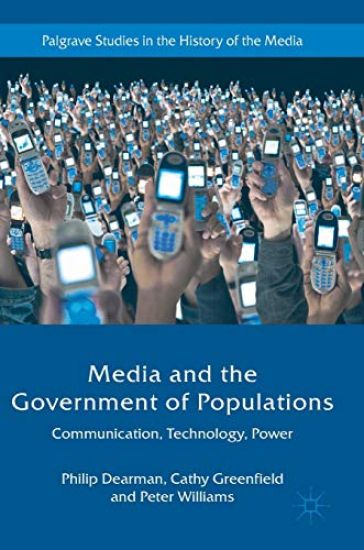
Media and the Government of Populations

Media and the Government of Populations

Philip Dearman; Cathy Greenfield; Peter Williams

Palgrave Macmillan
2018
sidottu
This book deals with the social, cultural and especially political significance of media by shifting from the usual focus on the public sphere and publics and paying attention to populations. It describes key moments where populations of different sorts have been subject to formative and diverse projects of governing, in which communication has been key. It brings together governmentality studies with the study of media practices and communication technologies. Chapters consider print culture and the new political technology of individuals; digital economies as places where populations are formed, known and managed as productive resources; workplaces, schools, clinics and homes as sites of governmental objectives; and how to appropriately link communication technologies and practices with politics. Through these chapters Philip Dearman, Cathy Greenfield and Peter Williams demonstrate the value of considering communication in terms of the governmentof populations.
Daniele Barbaro’s Perspective of 1568

Daniele Barbaro’s Perspective of 1568

Kim Williams; Cosimo Monteleone; Philip Steadman

Springer Nature Switzerland AG
2021
sidottu
A year after the second edition of his famous translation and commentary on Vitruvius, Daniele Barbaro published The Practice of Perspective, a text he had begun working on many years before. Barbaro was the first to publish a formal treatise entirely dedicated to the science of geometric perspective. In an informal style especially addressed to practicing artists and architects, Barbaro begins by drawing on and expanding the manuscript treatise of Piero della Francesca with regards to basics of perspective constructions for representing three-dimensional solids on two-dimensional media, and then goes on to show that perspective is a particularly suitable instrument for other scientific and artistic applications as well, including cartography, cosmology, stage set design, and anamorphosis. Here for the first time Barbaro’s The Practice of Perspective is made available to contemporary scholars in an English translation, augmented by annotations relating the printed treatise to the three unpublished manuscripts in Italian and Latin of the work now conserved in Venice’s Biblioteca Nazionale Marciana. A foreword by Philip Steadman sets the stage for this book. In-depth essays by authors Kim Williams and Cosimo Monteleone situate the treatise within the editorial panorama of the Cinquecento, outline the innovations that Barbaro brought to the study of perspective, and focus particularly on his creative explorations of geometric solids and the construction of clocks. Sometimes dismissed in recent studies as a compilation of known principles, the aim of this present book is to reveal the truly innovative nature of Barbaro’s experiments and results and restore him to his rightful place as an original scholar of Renaissance perspective theory.
Daniele Barbaro’s Perspective of 1568

Daniele Barbaro’s Perspective of 1568

Kim Williams; Cosimo Monteleone; Philip Steadman

Springer Nature Switzerland AG
2022
nidottu
A year after the second edition of his famous translation and commentary on Vitruvius, Daniele Barbaro published The Practice of Perspective, a text he had begun working on many years before. Barbaro was the first to publish a formal treatise entirely dedicated to the science of geometric perspective. In an informal style especially addressed to practicing artists and architects, Barbaro begins by drawing on and expanding the manuscript treatise of Piero della Francesca with regards to basics of perspective constructions for representing three-dimensional solids on two-dimensional media, and then goes on to show that perspective is a particularly suitable instrument for other scientific and artistic applications as well, including cartography, cosmology, stage set design, and anamorphosis. Here for the first time Barbaro’s The Practice of Perspective is made available to contemporary scholars in an English translation, augmented by annotations relating the printed treatise to the three unpublished manuscripts in Italian and Latin of the work now conserved in Venice’s Biblioteca Nazionale Marciana. A foreword by Philip Steadman sets the stage for this book. In-depth essays by authors Kim Williams and Cosimo Monteleone situate the treatise within the editorial panorama of the Cinquecento, outline the innovations that Barbaro brought to the study of perspective, and focus particularly on his creative explorations of geometric solids and the construction of clocks. Sometimes dismissed in recent studies as a compilation of known principles, the aim of this present book is to reveal the truly innovative nature of Barbaro’s experiments and results and restore him to his rightful place as an original scholar of Renaissance perspective theory.
Marsh and Martin's Oral Microbiology

Marsh and Martin's Oral Microbiology

Philip D. Marsh; Michael A.O. Lewis; David Williams; Melanie Wilson; Egija Zaura

Elsevier Health Sciences
2026
nidottu
Now completely up to date and featuring a new international author team, Marsh and Martin's Oral Microbiology, 7th Edition, remains the microbiology reference of choice for undergraduate and postgraduate dental students, researchers and a wide range of clinical dental professionals. Using a unique ecological approach, this popular textbook describes the complex relationship between the resident oral microbiome and the host in health and disease, providing a clear set of principles to explain whether the microbiota will have a beneficial or an adverse relationship with the host at a particular site. Explores the biological and clinical significance of the oral microbiota in the form of a biofilm on dental and mucosal surfaces Emphasises current concepts on the aetiology of dental caries and periodontal diseases, and reflects upon the impact that the genomic era has had on the field. Contains a new chapter describing traditional and contemporary (molecular) methods to determine the microbial composition and metabolic activity of the oral microbiome; expanded content on infection control in dentistry, including the impact of COVID-19; and in-depth chapters on the involvement of viruses, fungi and bacteria in orofacial infections and the role of oral microorganisms in systemic diseases. Features a visually appealing, full-colour design and Key Points throughout that help make learning more focused and efficient Includes self-assessment questions in each chapter that allow you to monitor your progress and identify areas for further study An eBook version is included with purchase. The eBook allows you to access all of the text, figures, and references, with the ability to search, customize your content, make notes and highlights, and have content read aloud
Oral Microbiology

Oral Microbiology

Philip D. Marsh; Michael A.O. Lewis; Helen Rogers; David Williams; Melanie Wilson

Churchill Livingstone
2016
nidottu
New edition of a highly popular textbook on oral microbiology suitable for undergraduate and postgraduate dental students, research workers, and a wide range of clinical dental professionals Successfully describes the complex relationship between the resident oral microbiota and the host in health and disease Retains a unique ecological approach to the subject which provides a clear set of principles to explain whether the microbiota will have a beneficial or an adverse relationship with the host at a particular site Exploration of the biological and clinical significance of the oral microbiota in the form of a biofilm on dental and mucosal surfaces Completely updated throughout by a new author team! Self-assessment questions in each chapter allow readers to monitor their progress Updated design with 'Key Points' throughout aids learning Reflects the impact that the genomic era has had on the field Expanded sections on infection control as well as therapeutic and prophylactic antibiotic use New sections on the benefits of the resident oral microbiota and on current concepts of factors driving dysbiosis in periodontal disease New chapter on the emerging role of oral microorganisms in systemic diseases
Plough Quarterly No. 38 - Repair

Plough Quarterly No. 38 - Repair

Rowan Williams; Makoto Fujimura; Stephanie Saldaña; Adam Nicholson; Hannah Rose Thomas; Narine Abgaryan; Leah Libresco Sergeant; Norman Wirzba; Benjamin Crosby; Kurt Armstrong; Philip Britts

PLOUGH PUBLISHING HOUSE
2023
nidottu
Our writers celebrate the work of repair – of objects, relationships, communities, and landscapes – and reckon with its limits. Consumers campaign for a “right to repair” in protest of products’ wasteful “planned obsolescence.” Repair cafés spring up, in which old-timers teach greenhorns to mend clothes and appliances. But much more than our possession stand in need of repair. For some, the Jewish phrase tikkun olam – to repair the world – may have become little more than a secular social justice mandate, not unlike the Christian cliché “God has no hands but ours.” Yet while we wait on God to repair the cosmos, there are indeed countless ways one can participate in this work, whether one is a mother, a handyman, a farmer, an artist, an teacher, or a pastor. The work may not be glamorous, but it calls forth our creativity and holds its own rewards. On this theme: - A handyman settles for humble work and doesn’t wish more for his children. - A mother mends her daughters’ clothes into extravagant works of arts. - A pastor in a declining denomination asks where to start repairing the church. - A farmer says a restored landscape will be more than it was before. - Yazidi, Rohingya, and Uyghur survivors of sexual violence find ways to reclaim their dignity. - Painter Makoto Fujimura says artists don’t fight culture wars, they make culture. - Prisoners and staff say prisons don’t rehabilitate, but education in prison just might. - A schoolteacher says education requires family, school, and community. - A church that prays in the language of Jesus, scattered by war, lives on in new places. Plough Quarterly features stories, ideas, and culture for people eager to apply their faith to the challenges we face. Each issue includes in-depth articles, interviews, poetry, book reviews, and art.