Kirjahaku
Etsi kirjoja tekijän nimen, kirjan nimen tai ISBN:n perusteella.
1000 tulosta hakusanalla Raymond S Slade
Biochemistry Second Edition, is a single-semester text designed for undergraduate non-biochemistry majors. Accessible, engaging, and informative, it is the perfect introduction to the subject for students who may approach chemistry with apprehension. Its unique emphasis on metabolism and its kinetic underpinnings gives the text up-to-the-minute relevance for students investigating current public health concerns, such as obesity and diabetes. Biochemistry Second Edition will encourage students to explore the basics of chemistry and its influence on biological problems. Key Features: Provides an understanding of (mostly) enzymatic reactions that are responsible for the function and maintenance of living things. This innovative text for non-biochemistry majors includes introductory material at the beginning of each chapter that contextualizes chapter themes in real-life scenarios. Online supporting materials with further opportunities for research and investigation. Synthesis questions at the end of each chapter that encourage students to make connections between concepts and ideas, as well as develop critical-thinking skills.About the Author:Raymond S. Ochs is a biochemist with a career-long specialty in metabolism spanning 30 years. Previously, he has written the textbook Biochemistry, contributed the metabolism chapters to another text, Principles of Biochemistry, and co-edited a collection of articles published as Metabolic Regulation, and the recent monograph Metabolic Strucure and Regulation. His research interests concern major pathways of liver and muscle, including glycolysis, gluconeogenesis, ureogenesis, fatty acid metabolism, glycogen metabolism, and control by cAMP, Ca2+, diacylglycerol, and AMPK. He is currently professor of pharmacy at St. John’s University in New York, teaching biochemistry, physiology, and medicinal chemistry.
There is a renewed interest in the fundamentals of energy metabolism, yet most people base their understanding on the views of generalists expressed in elementary textbooks. New techniques that enable analysis of thousands of metabolites provide useful data, but do not themselves substitute for an understanding of the fundamentals of metabolism. While classical ideas of metabolism are also valuable, some earlier ideas have not withstood further investigation. This book presents a personal philosophy but rests on what is broadly accepted by metabolic biochemists over the past few decades.
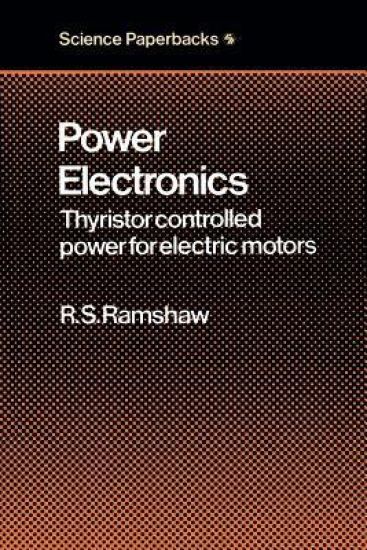
The following pages are meant for those who wish to use thyristors. The details of the physics of semiconductor materials or the design of thyristors themselves are unnecessary here but a general description of the device may help to avoid pitfalls during electric circuit design. Thyristor is the internationally recognized name for a particular semi conductor device. The name is derived from the Greek, the first part meaning switch and the second part an association with the transistor family. It has a trade name, viz. SCR (silicon controlled rectifier) and it got this name principally because it is a silicon device and it is used as a rectifier which can be controlled. As a controlled switch it forms a group together with the electromagnetic relay, the thyratron and the mercury arc rectifier. The advantages and disadvantages of the thyristor become apparent in the process of describing the device and its range of application. However, the present general interest, development and useof the thyristor, indicates that for many cases its many advantages make it superior to other devices. Control of rotating electric machines is a major interest of the author so that in this book the applications of the thyristor are towards this end. Thyristors are used so much in connection with the control of machines that it is worthwhile to go into some details of both the electric drive to be controlled and the possible thyristor control units.
Restaurant Financial Basics
Raymond S. Schmidgall; David K. Hayes; Jack D. Ninemeier
John Wiley Sons Inc
2002
nidottu
The complete, practical guide to managing the business side of a restaurant The success of a restaurant depends not only on great food and outstanding service, but also on sound financial management. Restaurant Financial Basics gives restaurant managers the financial knowledge and tools they need to understand, analyze, and report their restaurants finances accuratelyand use that data to help run the business effectively. Written clearly and with a minimum of jargon, this down-to-earth guide focuses on the crucial information busy managers must knowfor both day-to-day operations and long-term planning. It covers the full range of crucial basic accounting principles, including cash flow, pricing, budgeting, cost control, equipment accounting, and cash and revenue control. It completely demystifies the two most important financial statements for a restaurant business: the balance sheet and the income statement. Throughout, Restaurant Financial Basics offers valuable practical tools, including: *Managers Briefs that summarize critical accounting principles and practices *Ready-to-use forms for record-keeping and accounting *Easy checklists to help improve operations and planning *Web site resources for fast, up-to-date access to further information The Restaurant Basics Series provides restaurant owners and managers with expert advice and practical guidance on critical issues in restaurant operation and management. Written by leading authorities in their respective areas of expertise, these easy-to-use guides offer instant access to authoritative information on every aspect of the restaurant business and every type of restaurantindependent, chain, or franchise.
Handbook of Applied Cognition
Raymond S. Nickerson; Roger W. Schvaneveldt; Susan T. Dumais; D. Stephen Lindsay; Michelene T. H. Chi
John Wiley Sons Inc
1999
sidottu
Cognitive psychology is the basis of many applications in almost every area of technology, business, industry, and education. This book provides workers in applied arenas with presentations of research aimed directly at the problems and issues that confront them. It will cover key areas including business and industry, computers and technology, education and information, and health and law.
The Religion Of Philosophy Or The Unification Of Knowledge
Raymond S. Perrin
Kessinger Pub
2007
pokkari
How many times can one person be told "you've got six months to live."? What would you do if you were considered a "walking dead and not viable" after being diagnosed with a chronic illness? "Six Months of Grace" explores one man's struggle after a diagnosis of Chronic Sarcoidosis. This seemingly hopeless situation is taken in stride and countered with dignity, courage and life affirming techniques. Read on and discover how six months can seem like a lifetime.
This volume aims to review some of the recent developments and trends that seem especially relevant to any attempt to understand near-term-future possibilities; to consider what a variety of knowledgeable people are saying about changes and developments that could occur; and to relate the possibilities to needs and opportunities for human factors research. Human factors, in this case, includes not only the implications of human capabilities and limitations for the design of equipment and machines intended for human use, but also applied psychology in a more general sense. In particular, it is taken to involve social systems as well as physical ones, the interaction of people with the environment as well as with machines, the facilitation of communication between people as well as between people and computers, and the design of policies and procedures as well as the design of equipment. The author's intention is to focus on anticipated problems -- including opportunities as well as difficulties -- and ask how human factors research might contribute to solutions. It is assumed that there are ways in which such research could be useful in addressing societal problems that the profession has not yet realized and that these are more likely to be recognized in the future if the community is actively seeking to identify them.
This book stimulates thinking on the topic of detrimental environmental change and how research psychologists can help to address the problem. In addition to reporting environmentally relevant psychological research, the author identifies the most pressing questions from an environmental point of view. Psychology and Environmental Change: *focuses on ways in which human behavior contributes to the problem; *deals with the assessment and change of attitudes and with studies of change of behavior; *proposes ways in which psychological research can contribute to making technology and its products more environmentally benign; and *introduces topics such as consumption, risk assessment, cost-benefit and tradeoff analyses, competition, negotiation, and policymaking, and how they relate to the objective of protecting the environment.
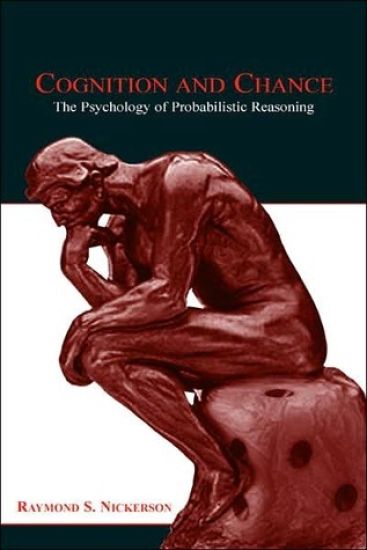
Lack of ability to think probabilistically makes one prone to a variety of irrational fears and vulnerable to scams designed to exploit probabilistic naiveté, impairs decision making under uncertainty, facilitates the misinterpretation of statistical information, and precludes critical evaluation of likelihood claims. Cognition and Chance presents an overview of the information needed to avoid such pitfalls and to assess and respond to probabilistic situations in a rational way. Dr. Nickerson investigates such questions as how good individuals are at thinking probabilistically and how consistent their reasoning under uncertainty is with principles of mathematical statistics and probability theory. He reviews evidence that has been produced in researchers' attempts to investigate these and similar types of questions. Seven conceptual chapters address such topics as probability, chance, randomness, coincidences, inverse probability, paradoxes, dilemmas, and statistics. The remaining five chapters focus on empirical studies of individuals' abilities and limitations as probabilistic thinkers. Topics include estimation and prediction, perception of covariation, choice under uncertainty, and people as intuitive probabilists. Cognition and Chance is intended to appeal to researchers and students in the areas of probability, statistics, psychology, business, economics, decision theory, and social dilemmas.
Ancestors in German Archives. Volume I
Raymond S. Wright III
Genealogical Publishing Company
2009
pokkari
Ancestors in German Archives. Volume II
Raymond S. Wright III
Genealogical Publishing Company
2009
pokkari
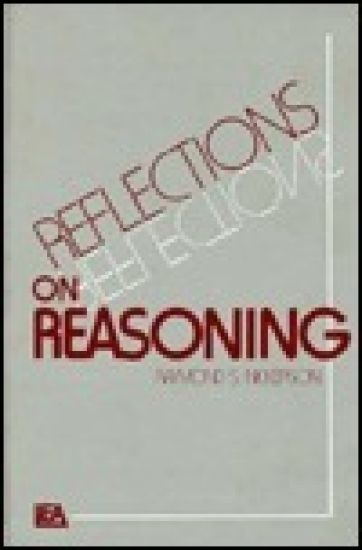
This book is an adaptation of a report entitled Notes about Reasoning, prepared under a project on The Training of Higher Cognitive Learning and Thinking Skills that was sponsored by the National Institute of Education. My purpose in producing the notes was to help me clarify my own thinking about reasoning and how the ability to reason effectively might be enhanced in the classroom. I did not intend to write a textbook on reasoning or a scholarly review of research on reasoning processes, and this book is not presented as either now. It still has the character of a collection of thoughts; it is being published with the hope that some of the ideas and suggestions in it may stimulate some others, especially teachers and students, to reflect more than they otherwise might have upon what it means to reason effectively. One does not, of course, become an effective reasoner by reading a book on reasoning or by taking a course in reasoning. Learning to reason well is surely a lifelong process—or at least a lifelong challenge. If this book is useful in helping some readers to see the value of an enduring commitment to that challenge, it will have served its purpose. I wish to thank the NIE Project Officers, Patricia Butler and Joseph Psotka, for their support and encouragement. I am grateful also to John Swets, Richard Herrnstein, David Perkins and Carol Chomsky for helpful comments on an early draft of the manuscript, to Anne Kerwin and Patricia Carroll for typing the manuscript and to Brenda Starr and Frank DiPace for making electronic delivery of it to the printer possible by working around the differences between the sending and receiving systems. Special thanks to my wife, Doris, for her constant help of countless types, and most especially for bringing into the world the four beautiful people to whom this book is dedicated.
First published in 1986. Reflections on Reasoning Is a clearly written introduction that guides high school and college students, teachers, and parents through straightforward discussions on the nature of logic, belief, and argument. While examining the nature of reasoning, Nickerson offers practical examples from everyday life to Illustrate how we can become more effective and self-aware in our reasoning.
Solubility of Nylon in Methanol-water Solutions.
Raymond S. Tuszynski
Hassell Street Press
2021
sidottu
This work has been selected by scholars as being culturally important and is part of the knowledge base of civilization as we know it.This work is in the public domain in the United States of America, and possibly other nations. Within the United States, you may freely copy and distribute this work, as no entity (individual or corporate) has a copyright on the body of the work.Scholars believe, and we concur, that this work is important enough to be preserved, reproduced, and made generally available to the public. To ensure a quality reading experience, this work has been proofread and republished using a format that seamlessly blends the original graphical elements with text in an easy-to-read typeface.We appreciate your support of the preservation process, and thank you for being an important part of keeping this knowledge alive and relevant.