Kirjojen hintavertailu. Mukana 11 244 527 kirjaa ja 12 kauppaa.

Kirjahaku

Etsi kirjoja tekijän nimen, kirjan nimen tai ISBN:n perusteella.

1000 tulosta hakusanalla Roderic A. Grupen

A Voyage to St. Kilda, the Remotest of all the Hebrides. Or, Western Isles of Scotland. ... To Which is Added, An Account of Roderick, the Late Imposter There, ... By M. Martin, Gent
The 18th century was a wealth of knowledge, exploration and rapidly growing technology and expanding record-keeping made possible by advances in the printing press. In its determination to preserve the century of revolution, Gale initiated a revolution of its own: digitization of epic proportions to preserve these invaluable works in the largest archive of its kind. Now for the first time these high-quality digital copies of original 18th century manuscripts are available in print, making them highly accessible to libraries, undergraduate students, and independent scholars.Delve into what it was like to live during the eighteenth century by reading the first-hand accounts of everyday people, including city dwellers and farmers, businessmen and bankers, artisans and merchants, artists and their patrons, politicians and their constituents. Original texts make the American, French, and Industrial revolutions vividly contemporary.++++The below data was compiled from various identification fields in the bibliographic record of this title. This data is provided as an additional tool in helping to insure edition identification: ++++Bodleian Library (Oxford)T152363London: printed for R. Griffith, 1749. 2],82p.; 8
Who Discovered the Sources of the Nile? a Letter to Sir Roderick I. Murchison ... with an Appendix Containing a Letter to ... the Lord Ashburton, Etc.
Title: Who discovered the Sources of the Nile? A letter to Sir Roderick I. Murchison ... with an appendix containing a letter to ... the Lord Ashburton, etc.Publisher: British Library, Historical Print EditionsThe British Library is the national library of the United Kingdom. It is one of the world's largest research libraries holding over 150 million items in all known languages and formats: books, journals, newspapers, sound recordings, patents, maps, stamps, prints and much more. Its collections include around 14 million books, along with substantial additional collections of manuscripts and historical items dating back as far as 300 BC.The GENERAL HISTORICAL collection includes books from the British Library digitised by Microsoft. This varied collection includes material that gives readers a 19th century view of the world. Topics include health, education, economics, agriculture, environment, technology, culture, politics, labour and industry, mining, penal policy, and social order. ++++The below data was compiled from various identification fields in the bibliographic record of this title. This data is provided as an additional tool in helping to insure edition identification: ++++ British Library Beke, Charles Tilstone; 1863. 16 p.; 8 . 7704.g.47.(32.)
The A to Z of Irish Cinema

The A to Z of Irish Cinema

Roderick Flynn; Patrick Brereton

Scarecrow Press
2010
nidottu
In 1898, documentary footage of a yacht race was shot by Robert A. Mitchell, making him the first Irishman to shoot a film within Ireland. Despite early exposure to the filmmaking process, Ireland did not develop a regular film industry until the late 1910s when James Mark Sullivan established the Film Company of Ireland. Since that time, Ireland has played host to many famous films about the country—Man of Aran, The Quiet Man, The Crying Game, My Left Foot, and Bloody Sunday—as well as others not about the country—Braveheart and Saving Private Ryan. It has also produced great directors such as Neil Jordan and Jim Sheridan, as well as throngs of exceptional actors and actresses: Colin Farrel, Colm Meaney, Cillian Murphy, Liam Neeson, Maureen O'Hara, and Peter O'Toole. The A to Z of Irish Cinema provides essential facts on the history of Irish cinema through a chronology; an introduction; a bibliography; and hundreds of cross-referenced dictionary entries on the pioneers and current leaders in the industry, the actors, directors, distributors, exhibitors, schools, arts centers, the government bodies and some of the legislation they passed, and the films.
Just a little from the top...

Just a little from the top...

Roderick Elms

The Choir Press
2020
sidottu
Just a Little From the Top is an autobiography of a lifetime in music. Roderick Elms' love of music throughout his childhood and secondary school at The City of London School led to the Royal Academy of Music, and a full time career at the highest level of music-making in London. It includes a multitude of anecdotes, many humorous, and reveals some of the workings of the music profession, including occasions when things have gone wrong, as a result of practical or mechanical failures, or due simply to incompetent leadership. In addition to his freelance performances for the BBC from the late seventies until the present, Roderick Elms describes the periods he spent with the London Symphony Orchestra, London Philharmonic Orchestra and the Royal Philharmonic Orchestra. There is a chapter about his work and travels as pianist with the eminent cellist Mstislav Rostropovich. He has made numerous solo recordings with the London orchestras and these are detailed together with the many film soundtracks to which he has contributed, notably the complete The Lord of the Rings, trilogy. Composing and arranging has also been a big part of his life and there is a chapter about this and the CD recordings made of his music (including 'A Little Fall-ish!'; 'Festive Frolic'; 'Moody Moves'; 'A Windy Christmas'). A little early biographical information takes the reader through the wonderful experiences gained by many from musical opportunities provided by the Redbridge Music Service and its music advisor, Malcolm Bidgood OBE. It also takes a trip through some of the Redbridge-based musical groups which played such a big part in the lives of young musicians living in that area in the late-sixties, seventies and eighties. Not least, the internationally unknown Gnaff Ensemble.
Europe: A New History

Europe: A New History

Roderick Beaton

BASIC BOOKS
2026
sidottu
A bold new history of Europe, from ancient Greece to the Russian invasion of Ukraine What do we talk about when we talk about Europe? Is it defined by geography? Or is it politics, or shared culture? In Europe, award-winning historian Roderick Beaton tells the story of Europe as never before--as the history of an idea, and a collective identity. Since its dramatic birth in ancient Greece, "Europe" has been defined, and redefined, by its people. Through this powerful lens, and with the narrative drive and scope of a novelist, Beaton deftly surveys Europe's major historical developments: the rise and fall of Rome; the explosion of Christianity; the intellectual ferment of the Renaissance and the Enlightenment; the arrival of Europeans in the Americas; the violent upheavals of the nineteenth and twentieth centuries; and the uncertainties of the present. Throughout, original sources allow the voices of the past, from Tacitus to Thatcher, to speak for themselves. Grappling with the multilayered identities that have always come with being European, Europe places the Europe of today in a long arc of history stretching back more than 2,500 years.
A Realistic Theory of Categories

A Realistic Theory of Categories

Roderick M. Chisholm

Cambridge University Press
1996
pokkari
Roderick Chisholm has been for many years one of the most important and influential philosophers contributing to metaphysics, philosophy of mind, and epistemology. This book can be viewed as a summation of his views on an enormous range of topics in metaphysics and epistemology. Yet it is written in the terse, lucid, unpretentious style that has become a hallmark of Chisholm’s work. The book is an original treatise designed to defend an original, non-Aristotelian theory of categories. Chisholm argues that there are necessary things and contingent things; necessary things being things that are not capable of coming into being or passing away. He defends the argument from design, and thus includes the category of necessary substance (God). Further contentions of the essay are that attributes are also necessary beings, but not necessary substances, and that human beings are contingent substances but may not be material substances.
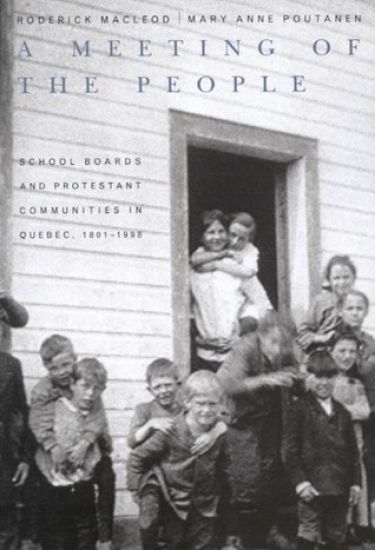
A Meeting of the People

A Meeting of the People

Roderick Macleod; Mary Anne Poutanen

McGill-Queen's University Press
2004
sidottu
In A Meeting of the People Roderick MacLeod and Mary Anne Poutanen look at the Protestant public education system and the communities that established, and were served by, its schools, from the origins of public education in 1801 to the dissolution of confessional school boards in 1998. They focus on key issues such as class, ethnicity, religion, gender, health and welfare, patriotism, and the nature of local administration, bringing to life the people who attempted to establish and maintain schools and considering relationships between school trustees, parents, teachers, and the wider public. Their analysis shows that communities recognized the importance of providing schooling, despite what were often bleak circumstances. The authors show that Protestant families often had to make a difficult choice between supporting better educational facilities in a central place far away or encouraging the survival of the local community through maintaining one of its key institutions, the local school. They explore the ambiguous nature of Protestant education, at times understood as schooling reserved for a religious minority and at others as a liberal approach similar to public schooling across North America. The Protestant community, begun as a British element within a small colony, has developed into a diverse array of people from across the religious spectrum, periodically redefining itself to meet the needs of a changing Quebec society.
A Meeting of the People

A Meeting of the People

Roderick Macleod; Mary Anne Poutanen

McGill-Queen's University Press
2004
nidottu
In A Meeting of the People Roderick MacLeod and Mary Anne Poutanen look at the Protestant public education system and the communities that established, and were served by, its schools, from the origins of public education in 1801 to the dissolution of confessional school boards in 1998. They focus on key issues such as class, ethnicity, religion, gender, health and welfare, patriotism, and the nature of local administration, bringing to life the people who attempted to establish and maintain schools and considering relationships between school trustees, parents, teachers, and the wider public. Their analysis shows that communities recognized the importance of providing schooling, despite what were often bleak circumstances. The authors show that Protestant families often had to make a difficult choice between supporting better educational facilities in a central place far away or encouraging the survival of the local community through maintaining one of its key institutions, the local school. They explore the ambiguous nature of Protestant education, at times understood as schooling reserved for a religious minority and at others as a liberal approach similar to public schooling across North America. The Protestant community, begun as a British element within a small colony, has developed into a diverse array of people from across the religious spectrum, periodically redefining itself to meet the needs of a changing Quebec society.
A Statistical History of All the Electoral Districts of the Province of Ontario Since 1867
This work has been selected by scholars as being culturally important and is part of the knowledge base of civilization as we know it.This work is in the public domain in the United States of America, and possibly other nations. Within the United States, you may freely copy and distribute this work, as no entity (individual or corporate) has a copyright on the body of the work.Scholars believe, and we concur, that this work is important enough to be preserved, reproduced, and made generally available to the public. To ensure a quality reading experience, this work has been proofread and republished using a format that seamlessly blends the original graphical elements with text in an easy-to-read typeface.We appreciate your support of the preservation process, and thank you for being an important part of keeping this knowledge alive and relevant.