Kirjojen hintavertailu. Mukana 11 244 527 kirjaa ja 12 kauppaa.

Kirjahaku

Etsi kirjoja tekijän nimen, kirjan nimen tai ISBN:n perusteella.

1000 tulosta hakusanalla S. Elizabeth Cook

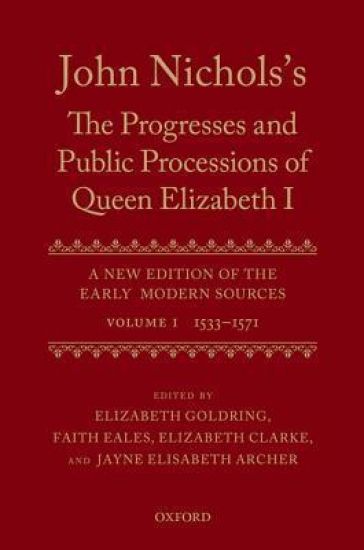
John Nichols's The Progresses and Public Processions of Queen Elizabeth: Volume I
John Nichols's The Progresses of Queen Elizabeth (1788-1823) has long been an indispensable reference tool for scholars working on Elizabethan court and culture - despite the serious limitations of an antiquarian edition now two centuries old. This old-spelling edition of the early modern materials contained in Nichols's Progresses is edited to high and consistent standards, and based on a critical re-examination of printed and manuscript sources. It is structured by a narrative of the two sets of annual progresses undertaken by Queen Elizabeth I: the 'summer progresses,' when Elizabeth travelled throughout southern England and the Midlands, visiting cities as far afield as Bristol, Coventry, Norwich, and Southampton; and the 'winter progresses,' when Elizabeth moved between her residences in and around London, including Richmond, Hampton Court, and Whitehall. New editions of the major progress entertainments - Kenilworth, Woodstock, Elvetham, Cowdray, Ditchley, and Harefield - are set alongside accounts of civic receptions, tilts and Accession Day entertainments, and non-dramatic texts, many of which have not been published since Nichols, including verses delivered by Eton scholars before the Queen (1563); John Lesley's Oratio (1574); Gabriel Harvey's Gratulationum Valdinensium (1578); and the Oxford and Cambridge verses on the death of Queen Elizabeth (1603). The editions are supported by translations of all non-English material, full scholarly annotation, illustrations, and maps. This will make John Nichols's The Progresses and Public Processions of Queen Elizabeth: A New Edition of the Early Modern Sources the most comprehensive collection of early modern texts pertaining to the court and culture of Queen Elizabeth. Volume I covers the years from 1533 to 1571.
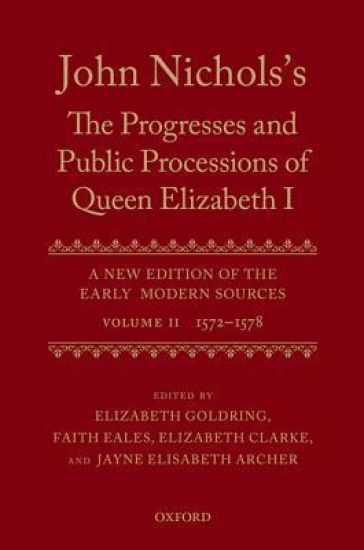
John Nichols's The Progresses and Public Processions of Queen Elizabeth: Volume II
John Nichols's The Progresses of Queen Elizabeth (1788-1823) has long been an indispensable reference tool for scholars working on Elizabethan court and culture - despite the serious limitations of an antiquarian edition now two centuries old. This old-spelling edition of the early modern materials contained in Nichols's Progresses is edited to high and consistent standards, and based on a critical re-examination of printed and manuscript sources. It is structured by a narrative of the two sets of annual progresses undertaken by Queen Elizabeth I: the 'summer progresses,' when Elizabeth travelled throughout southern England and the Midlands, visiting cities as far afield as Bristol, Coventry, Norwich, and Southampton; and the 'winter progresses,' when Elizabeth moved between her residences in and around London, including Richmond, Hampton Court, and Whitehall. New editions of the major progress entertainments - Kenilworth, Woodstock, Elvetham, Cowdray, Ditchley, and Harefield - are set alongside accounts of civic receptions, tilts and Accession Day entertainments, and non-dramatic texts, many of which have not been published since Nichols, including verses delivered by Eton scholars before the Queen (1563); John Lesley's Oratio (1574); Gabriel Harvey's Gratulationum Valdinensium (1578); and the Oxford and Cambridge verses on the death of Queen Elizabeth (1603). The editions are supported by translations of all non-English material, full scholarly annotation, illustrations, and maps. This will make John Nichols's The Progresses and Public Processions of Queen Elizabeth: A New Edition of the Early Modern Sources the most comprehensive collection of early modern texts pertaining to the court and culture of Queen Elizabeth. Volume II covers the years from 1572 to 1578.
John Nichols's The Progresses and Public Processions of Queen Elizabeth: Volume III
John Nichols's The Progresses of Queen Elizabeth (1788-1823) has long been an indispensable reference tool for scholars working on Elizabethan court and culture - despite the serious limitations of an antiquarian edition now two centuries old. This old-spelling edition of the early modern materials contained in Nichols's Progresses is edited to high and consistent standards, and based on a critical re-examination of printed and manuscript sources. It is structured by a narrative of the two sets of annual progresses undertaken by Queen Elizabeth I: the 'summer progresses,' when Elizabeth travelled throughout southern England and the Midlands, visiting cities as far afield as Bristol, Coventry, Norwich, and Southampton; and the 'winter progresses,' when Elizabeth moved between her residences in and around London, including Richmond, Hampton Court, and Whitehall. New editions of the major progress entertainments - Kenilworth, Woodstock, Elvetham, Cowdray, Ditchley, and Harefield - are set alongside accounts of civic receptions, tilts and Accession Day entertainments, and non-dramatic texts, many of which have not been published since Nichols, including verses delivered by Eton scholars before the Queen (1563); John Lesley's Oratio (1574); Gabriel Harvey's Gratulationum Valdinensium (1578); and the Oxford and Cambridge verses on the death of Queen Elizabeth (1603). The editions are supported by translations of all non-English material, full scholarly annotation, illustrations, and maps. This will make John Nichols's The Progresses and Public Processions of Queen Elizabeth: A New Edition of the Early Modern Sources the most comprehensive collection of early modern texts pertaining to the court and culture of Queen Elizabeth. Volume III covers the years from 1579 to 1595.
John Nichols's The Progresses and Public Processions of Queen Elizabeth: Volume IV
John Nichols's The Progresses of Queen Elizabeth (1788-1823) has long been an indispensable reference tool for scholars working on Elizabethan court and culture - despite the serious limitations of an antiquarian edition now two centuries old. This old-spelling edition of the early modern materials contained in Nichols's Progresses is edited to high and consistent standards, and based on a critical re-examination of printed and manuscript sources. It is structured by a narrative of the two sets of annual progresses undertaken by Queen Elizabeth I: the 'summer progresses,' when Elizabeth travelled throughout southern England and the Midlands, visiting cities as far afield as Bristol, Coventry, Norwich, and Southampton; and the 'winter progresses,' when Elizabeth moved between her residences in and around London, including Richmond, Hampton Court, and Whitehall. New editions of the major progress entertainments - Kenilworth, Woodstock, Elvetham, Cowdray, Ditchley, and Harefield - are set alongside accounts of civic receptions, tilts and Accession Day entertainments, and non-dramatic texts, many of which have not been published since Nichols, including verses delivered by Eton scholars before the Queen (1563); John Lesley's Oratio (1574); Gabriel Harvey's Gratulationum Valdinensium (1578); and the Oxford and Cambridge verses on the death of Queen Elizabeth (1603). The editions are supported by translations of all non-English material, full scholarly annotation, illustrations, and maps. This will make John Nichols's The Progresses and Public Processions of Queen Elizabeth: A New Edition of the Early Modern Sources the most comprehensive collection of early modern texts pertaining to the court and culture of Queen Elizabeth. Volume IV covers the years from 1596 to 1603.
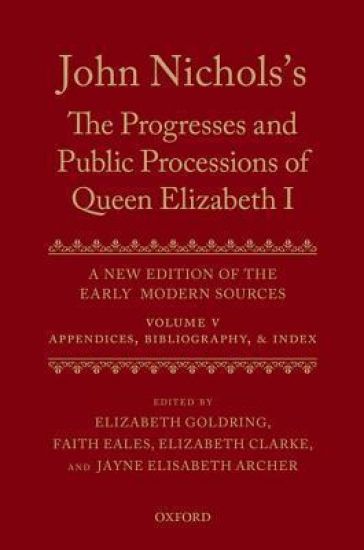
John Nichols's The Progresses and Public Processions of Queen Elizabeth: Volume V
John Nichols's The Progresses of Queen Elizabeth (1788-1823) has long been an indispensable reference tool for scholars working on Elizabethan court and culture - despite the serious limitations of an antiquarian edition now two centuries old. This old-spelling edition of the early modern materials contained in Nichols's Progresses is edited to high and consistent standards, and based on a critical re-examination of printed and manuscript sources. It is structured by a narrative of the two sets of annual progresses undertaken by Queen Elizabeth I: the 'summer progresses,' when Elizabeth travelled throughout southern England and the Midlands, visiting cities as far afield as Bristol, Coventry, Norwich, and Southampton; and the 'winter progresses,' when Elizabeth moved between her residences in and around London, including Richmond, Hampton Court, and Whitehall. New editions of the major progress entertainments - Kenilworth, Woodstock, Elvetham, Cowdray, Ditchley, and Harefield - are set alongside accounts of civic receptions, tilts and Accession Day entertainments, and non-dramatic texts, many of which have not been published since Nichols, including verses delivered by Eton scholars before the Queen (1563); John Lesley's Oratio (1574); Gabriel Harvey's Gratulationum Valdinensium (1578); and the Oxford and Cambridge verses on the death of Queen Elizabeth (1603). The editions are supported by translations of all non-English material, full scholarly annotation, illustrations, and maps. This will make John Nichols's The Progresses and Public Processions of Queen Elizabeth: A New Edition of the Early Modern Sources the most comprehensive collection of early modern texts pertaining to the court and culture of Queen Elizabeth. Volume V contains the appendices, bibliographies, and index.
Her Majesty's Spymaster: Elizabeth I, Sir Francis Walsingham, and the Birth of Modern Espionage
Sir Francis Walsingham's official title was principal secretary to Queen Elizabeth I, but in fact this pious, tight-lipped Puritan was England's first spymaster. A ruthless, fiercely loyal civil servant, Walsingham worked brilliantly behind the scenes to foil Elizabeth's rival Mary Queen of Scots and outwit Catholic Spain and France, which had arrayed their forces behind her. Though he cut an incongruous figure in Elizabeth's worldly court, Walsingham managed to win the trust of key players like William Cecil and the Earl of Leicester before launching his own secret campaign against the queen's enemies. Covert operations were Walsingham's genius; he pioneered techniques for exploiting double agents, spreading disinformation, and deciphering codes with the latest code-breaking science that remain staples of international espionage.
Charlotte's Inheritance. a Novel. by the Author of Lady Audley's Secret [I.E. Mary Elizabeth Braddon] ... Fifth Edition. Vol. II
Title: Charlotte's Inheritance. A novel. By the author of "Lady Audley's Secret" i.e. Mary Elizabeth Braddon] ... Fifth edition.Publisher: British Library, Historical Print EditionsThe British Library is the national library of the United Kingdom. It is one of the world's largest research libraries holding over 150 million items in all known languages and formats: books, journals, newspapers, sound recordings, patents, maps, stamps, prints and much more. Its collections include around 14 million books, along with substantial additional collections of manuscripts and historical items dating back as far as 300 BC.The FICTION & PROSE LITERATURE collection includes books from the British Library digitised by Microsoft. The collection provides readers with a perspective of the world from some of the 18th and 19th century's most talented writers. Written for a range of audiences, these works are a treasure for any curious reader looking to see the world through the eyes of ages past. Beyond the main body of works the collection also includes song-books, comedy, and works of satire. ++++The below data was compiled from various identification fields in the bibliographic record of this title. This data is provided as an additional tool in helping to insure edition identification: ++++ British Library Anonymous; Braddon, M. E.; 1868. 3 vol.; 8 . 12626.b.4.
Charlotte's Inheritance. a Novel. by the Author of Lady Audley's Secret [I.E. Mary Elizabeth Braddon] ... Fifth Edition, Vol. III
Title: Charlotte's Inheritance. A novel. By the author of "Lady Audley's Secret" i.e. Mary Elizabeth Braddon] ... Fifth edition.Publisher: British Library, Historical Print EditionsThe British Library is the national library of the United Kingdom. It is one of the world's largest research libraries holding over 150 million items in all known languages and formats: books, journals, newspapers, sound recordings, patents, maps, stamps, prints and much more. Its collections include around 14 million books, along with substantial additional collections of manuscripts and historical items dating back as far as 300 BC.The NOVELS OF THE 18th & 19th CENTURIES collection includes books from the British Library digitised by Microsoft. The collection includes major and minor works from a period which saw the development and triumph of the English novel. These classics were written for a range of audiences and will engage any reading enthusiast. ++++The below data was compiled from various identification fields in the bibliographic record of this title. This data is provided as an additional tool in helping to insure edition identification: ++++ British Library Anonymous; Braddon, Mary Elizabeth; 1868. 3 vol.; 8 . 12626.b.4.
Charlotte's Inheritance. a Novel. by the Author of Lady Audley's Secret [I.E. Mary Elizabeth Braddon] ... Fifth Edition. Vol. I.
Title: Charlotte's Inheritance. A novel. By the author of "Lady Audley's Secret" i.e. Mary Elizabeth Braddon] ... Fifth edition.Publisher: British Library, Historical Print EditionsThe British Library is the national library of the United Kingdom. It is one of the world's largest research libraries holding over 150 million items in all known languages and formats: books, journals, newspapers, sound recordings, patents, maps, stamps, prints and much more. Its collections include around 14 million books, along with substantial additional collections of manuscripts and historical items dating back as far as 300 BC.The FICTION & PROSE LITERATURE collection includes books from the British Library digitised by Microsoft. The collection provides readers with a perspective of the world from some of the 18th and 19th century's most talented writers. Written for a range of audiences, these works are a treasure for any curious reader looking to see the world through the eyes of ages past. Beyond the main body of works the collection also includes song-books, comedy, and works of satire. ++++The below data was compiled from various identification fields in the bibliographic record of this title. This data is provided as an additional tool in helping to insure edition identification: ++++ British Library Anonymous; Braddon, M. E.; 1868. 3 vol.; 8 . 12626.b.4.
Mr Darcy's Rescue: Darcy and Elizabeth What If? #2

Mr Darcy's Rescue: Darcy and Elizabeth What If? #2

Jennifer Lang

Createspace Independent Publishing Platform
2014
nidottu
What if Elizabeth had befriended Georgiana in Ramsgate? When Elizabeth Bennet sees Georgiana being abducted by George Wickham, she is forced to turn to Mr Darcy, who has made it clear that she is beneath him. When Georgiana has been rescued, Elizabeth is thankful she will never have to see Mr Darcy again. But fate has other plans . . . The novellas in the Darcy and Elizabeth What If? series are all separate, standalone stories. They can be read in any order.