Kirjojen hintavertailu. Mukana 11 627 373 kirjaa ja 12 kauppaa.

Kirjahaku

Etsi kirjoja tekijän nimen, kirjan nimen tai ISBN:n perusteella.

1000 tulosta hakusanalla Samir Badran; Viktor Frisk; Pascal Engman

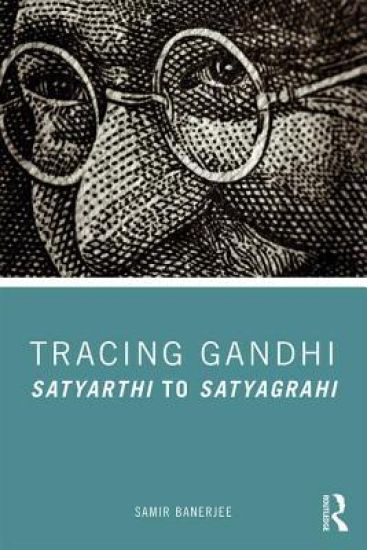
Tracing Gandhi

Tracing Gandhi

Samir Banerjee

Routledge India
2019
sidottu
This book traces the journey of Mahatma Gandhi, from being a simple and truth-seeking human being, a satyarthi, to a committed, conscious and social human being, a satyagrahi. It specifically looks at this critical transformation during the time Gandhi was in South Africa. The central argument of the book is that Gandhi evolved from being a satyarthi to a satyagrahi in South Africa. Subsequently in India, he consolidated his orientation with an emphasis on praxis, by developing his ideas as instruments for social and individual struggles. Marked by a series of events, this period was an intense quest of self-realization and understanding, and shows his journey from being Mohandas Karamchand Gandhi to being Mahatma Gandhi.The book discusses various elements of Gandhian thought and praxis – morality, wisdom, non-violence, truth, social justice, dharma, trusteeship, education, sarvodaya, Hind Swaraj, swadeshi, and social service – and interprets the relevance of Gandhi’s thought in the modern world by highlighting its unique significance for social transformation and change.Lucid and accessible, the book will be useful to scholars and researchers of Gandhi studies, Indian political thought, modern Indian history, and political studies.
Tracing Gandhi

Tracing Gandhi

Samir Banerjee

Routledge India
2019
nidottu
This book traces the journey of Mahatma Gandhi, from being a simple and truth-seeking human being, a satyarthi, to a committed, conscious and social human being, a satyagrahi. It specifically looks at this critical transformation during the time Gandhi was in South Africa. The central argument of the book is that Gandhi evolved from being a satyarthi to a satyagrahi in South Africa. Subsequently in India, he consolidated his orientation with an emphasis on praxis, by developing his ideas as instruments for social and individual struggles. Marked by a series of events, this period was an intense quest of self-realization and understanding, and shows his journey from being Mohandas Karamchand Gandhi to being Mahatma Gandhi.The book discusses various elements of Gandhian thought and praxis – morality, wisdom, non-violence, truth, social justice, dharma, trusteeship, education, sarvodaya, Hind Swaraj, swadeshi, and social service – and interprets the relevance of Gandhi’s thought in the modern world by highlighting its unique significance for social transformation and change.Lucid and accessible, the book will be useful to scholars and researchers of Gandhi studies, Indian political thought, modern Indian history, and political studies.

Digital Signal Processing

Digital Signal Processing

Samir I. Abood

CRC Press
2020
sidottu
Digital Signal Processing:A Primer with MATLAB® provides excellent coverage of discrete-time signals and systems. At the beginning of each chapter, an abstract states the chapter objectives. All principles are also presented in a lucid, logical, step-by-step approach. As much as possible, the authors avoid wordiness and detail overload that could hide concepts and impede understanding.In recognition of requirements by the Accreditation Board for Engineering and Technology (ABET) on integrating computer tools, the use of MATLAB® is encouraged in a student-friendly manner. MATLAB is introduced in Appendix C and applied gradually throughout the book. Each illustrative example is immediately followed by practice problems along with its answer. Students can follow the example step-by-step to solve the practice problems without flipping pages or looking at the end of the book for answers. These practice problems test students' comprehension and reinforce key concepts before moving onto the next section. Toward the end of each chapter, the authors discuss some application aspects of the concepts covered in the chapter. The material covered in the chapter is applied to at least one or two practical problems. It helps students see how the concepts are used in real-life situations.Also, thoroughly worked examples are given liberally at the end of every section. These examples give students a solid grasp of the solutions as well as the confidence to solve similar problems themselves. Some of hte problems are solved in two or three ways to facilitate a deeper understanding and comparison of different approaches.Designed for a three-hour semester course, Digital Signal Processing:A Primer with MATLAB® is intended as a textbook for a senior-level undergraduate student in electrical and computer engineering. The prerequisites for a course based on this book are knowledge of standard mathematics, including calculus and complex numbers.
Critical Currents and Superconductivity
The book comprises six chapters which deal with the critical currents and the ferromagnetism-superconductivity coexistence in high-Tc oxides. It begins by gathering key data for superconducting state and the fundamental properties of the conventional superconductors, followed by a recap of the basic theories of superconductivity. It then discusses the differences introduced by the structural anisotropy on the Ginzburg-Landau approach and the Lawrence-Doniach model before addressing the dynamics of vortices and the ferromagnetism-superconductivity coexistence in high-Tc oxides, and provides an outline of the pinning phenomena of vortices in these materials, in particular the pinning of vortices by the spins. It elucidates the methods to improve the properties of superconducting materials for industrial applications. This optimization aims at obtaining critical temperatures and densities of critical currents at the maximum level possible. Whereas the primary objective is the basic mechanisms pushing the superconductivity towards high temperatures, the secondary objective is to achieve a better understanding of the vortices pinning. This book is targeted at researchers and graduate students of fundamental and engineering sciences.
Migrations, Identities and Democratic Practices in India
This book explores contesting identities, international politics, migration and democratic practices in the context of globalizing India. Drawing on extensive ethnographic research, it looks at one of the oldest migratory routes across a volatile region in eastern India which is fraught with violent claims of separate statehood.The book offers an account of how the ‘North Bengal’ region has acted as a gateway to migrant populations over time and points to why it must be understood as a shifting and liminal space through a study of Bodoland, Gorkhaland, Kamatapuri, Siliguri and the Greater Cooch Behar movements. It shows the region’s politics of identity or quest for homeland not as a means of compensating for the lack or absence of identity, but as an everyday practice of living that very absence, across borders and boundaries, without arriving at any definitive and stable identity, along with impacts and manifestations in democratic political processes. A major intervention in modern political theory – shedding new light on concepts such as home and homeland, space and self, sovereignty, nation-state, freedom and democracy – this book will be of interest to scholars and researchers of political science, modern South Asian history, sociology and social anthropology, and migration and diaspora studies.
Protestant Missionaries in the Levant
Through focusing on the unintended by-products of New England Puritanism as a cultural transplant in the Levant, this book explores the socio-historical forces which account for the failure of early envoys’ attempts to convert the ‘native,’ population. Early failure in conversion led to later success in reinventing themselves as agents of secular and liberal education, welfare, and popular culture. Through making special efforts not to debase local culture, the missionaries’ work resulted in large sections of society becoming protestantized without being evangelized.An invaluable resource for postgraduates and those undertaking postdoctoral research, this book explores a seminal but overlooked interlude in the encounters between American Protestantism and the Levant. Using data from previously unexplored personal narrative accounts, Khalaf dates the emergence of the puritanical imagination, sparked by sentiments of American exceptionalism, voluntarism and "soft power" to at least a century before commonly assumed.
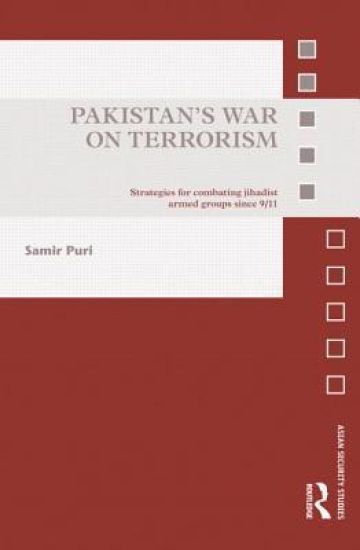
Pakistan's War on Terrorism

Pakistan's War on Terrorism

Samir Puri

Routledge
2011
sidottu
This book examines Pakistan's strategies in the war against Islamist armed groups that began late 2001, following the 9/11 attacks. The significance of the war inside Pakistan can hardly be understated. Starting in the tribal territories adjacent to Afghanistan, Pakistan’s war has come to engulf the majority of the country through a brutal campaign of suicide bombings. Thousands of Pakistani lives have been lost and the geostrategic balance of the region has been thrown into deep uncertainty. Pakistan's War on Terrorism is an account of a decade-long war following the 9/11 attacks, that is yet to be chronicled in systematic fashion as a campaign of military manoeuvre and terrorist reprisal. It is also an analytic account of Pakistan’s strategic calculus during this time, both in military and political terms, and how these factors have been filtered by Pakistan’s unique strategic culture. This text will be of great interest to students of Asian Politics, Terrorism and Political Violence, and Security Studies in general.
Pakistan's War on Terrorism

Pakistan's War on Terrorism

Samir Puri

Routledge
2013
nidottu
This book examines Pakistan's strategies in the war against Islamist armed groups that began late 2001, following the 9/11 attacks. The significance of the war inside Pakistan can hardly be understated. Starting in the tribal territories adjacent to Afghanistan, Pakistan’s war has come to engulf the majority of the country through a brutal campaign of suicide bombings. Thousands of Pakistani lives have been lost and the geostrategic balance of the region has been thrown into deep uncertainty. Pakistan's War on Terrorism is an account of a decade-long war following the 9/11 attacks, that is yet to be chronicled in systematic fashion as a campaign of military manoeuvre and terrorist reprisal. It is also an analytic account of Pakistan’s strategic calculus during this time, both in military and political terms, and how these factors have been filtered by Pakistan’s unique strategic culture. This text will be of great interest to students of Asian Politics, Terrorism and Political Violence, and Security Studies in general.
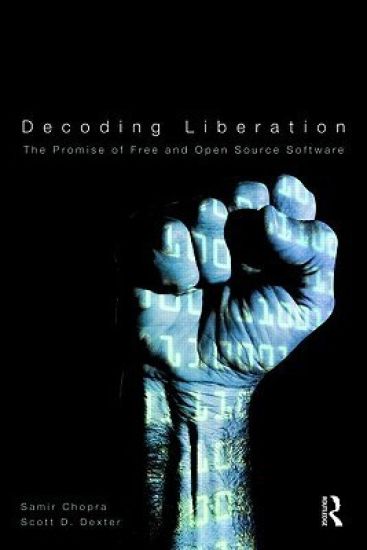
Decoding Liberation

Decoding Liberation

Samir Chopra; Scott D. Dexter

Routledge
2009
nidottu
Choice Outstanding Academic TitleSoftware is more than a set of instructions for computers: it enables (and disables) political imperatives and policies. Nowhere is the potential for radical social and political change more apparent than in the practice and movement known as "free software." Free software makes the knowledge and innovation of its creators publicly available. This liberation of code—celebrated in free software’s explicatory slogan "Think free speech, not free beer"—is the foundation, for example, of the Linux phenomenon. Decoding Liberation provides a synoptic perspective on the relationships between free software and freedom. Focusing on five main themes—the emancipatory potential of technology, social liberties, the facilitation of creativity, the objectivity of computing as scientific practice, and the role of software in a cyborg world—the authors ask: What are the freedoms of free software, and how are they manifested? This book is essential reading for anyone interested in understanding how free software promises to transform not only technology but society as well.
Decoding Liberation

Decoding Liberation

Samir Chopra; Scott D. Dexter

Routledge
2007
sidottu
Software is more than a set of instructions for computers: it enables (and disables) political imperatives and policies. Nowhere is the potential for radical social and political change more apparent than in the practice and movement known as "free software." Free software makes the knowledge and innovation of its creators publicly available. This liberation of code—celebrated in free software’s explicatory slogan "Think free speech, not free beer"—is the foundation, for example, of the Linux phenomenon. Decoding Liberation provides a synoptic perspective on the relationships between free software and freedom. Focusing on five main themes—the emancipatory potential of technology, social liberties, the facilitation of creativity, the objectivity of computing as scientific practice, and the role of software in a cyborg world—the authors ask: What are the freedoms of free software, and how are they manifested? This book is essential reading for anyone interested in understanding how free software promises to transform not only technology but society as well.
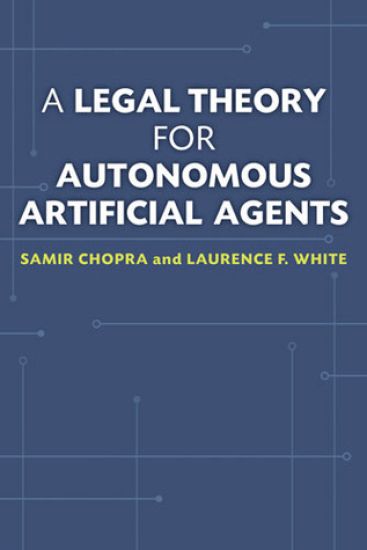
A Legal Theory for Autonomous Artificial Agents

A Legal Theory for Autonomous Artificial Agents

Samir Chopra; Laurence F. White

The University of Michigan Press
2011
nidottu
“An extraordinarily good synthesis from an amazing range of philosophical, legal, and technological sources . . . the book will appeal to legal academics and students, lawyers involved in e-commerce and cyberspace legal issues, technologists, moral philosophers, and intelligent lay readers interested in high tech issues, privacy, [and] robotics.” —Kevin Ashley, University of Pittsburgh School of LawAs corporations and government agencies replace human employees with online customer service and automated phone systems, we become accustomed to doing business with nonhuman agents. If artificial intelligence (AI) technology advances as today’s leading researchers predict, these agents may soon function with such limited human input that they appear to act independently. When they achieve that level of autonomy, what legal status should they have?Samir Chopra and Laurence F. White present a carefully reasoned discussion of how existing philosophy and legal theory can accommodate increasingly sophisticated AI technology. Arguing for the legal personhood of an artificial agent, the authors discuss what it means to say it has “knowledge” and the ability to make a decision. They consider key questions such as who must take responsibility for an agent’s actions, whom the agent serves, and whether it could face a conflict of interest.
Beirut

Beirut

Samir Kassir; Robert Fisk

University of California Press
2010
sidottu
Widely praised as the definitive history of Beirut, this is the story of a city that has stood at the crossroads of Mediterranean civilization for more than four thousand years. The last major work completed by Samir Kassir before his tragic death in 2005, "Beirut" is a tour de force that takes the reader from the ancient to the modern world, offering a dazzling panorama of the city's Seleucid, Roman, Arab, Ottoman, and French incarnations. Kassir vividly describes Beirut's spectacular growth in the nineteenth and twentieth centuries, concentrating on its emergence after the Second World War as a cosmopolitan capital until its near destruction during the devastating Lebanese civil war of 1975-1990. Generously illustrated and eloquently written, "Beirut" illuminates contemporary issues of modernity and democracy while at the same time memorably recreating the atmosphere of one of the world's most picturesque, dynamic, and resilient cities.
Beirut

Beirut

Samir Kassir; Robert Fisk

University of California Press
2010
pokkari
Widely praised as the definitive history of Beirut, this is the story of a city that has stood at the crossroads of Mediterranean civilization for more than four thousand years. The last major work completed by Samir Kassir before his tragic death in 2005, "Beirut" is a tour de force that takes the reader from the ancient to the modern world, offering a dazzling panorama of the city's Seleucid, Roman, Arab, Ottoman, and French incarnations. Kassir vividly describes Beirut's spectacular growth in the nineteenth and twentieth centuries, concentrating on its emergence after the Second World War as a cosmopolitan capital until its near destruction during the devastating Lebanese civil war of 1975-1990. Generously illustrated and eloquently written, "Beirut" illuminates contemporary issues of modernity and democracy while at the same time memorably recreating the atmosphere of one of the world's most picturesque, dynamic, and resilient cities.
Jordan in the 1967 War

Jordan in the 1967 War

Samir A. Mutawi

Cambridge University Press
2002
pokkari
Jordan was the most deeply affected of all the Arab nations by Israel’s victory in the 1967 war, in which huge tracts of Arab land, including the West Bank, Jerusalem, the Gaza Strip and the Golan Heights, came under Israel’s control. Yet this is the first study to consider the war from the Jordanian perspective. It analyses the reasons for Jordan’s unreserved and, to many, unexpected participation and provides a detailed description of the dramatic three days of war, including an analysis of the effects of Egyptian control of the Jordanian-Israeli border. Samir Mutawi’s use of interviews with surviving Jordanian participants - politicians, military commanders, intelligence personnel and, most importantly, King Hussein - as well as Jordanian army records and books and memoirs in Arabic provides a new perspective on the war and on Jordan’s position in the immediate post-war period.
Anxiety

Anxiety

Samir Chopra

PRINCETON UNIVERSITY PRESS
2024
sidottu
How philosophy can teach us to be less anxious about being anxious by understanding that it’s an essential part of being humanToday, anxiety is usually thought of as a pathology, the most diagnosed and medicated of all psychological disorders. But anxiety isn’t always or only a medical condition. Indeed, many philosophers argue that anxiety is a normal, even essential, part of being human, and that coming to terms with this fact is potentially transformative, allowing us to live more meaningful lives by giving us a richer understanding of ourselves. In Anxiety, Samir Chopra explores valuable insights about anxiety offered by ancient and modern philosophies—Buddhism, existentialism, psychoanalysis, and critical theory. Blending memoir and philosophy, he also tells how serious anxiety has affected his own life—and how philosophy has helped him cope with it.Chopra shows that many philosophers—including the Buddha, Kierkegaard, Nietzsche, Freud, and Heidegger—have viewed anxiety as an inevitable human response to existence: to be is to be anxious. Drawing on Karl Marx and Herbert Marcuse, Chopra examines how poverty and other material conditions can make anxiety worse, but he emphasizes that not even the rich can escape it. Nor can the medicated. Inseparable from the human condition, anxiety is indispensable for grasping it. Philosophy may not be able to cure anxiety but, by leading us to greater self-knowledge and self-acceptance, it may be able to make us less anxious about being anxious.Personal, poignant, and hopeful, Anxiety is a book for anyone who is curious about rethinking anxiety and learning why it might be a source not only of suffering but of insight.
Anxiety

Anxiety

Samir Chopra

PRINCETON UNIVERSITY PRESS
2025
pokkari
How philosophy can teach us to be less anxious about being anxious by understanding that it’s an essential part of being humanToday, anxiety is usually thought of as a pathology, the most diagnosed and medicated of all psychological disorders. But anxiety isn’t always or only a medical condition. Indeed, many philosophers argue that anxiety is a normal, even essential, part of being human, and that coming to terms with this fact is potentially transformative, allowing us to live more meaningful lives by giving us a richer understanding of ourselves. In Anxiety, Samir Chopra explores valuable insights about anxiety offered by ancient and modern philosophies—Buddhism, existentialism, psychoanalysis, and critical theory. Blending memoir and philosophy, he also tells how serious anxiety has affected his own life—and how philosophy has helped him cope with it.Chopra shows that many philosophers—including the Buddha, Kierkegaard, Nietzsche, Freud, and Heidegger—have viewed anxiety as an inevitable human response to existence: to be is to be anxious. Drawing on Karl Marx and Herbert Marcuse, Chopra examines how poverty and other material conditions can make anxiety worse, but he emphasizes that not even the rich can escape it. Nor can the medicated. Inseparable from the human condition, anxiety is indispensable for grasping it. Philosophy may not be able to cure anxiety but, by leading us to greater self-knowledge and self-acceptance, it may be able to make us less anxious about being anxious.Personal, poignant, and hopeful, Anxiety is a book for anyone who is curious about rethinking anxiety and learning why it might be a source not only of suffering but of insight.