
Kirjahaku
Etsi kirjoja tekijän nimen, kirjan nimen tai ISBN:n perusteella.
1000 tulosta hakusanalla Sarah Butler

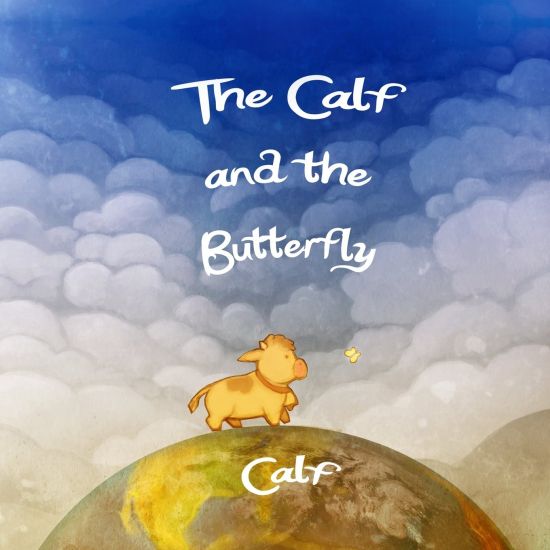
Sometimes, in your life, you may feel that you will never grow up. Some day soon, you will grow big and tall. I Want To Be A Butterfly, is about a cute colorful caterpillar who's name is Danny. He wants to grow into a butterfly. He has so many dreams and hopes. He is so excited to have his own wings Rhyming words are used, with small sentence structure.
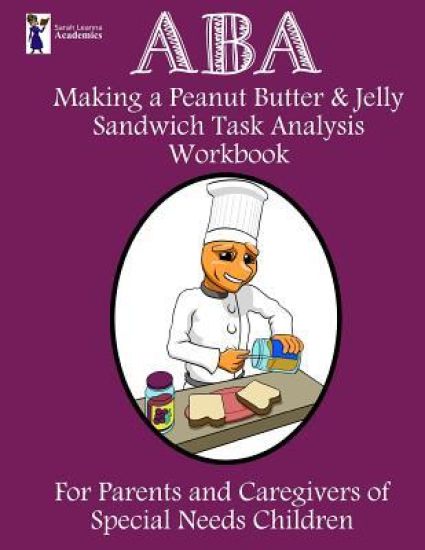
ABA Making a Peanut Butter & Jelly Sandwich Task Analysis Workbook
Sarah Leanna Academics
Createspace Independent Publishing Platform
2018
nidottu
The ABA Making a Peanut Butter & Jelly Sandwich Task Analysis Workbook aids parents and caregivers in teaching the step-by-step process of making a familiar lunchtime treat. Daily, the client will attempt the task in simple broken-down parts and results will be recorded. The client may at first only be able to do a couple of the steps or just one step. But in time, with repetition, he or she may learn to master the skill in its entirety. Teaching life skills step-by-step breaks down the process of tasks to make each more attainable - each task becomes less intimidating to the client. NOTE: Each book in my ABA Task Analysis series is designed with an optional performance key that you can use to precisely describe how each step was done. If you want to simplify the data recording, improvise by marking each box with an

Reprint of the original, first published in 1883.

How to Use Olive Butter: A Collection of Valuable Cooking Recipes
Sarah Tyson Heston Rorer
Antigonos Verlag
2025
nidottu

Tap Dancing on Quicksand While Gargling Peanut Butter is the story of one family's AIDS Journey within the Christian community.

All living things need food to give them energy to live. Plants that make their own food and animals that eat plants or other plant-eating animals are linked together by many different food chains. This book looks at a food chain in a Central American rainforest. The text introduces young children to the scientific vocabulary associated with food chains and big, beautiful photographs bring the rainforest food chain to life.The Follow the Food Chain series helps children aged 6 and up to explore food chains and webs in a range of habitats, from an ocean to a pond and from a rainforest to a desert. Titles in the 4-book series are: Who Ate the Butterfly?, Who Ate the Frog?, Who Ate the Penguin? and Who Ate the Snake?.

Divorce in Medieval England is intended to reorient scholarly perceptions concerning divorce in the medieval period. Divorce, as we think of it today, is usually considered to be a modern invention. This book challenges that viewpoint, documenting the many and varied uses of divorce in the medieval period and highlighting the fact that couples regularly divorced on the grounds of spousal incompatibility. Because the medieval church was determined to uphold the sacrament of marriage whenever possible, divorce in the medieval period was a much more complicated process than it is today. Thus, this book steps readers through the process of divorce, including: grounds for divorce, the fundamentals of the process, the risks involved, financial implications for wives who were legally disabled thanks to the rules of coverture, the custody and support of children, and finally, what happens after a divorce. Readers will gain a much greater appreciation of marriage and women’s position in later medieval England.
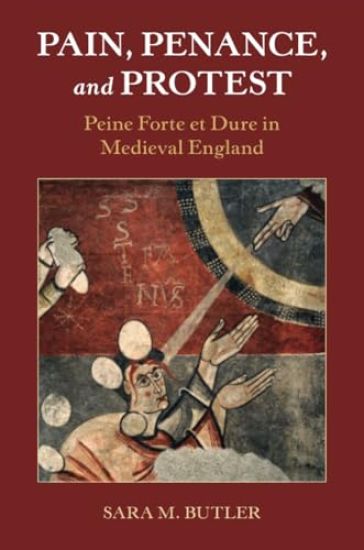
In medieval England, a defendant who refused to plead to a criminal indictment was sentenced to pressing with weights as a coercive measure. Using peine forte et dure ('strong and hard punishment') as a lens through which to analyse the law and its relationship with Christianity, Butler asks: where do we draw the line between punishment and penance? And, how can pain function as a vehicle for redemption within the common law? Adopting a multidisciplinary approach, this book embraces both law and literature. When Christ is on trial before Herod, he refused to plead, his silence signalling denial of the court's authority. England's discontented subjects, from hungry peasant to even King Charles I himself, stood mute before the courts in protest. Bringing together penance, pain and protest, Butler breaks down the mythology surrounding peine forte et dure and examines how it functioned within the medieval criminal justice system.
England has traditionally been understood as a latecomer to the use of forensic medicine in death investigation, lagging nearly two-hundred years behind other European authorities. Using the coroner's inquest as a lens, this book hopes to offer a fresh perspective on the process of death investigation in medieval England. The central premise of this book is that medical practitioners did participate in death investigation – although not in every inquest, or even most, and not necessarily in those investigations where we today would deem their advice most pertinent. The medieval relationship with death and disease, in particular, shaped coroners' and their jurors' understanding of the inquest's medical needs and led them to conclusions that can only be understood in context of the medieval world's holistic approach to health and medicine. Moreover, while the English resisted Southern Europe's penchant for autopsies, at times their findings reveal a solid understanding of internal medicine. By studying cause of death in the coroners' reports, this study sheds new light on subjects such as abortion by assault, bubonic plague, cruentation, epilepsy, insanity, senescence, and unnatural death.
England has traditionally been understood as a latecomer to the use of forensic medicine in death investigation, lagging nearly two-hundred years behind other European authorities. Using the coroner's inquest as a lens, this book hopes to offer a fresh perspective on the process of death investigation in medieval England. The central premise of this book is that medical practitioners did participate in death investigation – although not in every inquest, or even most, and not necessarily in those investigations where we today would deem their advice most pertinent. The medieval relationship with death and disease, in particular, shaped coroners' and their jurors' understanding of the inquest's medical needs and led them to conclusions that can only be understood in context of the medieval world's holistic approach to health and medicine. Moreover, while the English resisted Southern Europe's penchant for autopsies, at times their findings reveal a solid understanding of internal medicine. By studying cause of death in the coroners' reports, this study sheds new light on subjects such as abortion by assault, bubonic plague, cruentation, epilepsy, insanity, senescence, and unnatural death.

Divorce in Medieval England is intended to reorient scholarly perceptions concerning divorce in the medieval period. Divorce, as we think of it today, is usually considered to be a modern invention. This book challenges that viewpoint, documenting the many and varied uses of divorce in the medieval period and highlighting the fact that couples regularly divorced on the grounds of spousal incompatibility. Because the medieval church was determined to uphold the sacrament of marriage whenever possible, divorce in the medieval period was a much more complicated process than it is today. Thus, this book steps readers through the process of divorce, including: grounds for divorce, the fundamentals of the process, the risks involved, financial implications for wives who were legally disabled thanks to the rules of coverture, the custody and support of children, and finally, what happens after a divorce. Readers will gain a much greater appreciation of marriage and women’s position in later medieval England.
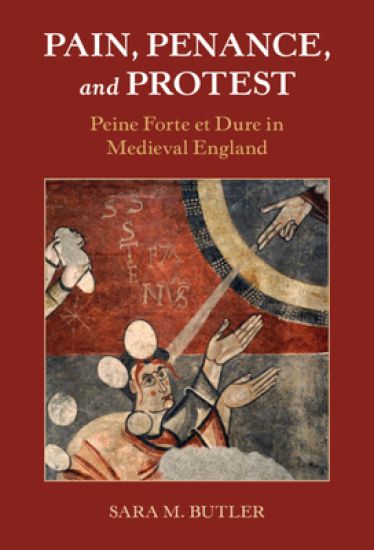
In medieval England, a defendant who refused to plead to a criminal indictment was sentenced to pressing with weights as a coercive measure. Using peine forte et dure ('strong and hard punishment') as a lens through which to analyse the law and its relationship with Christianity, Butler asks: where do we draw the line between punishment and penance? And, how can pain function as a vehicle for redemption within the common law? Adopting a multidisciplinary approach, this book embraces both law and literature. When Christ is on trial before Herod, he refused to plead, his silence signalling denial of the court's authority. England's discontented subjects, from hungry peasant to even King Charles I himself, stood mute before the courts in protest. Bringing together penance, pain and protest, Butler breaks down the mythology surrounding peine forte et dure and examines how it functioned within the medieval criminal justice system.

Do your kids hate math?Many students fail to understand the value of math, and some grow to hate it. Want proof? Read genuine letters students wrote to math, compiled by the authors in this Dear Math book.Discover the root of this problem.15-year veteran math teacher, Sarah Strong, and her high school student, Gigi Butterfield, address concerns about negativity around teaching and learning math and why kids hate math (at least some of them).Digging into the feelings math evoked in hundreds of middle and high school students-that math is unnecessary, oppressive, and intimidating-the authors explore ways to spin student expressions of problem-solving unworthiness into an antidote for their disdain for math.Using "Dear Math" letters, as well as other teaching math tools in this book, you can help students build a healthy and whole relationship with their inner mathematician.Learn how to use the most important skill of all-listening-to help students and teachers discover: The empowerment of mathThe importance and usefulness of mathHow to help kids love mathThe beauty of mathematics in practiceThe journey from hatred of math, to appreciation of math and, in some cases, a lifelong relationship with mathWhat do letters to Math look like?Read Dear Math today and uncover the feelings students are typically unwilling to share with teachers. And how to turn the negative into a positive.

Nestled in the outskirts of Atlanta, in a suburb called Druid Hills, lies Briarcliff Mansion. It sits on Briarcliff Road in the Briarcliff neighborhood, surrounded by strip malls and business with Briarcliff in their names. The mansion and the land it occupies are owned by Emory University, which refers to it as its “Briarcliff Campus.” Fortune and Folly, in part, illuminates the largely lost story of how the mansion, and the entire surrounding neighborhood, got its name. But in order to understand the mansion, we have to understand the man who built it.Briarcliff Mansion once belonged to a man named Asa Candler, Jr.—or Buddie as friends and family knew him. The second son and namesake of Coca-Cola founder Asa Griggs Candler, Buddie was a wealthy real estate developer of great successes and greater failures. A man of big vision and bigger adventures, and a socialite whose boisterous, unapologetic personality made him both beloved and reviled in the Atlanta community between 1910 and 1950. But after he passed away in 1953, his stories faded from memory, either tangled up with or overshadowed by his father.It’s no mystery why Briarcliff garners attention. It’s self-consciously grandiose, built to display maximum grandeur to the neighborhood. It towers over the landscape, set far back from the road behind a filled-in, overgrown pool. Its face is stitched together where a music hall was added two years after the main house was completed, and the bricks don’t quite match up.Fortune and Folly offers a deep-dive into the life of Asa Candler, Jr. to excavate a piece—and place—of Atlanta history.

Luna Station Quarterly Issue 021
Sam Butler; Robin Eames; Sara Norja
Luna Station Press
2015
nidottu

Assessorexamen im Öffentlichen Recht
Gerhard Bülter; Anke Eggert; Sarah Peick
Müller C.F.
2021
nidottu

Why Music is Genetic
Jörn Bullerdiek; Christine Süßmuth; Dietrich Grönemeyer; Sarah Darwin
Springer-Verlag Berlin and Heidelberg GmbH Co. KG
2026
sidottu
New York in the Roaring Twenties—a riveting true-crime novel, based on one of the most notorious unsolved murders of the era, where power, politics, and secrets conspire to bury the truth. Manhattan, 1923. Scandalous flapper Dot King is found dead in her Midtown apartment, a bottle of chloroform beside her and a fortune in jewels missing. Dot’s headline-making murder grips the city. It also draws a clutch of lovers, parasites, and justice seekers into one of the city’s most mesmerizing mysteries. Among them: Daily News crime reporter Julia Harpman, chasing the story while navigating a male-dominated industry; righteous NYPD detective John D. Coughlin, struggling against city corruption; and Ella Bradford, the victim’s Harlem maid, closest confidante, and keeper of secrets. Adding fuel to the already volatile crime: a politically connected Philadelphia socialite, an Atlantic City bootlegger, Dot’s dicey gigolo lover, a sultry Broadway dancer, and a cagey sugar daddy guarding secrets of his own. From Broadway’s glittering lights to its sordid underbelly to the machinations of the country’s most powerful men, Julia embarks on a quest for justice. What she discovers, twist after breathtaking twist, might be even more nefarious than murder.

New York in the Roaring Twenties—a riveting true-crime novel, based on one of the most notorious unsolved murders of the era, where power, politics, and secrets conspire to bury the truth.Manhattan, 1923. Scandalous flapper Dot King is found dead in her Midtown apartment, a bottle of chloroform beside her and a fortune in jewels missing. Dot’s headline-making murder grips the city. It also draws a clutch of lovers, parasites, and justice seekers into one of the city’s most mesmerizing mysteries.Among them: Daily News crime reporter Julia Harpman, chasing the story while navigating a male-dominated industry; righteous NYPD detective John D. Coughlin, struggling against city corruption; and Ella Bradford, the victim’s Harlem maid, closest confidante, and keeper of secrets. Adding fuel to the already volatile crime: a politically connected Philadelphia socialite, an Atlantic City bootlegger, Dot’s dicey gigolo lover, a sultry Broadway dancer, and a cagey sugar daddy guarding secrets of his own.From Broadway’s glittering lights to its sordid underbelly to the machinations of the country’s most powerful men, Julia embarks on a quest for justice. What she discovers, twist after breathtaking twist, might be even more nefarious than murder.