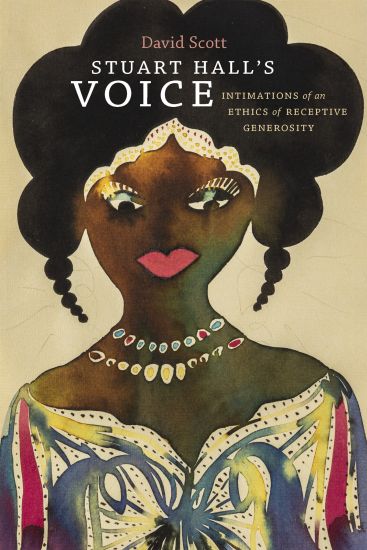
Stuart Hall’s Voice explores the ethos of style that characterized Stuart Hall’s intellectual vocation. David Scott frames the book-which he wrote as a series of letters to Hall in the wake of his death-as an evocation of friendship understood as the moral and intellectual medium in which his dialogical hermeneutic relationship with Hall’s work unfolded. In this respect, the book asks: what do we owe intellectually to the work of those whom we know well, admire, and honor? Reflecting one of the lessons of Hall’s style, the book responds: what we owe should be conceived less in terms of criticism than in terms of listening. Hall’s intellectual life was animated by voice in literal and extended senses: not only was his voice distinctive in the materiality of its sound, but his thinking and writing were fundamentally shaped by a dialogical and reciprocal practice of speaking and listening. Voice, Scott suggests, is the central axis of the ethos of Hall’s style. Against the backdrop of the consideration of the voice’s aspects, Scott specifically engages Hall’s relationship to the concepts of "contingency" and "identity," concepts that were dimensions less of a method as such than of an attuned and responsive attitude to the world. This attitude, moreover, constituted an ethical orientation of Hall’s that should be thought of as a special kind of generosity, namely a "receptive generosity," a generosity oriented as much around giving as receiving, as much around listening as speaking.
The 1640s were one of the most exciting and bloody decades in British and Irish history. This book interweaves the narrative threads in each theatre of conflict to provide an holistic account and analysis of the wars in and between England, Scotland and Ireland, from the Covenanter Rebellion to the execution of Charles I.Politics and War in the Three Stuart Kingdoms, 1637-49- stresses the need to examine the English Civil War within the context of the other conflicts in Scotland and Ireland, and vice versa- explores key themes, such as the relationship between armies and elites- assesses the extent to which the wars in and between the kingdoms were the product of religious and ethnic hatredUsing a wide range of original and secondary sources, and incorporating the latest research, David Scott offers a challenging new interpretation of political structure and dynamics in the warring Stuart realms.
The 1640s were one of the most exciting and bloody decades in British and Irish history. This book interweaves the narrative threads in each theatre of conflict to provide an holistic account and analysis of the wars in and between England, Scotland and Ireland, from the Covenanter Rebellion to the execution of Charles I.Politics and War in the Three Stuart Kingdoms, 1637-49- stresses the need to examine the English Civil War within the context of the other conflicts in Scotland and Ireland, and vice versa- explores key themes, such as the relationship between armies and elites- assesses the extent to which the wars in and between the kingdoms were the product of religious and ethnic hatredUsing a wide range of original and secondary sources, and incorporating the latest research, David Scott offers a challenging new interpretation of political structure and dynamics in the warring Stuart realms.
Once used exclusively by bodybuilders other athletes, steroids are now primarily consumed by men who want to look better. Steroids and the Growing Crisis of Male Body Image aims to introduce laypeople, clinicians, and academics to a better and more modern understanding of steroids and the men who use them. This informative new resource discusses the history of steroids, the stigma and stereotypes surrounding use, the role of steroids in the realm of eating disorder behavior, muscle dysmorphia, connections between steroid use and masculinity, as well as ideas for clinical and population-level interventions to help body dissatisfied men who are or have considered using steroids.
Once used exclusively by bodybuilders other athletes, steroids are now primarily consumed by men who want to look better. Steroids and the Growing Crisis of Male Body Image aims to introduce laypeople, clinicians, and academics to a better and more modern understanding of steroids and the men who use them. This informative new resource discusses the history of steroids, the stigma and stereotypes surrounding use, the role of steroids in the realm of eating disorder behavior, muscle dysmorphia, connections between steroid use and masculinity, as well as ideas for clinical and population-level interventions to help body dissatisfied men who are or have considered using steroids.
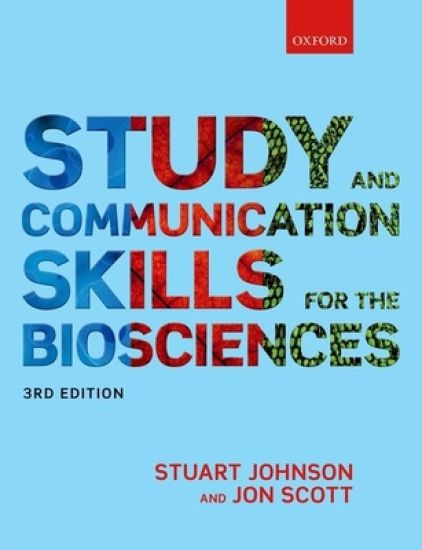
Study and Communication Skills for the Biosciences is tailored specifically to the needs of bioscience students, both at university, and beyond. Written in an engaging and supportive manner, with examples throughout that demonstrate the relevance of topics covered to bioscience degree programmes, the book will assist you with the transition from school to university, with your studies at university, and with your progression to employment after leaving university. New to this edition, the book now includes discussion of how best to use recorded lectures in learning and revision, and how to get the most out of flipped classrooms and interactive lectures.. The chapter on employability has new content on technological change in the workplace, how to perform well in a video interview, and how best to use online networks for career advancement. A new section also explores how to critically review a research paper. A new learning feature, 'Try this for yourself', shows how you can apply the book's principles to your own life and studies. Covering the full range of study and communication skills that you need to study to succeed in your studies, this book is essential reading for any bioscience student who wants to get the most out of their degree.
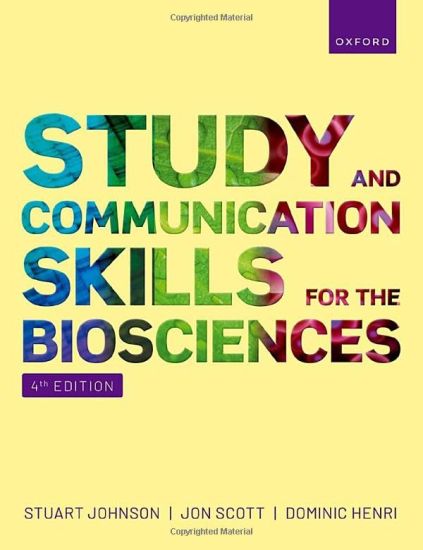
The only text to focus on study and communication skills specifically for bioscience students, helping them get the most out of their degree, and develop the skills and experience that will make them more employable after graduation. Written in an encouraging manner using biological examples, this book assists students as they transition to university studies and progress to employment. Readers are guided towards a greater understanding of what they need to do to make the most of resources available, how to approach assessment in a way that recognizes what they need to achieve, and how to reflect on their progress to maximize employability. Key features: Written by two award winning bioscience teachers and a career development specialist with a background in bioscience to offer expert guidance throughout. A particular emphasis on foundational skills that really make a difference to students: 'managing your time well', 'thinking critically', and 'developing yourself'. Biological examples throughout demonstrate the relevance of the skills being discussed to students' programme of study. The authors explain how to communicate ideas effectively across all required assessment formats, and how to prepare for and complete exams whilst maintaining wellbeing to help students succeed in their assessments. The flexible structure enables students to read the chapters in any order, tailoring their reading to the skills most relevant to them. New to this edition: 'What I Wish I Knew Earlier' videos capture bioscience students reflecting on their university experience and sharing their key takeaways to help other students thrive. A fresh structure to the content, with new chapters including Chapter 5 'Getting yourself organized' and Chapter 12 'Key competencies: collaboration and critical thinking', which provide broader coverage and greater support than ever before. A discussion around the use of Generative AI in university provides students with insights into the benefits and drawbacks of this new technology with a focus on academic integrity and best practices. A greater focus on student wellbeing encourages students to balance their responsibilities in and outside of university. Digital formats and online resources: The 4th edition is available for students and institutions to purchase in a variety of formats: the e-book and Science Trove offer a mobile experience and convenient access along with student-created videos, additional poster examples, functionality tools, navigation features and links that offer extra learning support. For more information about e-books, please visit www.oxfordtextbooks.co.uk/ebooks
This book explains how improvements in intelligence analysis can bene!t policing. Written by experts with experience in police higher education and professional practice, this accessible text provides students with both practical knowledge and a critical understanding of the subject. The book is divided into three key parts: Part One outlines how the concept of intelligence was initially embraced and implemented by the police and provides a critique of intelligence sources. It examines the strategic use of intelligence and its procedural framework. It provides a summary of the role of the intelligence analyst, establishing the characteristics of effective practitioners. Part Two describes good practice and explains the practical tools and techniques that effective analysts use in the reduction and investigation of crime. Part Three examines more recent developments in intelligence analysis and looks to the future. This includes the move to multi-agency working, the advent of big data and the role of AI and machine learning. Filled with case studies and practical examples, this book is essential reading for all undergraduates and postgraduates taking courses in Professional Policing, and Criminal Justice more widely. It will also be of interest to existing practitioners in this field.
This book explains how improvements in intelligence analysis can bene!t policing. Written by experts with experience in police higher education and professional practice, this accessible text provides students with both practical knowledge and a critical understanding of the subject. The book is divided into three key parts: Part One outlines how the concept of intelligence was initially embraced and implemented by the police and provides a critique of intelligence sources. It examines the strategic use of intelligence and its procedural framework. It provides a summary of the role of the intelligence analyst, establishing the characteristics of effective practitioners. Part Two describes good practice and explains the practical tools and techniques that effective analysts use in the reduction and investigation of crime. Part Three examines more recent developments in intelligence analysis and looks to the future. This includes the move to multi-agency working, the advent of big data and the role of AI and machine learning. Filled with case studies and practical examples, this book is essential reading for all undergraduates and postgraduates taking courses in Professional Policing, and Criminal Justice more widely. It will also be of interest to existing practitioners in this field.
What does successful public policy look like, and how has it been achieved in Australia? What strategies are needed to overcome petty partisanship and narrow self-interest? And who gets to decide what a 'better Australia' even looks like? In A Better Australia John Brumby, Scott Hamilton and Stuart Kells examine policy design, implementation and reform, and show what can be achieved when engagement is sincere and intent clear. Leading policymakers and political insiders - Julia Gillard, Malcolm Turnbull, Cheryl Kernot, John Hewson, Ken Wyatt, Christine Milne and more - dissect the development of successful policy in energy, gun control, natural resources taxation, disability insurance, marriage equality, gender equality in the workplace, superannuation, reproductive healthcare reform, Closing the Gap and the pandemic response.A Better Australia takes us behind the scenes of the hard-won policy battles, showing the wide-ranging effects of good policy.
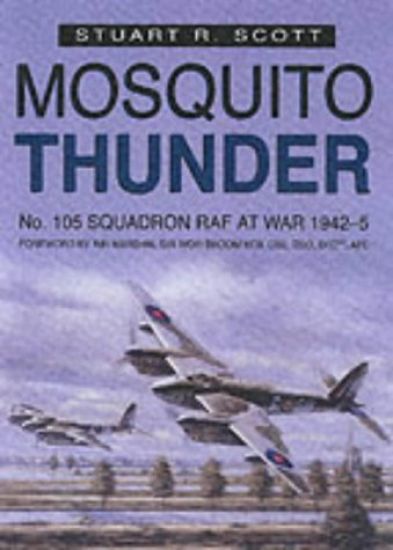
The sequel to "Battle-axe Blenheims", this is the true account of the heroic exploits of a famous bomber squadron between 1942 and 1945, taking up where the first book left off. No.105 Squadron was the first RAF bomber squadron to fly the de Havilland Mosquito. The book looks firstly at the squadron's operations pioneering low-level and shallow dive attacks on enemy targets. In the face of deadly anti-aircraft fire, these operations resulted in a high casualty rate, with many awards for bravery handed out to aircrews. The squadron transferred to the elite No.8 (Pathfinder Force) Group where it flew high level precision "Oboe" target marking sorties in support of Main Force bombing attacks. The author includes in his narrative the Battle of the Ruhr in 1943, the opening of the Second Front in 1944, and the Battle of the Bulge in 1944-45. The concluding period covers the immediate post-war emergency food supply drops to the starving people of Holland before the squadron finally disbanded. First-hand accounts from surviving Mosquito crews are used by the author to support his narrative, combined with many previously unpublished photographs.
As we enter the twenty-first century the ultimate objective of environmental management programs should be to manipulate ecosystems so that they fulfill the needs of humans and at the same time maintain their integrity. In this new ground-breaking work, Scott Isard and Stuart Gage look at the importance of anticipating consequences of the aerial flow of biota as new strategies to understand and manage our environment.A sound understanding of the biological and meteorological interactions that govern the movement of organisms in the atmosphere is a prerequisite to the development of successful management strategies for terrestrial ecosystems. Inflows and outflows of organisms to and from habitats can be as important as birth and death rates in regulating the dynamics of populations. Isard and Gage focus on predicting events that destabilize relationships among organisms and between populations and their environment.This preventive management strategy is based on the premise that the ability to understand and predict dynamics of populations in an ecosystem allows for optimal and integrative use of a wide variety of methods to enhance human resource production and to reduce harmful impacts of diseases and organisms on humans. It is a paradigm that focuses on manipulating ecosystems to maintain the long-term stability of their diverse populations and the interactions among organisms and their environment. In many ecological systems, sudden and dramatic population fluctuations often result from movement of biota from one habitat to another. The design of grand plans to manage ecosystems without concern for the inflow and outflow of organisms associated with those ecosystems could be tragic.