Kirjojen hintavertailu. Mukana 11 717 486 kirjaa ja 12 kauppaa.

Kirjahaku

Etsi kirjoja tekijän nimen, kirjan nimen tai ISBN:n perusteella.

1000 tulosta hakusanalla Steven D. Anderson

Nietzsche's Perspectivism

Nietzsche's Perspectivism

Steven D Hales; Rex Welshon

University of Illinois Press
2000
nidottu
In Nietzsche's Perspectivism, Steven Hales and Rex Welshon offer an analytic approach to Nietzsche's important idea that truth is perspectival. Drawing on Nietzsche's entire published corpus, along with manuscripts he never saw to press, they assess the different perspectivisms at work in Nietzsche's views with regard to truth, logic, causality, knowledge, consciousness, and the self. They also examine Nietzsche's perspectivist ontology of power and the attendant claims that substances and subjects are illusory while forces and alliances of power constitute the only reality. Hales and Welshon present Nietzsche's treatment of perspectivism as both more complex and more fruitful than the common view of it as a doctrine that truth is not objective. Neither a metaphor nor a methodology, perspectivism emerges as a protean concept akin to a unifying theme; an alternative to the absolutism that recurs in science, philosophy, and religion; and a technique for revealing the unimagined possibilities open to every individual.

Design Structure Matrix Methods and Applications

Design Structure Matrix Methods and Applications

Steven D. Eppinger; Tyson R. Browning

MIT Press
2016
pokkari
An introduction to a powerful and flexible network modeling tool for developing and understanding complex systems, with many examples from a range of industries.Design structure matrix (DSM) is a straightforward and flexible modeling technique that can be used for designing, developing, and managing complex systems. DSM offers network modeling tools that represent the elements of a system and their interactions, thereby highlighting the system's architecture (or designed structure). Its advantages include compact format, visual nature, intuitive representation, powerful analytical capacity, and flexibility. Used primarily so far in the area of engineering management, DSM is increasingly being applied to complex issues in health care management, financial systems, public policy, natural sciences, and social systems. This book offers a clear and concise explanation of DSM methods for practitioners and researchers.
Fictions, Lies, and the Authority of Law

Fictions, Lies, and the Authority of Law

Steven D. Smith

University of Notre Dame Press
2021
sidottu
Fictions, Lies, and the Authority of Law discusses legal, political, and cultural difficulties that arise from the crisis of authority in the modern world. Is there any connection linking some of the maladies of modern life—"cancel culture," the climate of mendacity in public and academic life, fierce conflicts over the Constitution, disputes over presidential authority? Fictions, Lies, and the Authority of Law argues that these diverse problems are all a consequence of what Hannah Arendt described as the disappearance of authority in the modern world. In this perceptive study, Steven D. Smith offers a diagnosis explaining how authority today is based in pervasive fictions and how this situation can amount to, as Arendt put it, "the loss of the groundwork of the world." Fictions, Lies, and the Authority of Law considers a variety of problems posed by the paradoxical ubiquity and absence of authority in the modern world. Some of these problems are jurisprudential or philosophical in character; others are more practical and lawyerly—problems of presidential powers and statutory and constitutional interpretation; still others might be called existential. Smith's use of fictions as his purchase for thinking about authority has the potential to bring together the descriptive and the normative and to think about authority as a useful hypothesis that helps us to make sense of the empirical world. This strikingly original book shows that theoretical issues of authority have important practical implications for the kinds of everyday issues confronted by judges, lawyers, and other members of society. The book is aimed at scholars and students of law, political science, and philosophy, but many of the topics it addresses will be of interest to politically engaged citizens.
The Disintegrating Conscience and the Decline of Modernity

The Disintegrating Conscience and the Decline of Modernity

Steven D. Smith

UNIVERSITY OF NOTRE DAME PRESS
2023
sidottu
This book considers how the modern concept of "conscience" turns the historic commitment on its head, in a way that underlies the decadence of modern society. Steven D. Smith's books are always anticipated with great interest by scholars, jurists, and citizens who see his work on foundational questions surrounding law and religion as shaping the debate in profound ways. Now, in The Disintegrating Conscience and the Decline of Modernity, Smith takes as his starting point Jacques Barzun's provocative assertion that "the modern era" is coming to an end. Smith considers the question of decline by focusing on a single theme—conscience—that has been central to much of what has happened in Western politics, law, and religion over the past half-millennium. Rather than attempting to follow that theme step-by-step through five hundred years, the book adopts an episodic and dramatic approach by focusing on three main figures and particularly portentous episodes: first, Thomas More's execution for his conscientious refusal to take an oath mandated by Henry VIII; second, James Madison's contribution to Virginia law in removing the proposed requirement of religious toleration in favor of freedom of conscience; and, third, William Brennan's pledge to separate his religious faith from his performance as a Supreme Court justice. These three episodes, Smith suggests, reflect in microcosm decisive turning points at which Western civilization changed from what it had been in premodern times to what it is today. A commitment to conscience, Smith argues, has been a central and in some ways defining feature of modern Western civilization, and yet in a crucial sense conscience in the time of Brennan and today has come to mean almost the opposite of what it meant to Thomas More. By scrutinizing these men and episodes, the book seeks to illuminate subtle but transformative changes in the commitment to conscience—changes that helped to bring Thomas More's world to an end and that may also be contributing to the disintegration of (per Barzun) "the modern era."
The Disintegrating Conscience and the Decline of Modernity

The Disintegrating Conscience and the Decline of Modernity

Steven D. Smith

UNIVERSITY OF NOTRE DAME PRESS
2026
nidottu
This book considers how the modern concept of "conscience" turns the historic commitment on its head, in a way that underlies the decadence of modern society.Steven D. Smith's books are always anticipated with great interest by scholars, jurists, and citizens who see his work on foundational questions surrounding law and religion as shaping the debate in profound ways. Now, in The Disintegrating Conscience and the Decline of Modernity, Smith takes as his starting point Jacques Barzun's provocative assertion that "the modern era" is coming to an end. Smith considers the question of decline by focusing on a single theme—conscience—that has been central to much of what has happened in Western politics, law, and religion over the past half-millennium. Rather than attempting to follow that theme step-by-step through five hundred years, the book adopts an episodic and dramatic approach by focusing on three main figures and particularly portentous episodes: first, Thomas More's execution for his conscientious refusal to take an oath mandated by Henry VIII; second, James Madison's contribution to Virginia law in removing the proposed requirement of religious toleration in favor of freedom of conscience; and, third, William Brennan's pledge to separate his religious faith from his performance as a Supreme Court justice. These three episodes, Smith suggests, reflect in microcosm decisive turning points at which Western civilization changed from what it had been in premodern times to what it is today. A commitment to conscience, Smith argues, has been a central and in some ways defining feature of modern Western civilization, and yet in a crucial sense conscience in the time of Brennan and today has come to mean almost the opposite of what it meant to Thomas More. By scrutinizing these men and episodes, the book seeks to illuminate subtle but transformative changes in the commitment to conscience—changes that helped to bring Thomas More's world to an end and that may also be contributing to the disintegration of (per Barzun) "the modern era."
Picturing Indians

Picturing Indians

Steven D. Hoelscher; Paul S. Boyer

University of Wisconsin Press
2008
nidottu
Today a tourist mecca, the area now known as the Wisconsin Dells was once wilderness - and a gathering place for the region's Native peoples, the Ho-Chunk, who for centuries migrated to this part of the Wisconsin River for both sustenance and spiritual renewal. By the late 1800s their numbers had dwindled through displacement or forcible removal, and it was this smaller band that caught the attention of photographer Henry Hamilton Bennett. Having built his reputation on his photographs of the Dells' steep gorges and fantastic rock formations, H. H. Bennett now turned his camera upon the Ho-Chunk themselves, and thus began the many-layered relationship unfolded by Steven D. Hoelscher in ""Picturing Indians: Photographic Encounters and Tourist Fantasies in H. H. Bennett's Wisconsin Dells"".The interactions between Indian and white man, photographer and photographed, suggested a relationship in which commercial motives and friendly feelings mixed, though not necessarily in equal measure. The Ho-Chunk resourcefully sought new ways to survive in the increasingly tourist-driven economy of the Dells. Bennett, struggling to keep his photography business alive, capitalized on America's comfortably nostalgic image of Native peoples as a vanishing race, no longer threatening and now safe for white consumption.Hoelscher traces these developments through letters, diaries, financial records, guidebooks, and periodicals of the day. He places Bennett within the context of contemporary artists and photographers of American Indians and examines the receptions of this legacy by the Ho-Chunk today. In the final chapter, he juxtaposes Bennett's depictions of Native Americans with the work of present-day Ho-Chunk photographer Tom Jones, who documents the lives of his own people with a subtlety and depth foreshadowed, a century ago, in the flickers of irony, injury, humor, and pride conveyed by his Ho-Chunk ancestors as they posed before the lens of a white photographer.
A History of Badger Baseball

A History of Badger Baseball

Steven D. Schmitt

University of Wisconsin Press
2017
sidottu
For more than a century, the University of Wisconsin fielded baseball teams. This comprehensive history combines colorful stories from the archives, interviews with former players and coaches, a wealth of historic photographs, and the statistics beloved by fans of the game. The earliest intercollegiate varsity sport at Wisconsin, the baseball team was founded in 1870, less than a decade after the start of the Civil War. It dominated its first league, made an unprecedented trip to Japan in 1909, survived Wisconsin's chilly spring weather, two world wars, and perennial budget crises, producing some of the finest players in Big Ten history—and more than a few major leaguers. Fan traditions included torchlight parades, kazoos, and the student band playing ""A Hot Time in the Old Town Tonight"" as early as 1901.There is painful history here, too. African Americans played on Wisconsin's first Big Ten championship team in 1902, including team captain Julian Ware, but there were none on the team between 1904 and 1960. Heartbreaking to many fans was the 1991 decision to discontinue baseball as a varsity sport at the university. Today, Wisconsin is the only member of the Big Ten conference without a men's baseball team.Appendixes provide details of team records and coaches, All Big Ten and All American selections, Badgers in the major leagues, and Badgers in the amateur free-agent draft.
Writing to Win

Writing to Win

Steven D Stark

Random House Inc
2012
nidottu
From a master teacher and writer, a fully revised and updated edition of the results-oriented approach to legal writing that is clear, that persuades--and that WINS. More than almost any profession, the law has a deserved reputation for opaque, jargon-clogged writing. Yet forceful writing is one of the most potent weapons of legal advocacy. In this new edition of "Writing to Win," Steven D. Stark, a former lecturer on law at Harvard Law School, who has inspired thousands of aspiring and practicing lawyers, applies the universal principles of powerful, vigorous prose to the job of making a legal case--and winning it. "Writing to Win" focuses on the writing of lawyers, not judges, and includes dozens of examples of effective (and ineffective) real-life legal writing--as well as compelling models drawn from advertising, journalism, and fiction. It deals with the challenges lawyers face in writing, from organization to strengthening and editing prose; offers incisive ways of improving arguments; addresses litigation and technical writing in all its forms; and covers the writing attorneys must perform in their daily practice, from email memos to briefs and contracts. Each chapter opens with a succinct set of rules for easy reference. With new sections on client communication and drafting affidavits, as well as updated material throughout, "Writing to Win" is the most practical and efficacious legal-writing manual available.
Desmond Tutu

Desmond Tutu

Steven D. Gish

Greenwood Press
2004
sidottu
History will remember Desmond Tutu, who has been called South Africa's Martin Luther King, Jr., as a great leader in the struggle against apartheid. In this new biography, which includes original quotations from the author's interviews with Tutu, readers will follow the steady progress of a boy and man who has held an irrepressible faith in humankind and his God. They will learn about his family, schooling, important mentors, and extraordinary career trajectory in South Africa and abroad. Now retired, Tutu's accomplishments and contributions to the world can be fully appreciated. The clear explanation of the policy of apartheid, how it affected Tutu and his family, and how he helped to bring it crashing down will affect and inform students as no history alone can. They will marvel over his sparkling wit and effervescent personality, his nonviolent stance in the face of intense racial hatred and harassment, and his persistence against enormous odds. This will be an effortless, enjoyable, enlightening and inspiring read.
Concierge Medicine

Concierge Medicine

Steven D. Knope

Praeger Publishers Inc
2008
sidottu
There is wide consensus that our current healthcare system is, to put it mildly, broken. In this time of HMOs, mismanaged care, and a failing Medicare system, patients and doctors alike are dissatisfied with the status quo. But Knope explains that there is a solution - Concierge Medicine. This new system, sweeping the nation yet still the subject of some controversy, allows consumers to contract directly with a doctor to get individualized care. It's a return to Marcus Welby-style medicine, says Knope, and it provides what he calls a critical element for the best care - time. Ample time for doctors to care for their patients, and to restore the doctor-patient relationship that has fallen into the past with our current assembly-line, fast food medicine. The first book published giving in-depth explanation of Concierge Medicine, this work also provides concrete advice on how to find, interview, and budget for a concierge doctor, using changes in tax law that allow patients to open Health Savings Accounts. Patient vignettes provide personal insights from consumers of Concierge Medicine, and further description of what is involved to use this new approach for optimal health.Knope clearly explains the pressures that led to our current assembly-line healthcare system, allowing the reader to see also why the fact that a typical doctor's visit these days lasts just seven minutes works against any attempt to get, or for doctors to give, the best of care. Health is our most precious asset, says Knope, and like financial wealth, what he sees as health wealth also takes time, effort, and money to nurture. The three critical components of optimal health discussed are: a good relationship with a qualified doctor, regular exercise, and good nutrition. Concierge doctors customize a nutrition and exercise program unique to the needs of each individual. Yet there are detractors who argue Concierge Medicine is unfair, because it allows just those who can afford it unlimited access to a doctor. Knope confronts that question of medical ethics also. This book will doubtless stimulate not only ideas and action, but wide discussion and debate.
Desmond Tutu

Desmond Tutu

Steven D. Gish

Greenwood Press
2004
nidottu
History will remember Desmond Tutu, who has been called South Africa's Martin Luther King, Jr., as a great leader in the struggle against apartheid. In this new biography, which includes original quotations from the author's interviews with Tutu, readers will follow the steady progress of a boy and man who has held an irrepressible faith in humankind and his God. They will learn about his family, schooling, important mentors, and extraordinary career trajectory in South Africa and abroad. Now retired, Tutu's accomplishments and contributions to the world can be fully appreciated. The clear explanation of the policy of apartheid, how it affected Tutu and his family, and how he helped to bring it crashing down will affect and inform students as no history alone can. They will marvel over his sparkling wit and effervescent personality, his nonviolent stance in the face of intense racial hatred and harassment, and his persistence against enormous odds. This will be an effortless, enjoyable, enlightening and inspiring read.
Why Germany Nearly Won

Why Germany Nearly Won

Steven D. Mercatante

Praeger Publishers Inc
2012
sidottu
This book offers a unique perspective for understanding how and why the Second World War in Europe ended as it did—and why Germany, in attacking the Soviet Union, came far closer to winning the war than is often perceived.Why Germany Nearly Won: A New History of the Second World War in Europe challenges this conventional wisdom in highlighting how the re-establishment of the traditional German art of war—updated to accommodate new weapons systems—paved the way for Germany to forge a considerable military edge over its much larger potential rivals by playing to its qualitative strengths as a continental power. Ironically, these methodologies also created and exacerbated internal contradictions that undermined the same war machine and left it vulnerable to enemies with the capacity to adapt and build on potent military traditions of their own.The book begins by examining topics such as the methods by which the German economy and military prepared for war, the German military establishment's formidable strengths, and its weaknesses. The book then takes an entirely new perspective on explaining the Second World War in Europe. It demonstrates how Germany, through its invasion of the Soviet Union, came within a whisker of cementing a European-based empire that would have allowed the Third Reich to challenge the Anglo-American alliance for global hegemony—an outcome that by commonly cited measures of military potential Germany never should have had even a remote chance of accomplishing. The book's last section explores the final year of the war and addresses how Germany was able to hang on against the world's most powerful nations working in concert to engineer its defeat.
Dermatopathology, An Issue of Clinics in Laboratory Medicine

Dermatopathology, An Issue of Clinics in Laboratory Medicine

Steven D. Billings

Elsevier - Health Sciences Division
2017
sidottu
This issue of Clinics in Laboratory Medicine, edited by Dr. Steven Billings, will cover Dermatopathology. Topics covered in this issue include Blue nevi and related lesions, sentinel lymph node biopsies in melanoma, Spitzoid melanocytic neoplasms, Tumor immunology related to melanoma, Molecular aspects of melanoma, Merkel cell carcinoma, Cutaneous Squamous Cell Carcinoma, Cutaneous T-cell lymphomas, Cutaneous B-cell lymphomas, Myeloid neoplasms, among others.
Pain Review

Pain Review

Steven D. Waldman

Elsevier - Health Sciences Division
2016
nidottu
Easy to read and easy to use, Pain Review, 2nd Edition provides you with the most up-to-date, comprehensive review of pain medicine available. Written by Steven Waldman, MD, a leading author in the specialty of pain medicine, this book gives you exactly what you need - an easily understandable, targeted review of the essential basic science; beautifully illustrated, full-color anatomic figures; and a comprehensive review of common and uncommon pain syndromes, as well as how-to-do-it explanations of all of the pain management injection and nerve block techniques that every practitioner needs to know. Pain Review, 2nd Edition is an excellent tool for reviewing the specialty and for preparing for your pain medicine board review, recertification, or for the practice of pain medicine. Provides the reader with clearly written review of the signs, symptoms and physical findings of 95 defined pain syndromes classified by body region. Presents an easy-to-follow, generously illustrated, step-by step roadmap of how to perform 113 individual nerve blocks and injection techniques, as well as a review of associated pitfalls and complications. Follows an easy-to-read templated format throughout for quick mastery and retrieval of information, closely matching the format and content of the American Board of Anesthesiology pain medicine board certification exam. Maintains a consistent approach and editorial style as a single-authored text by noted authority Steven D. Waldman, MD. NEW! Conceptual illustrations are now in full color to help you better visualize injection techniques. Hundreds of NEW full color tables and figures simplify learning. NEW, updated design offers visual appeal and ease of use. Updated references throughout direct you to the most up-to-date source material. Expert ConsultT eBook version included with purchase. This enhanced eBook experience allows you to search all of the text, figures, videos, and references from the book on a variety of devices.
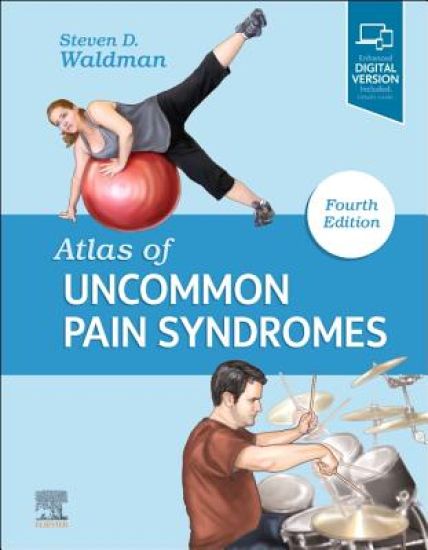
Atlas of Uncommon Pain Syndromes

Atlas of Uncommon Pain Syndromes

Steven D. Waldman

Elsevier - Health Sciences Division
2019
sidottu
Covering the many relatively uncommon pain conditions that are often misdiagnosed, this one-of-a-kind visual resource clearly presents the extensive knowledge and experience of world-renowned pain expert Steven D. Waldman, MD, JD. Atlas of Uncommon Pain Syndromes, 4th Edition, first and foremost helps you make a correct diagnosis - a critical step in managing patients in chronic pain. Hundreds of high-quality illustrations, as well as x-rays, ultrasound, CTs, and MRIs, help you confirm your diagnoses with confidence. Offers head-to-toe coverage - 135 conditions in all - providing concise, easy-to-read chapters for each condition. Dr. Waldman's practical guidance is designed to help you make the correct diagnosis of uncommon pain syndromes, even the signs and symptoms don't quite fit. Explains each pain syndrome using a consistent, easy-to-follow format: an ICD-10 CM code for billing purposes, followed by a brief description of the signs and symptoms, laboratory and radiographic testing, differential diagnosis, available treatment options, and clinical pearls. Features updated chapters throughout, as well as 12 new chapters covering Hemicrania Continua, Acute Calcific Prevertebral Tendinitis, Sternohyoid Syndrome Snapping Scapula Syndrome, Erythromelagia, Foix-Alajouanine Syndrome, Lumbar Paraspinous Muscle Compartment Syndrome, Clunealgia, Nutcracker Syndrome, Paroxysmal Extreme Pain Disorder, Iliopsoas Tendon Rupture, and Snapping Pes Anserinus Syndrome Provides practitioners and trainees in pain medicine, anesthesiology, neurology, psychiatry, physical medicine and rehabilitation, primary care, and more with a firm foundation in the diagnosis of uncommon pain in daily practice. Enhanced eBook version included with purchase. Your enhanced eBook allows you to access all of the text, figures, and references from the book on a variety of devices.
Orofacial Pain, An Issue of Dental Clinics of North America

Orofacial Pain, An Issue of Dental Clinics of North America

Steven D. Bender

Elsevier - Health Sciences Division
2018
sidottu
This issue of Dental Clinics of North America focuses on Orofacial Pain, and is edited by Dr. Steven D. Bender. Articles will include: An Introduction to Orofacial Pain; Clinical Assessment of the Orofacial Pain Patient; Imaging in Orofacial Pain; Musculoskeletal Disorders; Neuropathic Orofacial Pain; Burning Mouth Syndrome; Painful Oral Lesions; The Primary Headaches; Sleep and Pain; Sleep Bruxism; Sex, Gender and Orofacial Pain; Mind-Body Considerations in Orofacial Pain; and more!
Atlas of Interventional Pain Management

Atlas of Interventional Pain Management

Steven D. Waldman

Elsevier - Health Sciences Division
2020
sidottu
An essential resource for pain medicine clinicians at all levels of practice and training, Atlas of Interventional Pain Management, 5th Edition, is a comprehensive, easy-to-follow guide to delivering safe, accurate, and cost-effective relief for patients with acute and chronic pain. Dr. Steven D. Waldman walks you step by step through each procedure, incorporating all clinically appropriate imaging modalities to help you achieve the best possible outcomes for more than 160 nerve block procedures. Focuses on the how rather than the why of interventional pain procedures, offering an abundance of high-quality, full-color illustrations to demonstrate the best technique. Incorporates all clinically useful imaging modalities that increase needle placement precision, including significantly expanded content on office-based ultrasound guided techniques as well as fluoroscopy and computed tomography guided procedures. Keeps you up to date with 19 brand-new chapters, including Selective Maxillary Nerve Block: Suprazygomatic Approach, Brachial Plexus Block: Retroclavicular Approach, Erector Spinae Plane Block, Transversalis Fascia Plane Block, Adductor Canal Block, Dorsal Root Ganglion Stimulation, Sacral Neuromodulation, and more. Provides Indications, Clinically Relevant Anatomy, Technique, Side Effects and Complications, and Clinical Pearls and updated CPT codes for each procedure. Clearly illustrates the anatomical targets for each procedure and the appropriate needle placement and trajectory used to reach each target. Includes access to procedural videos covering Cervical Translaminar Epidural Block, Cervical Paravertebral Medical Branch Block, Percutaneous Facet Fusion, Lumbar Transforaminal Epidural Block, and more. Enhanced eBook version included with purchase. Your enhanced eBook allows you to access all of the text, figures, and references from the book on a variety of devices.
The Spine

The Spine

Steven D. Waldman

Elsevier - Health Sciences Division
2021
sidottu
Linking theory to practice through the use of authentic clinical cases, Dr. Steven D. Waldman's Pain Medicine: A Case-Based Learning Series helps readers acquire the valuable skill of effective diagnostic thinking in daily practice. The Spine volume uses an in-depth case format, preparing you to correctly analyze clinical vignettes and formulate a clinically sound, evidence-based approach to realistic patient scenarios. This highly effective leaning and assessment tool provides practical clinical insights into the best methods for diagnosis and treatment for the successful management of patients with spine-related pain. Presents real-world patients in a real-world clinical setting, making learning fun and engaging. The Case-Based Learning approach focuses learners and clinicians on the key elements for each diagnosis and helps develop a deep understanding of how to diagnose and treat each condition. Covers everyday clinical problems such as Herniated Disc, Lumbar Strain, Thoracic Vertebral Compression Fracture, Epidural Abscess,?Spondylosis, Spinal Stenosis, Sacroiliac Joint Pain, and more. Cases unfold just the way they do in your clinic. Each case is accompanied with thoughtful clinical commentary and key messages from the author. Each chapter uses high-quality radiographic images, clinical photos, and full-color drawings to facilitate a clear, easy-to-understand approach to evaluation and diagnosis. An ideal self-assessment and review tool for pain medicine practitioners and trainees, as well as those preparing for the American Board of Anesthesiology Pain Medicine certification and recertification exam. Enhanced eBook version included with purchase. Your enhanced eBook allows you to access all of the text, figures, and references from the book on a variety of devices.
Atlas of Pain Management Injection Techniques

Atlas of Pain Management Injection Techniques

Steven D. Waldman

Elsevier - Health Sciences Division
2022
sidottu
Ideal for hands-on, day-to-day use in practice, Atlas of Pain Management Injection Techniques, 5th Edition, helps you master the key nerve blocks you need to know to successfully treat 200 common and uncommon pain syndromes. Focusing on the "how to? details of pain management injection techniques, this bestselling atlas by Dr. Steven D. Waldman equips you to deliver safe, accurate and cost-effective pain relief to your patients using the most clinically appropriate imaging modalities. It demonstrates exactly how to evaluate the causes of pain, identify the most promising injection technique, locate the injection site with precision, and deliver effective relief to patients. Helps you find information quickly with a logical organization by anatomic region, and templated chapters that cover indications and clinical considerations, clinically relevant anatomy, technique, side effects and complications, and Dr. Waldman's own clinical pearls. Includes 14 brand-new injection techniques, including Chalazion Injection; Botox Injection for Migraine; Intra-articular Injections of the Glenohumeral, Hip, Ankle, and Knee Joints; Rectus Sheath Block; Fascia Iliaca Plane Block; Penile Block; and more. Incorporates all clinically useful imaging modalities including expanded information on office-based ultrasound-guided techniques as well as fluoroscopy and CT-guided procedures. Illustrates the anatomical targets for each procedure and the appropriate needle placement and trajectory used to reach each target. Features new full-color anatomic drawings as well as photographs, radiographs, ultrasound, CT, and MRI images throughout. Provides clear guidance on the risks and benefits of each procedure/technique. Enhanced eBook version included with purchase. Your enhanced eBook allows you to access all of the text, figures, and references from the book on a variety of devices.
The Wrist and Hand

The Wrist and Hand

Steven D. Waldman

Elsevier - Health Sciences Division
2022
sidottu
Here is the perfect text you need to provide your learners with real-life clinical scenarios that are ideal for Case-Based Learning and Discussion. Presents real-world patients in a real-world clinical setting, making learning fun and engaging. The Case-Based Learning approach focuses learners and clinicians on the key elements for each diagnosis and helps develop a deep understanding of how to diagnose and treat each condition. Covers everyday clinical problems such as arthritis pain at the wrist and at the at the carpometacarpal joints, carpal tunnel syndrome, trigger thumb and trigger finger, Dupuytren's contracture, and more. Cases unfold just the way they do in your clinic. Each case is accompanied with thoughtful clinical commentary and key messages from the author. Each chapter uses high-quality radiographic images, clinical photos, and full-color drawings to facilitate a clear, easy-to-understand approach to evaluation and diagnosis. An ideal self-assessment and review tool for pain medicine practitioners and trainees, as well as those preparing for the American Board of Anesthesiology Pain Medicine certification and recertification exam. Enhanced eBook version included with purchase. Your enhanced eBook allows you to access all of the text, figures, and references from the book on a variety of devices.