This book has been considered by academicians and scholars of great significance and value to literature. This forms a part of the knowledge base for future generations. So that the book is never forgotten we have represented this book in a print format as the same form as it was originally first published. Hence any marks or annotations seen are left intentionally to preserve its true nature.
Vie de S. A. R. Mgr le duc de Berry, par Th. DelbareDate de l'edition originale: 1820Ce livre est la reproduction fidele d une uvre publiee avant 1920 et fait partie d une collection de livres reimprimes a la demande editee par Hachette Livre, dans le cadre d un partenariat avec la Bibliotheque nationale de France, offrant l opportunite d acceder a des ouvrages anciens et souvent rares issus des fonds patrimoniaux de la BnF.Les uvres faisant partie de cette collection ont ete numerisees par la BnF et sont presentes sur Gallica, sa bibliotheque numerique.En entreprenant de redonner vie a ces ouvrages au travers d une collection de livres reimprimes a la demande, nous leur donnons la possibilite de rencontrer un public elargi et participons a la transmission de connaissances et de savoirs parfois difficilement accessibles.Nous avons cherche a concilier la reproduction fidele d un livre ancien a partir de sa version numerisee avec le souci d un confort de lecture optimal. Nous esperons que les ouvrages de cette nouvelle collection vous apporteront entiere satisfaction.Pour plus d informations, rendez-vous sur www.hachettebnf.fr
This book is the standard preparatory text for APICS certification exams! It discusses how to use the latest MPC techniques to improve your supply chain effectiveness. In today's manufacturing environment, decisions must be made immediately and with little time for on-the-spot research or second-guessing. More than at any time in the past, professionals must rethink virtually every aspect of this streamlined manufacturing approach - or risk being left behind in the newly urgent race to both cut costs and reduce time. "Manufacturing Planning and Control Systems for Supply Chain Management, Fifth Edition" provides the information and analysis you need to remain both current and competitive. Completely revised and updated, this authoritative and essential book covers the new and existing state-of-the-manufacturing-art in areas including: Supply chain management; Demand management; Sales and operations planning; Material requirements planning (MRP); Enterprise resource planning (ERP); Production activity control; Inventory management; and, Capacity planning and utilization. The customer is king in today's manufacturing environment, and meeting customer demands has become the chief imperative for manufacturing success. Let "Manufacturing Planning and Control Systems for Supply Chain Management" provide you with the up-to-the-minute knowledge you need to meet those demands, and the details to meet them with dramatically greater speed and precision than your competitors. The world of manufacturing is experiencing a top-to-bottom transformation of a magnitude not seen since Henry Ford introduced the assembly line. Enterprise resource planning (ERP) systems increasingly integrate all internal company activities and functions, including manufacturing planning and control (MPC) systems. Decision making is transferred to floor level teams. Efficiency-driven processes are now being combined with global, web-driven interconnectedness between suppliers and customers, where the focus is on efficiencies gained by managing elaborate supply chains and networks. In all of this, today's customers set the manufacturing agenda, demanding increased speed, greater variety - and even a hand in the manufacturing process itself. Manufacturing Planning and Control Systems for Supply Chain Management, Fifth Edition, has been completely revamped to help you excel in this new manufacturing environment. Manufacturing professionals at every level, along with anyone studying for the APICS certification exams, can turn to this authoritative manufacturing professionals' handbook for the latest facts, techniques, and guidelines, in areas including: Enterprise Resource Planning (ERP) - What ERP is and how it works, including implementation examples and lessons from Eli Lilly, Scotts, and other multinational firms; Supply Chain Management - Methods for coordinating flows of materials and information across companies, for dramatic improvement in overall effectiveness, with examples from Nokia, Hewlett-Packard, and Flextronics; Just-in-Time - JIT's key principles and features and how they impact MPC systems, with examples from JIT pioneer Toyota as well as the latest advances in JIT-based practices; and, Strategy and MPC System Design - Options for linking MPC system design with corporate strategy, plus integrating MRP and JIT in existing or new MPS systems. It also includes Advanced Concepts - New approaches and frameworks in sales and operations planning, material requirements planning, scheduling, and supply chain partnering. "Manufacturing Planning and Control Systems" is both the classic field handbook for manufacturing professionals and the comprehensive preparatory text for APICS certification courses. Now, in this thoroughly revised and updated fifth edition, this vital book once again provides you with hands-on details of the latest MPC research and practice, and gives you the competitive advantage you need in today's high-stakes, no-holds-barred global manufacturing arena.
A young couple, Sally and Tim, meet and fall in love. After three months of being together, they marry. Sally, however, had not revealed to her husband that she carries a dreadful disease in her blood: schizophrenia. Her mother hastens to the couple and warns Tim about the difficulty of helping anyone so affected. She affirms that she would not hold it against him to divorce her daughter because he has no concept of what he would endure to live under such circumstances. Tim remains true to his love and passion. Mrs. Kalichevsky begins living with them in order to help if there should be problems. Soon afterwards, Tim is given the greatest shock of his life, and it is only the beginning. While the family meets many challenges, the sad death of the mother leaves the couple alone to face their fate. Dr. Thomas Berry is a retired Professor of Russian Language and Literature. He lectures for Johns Hopkins University, the Smithsonian Institution, the Russian Cultural Center of the Russian Embassy in Washington, D.C., and on numerous international cruise lines. He received a "Gramota" from the Russian Government for service. He has published eleven academic books and eight novels. He has traveled extensively all over the globe. His websites: www.thomaseberry.com and sbprabooks.com/thomaseberry
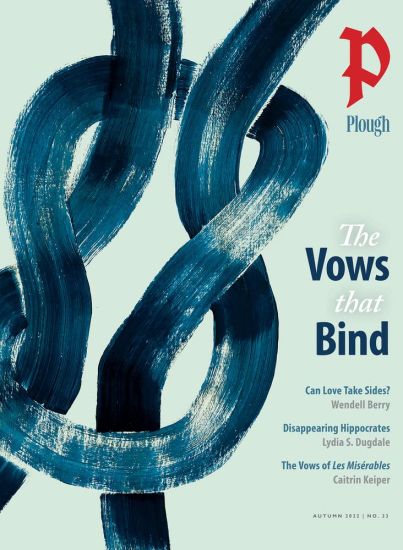
In a culture that prizes keeping one’s options open, making commitments offers something more valuable. The consumerism and instant gratification of “liquid modernity” feed a general reluctance to make commitments, a refusal to be pinned down for the long term. Consider the decline of three forms of commitment that involve giving up options: marriage, military service, and monastic life. Yet increasing numbers of people question whether unprecedented freedom might be leading to less flourishing, not more. They are dissatisfied with an atomized way of life that offers endless choices of goods, services, and experiences but undermines ties of solidarity and mutuality. They yearn for more heroic virtues, more sacrificial commitments, more comprehensive visions of the individual and common good. It turns out that the American Founders were right: the Creator did endow us with an unalienable right of liberty. But he has endowed us with something else as well, a gift that is equally unalienable: desire for unreserved commitment of all we have and are. Our liberty is given us so that we in turn can freely dedicate ourselves to something greater. Ultimately, to take a leap of commitment, even without knowing where one will land, is the way to a happiness worth everything. On this theme: - Lydia S. Dugdale asks what happened to the Hippocratic Oath in modern medicine. - Caitrin Keiper looks at competing vows in Victor Hugo’s Les Misérables. - Kelsey Osgood, an Orthodox Jew, asks why lifestyle discipline is admired in sports but not religion. - Wendell Berry says being on the side of love does not allow one to have enemies. - Phil Christman spoofs the New York Times Vows column. - Andreas Knapp tells why he chose poverty. - Norann Voll recounts the places a vow of obedience took her. - Carino Hodder says chastity is for everyone, not just nuns. - Dori Moody revisits her grandparents’ broken but faithful marriage. - Randall Gauger, a Bruderhof pastor, finds that lifelong vows make faithfulness possible. - King-Ho Leung looks at vows, oaths, promises, and covenants in the Bible. Also in the issue: - A young Black pastor reads Clarence Jordan today. - Activists discuss the pro-life movement after Roe and Dobbs. - Children learn from King Arthur, Robin Hood, and the occasional cowboy. - Original poetry by Ned Balbo - Reviews of Montgomery and Biklé’s What Your Food Ate, Mohsin Hamid’s The Last White Man, and Bonnie Kristian’s Untrustworthy - A profile of Sadhu Sundar Singh Plough Quarterly features stories, ideas, and culture for people eager to apply their faith to the challenges we face. Each issue includes in-depth articles, interviews, poetry, book reviews, and art.
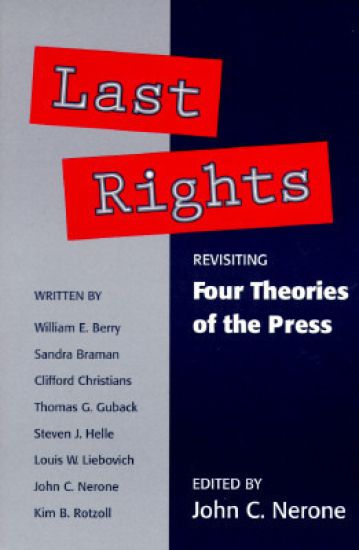
Though subjected to years of criticism, Four Theories of the Press remains a core text in communications. Its influence on the field, impact on generations of journalists, and ability to spark debate on why the press acts as it does continue to make it an oft-quoted source and classroom staple. In Last Rights, eight communications scholars critique and expand on the classic text. The authors argue that Four Theories spoke to and for a world beset by a cold war ended long ago. At the same time, they praise the book for offering an alternative view of the press and society and as a useful tool for helping scholars and citizens alike grapple with contradictions in classical liberalism. They also raise important questions about the Internet and other major changes in communications systems and society since the original publication of Four Theories. Contributors: William E. Berry, Sandra Braman, Clifford Christians, Thomas G. Guback, Steven J. Helle, Louis W. Liebovich, John C. Nerone, and Kim B. Rotzoll
Russian Girl-American MigrantBy: Thomas E. Berry, Ph, D.Reared in Stalin's communist world, where Lenin was the Godhead, a lovely and charming 17-year-old Russian girl is graduating from one of the famous Soviet Pioneer Schools. Sonya had been an excellent student, specializing in Lenin's political philosophy. She has graduated with a position in the famous Lenin Library in Moscow.When communism failed in the late 1980s, the US Government was granted a small research center in the Lenin library. Five American scholars were sent to study the new Yeltson government. The director of the American delegation is drawn to Sonya's beauty, while Sonya is drawn to his kindness, humor and wisdom. They fall in love, marry and she returns with him to the America.In America Sonya discovers all the advantages of a free society. She lectures on TV, comparing Lenin's socialism with American democracy. She lectures all over the country, and becomes a popular figure.About the AuthorDr. Thomas Berry is a retired Professor of Russian Language and Literature. He Lectures for John Hopkins University, the Smithsonian Institution, the Russian Cultural Center of the Russian Embassy in Washington D.C. and on numerous international cruise lines. He received a "Gramota" from the Russian government for enhancement of relations with that country and the USA. He has published eleven academic books and eight novels. H has traveled extensively all over the globe.His webs: www.amazon-thomaseberry.com and sbprabooks.com/thomaseberry
Manufacturing Planning & Control for Supply Chain Management, 6e by Jacobs, Berry, and Whybark (formerly Vollmann, Berry, Whybark, Jacobs) is a comprehensive reference covering both basic and advanced concepts and applications for students and practicing professionals. The text provides an understanding of supply chain planning and control techniques with topics including purchasing, manufacturing, warehouse, and logistics systems. Manufacturing Planning & Control for Supply Chain Management, 6e continues to be organized in a flexible format, with the basic coverage in chapters 1-8 followed by the last four chapters that focus on the integration of manufacturing with the supply chain. Each chapter provides a managerial issues overview, a detailed technical presentation related to the topic, company examples, and concluding principles. This book is the essential desk reference for Supply Chain Planning and Control techniques.
Manufacturing Planning & Control for Supply Chain Management, 6e by Jacobs, Berry, and Whybark (formerly Vollmann, Berry, Whybark, Jacobs) is a comprehensive reference covering both basic and advanced concepts and applications for students and practicing professionals. The text provides an understanding of supply chain planning and control techniques with topics including purchasing, manufacturing, warehouse, and logistics systems. Manufacturing Planning & Control for Supply Chain Management, 6e continues to be organized in a flexible format, with the basic coverage in chapters 1-8 followed by the last four chapters that focus on the integration of manufacturing with the supply chain. Each chapter provides a managerial issues overview, a detailed technical presentation related to the topic, company examples, and concluding principles. This book is the essential desk reference for Supply Chain Planning and Control techniques.
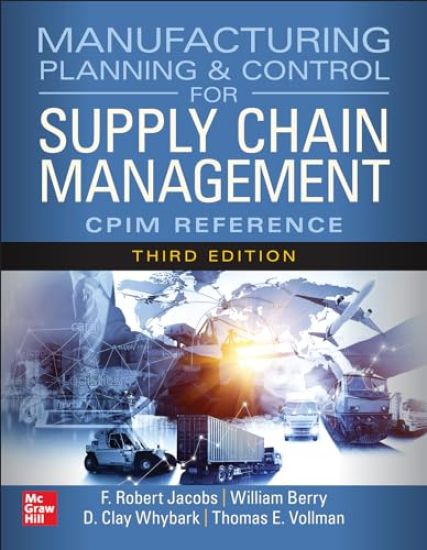
Your definitive reference for manufacturing planning and control professionals—updated for the 2-part version of the CPIM exam Written by a team of recognized experts, Manufacturing Planning and Control for Supply Chain Management: The CPIM Reference, Second Edition, features hundreds of practice questions for the CPIM exams. The book arms you with the knowledge you need to obtain the coveted CPIM designation. You’ll get cutting-edge practices that provide an advantage in today’s global manufacturing environment. Included throughout the book are illustrative examples, practice problems, case studies, and spreadsheets for quick, practical implementation of some of the techniques in the book. Maximize supply chain efficiency, productivity, and profitability, as well as customer satisfaction, using the hand-on information contained in this comprehensive resource.Coverage includes:•Manufacturing planning and control •Enterprise resource planning •Demand management •Forecasting •Advanced sales and operations planning •Master production scheduling •Material requirements planning •Advanced MRP•Capacity planning and management •Production activity control •Just-in-time •Distribution requirements planning •Management of supply chain logistics •Order point inventory control methods •Strategy and MPC system design
F. Robert Jacobs; Kraig Knutson; William Berry; Clifford Schexnayder; D. Clay Whybark; Christine Fiori; Thomas Vollmann; Robert Schmitt; Aaron Cohen; Meredith Kinkle
Your definitive guide to MPC as it relates to supply chains—fully updated for the latest version of the CPIM exam Maximize supply chain efficiency, productivity, and profitability—as well as customer satisfaction—using the hands-on information contained in this thoroughly revised resource. Written by a team of recognized experts, the book contains new coverage of Cloud-based systems, artificial intelligence, and data analytics.Designed for both professional and classroom use, Manufacturing Planning and Control for Supply Chain Management: The CPIM Reference, Third Edition, features hundreds of practice questions, examples, and case studies. The book arms you with the knowledge you need to pass the current version of the exam and obtain the coveted Certified in Planning and Inventory Management (CPIM) designation. The book can also serve as an invaluable desk reference for managers new to the field. For the experienced manager, the book offers concise descriptions of the Supply Chain functions such as Forecasting, Sales and Operations Planning, Material Requirements Planning, Material Requirements Planning, Distribution Requirements Planning, and Scheduling. You’ll get cutting-edge MPC best practices that will give you the advantage in today's global manufacturing environment.• Features updated exam prep content and practice questions for the two-part CPIM exam• Contains three new case studies and updates of case studies from previous editions• Written by a group of experienced manufacturing and planning control educators
Eberhard Arnold; Dietrich Bonhoeffer; Martin Luther King; C. S. Lewis; Wendell Berry; Dorothy Day; Leo Tolstoy; N. T. Wright; Richard Rohr; Madeleine L'Engle; Thomas Merton
Fifty-two readings to spark weekly group discussion on putting Jesus’ most central teachings into practice.Jesus’ most famous teaching, the Sermon on the Mount, possesses an irresistible quality. Who hasn’t felt stirred and unsettled after reading these words, which get to the root of the human condition? This follow-up to the acclaimed collection Called to Community: The Life Jesus Wants for His People taps an even broader array of sources, bringing together prophetic voices from every era and a range of traditions to consider the repercussions of these essential words. More than a commentary or devotional, this book is designed to be read together with others, to inspire communities of faith to discuss what it might look like to put Jesus’ teachings into practice today.
Easter is the high point of the year for millions of Christians around the world. And for most of them, there can be no Easter without Lent, the season that leads up to it. A time for self-denial, soul-searching, and spiritual preparation, Lent makes time for daily reading and reflection. This time-tested collection of devotions will deepen and stretch your faith, and can be returned to year after year. Culled from the wealth of twenty centuries, the selections are ecumenical in scope, representing the best classic and contemporary Christian writers. This expanded second edition adds dozens of voices, new and old, and takes the reader all the way through Eastertide to Pentecost. Includes ninety-six Lenten and Easter readings, plus seven chapter-opening poems, by Eberhard Arnold, Saint Augustine, Wendell Berry, Christoph Friedrich Blumhardt, Dietrich Bonhoeffer, G. K. Chesterton, Dorothy Day, Meister Eckhart, Khalil Gibran, Clarence Jordan, Soren Kierkegaard, Madeleine L'Engle, C. S. Lewis, George MacDonald, Thomas Merton, Malcolm Muggeridge, Kathleen Norris, Henri Nouwen, Christina Rosetti, Fleming Rutledge, Dorothy Sayers, Edith Stein, Mother Teresa, Leo Tolstoy, N. T. Wright, Alfred Kazin, Amy Carmichael, Barbara Brown Taylor, Barbara Cawthorne Crafton, Blaise Pascal, Brennan Manning, Dag Hammarskjöld, Dorothee Soelle, Dylan Thomas, E. Stanley Jones, Emil Brunner, Frederick Buechner, Fyodor Dostoevsky, Geoffrey Hill, Henry Drummond, J. Heinrich Arnold, Jean-Pierre de Caussade, Johann Christoph Arnold, John Dear, John Donne, John Masefield, John Stott, John Updike, Jürgen Moltmann, Karl Barth, Madeleine L’Engle, Martin Luther, Oscar Wilde, Oswald Chambers, Paul Tillich, Peter Kreeft, Philip Berrigan, Philip Yancey, Romano Guardini, Sadhu Sundar Singh , Saint Augustine, Simone Weil, Thomas à Kempis, Toyohiko Kagawa, Walter J. Ciszek, Walter Wangerin, Watchman Nee, William Willimon and others.