Kirjojen hintavertailu. Mukana 11 244 527 kirjaa ja 12 kauppaa.

Kirjahaku

Etsi kirjoja tekijän nimen, kirjan nimen tai ISBN:n perusteella.

1000 tulosta hakusanalla Timothy D. Johnson

Road Dogs and Loners

Road Dogs and Loners

Timothy D. Pippert

Lexington Books
2007
nidottu
Using ethnographic interviews, an affiliation scale, and observational data from two 'soup kitchens' of homeless men, Road Dogs and Loners investigates the various family types that homeless road dogs and loners rely on for support. Pippert specifically compares homeless men who typically partnered up with homeless men who were self-described loners. The groups are compared here in terms of their contact and support with biological, created, and fictive families. Interdisciplinary in nature, this work tackles themes that are relevant to the study of social class, stratification, economics, social problems, family sociology, social theory and research methods. Road Dogs and Loners provides an updated and in-depth, personal perspective on the lives and relationships of homeless men in America.
Ritual Practices in Congregational Identity Formation
Ritual Practices in Congregational Identity Formation investigates the educational roles of ritual practices in the process of congregational identity formation. Son identifies and analyzes various kinds of Christian rituals with respect to how rituals influence the formational processes of a congregation’s identity. Based on Victor Turner’s ritual theory, this book also investigates the pedagogical and transformative efficacies of ritual practices within the dynamics of congregational education.
The Shaker Furniture Handbook

The Shaker Furniture Handbook

Timothy D. Rieman; Jean M. Burks

Schiffer Publishing Ltd
2004
nidottu
This is the perfect introduction to Shaker furniture design.This concise book surveys distinctive furniture styles produced during the nineteenth and twentieth centuries in Shaker communities of New England, Kentucky, and Ohio, with over 130 beautiful full color images. Free-standing tables, chairs, boxes, desks, built-in cupboards, and cases of drawers are shown. The text provides an introduction to nearly twenty Shaker communities, their known cabinetmakers, identifiable traits of furniture designs unique to specific Shaker communites, and the characteristic colorful paints and stains used to finish them.
Shaker Furniture

Shaker Furniture

Timothy D. Rieman

Schiffer Publishing Ltd
2006
sidottu
English founder Ann Lee and a small group of followers brought the Shaker faith to New England in 1774. Dedicated to a simple, communal lifestyle outside of society, this movement spread throughout New England and the Midwest during the eighteenth and nineteenth centuries. The furniture produced by Shakers for their own use was beautiful in its simplicity and functionality. 300 historical and modern photos provide a visual tour of masterpieces of Shaker furniture and an introduction to the faithful artisans who produced them. Among the items displayed are benches, blanket chests, cases of drawers, chairs, counters, cupboards, desks, rockers, stands, tables, wall clocks, workbenches, and work tables. This book will be a treasure for all who enjoy, own, and create handmade furniture.
Remote Sensing for Monitoring Embankments, Dams, and Slopes

Remote Sensing for Monitoring Embankments, Dams, and Slopes

Timothy D. Stark; Thomas Oommen; Zhangwei Ning

American Society of Civil Engineers
2021
nidottu
Sponsored by the Embankments, Dams, and Slopes Technical Committee of the Geo-Institute of ASCERemote Sensing for Monitoring Embankments, Dams, and Slopes: Recent Advances, GSP 322, provides information on selecting and deploying a monitoring network to assess the behavior, geometry, total and differential EDS movement, and potential risks of the EDS movement on people and infrastructure.Topics include general technologies used for EDS monitoring, selection and installation of networked sensors for predictive analytics and image recognition, application of monitoring techniques in the design of early warning systems, case studies, and support for decision-makers in implementing early warning systems.Information on a broad range of technologies, such as radio detection and ranging (radar), synthetic aperture radar (SAR), interferometric synthetic aperture radar (InSAR), light detection and ranging (LiDAR), digital photogrammetry and image processing, microelectromechanical systems (MEMS), automatic motorized total stations (AMTS), and unmanned aircraft systems (UAS) to deploy the remote sensing technologies is also included.This Geotechnical Special Publication will be useful to both practitioners and researchers to understand and utilize currently available remote sensing technology and to advance and refine the monitoring of embankments, dams, and slopes.
Ammianus Marcellinus and the Representation of Historical Reality
Much of what we know today of Rome in the fourth century has its source in Res Gestae, the sole surviving work of the historian Ammianus Marcellinus. The accuracy of Ammianus' reporting has come under question over the past fifty years, however, and Timothy D. Barnes here offers new grist for skepticism. This is the first book on Ammianus to place equal emphasis on the literary and historical aspects of his writing. Barnes assesses Ammianus' depiction of historical reality by investigating the Res Gestae's strengths and weaknesses, as well as its literary qualities. He examines its structure and arrangement, emphasizes its Greek and pagan features, and points out the extent to which Ammianus drew on his imagination in shaping the narrative. Ammianus, raised as a Christian, became an apostate when Julian seemed to promise a return to traditional religion and values. In Res Gestae, he expressed strongly held views, often in vivid and extreme language. Barnes explores the historian's biases and personal prejudices, documenting seemingly intentional distortions and demonstrating that Ammianus advanced a pessimistic and anti-Christian interpretation of the Roman Empire.
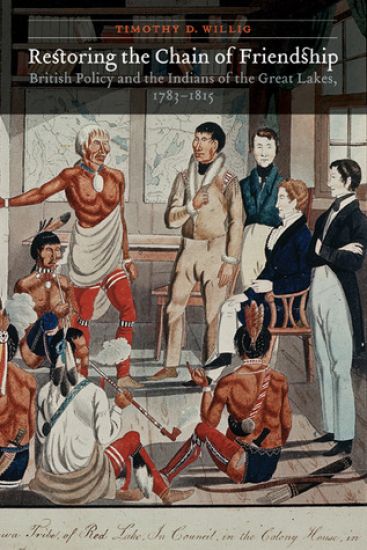
Restoring the Chain of Friendship

Restoring the Chain of Friendship

Timothy D. Willig

University of Nebraska Press
2008
sidottu
During the American Revolution the British enjoyed a unified alliance with their Native allies in the Great Lakes region of North America. By the War of 1812, however, that "chain of friendship" had devolved into smaller, more local alliances. To understand how and why this pivotal shift occurred, Restoring the Chain of Friendship examines British and Native relations in the Great Lakes region between the end of the American Revolution and the end of the War of 1812. Timothy D. Willig traces the developments in British-Native interaction and diplomacy in three regions: those served by the agencies of Fort St. Joseph, Fort Amherstburg, and Fort George. During the late eighteenth and early nineteenth centuries, the Native peoples in each area developed unique relationships with the British. Relations in these regions were affected by such factors as the local success of the fur trade, Native relations with the United States, geography, the influence of British-Indian agents, intertribal relations, Native acculturation or cultural revitalization, and constitutional issues of Native sovereignty and legal statuses. Assessing the wide variety of factors that influenced relations in each of these areas, Willig determines that it was nearly impossible for Britain to establish a single Indian policy for its North American borderlands, and it was thus forced to adapt to conditions and circumstances particular to each region.
Restoring the Chain of Friendship

Restoring the Chain of Friendship

Timothy D. Willig

University of Nebraska Press
2014
pokkari
During the American Revolution, the British enjoyed a unified alliance with their Native allies in the Great Lakes region of North America. By the War of 1812, however, that "chain of friendship" had devolved into smaller, more local alliances. To understand how and why this pivotal shift occurred, Restoring the Chain of Friendship examines British and Native relations in the Great Lakes region between the end of the American Revolution and the end of the War of 1812. Timothy D. Willig traces the developments in British-Native interaction and diplomacy in the three regions served by the agencies of Fort St. Joseph, Fort Amherstburg, and Fort George respectively. During the late eighteenth and early nineteenth centuries, the Native peoples in each area developed unique relationships with the British. Relations in these regions were affected by such factors as the local success of the fur trade, Native relations with the United States, geography, the influence of British-Indian agents, intertribal relations, Native acculturation or cultural revitalization, and constitutional issues of Native sovereignty and legal statuses. Assessing the wide variety of factors that influenced relations in each of these areas, Willig determines that it was nearly impossible for Britain to establish a single Indian policy for its North American borderlands, and it was thus forced to adapt to conditions and circumstances particular to each region.
Lutheranism and American Culture

Lutheranism and American Culture

Timothy D. Grundmeier

LOUISIANA STATE UNIVERSITY PRESS
2026
sidottu
Timothy D. Grundmeier's Lutheranism and American Culture examines the transformation of the nation's third-largest Protestant denomination over the course of the nineteenth century. In the antebellum era, leading voices within the church believed that the best way to become American was by modifying certain historic doctrines deemed too Catholic and cooperating with Anglo-evangelicals in revivalism and social reform. However, by the mid-1870s, most Lutherans had rejected this view. Though they remained proudly American, most embraced a religious identity characterized by a commitment to their church's confessions, isolation from other Christians, and a conservative outlook on political and social issues. Grundmeier shows that this transformation did not happen in a vacuum. Throughout the Civil War and early years of Reconstruction, disputes over slavery and politics led to quarrels about theology and church affairs. During the war and immediately after, the Lutheran church in the United States experienced two major schisms, both driven by clashing views on the national conflict. In the postbellum years, Lutherans adopted increasingly conservative positions in theology and politics, mainly in reaction to the perceived "radicalism" of the era. By the final decades of the nineteenth century, Lutherans had established a rigorously conservative and definitively American form of the faith, distinct from their coreligionists in Europe and other Protestants in the United States. Although Grundmeier focuses on a single religious tradition, his study has implications for several areas of Civil War scholarship. First, it demonstrates how the Lutheran experience diverged from that of other Protestant groups, thereby expanding our understanding of how American Christians responded to the era's crises, including slavery, sectionalism, and national identity. In addition, his work reinforces and extends many of the findings in other historical fields: the political culture of the Mid-Atlantic and Midwest, the views of German and Scandinavian immigrants, and the various forms of conservatism among white northerners. Grundmeier's most significant contribution, however, is examining a previously unexplored subject. In the vast corpus of works on the Civil War era and American religious history, scholars have almost entirely overlooked the views and experiences of Lutherans. Lutheranism and American Culture seeks to remedy that neglect and serve as the starting point for understanding the formative decades of this distinctive faith.
Contested Boundaries

Contested Boundaries

Timothy D. Hall

Duke University Press
1994
sidottu
The First Great Awakening in eighteenth-century America challenged the institutional structures and raised the consciousness of colonial Americans. These revivals gave rise to the practice of itinerancy in which ministers and laypeople left their own communities to preach across the countryside. In Contested Boundaries, Timothy D. Hall argues that the Awakening was largely defined by the ensuing debate over itinerancy. Drawing on recent scholarship in cultural and social anthropology, cultural studies, and eighteenth-century religion, he reveals at the center of this debate the itinerant preacher as a catalyst for dramatic change in the religious practice and social order of the New World.This book expands our understanding of evangelical itinerancy in the 1740s by viewing it within the context of Britain’s expanding commercial empire. As pro- and anti-revivalists tried to shape a burgeoning transatlantic consumer society, the itinerancy of the Great Awakening appears here as a forceful challenge to contemporary assumptions about the place of individuals within their social world and the role of educated leaders as regulators of communication, order, and change. The most celebrated of these itinerants was George Whitefield, an English minister who made unprecedented tours through the colonies. According to Hall, the activities of the itinerants, including Whitefield, encouraged in the colonists an openness beyond local boundaries to an expanding array of choices for belief and behavior in an increasingly mobile and pluralistic society. In the process, it forged a new model of the church and its social world. As a response to and a source of dynamic social change, itinerancy in Hall’s powerful account provides a prism for viewing anew the worldly and otherworldly transformations of colonial society. Contested Boundaries will be of interest to students and scholars of colonial American history, religious studies, and cultural and social anthropology.
Contested Boundaries

Contested Boundaries

Timothy D. Hall

Duke University Press
1994
pokkari
The First Great Awakening in eighteenth-century America challenged the institutional structures and raised the consciousness of colonial Americans. These revivals gave rise to the practice of itinerancy in which ministers and laypeople left their own communities to preach across the countryside. In Contested Boundaries, Timothy D. Hall argues that the Awakening was largely defined by the ensuing debate over itinerancy. Drawing on recent scholarship in cultural and social anthropology, cultural studies, and eighteenth-century religion, he reveals at the center of this debate the itinerant preacher as a catalyst for dramatic change in the religious practice and social order of the New World.This book expands our understanding of evangelical itinerancy in the 1740s by viewing it within the context of Britain’s expanding commercial empire. As pro- and anti-revivalists tried to shape a burgeoning transatlantic consumer society, the itinerancy of the Great Awakening appears here as a forceful challenge to contemporary assumptions about the place of individuals within their social world and the role of educated leaders as regulators of communication, order, and change. The most celebrated of these itinerants was George Whitefield, an English minister who made unprecedented tours through the colonies. According to Hall, the activities of the itinerants, including Whitefield, encouraged in the colonists an openness beyond local boundaries to an expanding array of choices for belief and behavior in an increasingly mobile and pluralistic society. In the process, it forged a new model of the church and its social world. As a response to and a source of dynamic social change, itinerancy in Hall’s powerful account provides a prism for viewing anew the worldly and otherworldly transformations of colonial society. Contested Boundaries will be of interest to students and scholars of colonial American history, religious studies, and cultural and social anthropology.
Beyond Exoticism

Beyond Exoticism

Timothy D. Taylor

Duke University Press
2007
sidottu
In Beyond Exoticism, Timothy D. Taylor considers how western cultures’ understandings of racial, ethnic, and cultural differences have been incorporated into music from early operas to contemporary television advertisements, arguing that the commonly used term “exoticism” glosses over such differences in many studies of western music. Beyond Exoticism encompasses a range of musical genres and musicians, including Mozart, Beethoven, Jean-Philippe Rameau, Maurice Ravel, Charles Ives, Henry Cowell, Bally Sagoo, and Bill Laswell as well as opera, symphony, country music, and “world music.” Yet, more than anything else, it is an argument for expanding the purview of musicology to take into account not only composers’ lives and the formal properties of the music they produce but also the larger historical and cultural forces shaping both music and our understanding of it. Beginning with a focus on musical manifestations of colonialism and imperialism, Taylor discusses how the “discovery” of the New World and the development of an understanding of self as distinct from the other, of “here” as different from “there,” was implicated in the development of tonality, a musical system which effectively creates centers and margins. He describes how musical practices signifying nonwestern peoples entered the western European musical vocabulary and how Darwinian thought shaped the cultural conditions of early-twentieth-century music. In the era of globalization, new communication technologies and the explosion of marketing and consumption have accelerated the production and circulation of tropes of otherness. Considering western music produced under rubrics including multiculturalism, collaboration, hybridity, and world music, Taylor scrutinizes contemporary representations of difference. He argues that musical interpretations of the nonwestern other developed hundreds of years ago have not necessarily been discarded; rather they have been recycled and retooled.
Beyond Exoticism

Beyond Exoticism

Timothy D. Taylor

Duke University Press
2007
pokkari
In Beyond Exoticism, Timothy D. Taylor considers how western cultures’ understandings of racial, ethnic, and cultural differences have been incorporated into music from early operas to contemporary television advertisements, arguing that the commonly used term “exoticism” glosses over such differences in many studies of western music. Beyond Exoticism encompasses a range of musical genres and musicians, including Mozart, Beethoven, Jean-Philippe Rameau, Maurice Ravel, Charles Ives, Henry Cowell, Bally Sagoo, and Bill Laswell as well as opera, symphony, country music, and “world music.” Yet, more than anything else, it is an argument for expanding the purview of musicology to take into account not only composers’ lives and the formal properties of the music they produce but also the larger historical and cultural forces shaping both music and our understanding of it. Beginning with a focus on musical manifestations of colonialism and imperialism, Taylor discusses how the “discovery” of the New World and the development of an understanding of self as distinct from the other, of “here” as different from “there,” was implicated in the development of tonality, a musical system which effectively creates centers and margins. He describes how musical practices signifying nonwestern peoples entered the western European musical vocabulary and how Darwinian thought shaped the cultural conditions of early-twentieth-century music. In the era of globalization, new communication technologies and the explosion of marketing and consumption have accelerated the production and circulation of tropes of otherness. Considering western music produced under rubrics including multiculturalism, collaboration, hybridity, and world music, Taylor scrutinizes contemporary representations of difference. He argues that musical interpretations of the nonwestern other developed hundreds of years ago have not necessarily been discarded; rather they have been recycled and retooled.

Embodying Difference

Embodying Difference

Timothy D. Amos

University of Hawai'i Press
2011
sidottu
The burakumin, Japan's largest minority group, have been the focus of an extensive yet strikingly homogenous body of Japanese language research. The master narrative in much of this work typically links burakumin to premodern occupational groups which engaged in a number of socially polluting tasks like tanning and leatherwork. This master narrative, however, when subjected to close scrutiny, tends to raise more questions than it answers, particularly for the historian. Is there really firm historical continuity between premodern outcaste and modern burakumin communities? Is the discrimination experienced by historic and contemporary outcaste communities actually the same? Does the way burakumin frame their own experience significantly affect mainstream understandings of their plight? This book is the result of a decade-and-a-half-long search for answers to these questions. Based on an extensive array of original archival material, ethnographical research, and critical historiographical work, it argues that there needs to be a fundamental reconceptualisation of the buraku problem for two main reasons. First, the master narrative is built on empirically and conceptually questionable foundations; and second, mainstream accounts tend to overlook the very important role burakumin and other interested parties play in the construction and maintenance of the narrative. By continually drawing a straight line between premodern outcaste groups and today's burakumin, and equating the types of discrimination suffered by members of this community today with that faced by their premodern counterparts, the Japanese government, the general population, scholars, and burakumin activists tend to overlook some of the real changes that have often taken place both in who is identified as members of socially marginalized groups in Japan and how they experience that identification. Clinging to this master narrative, moreover, serves to restrict the ways in which burakumin can productively and more inclusively identify in the present to imagine a liberated future for themselves. Timothy Amos' attempt to rethink the boundaries of buraku history and the category of the outcaste in Japan results in a compelling study of buraku issues for any audience. Not for sale in South Asia
Embodying Difference

Embodying Difference

Timothy D. Amos

University of Hawai'i Press
2011
nidottu
The burakumin, Japan's largest minority group, have been the focus of an extensive yet strikingly homogenous body of Japanese language research. The master narrative in much of this work typically links burakumin to premodern occupational groups which engaged in a number of socially polluting tasks like tanning and leatherwork. This master narrative, however, when subjected to close scrutiny, tends to raise more questions than it answers, particularly for the historian. Is there really firm historical continuity between premodern outcaste and modern burakumin communities? Is the discrimination experienced by historic and contemporary outcaste communities actually the same? Does the way burakumin frame their own experience significantly affect mainstream understandings of their plight? This book is the result of a decade-and-a-half-long search for answers to these questions. Based on an extensive array of original archival material, ethnographical research, and critical historiographical work, it argues that there needs to be a fundamental reconceptualisation of the buraku problem for two main reasons. First, the master narrative is built on empirically and conceptually questionable foundations; and second, mainstream accounts tend to overlook the very important role burakumin and other interested parties play in the construction and maintenance of the narrative. By continually drawing a straight line between premodern outcaste groups and today's burakumin, and equating the types of discrimination suffered by members of this community today with that faced by their premodern counterparts, the Japanese government, the general population, scholars, and burakumin activists tend to overlook some of the real changes that have often taken place both in who is identified as members of socially marginalized groups in Japan and how they experience that identification. Clinging to this master narrative, moreover, serves to restrict the ways in which burakumin can productively and more inclusively identify in the present to imagine a liberated future for themselves. Timothy Amos' attempt to rethink the boundaries of buraku history and the category of the outcaste in Japan results in a compelling study of buraku issues for any audience. Not for sale in South Asia