Kirjojen hintavertailu. Mukana 12 390 323 kirjaa ja 12 kauppaa.

Kirjahaku

Etsi kirjoja tekijän nimen, kirjan nimen tai ISBN:n perusteella.

1000 tulosta hakusanalla Tom Cooper

Paradise Afire, Volume 1

Paradise Afire, Volume 1

Adrien Fontanellaz; Tom Cooper

Helion Company
2018
nidottu
When released into independence from Great Britain, in 1948, the stunningly beautiful island of Ceylon, re-named Sri Lanka in 1972, was expected to become a sort of `South Asian Singapore’. However, stable political order and bright economic prospects proved insufficient to maintain peace. A host of unsolved ethnic conflicts and social inequalities conspired to erupt into an armed conflict, in 1971. When this broke out the entire Sri Lankan society was shocked to its core by a large-scale insurgency instigated by a Sinhalese Maoist group, JVP. Worst still, this was followed by the gradual build-up of several other Tamil groups in the north of the island. Following riots known as `Black July’, in 1983, Sri Lanka was ripped apart by a murderous war against Tamil insurgents, which caught the armed forces wrong-footed because of the government’s reluctance to build-up its military to necessary levels. This came to a temporary stop in 1987, with the implementation of a peace arrangement virtually enforced by the government of India and a deployment of a large peacekeeping force of the Indian military. By the time, the notorious LTTE emerged as the most powerful Tamil insurgent movement, and the principal opponent of the Sri Lankan armed forces. Eventually, the Indian military intervention proved to be only a temporary solution. The LTTE turned against the Indian military but suffered heavily in return. However, this provided some breathing space for the Sri Lankan military, which then launched a vicious and protracted counterinsurgency campaign against the JVP. The fighting thus went on. Relying on extensive studies of the Sri Lankan War with the help of first-hand sources, official documentation and publications from all of involved parties, this volume provides an in-depth and particularly detailed account of military operations during the first 16 years of this war.
Desert Storm Volume 2

Desert Storm Volume 2

Ted Hooton; Tom Cooper

Helion Company
2021
nidottu
Early in the morning of 2 August 1990, aircraft of the Iraqi Air Force bombed Kuwaiti air bases, and then the Iraqi Republican Guards stormed into the country. Thus began what would be called the ‘Gulf War’ – or the ‘II Gulf War’ or ‘II Persian Gulf War’ – fought between January and March 1991. Although encountering some problems, the Iraqi forces occupied Kuwait in a matter of a few days. However, when President Saddam Hussein of Iraq unleashed his military upon Kuwait, little did he know what kind of reaction he would provoke from the Western superpowers, and what kind of devastation his country would suffer in return. Concerned about the possibility of Iraq continuing its advance into Saudi Arabia, the USA – in coordination with Great Britain, France, and several local allies – reacted by deploying large contingents of their air, land and naval forces to the Middle East.##Months of fruitless negotiations and the continuous military build-up – Operation Desert Shield – followed, as tensions continued to increase. Determined to retain Kuwait, and despite multiple warnings from his own generals, Saddam Hussein rejected all demands to withdraw. The USA and its allies, ‘the Coalition’, were equally as determined to drive out the invader and restore Kuwaiti independence. Gradually, they agreed this would have to be by force. Following an authorisation from the United Nations, the Coalition launched the Operation Desert Storm, on 17 January 1991, opening one of the most intensive air campaigns in history. The last conventional war of the 20th Century saw the large, but essentially traditional, Iraqi Army overwhelmed by forces trained and equipped to exploit the latest technologies. Desert Storm reveals the whole war fought between Iraq and an international coalition, from the start of this campaign to its very end. Largely based on data released from official archives, spiced with numerous interviews, and illustrated with over 100 photographs, 18 colour profiles and maps, it offers a refreshing insight into this unique conflict. Volume 2 of Desert Storm tells the story of the air campaign, naval operations, the 100 hours of the land war, and the aftermath of this conflict.
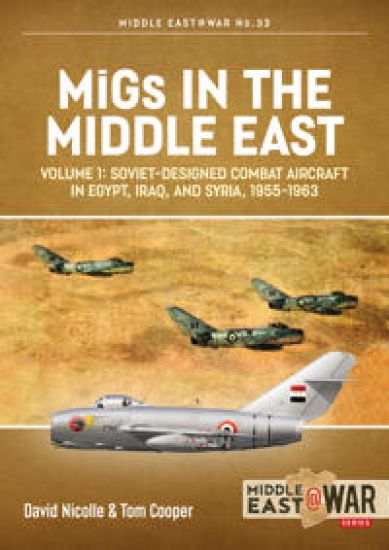
Migs in the Middle East  Volume 1

Migs in the Middle East Volume 1

Davis Nicolle; Tom Cooper

Helion Company
2021
nidottu
Egypt and Czechoslovakia signed the so-called ‘Czechoslovak Arms Deal’, thus initiating a unique era of close cooperation between major Arab military powers, the former Union of the Soviet Socialist Republics (USSR) and its allies. During the first decade of this period, the air force of Egypt, followed by those of (in chronological order) Syria, Iraq, Morocco and Algeria, were all equipped with dozens and then hundreds of Soviet-made fighters designed by the Mikoyan I Gurevich Design Bureau – the same swept-wing jets that took the Western powers by surprise during the Korean War. While the first generation of MiG jet fighter – the MiG-15 – saw only a relatively brief service in Egypt, its more efficient and uprated successor, the MiG-17F, entered service in bigger numbers, and then formed the backbone of additional air forces around the Middle East. The MiG-17PF became the first radar-equipped combat aircraft while the MiG-19 became the first supersonic fighter flown by the air forces of Egypt and Iraq, in the period 1958-1963. In Morocco and Algeria, the MiG-17 was the first and the only jet fighter in service during the first half of the 1960s.Unsurprisingly, MiG-15s, MiG-17s and MiG-19s thus served with many different units and – especially in Egypt and Algeria, and also in Syria – wore a wide range of very different, and often very colourful unit insignia and other markings. They were also flown by many pilots who subsequently played crucial roles in the future of their nations. Based on original documentation and extensive interviews with veterans, and richly illustrated, MiGs in the Middle East, Volume 1 is a unique source of reference on the operational history of MiG-15, MiG-17, and MiG-19 fighter jets in Algeria, Egypt, Iraq, Morocco, and Syria from 1955 until 1956. This is the first volume in a mini-series.
War of Intervention in Angola, Volume 4

War of Intervention in Angola, Volume 4

Adrien Fontanellaz; Tom Cooper; José Augusto Matos

Helion Company
2021
nidottu
War of Intervention in Angola, Volume 4, continues the coverage of the operational history of the Angolan Air Force and Air Defence Force (FAPA/DAA) as told by Angolan and Cuban sources, in the period 1985-1988. Many accounts of this conflict - better known in the West as the ‘Border War’ or the 'Bush War', as named by its South African participants - consider the operations of the FAPA/DAA barely worth commentary. At most, they mention a few air combats involving Mirage F.1 interceptors of the South African Air Force (SAAF) in 1987 and 1988, and perhaps a little about the activity of the FAPA/DAA’s MiG-23s. However, a closer study of Angolan and Cuban sources reveals an entirely different image of the air war over Angola in the 1980s: indeed, it reveals the extent to which the flow of the entire war was dictated by the availability - or the lack - of air power. These issues strongly influenced the planning and conduct of operations by the commanders of the Angolan and Cuban forces. Based on extensive research with the help of Angolan and Cuban sources, War of Intervention in Angola, Volume 4, traces the Angolan and Cuban application of air power between 1985-1988 - during which it came of age - and the capabilities, intentions, and the combat operations of the air forces. The volume is illustrated with 100 rarely seen photographs, half a dozen maps and 15 colour profiles, and provides a unique source of reference on this subject.
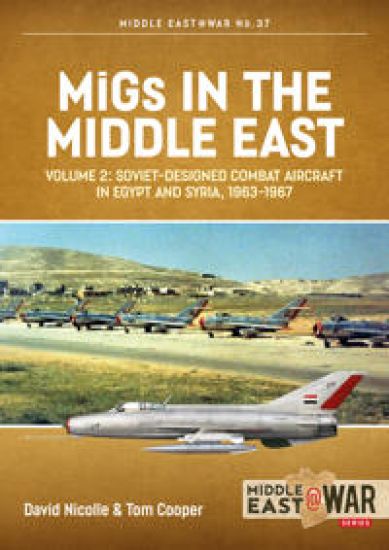
Migs in the Middle East, Volume 2

Migs in the Middle East, Volume 2

David Nicolle; Tom Cooper

Helion Company
2021
nidottu
During and after the June 1967 Arab-Israeli War, fighter-bombers of Soviet-design and manufacture served in the air forces of two frontline Arab states facing Israel: Egypt and Syria. While Algeria and Iraq also deployed contingents flying Soviet-made fighter jets, only the latter saw any significant action. Immediately after, and in reaction to losses and negative experiences from the war with Israel, unprecedented numbers of MiGs were delivered to air forces in the Middle East. The USSR replaced all Egyptian and Syrian losses on 1-for-1 basis, while Iraq and Algeria placed huge orders. Moreover, the USSR replaced Egypt as the main supporter of the republican government in what was then Northern Yemen, and Sudan appeared on the scene to place orders for its own air force. Subsequently, the British Protectorate of Aden achieved independence, quickly established friendly ties to the Soviet Union and Cuba, and began acquiring jet fighters of Soviet origin. Unsurprisingly, by the early 1970s, not only older MiG-15s and MiG-17s but also newer types like MiG-21s served in huge numbers with at least half a dozen air forces around the Middle East. They wore a wide range of very different, and often very colourful unit insignia and other markings, and were flown by many pilots who would subsequently play crucial roles in the future of their nations.##Based on original documentation and extensive interviews with veterans, and richly illustrated, MiGs in the Middle East, Volume 2 is a unique source of reference on the operational history of MiG-15, MiG-17, MiG-19 and MiG-21 fighter jets in Algeria, Egypt, Iraq, Morocco, Syria, North and South Yemen from 1967 until 1975.
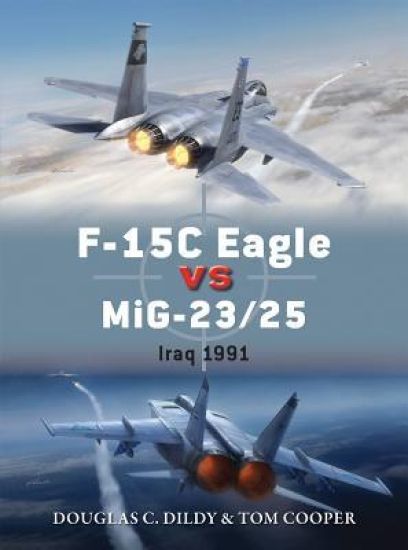
F-15C Eagle vs MiG-23/25

F-15C Eagle vs MiG-23/25

Douglas C. Dildy; Tom Cooper

Osprey Publishing
2016
nidottu
Following the relatively poor performance of America's multi-role fighters during the Vietnam War, the F-15 Eagle was designed as a dedicated air superiority fighter. But, instead of Soviet pilots, it came up against pilots of Saddam Hussein's Iraqi airforce. This book analyses the combat between the American and Soviet 'Cold War fighters' in a balanced manner, examining how the technical abilities of the aircraft combined with the different levels of training available to opposing pilots and groundcrews allowed the F-15s to destroy the Iraqi offensive abilities within weeks of the First Gulf War starting.Packed with artwork, illustrations and photographs, this book places the reader in the cockpit during one of the last major dogfighting air wars in modern history.
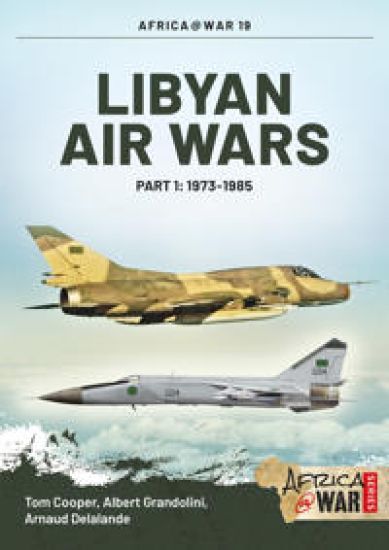
Libyan Air Wars

Libyan Air Wars

Albert Grandolini; Arnaud Delelande; Tom Cooper

Helion Company
2015
nidottu
Between 1973 and 1989, various Western powers and Libya were entangled in a seemingly never-ending exchange of blows. Supposedly launched in retaliation for one action or the other, this confrontation resulted in a number of high-profile, even through low-scale, clashes between the Libyan Arab Air Force (LAAF), the US Navy and even the French. Meanwhile, almost as a sideshow, the LAAF - quantitatively one of the most potent air forces in North Africa and the Middle East - also saw intensive deployment in Chad. Initially, with sporadic fighting between different parties for the control of N'Djamena, the Chadian capital, this conflict eventually turned into a major war when Libya invaded the country outright. The LAAF deployed not only French-made Mirage but also Soviet-made fighter-bombers of MiG and Sukhoi design, Mil-designed helicopters and even bombers of Tupolev design, to establish her dominance over the extensive battlefield of the Sahara Desert. Because of the Cold War but also due to confrontation with Libya over a number of other issues, France - a one-time major arms supplier to Libya - and the USA gradually got dragged into the war. Deployments of their troops and intelligence services in Chad, Egypt and the Sudan never resulted in a full-scale war against Libya, but time and again culminated in small-scale aerial operations that proved crucial to developments on the ground, several of which are still a matter of extensive debate. Detailing not only the aerial operations but the ground war and the geo-political background of these conflicts, and illustrated with over 100 contemporary photographs, maps and all-new colour profiles, this volume provides a unique insight into an otherwise completely forgotten conflict that raged from the skies over the southern Mediterranean to southern Chad and northern Sudan, yet one that not only represented a formative period of the LAAF, but which also prompted a number of crucial modifications and developments in France and the USA.
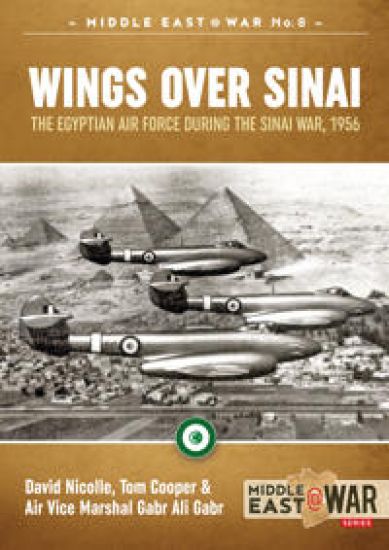
Wings Over Sinai

Wings Over Sinai

David Nicolle; Air Vice Marshal Gabr Ali Gabr; Tom Cooper

Helion Company
2017
nidottu
Sixty years since the tripartite aggression of France, Great Britain and Israel against Egypt, this is the first account about Egyptian military operations during the Suez War of 1956 (or `Suez Crisis’, as it is known in the West). Based on research with the help of official Egyptian documentation and recollections of crucial participants, this book provides an unique and exclusive insight into the `other side’ of a war that many consider has marked `the end of the British Empire’. From the Western point of view, the situation is usually explained in quite simple terms: in retaliation for President Gamal Abdel Nasser’s nationalisation of the Universal Suez Canal Company - and thus the strategically important waterway of the Suez Canal - France and Great Britan (operating in concert with Israel) launched the operation codenamed 'Musketeer'. Divided into three phases, each shaded into the other; this aimed at obliterating the Egyptian Air Force, occupying the whole of the Suez Canal and toppling Nasser’s government. From the Egyptian point of view, backgrounds were much more complex than this. Striving to modernize the country, a new and inexperienced government in Cairo launched a number of major projects, including one for the construction of a gigantic Asswan Dam on the Nile. The only Western power ready to help finance this project, the USA conditioned its support with basing rights for its military. With the last British soldiers still about to leave the country - and thus end Egypt’s occupation by foreign powers for the first time in 2,000 years - Nasser found this unacceptable. Around the same time, Egypt found itself under pressure from Israeli raids against border posts on the Sinai. Left without a solution, Cairo decided to nationalize the Suez Canal in order to finance the Aswan Dam project, but also to start purchasing arms from the Soviet Union. In an attempt to bolster Egyptian defenses without antagonizing Western powers, Nasser concluded the so-called `Czech Arms deal’ with Moscow - resulting in the acquisition of Soviet arms via Czechoslovakia. Little known in Cairo at the time, such moves tripped several `red lines’ in Israel and in the West - in turn prompting aggression that culminated in a war. Wings over Sinai is, first and foremost, an account of the battle for survival of the Egyptian Air Force (EAF). Caught in the middle of conversion to Soviet-types, this proved more than a match for Israel, but were hopelessly ill-prepared to face the military might of Great Britain and France too. Sustained, days-long air strikes on Egyptian air bases caused heavy damage, but were nowhere near as crippling as the losses usually claimed and assessed by the British, French and Israelis. The EAF not only survived that conflict in quite a good order, but also quickly recovered. This story is told against the backdrop of the fighting on the ground and the air and naval invasion by British and French forces. Richly illustrated with plenty of new and previously unpublished photographs, maps (and 15 color profiles), this action-packed volume is illustrates all aspects of camouflage, markings and various equipment of British and Soviet origin in Egyptian military service as of 1956.
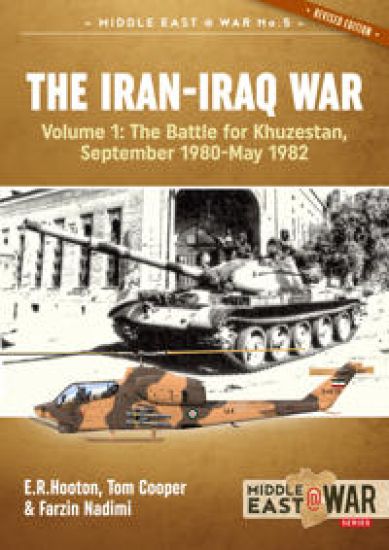
The Iran-Iraq War

The Iran-Iraq War

E.R. Hooton; Tom Cooper; Farzin Nadimi

Helion Company
2019
nidottu
The Iran-Iraq War was one of the bloodiest conflicts of the 20th Century and accidentally created the current nightmare of Islamic fundamentalist terrorism. There have been many books on the conflict but this is the first detailed military history using materials from both sides, as well as materials obtained from US Intelligence circles and British Governmental archives. It provides a unique insight into a war which began through miscalculation and rapidly escalated into the longest conventional conflict in the post Second World War era. The first volume looks at the background and describes in detail how Saddam Hussein decided to invade but hamstrung the Iraqi Army to restrict its greatest success to a narrow strip of territory in Iran’s southern province of Khuzestan. This left the Iraqis unable either to advance or withdraw and exposed them to ever greater and more successful Iranian counter-strokes which drove them out in May 1982 in the ferocious Battle of Khorramshahr.
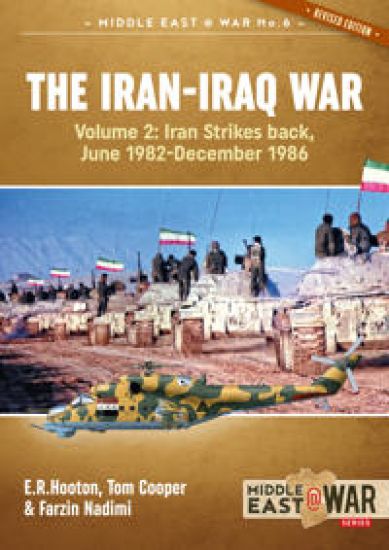
The Iran-Iraq War

The Iran-Iraq War

E.R. Hooton; Tom Cooper; Farzin Nadimi

Helion Company
2019
nidottu
Volume 2 takes up the account after Iraq withdrew from Khuzestan and is based upon material from both sides, from US Intelligence data, British Government documents and secret Iraqi files. Iraq’s withdrawal exposed the great southern city of Basra to Iranian attack but it was shielded by fortifications based upon a huge anti-tank ditch, the so-called Fish Lake, which the Iranians tried to storm in the summer of 1982. This bloody failure left Tehran in a position where prestige prevented a withdrawal into Iran but the armed forces lacked the resources to bring the conflict to a favourable conclusion. During the next four years the Iranians tried to outflank the Fish Lake defences initially through the marshes in the north and finally through an attack on the Fao Peninsula which increased national prestige but was a strategic failure and paved the way for Iraq’s massive victories in 1988. This followed a series of successful defensive battles in which the Iranians were driven back with great loss. This account describes the battles in greater detail than before and, by examining them, provides unique insights and ends many of the myths which are repeated in many other accounts of this conflict.
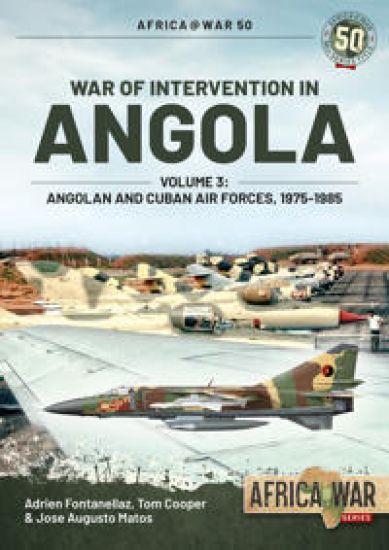
War of Intervention in Angola, Volume 3

War of Intervention in Angola, Volume 3

Adrien Fontanellaz; José Matos; Tom Cooper

Helion Company
2020
nidottu
War of Intervention in Angola, Volume 3 covers the air warfare during the II Angolan War – fought 1975-1992 – through narrating the emergence and operational history of the Angolan Air Force and Air Defence Force (FAPA/DAA) as told by Angolan and Cuban sources. Most accounts of this conflict – better known in the West as the ‘Border War’ or the ‘Bush War’, as named by its South African participants – tend to find the operations by the FAPA/DAA barely worth mentioning. A handful of published histories mention two of its MiG-21s claimed as shot down by Dassault Mirage F.1 interceptors of the South African Air Force (SAAF) in 1981 and 1982, and at least something about the activities of its MiG-23 interceptors during the battles of the 1987-1988 period. On the contrary, the story told by Angolan and Cuban sources not only reveals an entirely different image of the air war over Angola of the 1980s: indeed, it reveals to what degree this conflict was dictated by the availability – or the lack of – air power and shows that precisely this issue dictated the way that the commanders of the Cuban contingents deployed to the country – whether as advisors or as combat troops – planned and conducted their operations. It is thus little surprising that the first contingent of Cuban troops deployed to Angola during Operation Carlota, in late 1975, included a sizeable group of pilots and ground personnel who subsequently helped build-up the FAPA/DAA from virtually nothing. They continued that work over the following 14 years - sometimes in cooperation of Soviet advisors and others from East European countries – eventually establishing an air force that by 1988 maintained what South African military intelligence and the media subsequently described as the ‘most advanced air defence system in Africa’. Not only the air defence system in question, but also the aircraft serving as its extended arms, ultimately managed a unique feat in contemporary military history: they enabled an air force equipped with Soviet-made aircraft and trained along the Soviet doctrine to establish at least a semblance of aerial superiority over an air force equipped with Western-made aircraft and operating under a Western doctrine. Based on extensive research with help of Angolan and Cuban sources, the ‘War of Intervention in Angola, Volume 3’, traces the military build-up of the FAPA/DAA in the period 1975-1992, its capabilities and its intentions. Moreover, it provides a unique, blow-by-blow account of its combat operations and experiences. The volume is illustrated with 100 rare photographs, half a dozen maps and 15 colour profiles, thus providing a unique source of reference on this topic.
Desert Storm Volume 1

Desert Storm Volume 1

E.R. Hooton; Tom Cooper

Helion Company
2019
nidottu
Early in the morning of 2 August 1990, aircraft of the Iraqi Air Force bombed Kuwaiti air bases, and then the Iraqi Republican Guards stormed into the country. Thus began what would be called the ‘Gulf War’ – also the ‘II Gulf War’, and sometimes the ‘II Persian Gulf War’ – fought between January and March 1991. Although encountering some problems, the Iraqi forces occupied Kuwait in a matter of few days. However, when President Saddam Hussein of Iraq unleashed his military upon Kuwait, little did he know what kind of reaction he would provoke from the Western superpowers, and what kind of devastation his country would suffer in return. Concerned about the possibility of Iraq continuing its advance into Saudi Arabia, the USA – in coordination with Great Britain, France, and several local allies – reacted by deploying large contingents of their air-, land- and naval forces to the Middle East. Months of fruitless negotiations and the continuous military build-up – Operation Desert Shield – followed, as tensions continued to increase. Determined to retain Kuwait, and despite multiple warnings from his own generals, Saddam Hussein rejected all demands to withdraw. The USA and its allies, ‘the Coalition’, were as determined to drive out the invader and restore Kuwaiti independence. Gradually, they agreed this would have to be by force. Following an authorisation from the United Nations, the Coalition launched the Operation Desert Storm, on 17 January 1991, opening one of the most intensive air campaigns in history. The last conventional war of the 20th Century saw the large, but essentially traditional, Iraqi Army overwhelmed by forces trained and equipped to exploit the latest technologies. Desert Storm reveals the whole war fought between Iraq and an international coalition, from the start of this campaign to its very end. Largely based on data released from official archives, spiced with numerous interviews, and illustrated with over 100 photographs, 18 colour profiles and maps, it offers a refreshing insight into this unique conflict.
Fame: Pride: Pete Buttigieg, Anderson Cooper, Tom Daley, Freddie Mercury and Ryan Murphy
Stand strong. Be loud. Be proud. This unique graphic novel is a tribute to the lives and accompaniments of those who are proud to stand up for those who aren't afraid to live authentically. Superstar artist George Amaru provides a stunning one of three covers that link together to showcase the Pride Flag. Peter Paul Montgomery Buttigieg, a veteran of the war in Afghanistan, is the son of intellectuals. After graduating from Harvard and studying as a Rhodes Scholar at Oxford, Pete became the nation's youngest mayor and the first openly gay candidate for President of the United States. Born with a silver spoon in his mouth, the silver fox, Anderson Cooper, chose to follow his journalism passion with a vengeance. Freddie Mercury was a British musician, singer, and songwriter, best known as the lead vocalist and lyricist of the iconic rock band Queen. Ryan Murphy, the creator of the enduring television shows Nip/Tuck, American Horror Story, and Glee, came out as gay to his first therapist. The therapist declared him "too precious for his own good." So is his work. Tom Daley, British diver Tom Daley made quite a splash at the 2012 Olympic Games with his winning personality and dedication to LGBTQ activism. This 96-page graphic novel will make you feel more pride. The FAME series has been showcased in the Advocate, Time and People Magazine.