Kirjojen hintavertailu. Mukana 12 390 323 kirjaa ja 12 kauppaa.

Kirjahaku

Etsi kirjoja tekijän nimen, kirjan nimen tai ISBN:n perusteella.

1000 tulosta hakusanalla Walid Abdallah

Bioengineering for Surgery

Bioengineering for Surgery

Walid Farhat; James Drake

Chandos Publishing (Oxford) Ltd
2015
sidottu
Bioengineering is the application of engineering principles to address challenges in the fields of biology and medicine encompassing the principles of engineering design to the full spectrum of living systems. In surgery, recent advances in minimal invasive surgery and robotics are the culmination of the work that both engineers and surgeons have achieved in the medical field through an exciting and challenging interface. This interface rests on the medical curiosity and engineering solutions that lead eventually to collaboration and development of new ideas and technologies. Most recently, innovation by surgeons has become a fundamental contribution to medical research in the surgical field, and it is through effective communication between surgeons and biomedical engineers and promoting collaborative initiatives that translational research is possible. Bioengineering for Surgery explores this interface between surgeons and engineers and how it leads to innovation processes, providing clinical results, fundraising and prestige for the academic institution. This book is designed to teach students how engineers can fit in with their intended environment and what type of materials and design considerations must be taken into account in regards to medical ideas.
The Confrontation

The Confrontation

Walid Phares

Palgrave Macmillan
2009
nidottu
In Future Jihad, terrorism and Middle East expert Walid Phares gave a definitive account of the historical and cultural forces that led to September 11 and the rise of radical Islam. In The War of Ideas, he revealed the conflict of ideologies that underlie the War on Terror. Now, in The Confrontation, he identifies the clashes to come and provides a blueprint for defeating the forces of jihad. Moving from the ravaged villages of the Sudan to London's Muslim neighborhoods to the battlefields of Iraq and Afghanistan, he illuminates the vast and complex world of the global jihadist movement. He offers a multi-pronged strategy, global in scope, and calls on the world's diverse local and international institutions to come together and coordinate their efforts. Pointing the way forward, this book shows how we might reclaim a world that is safe for freedom and democratic societies.
Whatever Happened to Antara?

Whatever Happened to Antara?

Walid Ikhlassi

University of Texas Press
2004
pokkari
Walid Ikhlassi evokes the individual's struggle for dignity and significance in the Syrian city of Aleppo during the French mandate of the forties and fifties. His characters' seeking of personal fulfillment parallels the struggle of the nation for self-definition. The changing political and cultural landscape of Syria challenges individuals in their attempts to live lives of integrity, as Ikhlassi provides analytical insights into the civil society of Syria, the axis of his writing. From the boy Antara who personifies the Arab legend of a half-African slave warrior/hero to everyday middle-aged lovers, Ikhlassi's characters fight colonial oppression and corruption from the newly formed government. Foreign and internal forces challenge the evolution of a modern nation rooted in traditional Arab values. Its strong and determined men and women refuse to accept victimhood. The introduction by author and critic Elizabeth Warnock Fernea places the stories in their historical and literary context. An avowed experimentalist, Ikhlassi portrays the modern human situation through techniques as widely divergent as realism, surrealism, interior monologue, and stream-of-consciousness. Selections of his work have been translated into English, Russian, French, German, Dutch, Armenian, and other languages.
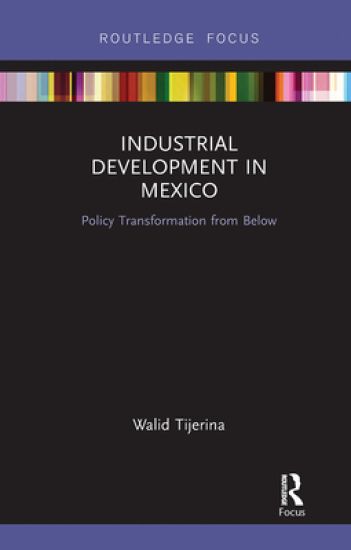
Industrial Development in Mexico

Industrial Development in Mexico

Walid Tijerina

Routledge
2019
sidottu
This book explores developmental policymaking across the multiple levels of Mexico’s contemporary state, arguing that many of the innovations in industrial policy have been driven at the subnational level. In the three decades since Mexico’s neoliberal turn in its political economy, subnational units of government have taken a lead in industrial transformation, galvanising policy from below. With most literature on new developmentalism focusing on the national level, this book is an important exploration of the differentiated and rewarding results that may be found below the state’s centre. Based on an original dataset of written and oral interviews gained from national and subnational governmental units of industrial policymaking in Mexico, the book shows how attribution and power are diffused across the contemporary state’s multiple levels. Notable subnational projects explored by the book include public-private collaboration, productive investments and an interesting array of incentives targeted towards industrial upgrading and innovation. The book concludes by providing a distinctive and systematic comparison between subnational units from different countries in Latin America and further afield, in order to assess the commonalities of developmental roles and policies. Industrial Development in Mexico will be an important read for scholars across the fields of political science, political economy and Latin American development.
Industrial Development in Mexico

Industrial Development in Mexico

Walid Tijerina

Routledge
2020
nidottu
This book explores developmental policymaking across the multiple levels of Mexico’s contemporary state, arguing that many of the innovations in industrial policy have been driven at the subnational level. In the three decades since Mexico’s neoliberal turn in its political economy, subnational units of government have taken a lead in industrial transformation, galvanising policy from below. With most literature on new developmentalism focusing on the national level, this book is an important exploration of the differentiated and rewarding results that may be found below the state’s centre. Based on an original dataset of written and oral interviews gained from national and subnational governmental units of industrial policymaking in Mexico, the book shows how attribution and power are diffused across the contemporary state’s multiple levels. Notable subnational projects explored by the book include public-private collaboration, productive investments and an interesting array of incentives targeted towards industrial upgrading and innovation. The book concludes by providing a distinctive and systematic comparison between subnational units from different countries in Latin America and further afield, in order to assess the commonalities of developmental roles and policies. Industrial Development in Mexico will be an important read for scholars across the fields of political science, political economy and Latin American development.
The Dynamics of the Computer Industry: Modeling the Supply of Workstations and their Components
Computers communicate globally via satellite or fiber optic links, wide area networks share resources thousands of miles away, and the average home can have the capacity of access information at the push of a button - the digital information age has arrived! Several technologies have made this computer age possible, helped it grow, and affected its dynamics over time. This book addresses the problem of formulating a model that interrelates the factors that drive the supply of these technologies over time to the attributes of the computers that are manufactured from them.
Diwan of Hassan ibn Thabit

Diwan of Hassan ibn Thabit

Walid N. Arafat

Gibb Memorial Trust
1971
sidottu
Hassan ibn Thabit lived in Yathrib, the later Medina, and was of mature age when the Prophet Muhammad, leaving Mecca behind him, settled there. He was already an established poet and had found favour as a composer of eulogies on visits to the court of the Arab Princes of the Ghassanid dynasty. Although not an immediate convert, Hassan soon accepted Islam and became, if hardly Poet Laureate, the most conspicuous of those who, in spite of Muhammad's disapproval of poets in general, were able to use their talent for verse to serve the new religion and praise its Prophet. He lived on to a great age after Muhammad's death, perhaps largely in retirement; his own death most probably occurred in AD 659. As is usual with the literature of the earliest period of Islam, the poems attributed to Hassan include ones which can not be his. The Diwan seems to contain a substantial core of authentic work, but a proportion of it has been fathered on Hassan posthumously for various reasons, for instance, to serve the interest of the Medinan group to which he had belonged, the Ansar. Professor Arafat, who has long studied the problems of the Diwan, has provided an edition of the text which incorporates much new evidence, notably that of three important MSS in Istanbul, and he has supplied a thorough commentary.
The Divine Masterpiece

The Divine Masterpiece

Walid Loun Bouzerar

Dar al-Habib
2017
nidottu
Forty poems in praise of the Beloved Prophet Muhammad, peace and blessings be upon him, and his Message. The poetry in this collection was written during the author's travels. Poems written by the Holy Gates of the Master of the first and last, and in Jannat al-Baqi', in Madinat ul-Munawwara, peace and blessings be upon him, at the Mausoleum of al-Hussayn ibn 'Ali, in Cairo, may Allah be well pleased with them, on the road to Makkah, and others in a quiet home far away in cold Canada. Some were written in the Holy Month of Ramadhan, some in the blessed month of Rabi' ul-Awwal.May Allah bless every reader with a visit and vision of the Most Beautiful Created Being, peace and blessings be upon him, awake and asleep.
Oil and Development in the Arab Gulf States

Oil and Development in the Arab Gulf States

Walid I. Sharif

TAYLOR FRANCIS LTD
2023
sidottu
Oil and Development in the Arab Gulf States (1985) brings together in one volume the manifold sources of information on the Arab Gulf region, especially the impact of oil revenues on its economic, political and social development. It provides a balanced core of primary and secondary sources on various aspects of the economics of Arab oil between 1973 and 1983.
Oil and Development in the Arab Gulf States

Oil and Development in the Arab Gulf States

Walid I. Sharif

TAYLOR FRANCIS LTD
2025
nidottu
Oil and Development in the Arab Gulf States (1985) brings together in one volume the manifold sources of information on the Arab Gulf region, especially the impact of oil revenues on its economic, political and social development. It provides a balanced core of primary and secondary sources on various aspects of the economics of Arab oil between 1973 and 1983.
Wireless Communications and Networking for Unmanned Aerial Vehicles

Wireless Communications and Networking for Unmanned Aerial Vehicles

Walid Saad; Mehdi Bennis; Mohammad Mozaffari; Xingqin Lin

Cambridge University Press
2020
sidottu
A thorough treatment of UAV wireless communications and networking research challenges and opportunities. Detailed, step-by-step development of carefully selected research problems that pertain to UAV network performance analysis and optimization, physical layer design, trajectory path planning, resource management, multiple access, cooperative communications, standardization, control, and security is provided. Featuring discussion of practical applications including drone delivery systems, public safety, IoT, virtual reality, and smart cities, this is an essential tool for researchers, students, and engineers interested in broadening their knowledge of the deployment and operation of communication systems that integrate or rely on unmanned aerial vehicles.
Palestine in the Arab Dilemma (RLE Israel and Palestine)
For a long time the understanding of the Palestinian question has been dominated by the views offered by the Arab governments on the Israeli establishment. But any close examination of the policies of the Arab regimes would reveal that they have done very little to alleviate the plight of the Palestinians. Since the defeat of the Arab regime in June 1967, an increasing number of Arab scholars and intellectuals have been seriously and independently involved in reassessing the political and social conditions of their societies. This book, first published in 1979, is part of that more general attempt to discover the deep-rooted causes of defeat and the general state of socio-economic underdevelopment of the Arab region. The central theme of the four essays in this study pertains to the fluctuating relationship between the Arab regimes and the Palestinian Resistance Movement. It is within this context that the first essay examines the various factors which shaped the relationship at different intervals. The second then goes on to present a case study of how the contradictions between the Arab regimes and the Resistance Movement operate in a crisis situation and reach the level of an armed confrontation. The third essay examines the prospects for peace and war in the region in the light of the political conditions given before Sadat’s visit to Israel. And finally the fourth essay is concerned with Sadat’s peace initiative and its consequences on the relations between Egypt and the Palestinian Resistance Movement.
Palestine in the Arab Dilemma (RLE Israel and Palestine)
For a long time the understanding of the Palestinian question has been dominated by the views offered by the Arab governments on the Israeli establishment. But any close examination of the policies of the Arab regimes would reveal that they have done very little to alleviate the plight of the Palestinians. Since the defeat of the Arab regime in June 1967, an increasing number of Arab scholars and intellectuals have been seriously and independently involved in reassessing the political and social conditions of their societies. This book, first published in 1979, is part of that more general attempt to discover the deep-rooted causes of defeat and the general state of socio-economic underdevelopment of the Arab region. The central theme of the four essays in this study pertains to the fluctuating relationship between the Arab regimes and the Palestinian Resistance Movement. It is within this context that the first essay examines the various factors which shaped the relationship at different intervals. The second then goes on to present a case study of how the contradictions between the Arab regimes and the Resistance Movement operate in a crisis situation and reach the level of an armed confrontation. The third essay examines the prospects for peace and war in the region in the light of the political conditions given before Sadat’s visit to Israel. And finally the fourth essay is concerned with Sadat’s peace initiative and its consequences on the relations between Egypt and the Palestinian Resistance Movement.