Kirjojen hintavertailu. Mukana 11 342 296 kirjaa ja 12 kauppaa.

Kirjahaku

Etsi kirjoja tekijän nimen, kirjan nimen tai ISBN:n perusteella.

1000 tulosta hakusanalla Walter Lippmann

A Preface to Politics

A Preface to Politics

Walter Lippmann

Wilder Publications
2020
pokkari
The most incisive comment on politics to-day is indifference. When men and women begin to feel that elections and legislatures do not matter very much, that politics is a rather distant and unimportant exercise, the reformer might as well put to himself a few searching doubts. Indifference is a criticism that cuts beneath oppositions and wranglings by calling the political method itself into question. Leaders in public affairs recognize this. They know that no attack is so disastrous as silence, that no invective is so blasting as the wise and indulgent smile of the people who do not care. I have put forward a preliminary sketch for a theory of politics, a preface to thinking. Like all speculation about human affairs, it is the result of a grapple with problems as they appear in the experience of one man. For though a personal vision may at times assume an eloquent and universal language, it is well never to forget that all philosophies are the language of particular men.
The Phantom Public

The Phantom Public

Walter Lippmann

Wilder Publications
2021
sidottu
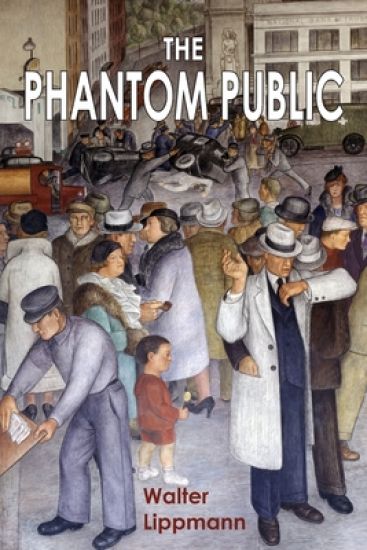
The Phantom Public was Lippman's most towering achievement influencing political thought for decades to come. In it Lippman posits that the public exists merely as an illusion, myth, and inevitably a phantom; that the common man cannot be expected to know enough about events entirely beyond their control to cast an informed and meaningful vote.
The Phantom Public

The Phantom Public

Walter Lippmann

Wilder Publications
2021
pokkari
The Phantom Public was Lippman's most towering achievement influencing political thought for decades to come. In it Lippman posits that the public exists merely as an illusion, myth, and inevitably a phantom; that the common man cannot be expected to know enough about events entirely beyond their control to cast an informed and meaningful vote.
American Inquisitors

American Inquisitors

Walter Lippmann

Transaction Publishers
1993
nidottu
American Inquisitors is one of the small gems among Walter Lippmann's larger books. Written in response to the trials of John Scopes and William McAndrew in 1925 and 1927, this volume contains a succinct analysis of a basic problem of democracy: the conflict between intellectual freedom and majority rule. In both cases, the state, acting in the name of popular sovereignty, sought to suppress teaching that was contrary to the tenets of religious fundamentalism and patriotic tradition. In distilling the arguments surrounding both trials, Lippmann sounds a warning against the tyranny of the majority and challenges people to rethink their theories of liberty and democracy.American Inquisitors consists of five related dialogues, each exploring a different dilemma at the heart of democratic political theory. The first two establish the principles of majority rule and freedom of the mind in the persons of William Jennings Bryan and Thomas Jefferson, with Socrates urging a reexamination of all principles..These dialogues debate the will and the rational capacity of the people to rule and demonstrate the relative nature of freedom in democratic society.The third and fourth dialogues set a fundamentalist against a modernist and an Americanist against a scholar. Lippmann resists easy stereotyping and puts challenging insights and plausible arguments into the mouths of all the parties. These dialogues ask whether commitment to community comes before intellectual inquiry, 'or whether the search for truth precedes identity. The final dialogue, between Socrates and a conscientious teacher, attempts to define the mission of teaching and determine when and how to face the consequences of truth. Lippmann concludes that the program of liberty is to deprive the sovereign of absolute and arbitrary rule. Taken as a whole, the dialogues constitute an essential consistency within Lippmann's political thought, and delineate a recurring problem hi American politcal culture. American Inquisitors will be of special interest to political scientists, historians, sociologists, and American studies specialists.
The Phantom Public

The Phantom Public

Walter Lippmann

Transaction Publishers
1993
nidottu
In an era disgusted with politicians and the various instruments of "direct democracy," Walter Lippmann's The Phantom Public remains as relevant as ever. It reveals Lippmann at a time when he was most critical of the ills of American democracy. Antipopulist in sentiment, this volume defends elitism as a serious and distinctive intellectual option, one with considerable precursors in the American past. Lippmann's demythologized view of the American system of government resonates today.The Phantom Public discusses the "disenchanted man" who has become disillusioned not only with democracy, but also with reform. According to Lippmann, the average voter is incapable of governance; what is called the public is merely a "phantom." In terms of policy-making, the distinction should not be experts versus amateurs, but insiders versus outsiders. Lippmann challenges the core assumption of Progressive politics as well as any theory that pretends to leave political decision making in the hands of the people as a whole.In his biography Walter Lippmann and the American Century, Ronald Steel praised The Phantom Public as "one of Lippmann's most powerfully argued and revealing books. In it he came fully to terms with the inadequacy of traditional democratic theory." This volume is part of a continuing series on the major works of Walter Lippmann. As more and more Americans are inclined to become apathetic to the political system, this classic will be essential reading for students, teachers, and researchers of political science and history.
Liberty and the News

Liberty and the News

Walter Lippmann

Transaction Publishers
1995
nidottu
This little gem of a book, which first appeared in 1920, was written in Walter Lippmann's thirtieth year. He was still full of the passionate faith in democracy that was evident in his writings before the First World War. From today's point of view, Lippmann's argument seems unusually prescient. He was troubled by distortions in newspaper journalism, but was also deeply aware of the need to protect a free press. Lippmann believed that toleration of alternative beliefs was essential to maintaining the vitality of democracy. Liberty and the News is a key transitional work in the corpus of Lippmann's writings. For it is here that he proposes that public opinion is largely a response not to truths but rather to a "pseudo-environment" which exists between people and the external world. Lippmann was worried that if the beliefs that get exchanged between people are hollow, and bear only a purely accidental relationship to the world as it truly is, then the entire case for democracy is in danger of having been built on sand. His concerns remain very much alive and important.
The Political Scene

The Political Scene

Walter Lippmann

Cosimo Classics
2020
pokkari
" The May 1916 speech by President Wilson] was an announcement that American isolation was ended, and that we were prepared to join a League of Peace. This was the foundation of all that followed, and it was intended to make clear to the world that America wouldn't abandon its traditional policy for imperialistic adventure, that if America had to fight it would fight for the peace and order of the world." --Walter Lippmann, in "An address delivered before the American Academy of Political and Social Science at Philadelphia," April, 1917 The Political Scene--An Essay on the Victory of 1918 (1919), by Walter Lippmann, describes the aftermath of the victory of the Allies in World War I and the foundation of the League of Nations. The insights of Lippmann, a journalist, in this book were especially based on his role as staff member to the American Commission to Negotiate the Peace in December 1918. In this capacity, he prepared a memorandum on Wilson's Fourteen Points, which served the American delegation as a basis for the peace discussions.
The Phantom Public

The Phantom Public

Walter Lippmann

Martino Fine Books
2022
pokkari
2022 Reprint of the 1925 Edition. Lippmann's The Phantom Public expresses the author's lack of faith in the democratic system by arguing that the public exists merely as an illusion, myth, and inevitably a phantom. As Carl Bybee wrote, "For Lippmann the public was a theoretical fiction and government was primarily an administrative problem to be solved as efficiently as possible, so that people could get on with their own individualistic pursuits". Lippmann posits that society is made up of two types of people: agents and bystanders (also referred to as insiders and outsiders). The agent is someone who can act "executively" on the basis of his own opinions to address the substance of an issue, and the bystander is the public, merely a spectator of action. Only those familiar enough with the substance of a problem are able to then analyze it and propose solutions, to take "executive action." Most of the time the public is just a "deaf spectator in the back row" because, for the most part, individuals are more interested in their private affairs and their individual relations than in those matters that govern society, the public questions about which they know very little. Remains an interesting discussion to this day. Contents: The disenchanted man -- The unattainable ideal -- Agents and bystanders -- What the public does -- The neutralization of arbitrary force -- The question Aristotle asked -- the nature of a problem -- Social contracts -- The two questions before the public -- The main value of public debate -- The defective rule -- The criteria of reform -- The principles of public opinion -- Society in its place -- Absentee rulers -- The realms of disorder.
A Preface to Politics

A Preface to Politics

Walter Lippmann

Createspace Independent Publishing Platform
2018
nidottu
This is a reproduction of a book published before 1923. This book may have occasional imperfections such as missing or blurred pages, poor pictures, errant marks, etc. that were either part of the original artifact, or were introduced by the scanning process. We believe this work is culturally important, and despite the imperfections, have elected to bring it back into print as part of our continuing commitment to the preservation of printed works worldwide. We appreciate your understanding of the imperfections in the preservation process, and hope you enjoy this valuable book.
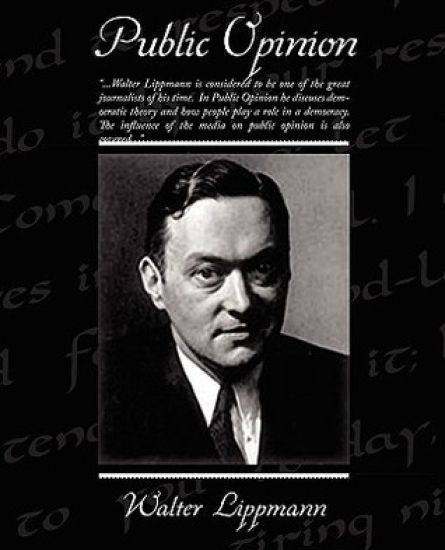
Public Opinion

Public Opinion

Walter Lippmann

Createspace Independent Publishing Platform
2018
nidottu
In what is widely considered the most influential book ever written by Walter Lippmann, the late journalist and social critic provides a fundamental treatise on the nature of human information and communication. As Michael Curtis indicates in his introduction to this edition, Public Opinion qualifies as a classic by virtue of its systematic brilliance and literary grace.The work is divided into eight parts, covering such varied issues as stereotypes, image making, and organized intelligence. The study begins with an analysis of "the world outside and the pictures hi our heads," a leitmotif that starts with issues of censorship and privacy, speed, words, and clarity, and ends with a careful survey of the modern newspaper. The work is a showcase for Lippmann's vast erudition. He easily integrated the historical, psychological, and philosophical literature of his day, and in every instance showed how relevant intellectual formations were to the ordinary operations of everyday life.The field of public opinion research has produced much since this 1922 classic, but no work is more compelling in its argument or lasting in its impact. Lippmann's conclusions are as meaningful in a world of television and computers as in the earlier period when newspapers were dominant. Public Opinion is of enduring significance for communications scholars, historians, - sociologists, and political scientists
Liberty and the News: Journalism, Democracy and Freedom
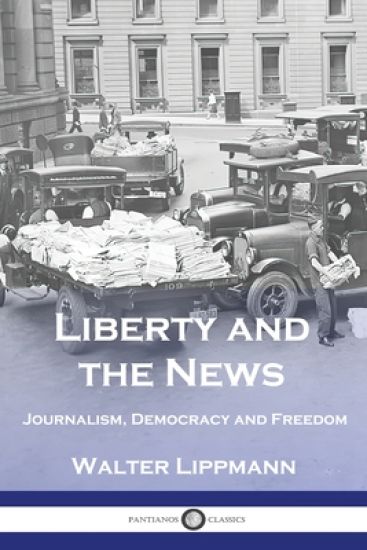
Walter Lippmann's poignant analysis of the news media, its relationship to democracy, and the exercise of personal liberty and free thought, remains a classic of its field.Although brief and more than a century old, Lippmann's examination of the media and its influence upon democratic government in the United States remains valuable. This title consists of three essays, all of which revolve around the relationship between the news media, the public, and the government. In the assessment of Lippmann, the media became a mouthpiece of the government during World War I; an entity which seeks not to simply report events, but to instruct and influence public opinion in a manner beneficial to the nation's government.Such circumstances are directly against the idea of a free press, and this usurpation is what Lippmann condemns in these essays. How and to what extent the media is in thrall to the state, and how this connection affects the quality and veracity of its news reports, remain poignant questions in the modern day. Thus the pointed criticisms and constructive suggestions expressed in this book retain relevance and importance, to students and individuals interested in how the news is created, and how its realities conflict with its ideals.
Drift and Mastery: An Attempt to Diagnose the Current Unrest
".....Democracy is more than the absence of czars, more than freedom, more than equal opportunity. It is a way of life, a use of freedom, an embrace of opportunity...." --Walter Lippmann, in the Introduction, 1916Drift and Mastery--An Attempt to Diagnose the Current Unrest, originally published in 1914, was Walter Lippmann's second book and established him as a major public intellectual within the progressive movement. This classic book explored the differences between traditional and progressive values. Lippmann argued that democracy and society were at drift due to social and economic changes, and that the mastery of science and rationality in government could restore the balance in society and serve the public interest.Drift and Mastery is a must-read for historians, political scientists, and all who are interested in American government and the Progressive Movement.
The Stakes of Diplomacy

The Stakes of Diplomacy

Walter Lippmann

Cosimo Classics
2020
nidottu
"...The Stakes of Diplomacy has perhaps more in it than any other to stimulate the reader to a serious study of world politics...." --F.P. Keppel in Political Science Quarterly, 1916The Stakes of Diplomacy, published in 1915, has been criticized by some as not being Walter Lippmann's most brilliant, influential, or scholarly. Still, this book is a fascinating reflection of Lippmann's thinking while World War I was raging. Also, this book offers a glimpse into Lippmann's quest for a solution to international conflicts by creating a legal framework to govern volatile areas around the world. The subsequent post-World-War-I-reality showed that Lippmann's ideas were not always accepted, let alone implemented. Now over one hundred years since he wrote this book, some of the issues he addresses are still, or again, at the forefront of intense debate, such as the role of democracies in international relations, sovereignty versus international organizations, and patriotism versus globalism. The Stakes of Diplomacy is a must-read for historians, foreign service professionals, and all who are interested in diplomacy and world politics.
A Preface to Politics

A Preface to Politics

Walter Lippmann

Cosimo Classics
2020
nidottu
"When men and women begin to feel that elections and legislatures do not matter very much, ...., the reformer might as well put to himself a few searching doubts.." --Walter Lippmann, from the IntroductionA Preface to Politics (1913) was the first book published by Walter Lippmann, one of the most influential journalists of the 20th century. This book of essays, written by 23-year-old Lippmann, is about the fundamental importance and purpose of politics. Although written more than a hundred years ago, many of Lippmann's observations are surprisingly valid for today's politics, such as that successful politicians understand and champion the concerns of the regular voter. Politics is more about emotions than logical reasoning. Government needs statesmen, rather than mechanical "routineers," which often rise to the political top. Due to Lippmann's early interest in socialism, this book is mildly socialistic. However, Lippmann was also critical of socialism and later moved completely away from this ideology. A Preface to Politics is a timeless classic and must-read for journalists, politicians, and all who are interested in American history and its lessons for today.
A Test of the News: An Examination of the News Reports in the New York Times on Aspects of the Russian Revolution of Special Importance to Americans,
"...Enlighten me now, o Muses, Tenants of Olympian homes, For you are goddesses, inside on everything, know everything.But we mortals hear only the news, and know nothing at all...."--The Iliad, Book II 484-486 A Test of the News, published as a supplement to The New Republic in 1920, was a study by the journalists Walter Lippmann and Charles Merz into the press coverage by the New York Times of the Bolshevik revolution. They found many inaccuracies and distortions in the Times' coverage and stated that "the news about Russia is a case of seeing not what was, but what men wished to see." In addition, they established that the Times reported ninety-one occasions that the revolutionary regime was near collapse. This study supported Lippmann's belief that "the present crisis of western democracy is a crisis in journalism." Even though his statement applied to the 1920s, the same could be said in 2019 where the reliability of mainstream news and the prevalence of "fake news" is at the forefront of many discussions.A Test of the News is a must-read for journalists, historians, and all who are interested in the importance of the media and current affairs.