Kirjojen hintavertailu. Mukana 11 627 463 kirjaa ja 12 kauppaa.

Kirjahaku

Etsi kirjoja tekijän nimen, kirjan nimen tai ISBN:n perusteella.

378 tulosta hakusanalla Yael Levin

Cuba Inside Out

Cuba Inside Out

Yael Prizant

Southern Illinois University Press
2013
nidottu
The collapse of the Soviet Union in 1989 drastically altered life in Cuba. Theatre artists were faced with new economic and social realities that changed their day-to-day experiences and ways of looking at the world beyond the island. The Cuban Revolution’s resistance to and intersections with globalization, modernity, emigration and privilege are central to the performances examined in this study.The first book-length study in English of Cuban and Cuban American plays, Cuba Inside Out provides a framework for understanding texts and performances that support, challenge, and transgress boundaries of exile and nationalism. Prizant reveals the intricacies of how revolution is staged theatrically, socially, and politically on the island and in the Cuban diaspora. This close examination of seven plays written since 1985 seeks to alter how U.S. audiences perceive Cuba, its circumstances, and its theatre.
Secularism and Hermeneutics

Secularism and Hermeneutics

Yael Almog

University of Pennsylvania Press
2019
sidottu
In the late Enlightenment, a new imperative began to inform theories of interpretation: all literary texts should be read in the same way that we read the Bible. However, this assumption concealed a problem-there was no coherent "we" who read the Bible in the same way. In Secularism and Hermeneutics, Yael Almog shows that several prominent thinkers of the era, including Johann Gottfried Herder, Moses Mendelssohn, Immanuel Kant, Georg Wilhelm Friedrich Hegel, and Friedrich Daniel Ernst Schleiermacher, constituted readers as an imaginary "we" around which they could form their theories and practices of interpretation. This conception of interpreters as a universal community, Almog argues, established biblical readers as a coherent collective. In the first part of the book, Almog focuses on the 1760s through the 1780s and examines these writers' works on biblical Hebrew and their reliance on the conception of the Old Testament as a cultural, rather than religious, asset. She reveals how the detachment of textual hermeneutics from confessional affiliation was stimulated by debates on the integration of Jews in Enlightenment Germany. In order for the political community to cohere, she contends, certain religious practices were restricted to the private sphere while textual interpretation, which previously belonged to religious contexts, became the foundation of the public sphere. As interpretive practices were secularized and taken to be universal, they were meant to overcome religious difference. Turning to literature and the early nineteenth century in the second part of the book, Almog demonstrates the ways in which the new literary genres of realism and lyric poetry disrupted these interpretive reading practices. Literary techniques such as irony and intertextuality disturbed the notion of a stable, universal reader's position and highlighted interpretation as grounded in religious belonging. Secularism and Hermeneutics reveals the tension between textual exegesis and confessional belonging and challenges the modern presumption that interpretation is indifferent to religious concerns.
The Cosmos, the Person, and the Sadhana

The Cosmos, the Person, and the Sadhana

Yael Bentor

UNIVERSITY OF VIRGINIA PRESS
2024
sidottu
A new translation and interpretation of a seminal fourteenth-century treatise on Tibetan Buddhist meditation Sadhana, which translates as “realization,” is the primary form of meditation in the Tantric Buddhism of Tibet. In this spiritual exercise, practitioners dissolve their ordinary reality—their identity and environment—and in its place visualize an awakened being. Eventually they actually transform into this divine being. In this vital new volume, Yael Bentor offers an invaluable translation of Tsongkhapa Lobzang Drakpa’s famous treatise on this form of meditation. Tsongkhapa was an influential monk, philosopher, and tantric yogi whose activities led to the formation of one of the four main schools of Tibetan Buddhism. His treatise draws fascinating links between tantric practice, cosmogony, and the life cycle of a yogi engaged in the practice. Bentor’s vivid translation, accompanied by her expert introduction and commentary, provides the grounding necessary to properly understand the text, tracing the reception and trajectory of Tsongkhapa’s work through history and evaluating its great relevance up to the present day.
The Cosmos, the Person, and the Sadhana

The Cosmos, the Person, and the Sadhana

Yael Bentor

UNIVERSITY OF VIRGINIA PRESS
2024
pokkari
A new translation and interpretation of a seminal fourteenth-century treatise on Tibetan Buddhist meditation Sadhana, which translates as “realization,” is the primary form of meditation in the Tantric Buddhism of Tibet. In this spiritual exercise, practitioners dissolve their ordinary reality—their identity and environment—and in its place visualize an awakened being. Eventually they actually transform into this divine being. In this vital new volume, Yael Bentor offers an invaluable translation of Tsongkhapa Lobzang Drakpa’s famous treatise on this form of meditation. Tsongkhapa was an influential monk, philosopher, and tantric yogi whose activities led to the formation of one of the four main schools of Tibetan Buddhism. His treatise draws fascinating links between tantric practice, cosmogony, and the life cycle of a yogi engaged in the practice. Bentor’s vivid translation, accompanied by her expert introduction and commentary, provides the grounding necessary to properly understand the text, tracing the reception and trajectory of Tsongkhapa’s work through history and evaluating its great relevance up to the present day.
A Manager's Guide to Virtual Teams
Yael Zofi’s proprietary Trust Wheel model is a proven solution to the unique challenges managers must overcome as more people migrate to partially or fully-remote working situations.Based on the author’s twenty-plus years of consulting experience, this powerful tool encourages cohesiveness and engagement among team members--even if they’ve never met. A Manager’s Guide to Virtual Teams does this by providing a practical road map for bridging the physical distance among coworkers, incorporating self-study exercises and simple, fun activities that develop trust and ensure your team’s success.The book explores the most critical elements to success for a team founded in trust, including:accountability,communication,conflict management,and deliverables.Complete with examples, case scenarios, and strategies to help you navigate even your biggest hurdles, A Manager’s Guide to Virtual Teams will help your disparate collection of people get their work “out the door” faster and better.
What Must Be Forgotten

What Must Be Forgotten

Yael Chaver

Syracuse University Press
2004
sidottu
As Zionism took root in Palestine, European Yiddish was employed within a dominant Hebrew context. A complex relationship between cultural politics and Jewish writing ensued that paved the way for modern Israeli culture. This enlightening volume reveals a previously unrecognized, alternative literature that flourished vigorously without legitimacy. Significant examples discussed include ethnically ambiguous fiction of Zalmen Brokhes, minority-oriented works of Avrom Rivess, and culturally pluralistic poetry by Rikuda Potash. The remote locales of these writers, coupled with the exuberant expressiveness of Yiddish, led to unique perceptions of Zionist endeavors in the Yishuv. Using tare archival material and personal interviews, What Must Be Forgotten unearths dimensions largely neglected in mainstream books on Yiddish and/or Hebrew studies.
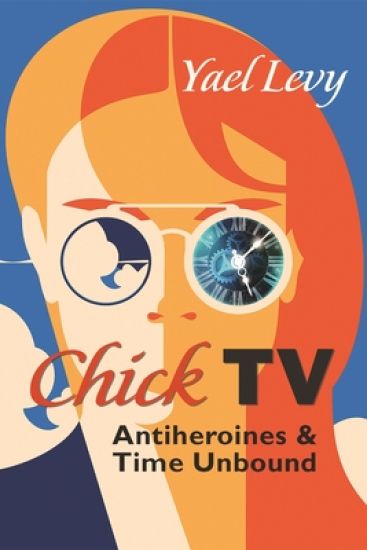
Chick TV

Chick TV

Yael Levy

Syracuse University Press
2022
pokkari
Tony Soprano, Don Draper, and Walter White ushered in the era of the television antihero, with compelling narratives and complex characters. While critics and academics celebrated these characters, the antiheroines who populatedtelevision screens in the twenty-first century were pushed to the margins and dismissed as "chick TV."In this volume, Yael Levy advances antiheroines to the forefront of television criticism, revealing the varied and subtle ways in which they perform feminist resistance. Offering a retooling of gendered media analyses, Levy finds antiheroism not only in the morally questionable cop and tormented lawyer, but also in the housewife and nurse who inhabit more stereotypical feminine roles. By analyzing Girls, Desperate Housewives, Nurse Jackie, Being Mary Jane, Grey’s Anatomy, Six Feet Under, Sister Wives, and the Real Housewives franchise, Levy explores the narrative complexities of "chick TV" and the radical feminist potential of these shows.
Chick TV

Chick TV

Yael Levy

Syracuse University Press
2022
sidottu
Tony Soprano, Don Draper, and Walter White ushered in the era of the television antihero, with compelling narratives and complex characters. While critics and academics celebrated these characters, the antiheroines who populatedtelevision screens in the twenty-first century were pushed to the margins and dismissed as "chick TV."In this volume, Yael Levy advances antiheroines to the forefront of television criticism, revealing the varied and subtle ways in which they perform feminist resistance. Offering a retooling of gendered media analyses, Levy finds antiheroism not only in the morally questionable cop and tormented lawyer, but also in the housewife and nurse who inhabit more stereotypical feminine roles. By analyzing Girls, Desperate Housewives, Nurse Jackie, Being Mary Jane, Grey’s Anatomy, Six Feet Under, Sister Wives, and the Real Housewives franchise, Levy explores the narrative complexities of "chick TV" and the radical feminist potential of these shows.
The Theatrical Critic as Cultural Agent

The Theatrical Critic as Cultural Agent

Yael Zarhy-Levo

Peter Lang Publishing Inc
2001
sidottu
The Theatrical Critic as Cultural Agent reconstructs the story of three British playwrights: Harold Pinter, Joe Orton and Tom Stoppard. It traces the process of their acceptance and establishment within the local context of the British theatre, as well as within the larger context of the group of European playwrights associated with the label Theatre of the Absurd . This book focuses on an overlooked link - theatre criticism and reviewing - thereby presenting criticism's role in the process of the formation of a theatrical school . Through an investigation of the practice of criticism in the various cases, this book discloses the mechanisms involved in the process of a new playwright's acceptance - the objectives sought, the repertoire of strategies employed, the subsequent impact on the progress of the playwright's career, and his historical standing in the theatrical canon. Recognizing critical consensus as a driving force in the process that determines a playwright's acceptance into the theatrical canon, this book advances the view that critical acceptance itself determines how history is reconstructed.
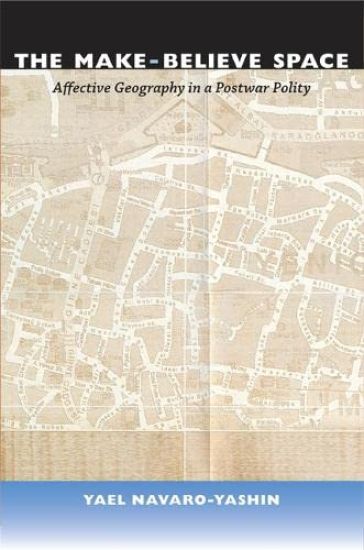
The Make-Believe Space

The Make-Believe Space

Yael Navaro

Duke University Press
2012
sidottu
The Make-Believe Space is a book of ethnographic and theoretical meditation on the phantasmatic entanglement of materialities in the aftermath of war, displacement, and expropriation. "Northern Cyprus," carved out as a separate space and defined as a distinct (de facto) polity since its invasion by Turkey in 1974, is the subject of this ethnography about postwar politics and social relations. Turkish-Cypriots' sociality in a reforged geography, rid of its former Greek-Cypriot inhabitants after the partition of Cyprus, forms the centerpiece of Yael Navaro-Yashin's conceptual exploration of subjectivity in the context of "ruination" and "abjection." The unrecognized state in Northern Cyprus unfolds through the analytical devices that she develops as she explores this polity's administration and raison d'être via affect theory. Challenging the boundaries between competing theoretical orientations, Navaro-Yashin crafts a methodology for the study of subjectivity and affect, and materiality and the phantasmatic, in tandem. In the process, she creates a subtle and nuanced ethnography of life in the long-term aftermath of war.
The Make-Believe Space

The Make-Believe Space

Yael Navaro

Duke University Press
2012
pokkari
The Make-Believe Space is a book of ethnographic and theoretical meditation on the phantasmatic entanglement of materialities in the aftermath of war, displacement, and expropriation. "Northern Cyprus," carved out as a separate space and defined as a distinct (de facto) polity since its invasion by Turkey in 1974, is the subject of this ethnography about postwar politics and social relations. Turkish-Cypriots' sociality in a reforged geography, rid of its former Greek-Cypriot inhabitants after the partition of Cyprus, forms the centerpiece of Yael Navaro-Yashin's conceptual exploration of subjectivity in the context of "ruination" and "abjection." The unrecognized state in Northern Cyprus unfolds through the analytical devices that she develops as she explores this polity's administration and raison d'être via affect theory. Challenging the boundaries between competing theoretical orientations, Navaro-Yashin crafts a methodology for the study of subjectivity and affect, and materiality and the phantasmatic, in tandem. In the process, she creates a subtle and nuanced ethnography of life in the long-term aftermath of war.
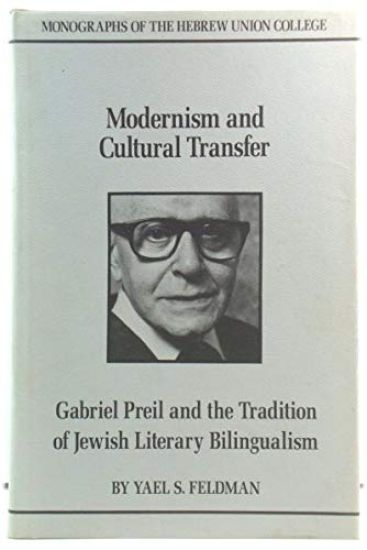
Modernism and Cultural Transfer

Modernism and Cultural Transfer

Yael S. Feldman

Hebrew Union College Press,U.S.
1986
sidottu
It was twentieth-century Modernism that introduced bilingualism into the literary arena. Used as a means for the contradictory aims of universalizing or individualizing the literary idiom, this practice was clearly part of the revolt against nineteenth-century Romanticism and nationalism. In contrast, Jewish bilingualism is rooted in the long history of exilic existence; its modern phase, moreover, is intimately related to the national revival of the Jewish people. As such, it fulfilled a unique role: time and again, literary experiments were conducted first in Yiddish, the spoken language, and later transferred to Hebrew, the "romantic classical" language of the national renaissance. The significance these transfers had for the historical poetics of Hebrew cannot be overestimated. They were instrumental in making what was a "scriptural" literature only a century ago into the modernized, lively literature we know today. Yet Hebrew did not give in easily. It was not until the 1950s, for instance, that Israeli poetry caught up with the poetic understatement of Western Modernism. Two decades earlier, however, Hebrew Modernism did make a breakthrough in America. It was Gabriel Preil, a Lithuanian-born resident of New York, who helped modernize Hebrew verse without so much as visiting the Land of Israel. The emergence of his imagistic free verse in the thirties and forties constituted a bold departure from the classical-romantic norms of Hebrew at the time. Thereafter Israeli modernists adopted him as a precursor, naturally attributing his innovations to the influence of Anglo-American imagism. But there is more to it than that. For Preil, who is currently approaching his 75th birthday, is, in fact, the latest link in the Jewish tradition of intracultural transfer. As this study shows, he absorbed his poetic modernism from the New York Yiddish Modernists, thereafter transferring it to Hebrew via his autotranslation and dual compositions. Yael Feldman here sheds light on this particular, and possibly last, instance in the history of Jewish bilingualism. Yet the significance of her work extends beyond the poetics of Hebrew literature. For it offers unique insights into both the mechanism of literary transfer and the constraints operative within it. In addition, it follows Preil's recent "metapoetic" journey to the borders of imagism and back, thereby illuminating the risks of limitation and dehumanization that have always plagued "pure" imagism. Finally, it shows how Preil's life work recapitulates the complex evolution of Western poetic Modernism with all its inherent paradoxes.
International Responses to Traumatic Stress

International Responses to Traumatic Stress

Yael Danieli; Nigel S. Rodley; Lars Weisaeth

Baywood Publishing Company Inc
1996
sidottu
"International Responses to Traumatic Stress" asks pertinent questions as the United Nations observes its 50th Anniversary. It focuses on the effects of traumatic stress which accompany personal and collective disasters. In an overcrowded world, recent catastrophes, natural as well as man-made, have left a wake of tormented people, ranging from political prisoners to humiliated UN peace-keepers.
The Universal Declaration of Human Rights

The Universal Declaration of Human Rights

Yael Danieli; Elsa Stamatopoulou; Clarence Dias

Baywood Publishing Company Inc
1999
sidottu
Containing contributions by specialists from the intergovernmental and non-governmental worlds and voices of victim/survivors, the book critically reviews the international and regional human rights systems established over the past 50 years in terms of their effectiveness for the victims of human rights violations, and provides future directions for the promotion and protection of human rights.
Sharing the Front Line and the Back Hills

Sharing the Front Line and the Back Hills

Yael Danieli

Baywood Publishing Company Inc
2001
sidottu
"Sharing the Front Line and the Back Hills" points to a crisis facing international institutions and the media who seek to alleviate and report human suffering throughout the world. The goals of the editor are to tell the story of thousands of individuals dedicated to helping others; and to integrate issues of protection and care into all levels of planning, implementing and evaluating international intervention and action. The book identifies approaches that have proven useful and explores and suggests future directions.
Colonial Bureaucracy and Contemporary Citizenship

Colonial Bureaucracy and Contemporary Citizenship

Yael Berda

Cambridge University Press
2024
pokkari
Colonial Bureaucracy and Contemporary Citizenship examines how the legacies of colonial bureaucracy continue to shape political life after empire. Focusing on the former British colonies of India, Cyprus, and Israel/Palestine, the book explores how post-colonial states use their inherited administrative legacies to classify and distinguish between loyal and suspicious subjects and manage the movement of populations, thus shaping the practical meaning of citizenship and belonging within their new boundaries. The book offers a novel institutional theory of 'hybrid bureaucracy' to explain how racialized bureaucratic practices were used by powerful administrators in state organizations to shape the making of political identity and belonging in the new states. Combining sociology and anthropology of the state with the study of institutions, this book offers new knowledge to overturn conventional understandings of bureaucracy, demonstrating that routine bureaucratic practices and persistent colonial logics continue to shape unequal political status to this day.
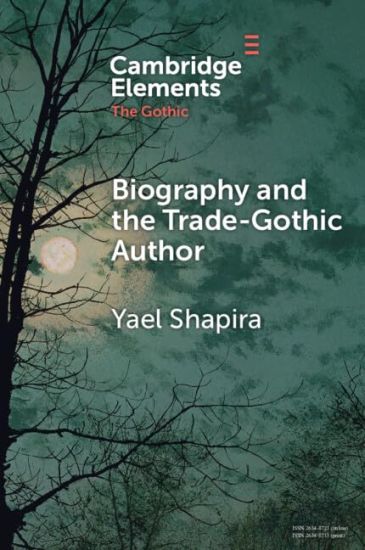
Biography and the Trade-Gothic Author

Biography and the Trade-Gothic Author

Yael Shapira

Cambridge University Press
2025
nidottu
This Element argues for the value of biography in studying trade Gothic – that is, Gothic novels published by unprestigious trade publishers during the Romantic period. As Section 1 argues, biography has been central to the study of canonical Gothic and, indeed, to the very formation of the Gothic canon, whereas the biographical obscurity of trade novelists has reinforced the marginalization of their works. The following sections draw on the case of Isabella Kelly (c. 1759–1857) to show how biographical knowledge can provide insight into seemingly formulaic Gothic novels. Section 2 uses new archival findings to offer an updated biography of Kelly, while Section 3 traces covert pieces of life writing embedded in her fiction. Section 4 focuses on Kelly's acquaintance with Matthew Lewis, drawing on her fiction to offer a speculative reassessment of their relationship and to question assumptions about the flow of influence in the Gothic literary marketplace.
Biography and the Trade-Gothic Author

Biography and the Trade-Gothic Author

Yael Shapira

Cambridge University Press
2025
sidottu
This Element argues for the value of biography in studying trade Gothic – that is, Gothic novels published by unprestigious trade publishers during the Romantic period. As Section 1 argues, biography has been central to the study of canonical Gothic and, indeed, to the very formation of the Gothic canon, whereas the biographical obscurity of trade novelists has reinforced the marginalization of their works. The following sections draw on the case of Isabella Kelly (c. 1759–1857) to show how biographical knowledge can provide insight into seemingly formulaic Gothic novels. Section 2 uses new archival findings to offer an updated biography of Kelly, while Section 3 traces covert pieces of life writing embedded in her fiction. Section 4 focuses on Kelly's acquaintance with Matthew Lewis, drawing on her fiction to offer a speculative reassessment of their relationship and to question assumptions about the flow of influence in the Gothic literary marketplace.