Kirjojen hintavertailu. Mukana 12 595 353 kirjaa ja 12 kauppaa.

Kirjahaku

Etsi kirjoja tekijän nimen, kirjan nimen tai ISBN:n perusteella.

1000 tulosta hakusanalla "Polymers"

Silicon-Based Inorganic Polymers

Silicon-Based Inorganic Polymers

Nova Science Publishers Inc
2008
sidottu
Inorganic polymers are large molecules, usually linear or branched chains with atoms other than carbon in their backbone. In this new advanced research book, silicon-based inorganic polymers are treated by J Cypryk (Poland), G. Kickelbick (Austria), X. Coqueret (France), A. Colas (Belgium), J. Koe (Japan), W. Uhlig (Switzerland), and by M. Rehahn and M. Weinmann (Germany). Different aspects of phosphorus-containing macromolecules are described by F.F. Stewart (USA), R. De Jaeger and L. Montagne (France), and by M. Carenza, S. Lora, and M.Gleria (Italy). Tin- and germanium-based polymers are illustrated by M. Okano (Japan), while inorganic dendrimers are presented by A.M. Caminade and J.P. Majoral (France) and by V. Balzani (Italy). Miscellaneous topics covering the flame-retardant and the intumescent behavior of the inorganic macromolecules (S. Bourbigot, France), ionically-conductive inorganic macromolecules (E. Montoneri, Italy) and chiral inorganic polymers (G.A. Carriedo and J.F. Garcia-Alonso, Spain) are also addressed.
Advances in Functional Heterochain Polymers
The book provides useful and updated information concerning multiple aspects of certain polymer types. These polymers are heterochain ones (polysiloxanes, polyazomethynes, polyaniline, polythiophene and polypyrrole, polyurethanes and polyimides) that can develop special or high performance properties of interest for advanced fields: electronics, optics, nanosciences, environmental protection, coatings, etc. The key aspects concerning synthesis and characterisation techniques, evaluation of their functionalities and main application directions are presented. One studied class of heterochain polymers consists in siloxane-containing polymers, besides other elements within the chain (N, P, B, and C). Their synthesis possibilities, as well as properties and functionalities in correlation with structures, are discussed. The most recent developments in liquid crystalline polymers of various architectures, containing siloxane segments in structure are reviewed, emphasising the role of Si-O bonds on their thermotropic and overall properties
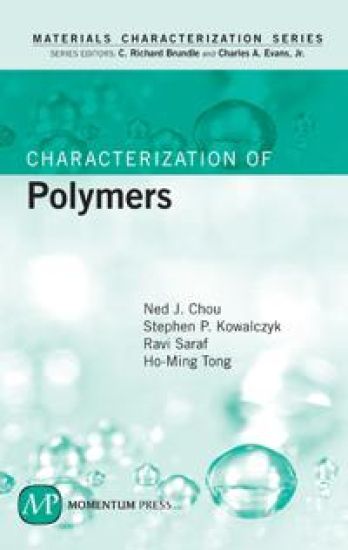
Characterization of Polymers

Characterization of Polymers

Ned J. Chou; Stephen P. Kowalczyk; Ravi Saraf; Ho-Ming Tong

Momentum Press
2010
sidottu
Polymers are organic, often complex molecular compounds used as the building blocks for plastics, elastomers and various types of synthetic engineered materials. Polymer scientists and chemists are not always familiar with the characterization methods best used for polymeric materials. And knowing what characterization technology works best can make a huge difference in getting an accurate understanding of internal and surface microstructure and ultimately desired properties for the myriads of polymer applications in use today. Useful case studies help to better illustrate the common types of problems and challenges when characterizing polymers.Review of basic polymer structures and synthesis routes, as well as chemical compositionCharacterization techniques appropriate for morphology of surfaces, interfaces and thin filmsUseful background on polymer surface thermodynamics, as well as adhesion properties and polymer-polymer interfaces properties and characterization techniques
Basics of Polymers

Basics of Polymers

Muralisrinivasan Subramanian

Momentum Press
2015
nidottu
Basics of Polymers: Fabrication and Processing Technology constitutes one of the most important aspects of polymer science and technology. The performance of polymers is evolving into the most rapidly increasing volume of production. Polymers are an important commodity in the modern lifestyle. They are undoubtedly superior materials in terms of their costs, processability, and functional properties. The fabrication and processing technology are showing higher growth than that of the number of polymer grades in the market. This book is a noteworthy text in the increasingly important field of plastics processing and should be of great interest, particularly to those in processing. It is a practical handbook, intended for students, engineers, and those involved in plastics processing. Education and training of personnel are of para-mount importance throughout the book which brings to light a whole host of career opportunities not usually considered for engineers and processors. This book is particularly valuable to all processors/educators as a resource that answers frequently asked questions.
Basics of Polymers

Basics of Polymers

Muralisrinivasan Natamai Subramanian

Momentum Press
2015
nidottu
Basics of Polymers: Materials and Synthesis is a major investigative tool in the design and synthesis of polymers in the modern academic and industrial fields. Materials and synthesis encompass a wide range of operations such as selection of monomer(s) and polymerization techniques for the synthesis of materials under various operating conditions. The design and synthesis of each process should therefore be based on specific features. This book highlights the diversity of approaches used in understanding polymer synthesis. This book is designed to be used as study materials for students, professionals, and professors that support their wide use on material and synthesis. It emphasizes the value of each relevant synthesis method and polymerization type, rather than complex mechanisms or the history of its development. An area of considerable interest in this book is polymer synthesis in terms of the relationship between the structure and function of monomer(s). This book is also directed toward postgraduate students and practicing engineers who wish to develop polymer synthesis.
Basics of Polymers, Volume I

Basics of Polymers, Volume I

Muralisrinivasan Natamai Subramanian

Momentum Press
2018
nidottu
The Basics of Polymers is written exclusively about chemical methods of polymer testing aimed at producing a high degree of manufacturing and quality control of polymer products. Polymer testing has assumed importance for industries dependent on polymers and additives as key product components. The text is intended to serve as a handbook for students, engineers, and people involved in polymer synthesis and laboratory work. This book provides information on identification and characterization of polymers by chemical methods. Specifically aimed at graduate-level students, its style of presentation is practical, making it easier to grasp. The author hopes this book will encourage and foster continuing method development and application of chemical methods for characterizing polymers. Education and training of people being of paramount importance, it is also valuable to all educators/processors as a tremendous resource that answers commonly asked questions.
Polyfunctional Stabilizers of Polymers

Polyfunctional Stabilizers of Polymers

Nova Science Publishers Inc
2009
sidottu
The monograph is of interest to scientists specialising in physical chemistry. The results of research of polyfunctional stabilisers from the point of view of correlation of structure, reactivity and inhibiting efficiency on the basis of general kinetic approach and modern physical, chemical and mathematical methods of identification of mechanisms of their stabilising action, both in modelling liquid-phase systems and solid polymers and their melts are analysed. The method of the comparative estimation of inhibiting properties of the polyfunctional compounds based on semiempirical correlations "structure -- properties" are considered. Aspects of chemistry of high-molecular compounds include the results of research of polymer analogous reactions of polyfunctional stabilisers with liable groups, contained in the composition of polymers at various stages of their ageing. In the final chapters of the monograph the data on ageing and stabilisation of various types of polymers (PO, PVC, heterogeneous chain polymers, rubbers, etc.) are considered, some variants of practical realisation of intramolecular and mix synergism of antioxidising action of polyfunctional stabilisers in polymers are presented. In whole, the book represents the scientific work devoted to the subject of the development of polyfunctional stabilisers, in this work some aspects of organic chemistry, physical chemistry, chemistry of high-molecular compounds, issues of ageing and stabilisation of polymers, practical forecasts for the usage of polyfunctional stabilisers are considered. The above said predetermines the importance of the monograph.
Handbook of Carbohydrate Polymers

Handbook of Carbohydrate Polymers

Nova Science Publishers Inc
2010
sidottu
Carbohydrates play an important role in many biological and biochemical processes, including the fertilisation, cell differentiation and maturation, protein folding and degradation. Carbohydrate polymers covers the study and exploitation of carbohydrate polymers which have current or potential industrial application in areas such as food, textiles, paper, wood, adhesives, biodegradables, biorefining, pharmaceuticals, and oil recovery. This book focuses on recent developments on carbohydrate-binding module (CBM) applications in the biomedical, biological and biotechnological fields. Furthermore, polysaccharides are complex carbohydrates that are made up chains of monosaccharide units linked by glycosidic bonds. This book reviews the literature on fibres spun from several polysaccharides and fibre spinning techniques, including both conventional fibre spinning methods and electrospinning. Resulting fibre properties and prospective applications are discussed. This book also reviews research on polysaccharide film-formation and characteristics, analysed mechanical and barrier properties of polysaccharide-based films, summarises applications of polysaccharide films in food products and makes conclusions as to the status of polysaccharide films and their future developmental direction. Other chapters in this book examine the pathways leading to the production of bioactive oligosaccharides that have biotechnological applications. The current progress in the development of marine carbohydrates into nutraceuticals and their applications are explored as well.
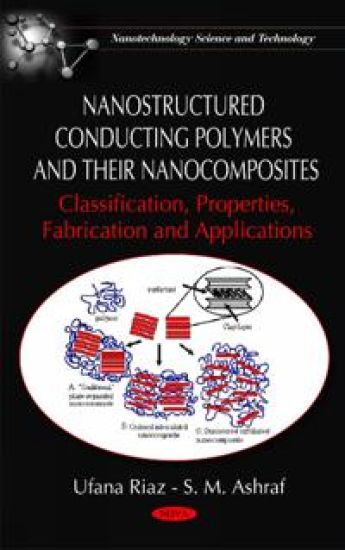
Nanostructured Conducting Polymers & their Nanocomposites

Nanostructured Conducting Polymers & their Nanocomposites

Ufana Riaz; S M Ashraf

Nova Science Publishers Inc
2011
sidottu
Dimensionality plays a critical role in determining the properties of matter. The nanostructure of a material is the key factor in the development of novel properties and in controlling the structure at the nano-level. Nanotechnology is therefore a highly promising field of the twenty-first century, which is expected to totally restructure the technological applications in the fields of semiconductors, inorganic as well as organic materials, energy storage, and biotechnology. The term "nanotechnology" can be defined as the controlled manipulation of materials with at least one dimension less than 100 nm. This technology attempts to integrate chemistry, physics, materials science, and biology to create new material properties that can be exploited to develop facile processes for the production of electronic devices, biomedical products, high performance materials and consumer articles. The commercialisation of nanotechnology is expected to boost wide technological development, improved quality of life and societal benefits around the world.
Thermoplastic & Thermosetting Polymers & Composites
This book presents current research in the study of thermoplastic and thermosetting polymers, including the fabrication of aromatic polyester composites containing carbon nanotubes; thermoplastic and thermosetting composites with natural fibres; phase separation of PMMA-modififed vinyl-ester thermosets; thermoplastic and thermosetting polymers from vegetable oils and the mechanisms of impregnation during compression molding of thermoplastic matrix composites.
Silicon-Organic Oligomers & Polymers with Inorganic & Organic-Inorganic Main Chains

Silicon-Organic Oligomers & Polymers with Inorganic & Organic-Inorganic Main Chains

Nodar Lekishvili; Victor Kopylov; Gennady Zaikov

Nova Science Publishers Inc
2011
sidottu
Most developed Si-N containing oligomers and polymers are silazaneorganic oligomers and polymers - one of the applicable siliconorganic poly-functional compounds with inorganic-organic main chains. They are using for production of various important technical compositions and materials with specific properties: polymer varnishes and coatings, water-repellents, polymer ceramics and silicon-nitride fibers, etc. They also successfully used in nanotechnology and as modifiers of the other organic and elementorganic oligomers, polymers and materials on their basis. In this book are described practically important and technologically justified four methods for obtaining polyfunctional siliconorganic polymers with organic - inorganic main chains.
New Developments in Polymers Research

New Developments in Polymers Research

Nova Science Publishers Inc
2012
nidottu
This new book presents and discusses current research in the study of polymer research. Topics discussed include a raman study of the pressure and temperature induced transformations in crystalline polymers of C60; eco-friendly (co)polyesters containing 1,4-cyclohexylene units and thermo-and pH-sensitivity of poly(N-vinylpyrrolidone) in water media.