Studienarbeit aus dem Jahr 2007 im Fachbereich Soziologie - Klassiker und Theorierichtungen, Note: 2,2, Ruprecht-Karls-Universit t Heidelberg (Institut f r Soziologie), Veranstaltung: Max Webers Herrschaftssoziologie, 11 Quellen im Literaturverzeichnis, Sprache: Deutsch, Abstract: In der heutigen Zeit und aus objektiver Sicht kann man zweifelsfrei davon ausgehen, dass Adolf Hitler als einer der herausragenden Redner in die Geschichte eingegangen ist. Viele Menschen bertrafen Hitler in der Kunst ihrer Dialektik, durch die Originalit t der Argumentation oder durch menschliche Botschaften. Doch keiner beherrschte die Kunst der ffentlichen Rede so diszipliniert und wechselseitig wie Hitler. Seine raffinierte Anwendung der Techniken in der ffentlichen Rede und eine sorgf ltige Vorbereitung der Ansprachen waren wesentliche Merkmale der Rhetorik. Hitler verf gte ber eine au ergew hnlich raffinierte Psychologie, um Menschen f r sich zu begeistern. Diese charakterliche St rke lie ihn, an der Seite der nationalsozialistischen Partei, zum herrschenden Mitglied im dritten Reich heranwachsen. Bei dem Versuch einer Interpretation der nationalsozialistischen Herrschaft wird die zentrale Figur Hitlers immer wieder zum Thema. Hierbei stellt sich die Frage, inwieweit die Person Hitlers f r die Entwicklung der nationalsozialistischen Herrschaft und die damit verbundenen Folgen, von Bedeutung ist und wie diese erkl rt werden kann. Gilt Adolf Hitler als ein charismatischer F hrer und inwiefern kann man die Merkmale der charismatischen Herrschaft von Max Weber auf Hitler anwenden? Um die Entstehungsweise nahezu ersch pfend erkl ren zu k nnen, muss man sowohl die vorhandenen gesellschaftlichen und politischen Kr fte als auch die Art und Weise, wie diese geb ndelt, expandiert und in eine Herrschaft transponiert wurde, n her beleuchten. Die Anwendung der charismatischen Herrschaft nach Max Weber bezieht die Erkl rungskomponenten mit in die Betrachtungsweise ein. In dieser Arbeit wi
Transport Nodal System provides a comprehensive introduction to the development of transport nodes and nodal systems, focusing on economic, operational, management, planning, policy, regulation and sustainability perspectives. Through a deep analysis on different types of transport nodes from diverse perspectives, this book shows the major issues and challenges that transport node planners, managers, and policymakers face, and how to address them. The book provides a clear framework for identifying the common attributes across all nodes that contribute to the efficient operations, planning, and management of transport facilities. Transport nodes such as seaports, inland terminals, airports, highways, and railroads are hubs in a multimodal transportation network that facilitate the smooth operation of passengers and freight. The book uniquely uses the transport node itself rather than a specific type of structure for a specific type of transport mode as the primary focus of analysis. While stressing the importance of transport nodes in developing efficient logistics and supply chains, the book also demonstrates that transport nodes are geographically embedded within a particular location, and that operations are inevitably affected by local factors, such as culture, the economy, the political and regulatory environment and other institutions.
Revolutionary essays on design, aesthetics and materialism - from one of the great masters of modern architectureAdolf Loos, the great Viennese pioneer of modern architecture, was a hater of the fake, the fussy and the lavishly decorated, and a lover of stripped down, clean simplicity. He was also a writer of effervescent, caustic wit, as shown in this selection of essays on all aspects of design and aesthetics, from cities to glassware, furniture to footwear, architectural training to why 'the lack of ornament is a sign of intellectual power'.Translated by Shaun WhitesideWith an epilogue by Joseph Masheck
The author, an archaeologist who spent eight years among the Pueblo tribes of New Mexico, provides in fictional form an invaluable reconstruction of prehistoric Indian culture of the Southwest. Introduction by Stefan Jovanovich.
Adolf Grünbaum is one of the giants of 20th century philosophy of science. This volume is the first of three collecting his most essential and highly influential work. The essays collected in this first volume focus on three related areas. They discuss scientific rationality-the problem of what it takes for a theory to be called scientific, and ask whether it is plausible to draw a clear distinction between science and non-science as was famously proposed by Karl Popper. They delve into the debate between determinism and indeterminism, in both science and in the humanities. Grünbaum defends the position of the Humane Determinist, which then leads to a thorough criticism of the current theological approaches to ethics and morality-where Grünbaum defends an explicit Secular Humanism-as well as of prominent theistic interpretations of twentieth century physical cosmologies. The second volume is devoted to Grünbaum's writings on the Philosophy of Physics and Space-Time, and the third to his lectures on the Philosophy of Psychology and Psychoanalysis, including his 1985 Gifford Lectures, which are to be published for the first time.
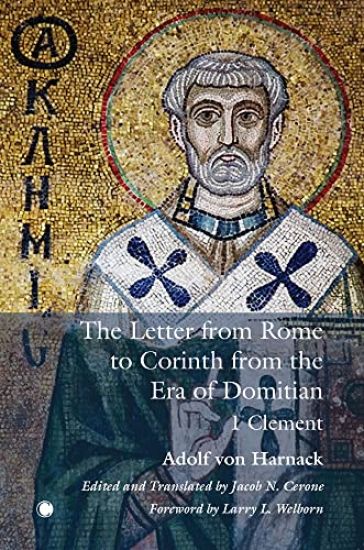
Das Schreiben der römischen Kirche an die korinthische aus der Zeit Domitians, Harnack's 'farewell gift' on 1 Clement to his students, was formative for several decades after its publication, and remains an influential work even in contemporary discussions of this ancient letter. Harnack contends that 1 Clement is the most important witness to early Christianity, and that a close study of this work will equip the reader better to understand its later developments. Now translated into English for the first time, it is presented alongside four influential essays pertaining to 1 Clement that Harnack wrote throughout his career, as well as a historical introduction and assessment of Harnack's work by Larry Welborn.
This work has been selected by scholars as being culturally important, and is part of the knowledge base of civilization as we know it. This work was reproduced from the original artifact, and remains as true to the original work as possible. Therefore, you will see the original copyright references, library stamps (as most of these works have been housed in our most important libraries around the world), and other notations in the work.This work is in the public domain in the United States of America, and possibly other nations. Within the United States, you may freely copy and distribute this work, as no entity (individual or corporate) has a copyright on the body of the work.As a reproduction of a historical artifact, this work may contain missing or blurred pages, poor pictures, errant marks, etc. Scholars believe, and we concur, that this work is important enough to be preserved, reproduced, and made generally available to the public. We appreciate your support of the preservation process, and thank you for being an important part of keeping this knowledge alive and relevant.