Kirjojen hintavertailu. Mukana 11 627 220 kirjaa ja 12 kauppaa.

Kirjahaku

Etsi kirjoja tekijän nimen, kirjan nimen tai ISBN:n perusteella.

1000 tulosta hakusanalla David R Addleman

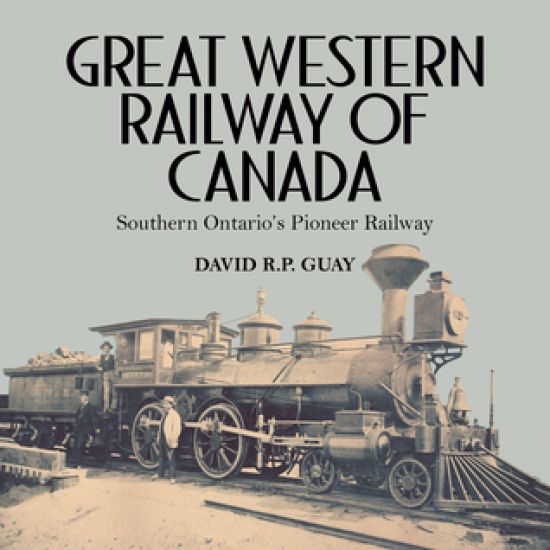
Great Western Railway of Canada

Great Western Railway of Canada

David R.P. Guay

Dundurn Group Ltd
2016
pokkari
A look back on the brief and spectacular history of Canada’s Great Western Railway.This book chronicles the genesis and all-too-brief existence of one of Canada’s greatest early railways, the Great Western Railway of Canada (1853–1882), a major precursor to the Canadian National Rail system.Today, the Great Western Railway of Canada is a little-known historic line, overlooked even by many railway aficionados. But it was truly a railway ahead of its time. It was a pioneer in combining land- and water-based transportation, including the introduction of river car-ferries and passenger/freight steamships on the Great Lakes. It made waves of a different kind with its acquisition of the American-owned railway linking Detroit, Grand Haven, and Milwaukee. And its mammoth workshops were industrial monuments in Hamilton and London, Ontario, where inventive geniuses laboured to supply the booming rail trade of southern Ontario.It was the ancestor of some of the most heavily used rail lines in all of Canada. This book has been written to do justice to a railway that truly must be considered one of Canada’s trailblazing lines. Amply illustrated with previously unpublished photographs and a thorough historical record of the Great Western Railway’s locomotives and rolling stock, it offers a ride back in time into the vanishing history of early Ontario railroading.
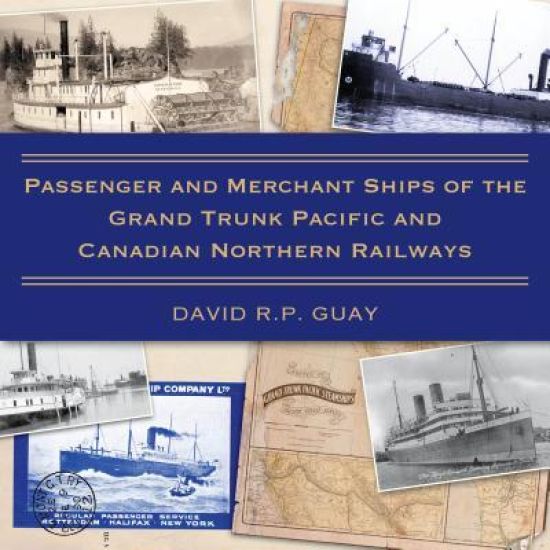
Passenger and Merchant Ships of the Grand Trunk Pacific and Canadian Northern Railways
The untold history of the maritime branches of two giants of early-twentieth-century Canadian railroads.The Grand Trunk Pacific Railway and the Canadian Northern Railway, two giants of Canadian rail transportation, each operated maritime shipping ventures during the early twentieth century.Numerous vessels, including sidewheel, paddlewheel, and propeller steamers, tugboats, and barges, helped to build and serve these railways. Passenger and merchant ships sailed the West Coast, the Great Lakes, and St. Lawrence River, and served Canadian and European ports, in a time when groundings, shipwrecks, and sinkings often claimed lives.These same steamship lines played an important role in World War I, when Canadian vessels ferried men and war supplies. Many troopships and freighters were torpedoed, and Canadian Northern’s entire transatlantic fleet was virtually obliterated. Illustrated with contemporary photographs and drawings, this book pays tribute to the maritime enterprises of two trailblazing Canadian railway greats.
C Programming: The Essentials for Engineers and Scientists

C Programming: The Essentials for Engineers and Scientists

David R. Brooks

Springer-Verlag New York Inc.
2012
nidottu
1 The Purpose of This Text This text has been written in response to two trends that have gained considerable momentum over the past few years. The first is the decision by many undergraduate engineering and science departments to abandon the traditional programming course based on the aging Fortran 77 standard. This decision is not surprising, considering the more modem features found in languages such as Pascal and C. However, Pascal never developed a strong following in scientific computing, and its use is in decline. The new Fortran 90 standard defines a powerful, modem language, but this long-overdue redesign of Fortran has come too late to prevent many colleges and universities from switching to C. The acceptance of C by scientists and engineers is based perhaps as. much on their perceptions of C as an important language, which it certainly is, and on C programming experience as a highly marketable skill, as it is on the suitability of C for scientific computation. For whatever reason, C or its derivative C++ is now widely taught as the first and often only programming language for undergraduates in science and engineering. The second trend is the evolving nature of the undergraduate engineering curriculum. At a growing number of institutions, the traditional approach of stressing theory and mathematics fundamentals in the early undergraduate years, and postponing real engineering applications until later in the curriculum, has been turned upside down.
Problem Solving with Fortran 90

Problem Solving with Fortran 90

David R. Brooks

Springer-Verlag New York Inc.
2012
nidottu
i.l Overview for Instructors The purpose of this text is to provide an introduction to the problem-solving capabilities of Fortran 90. The intended audience is undergraduate science and engineering students who have not previously taken a formal programming course. The focus is on the process of solving computational problems of interest to scientists and engineers, rather than on programming per se, which has several important implications for the contents of the text, as outlined later in the Preface. Fortran has long been favored as an introductory programming language for engineering and science students because of its historical roots and continued prominence in the professional practice of these disciplines. The Fortran 77 standard has been taught, within an essentially mainframe context, to an entire generation of scientists and engineers. However, many of the science and engineering calculations that, a generation ago, could be done only on mainframe computers can now be done on desktop computers, often using applications that don't require any programming at all.
Food Chemical Risk Analysis

Food Chemical Risk Analysis

David R. Tennant

Springer-Verlag New York Inc.
2011
nidottu
Food Chemical Risk Analysis provides an introduction to the sciences of food chemistry and risk analysis and demonstrates how the potential hazards associated with food chemicals can be assessed and managed. Food scares are never far from the news and particular attention is therefore focused on the consumer perception of risk and risk communication. Leading international experts provide unique insights in the future of food chemical risk analysis. Chapters on alternatives to animal testing show how emerging methods offer the prospect of a more rational human-based approach to toxicity testing. Discussions about relative risks and protective factors highlight the possibility that risks from food can be over-estimated and approaches to avoid such risks are proposed. The science of risk management is presented as more than just a method for translating science into policy by demonstrating how social, psychological, economic ethical and other factors can, and shouldbe taken into account. The book makes it clear that if risk communication is to be effective, an integrated approach to risk analysis must be adopted.
Introduction to the Theory of Stability

Introduction to the Theory of Stability

David R. Merkin

Springer-Verlag New York Inc.
2011
nidottu
Many books on stability theory of motion have been published in various lan­ guages, including English. Most of these are comprehensive monographs, with each one devoted to a separate complicated issue of the theory. Generally, the examples included in such books are very interesting from the point of view of mathematics, without necessarily having much practical value. Usually, they are written using complicated mathematical language, so that except in rare cases, their content becomes incomprehensible to engineers, researchers, students, and sometimes even to professors at technical universities. The present book deals only with those issues of stability of motion that most often are encountered in the solution of scientific and technical problems. This allows the author to explain the theory in a simple but rigorous manner without going into minute details that would be of interest only to specialists. Also, using appropriate examples, he demonstrates the process of investigating the stability of motion from the formulation of a problem and obtaining the differential equations of perturbed motion to complete analysis and recommendations. About one fourth of the examples are from various areas of science and technology. Moreover, some of the examples and the problems have an independent value in that they could be applicable to the design of various mechanisms and devices. The present translation is based on the third Russian edition of 1987.
The VHDL Handbook

The VHDL Handbook

David R. Coelho

Springer-Verlag New York Inc.
2012
nidottu
This book is intended to be a working reference for electronic hardware de­ signers who are interested in writing VHDL models. A handbook/cookbook approach is taken, with many complete examples used to illustrate the fea­ tures of the VHDL language and to provide insight into how particular classes of hardware devices can be modelled in VHDL. It is possible to use these models directly or to adapt them to similar problems with minimal effort. This book is not intended to be a complete reference manual for the VHDL language. It is possible to begin writing VHDL models with little background in VHDL by copying examples from the book and adapting them to particular problems. Some exposure to the VHDL language prior to using this book is recommended. The reader is assumed to have a solid hardware design background, preferably with some simulation experience. For the reader who is interested in getting a complete overview of the VHDL language, the following publications are recommended reading: • An Introduction to VHDL: Hardware Description and Design [LIP89] • IEEE Standard VHDL Language Reference Manual [IEEE87] • Chip-Level Behavioral Modelling [ARMS88] • Multi-Level Simulation of VLSI Systems [COEL87] Other references of interest are [USG88], [DOD88] and [CLSI87] Use of the Book If the reader is familiar with VHDL, the models described in chapters 3 through 7 can be applied directly to design problems.
Molecular Basis of Lymphokine Action

Molecular Basis of Lymphokine Action

David R. Webb; Carl W. Pierce; Stanley Cohen

Humana Press Inc.
2012
nidottu
The Fifth International Lymphokine Workshop was convened in Clearwater Beach, Florida, January 11-15, 1987. The theme chosen for the meeting was 'The Molecular Basis of Lymphokine Action," which reflected the opinion of the organizers as to how far the field had moved since the first Lymphokine Workshop only eleven years ago. As was evident at the last Lymphokine Workshop held in 1985, the contribution of molecular biology, particularly in the cloning of lymphokine genes, continues to play an important role in clarifying the structure of lymphokines, providing recombinant (read "pure") proteins for biological studies, and suggesting directions for studies of the molecular basis of lymphokine activity. The most recent lymphokines to yield to molecular cloning meth­ odology were the B-cell growth and differentiation factors, in partic­ ular BSF-1 or, as it is sometimes termed, interleukin 4. One of the surprises from this research is the broad spectrum of activities that can be attributed to this molecule, aside from its effects on B-cells, thus perhaps justifying its being called an interleukin. The interleukin 2 symposium demonstrated that even in a well-established research area, controversy and excitement can continue, when evidence was presented by several investigators indicating the presence of a second "converter" protein that changes the affinity of the now classical Tac antigen from a low to a high affinity IL-2 receptor.
Digital Transmission Systems

Digital Transmission Systems

David R. Smith

Springer-Verlag New York Inc.
2012
nidottu
Digital Transmission Systems, Third Edition, is a comprehensive overview of the theory and practices of digital transmission systems used in digital communication. This new edition has been completely updated to include the latest technologies and newest techniques in the transmission of digitized information as well as coverage of digital transmission design, implementation and testing.
Advances in Materials Characterization

Advances in Materials Characterization

David R. Rossington; Robert A. Condrate; Robert L. Snyder

Springer-Verlag New York Inc.
2012
nidottu
The characterization of materials and phenomena has historically been the principal limitation to the development in each area of science. Once what we are observing is well defined, a theoretical analysis rapidly follows. Modern theories of chemical bonding did not evolve until the methods of analytical chemistry had progressed to a point where the bulk stoichiometry of chemical compounds was firmly established. The great progress made during this century in understanding chemistry has followed directly from the development of an analytical chemistry based on the Dalton assumption of multiple proportions. It has only become apparent in recent years that the extension of our understanding of materials hinges on their non-stoichiometric nature. The world of non-Daltonian chemistry is very poorly understood at present because of our lack of ability to precisely characterize it. The emergence of materials science has only just occurred with our recognition of effects, which have been thought previously to be minor variations from ideality, as the principal phenomena controlling properties. The next step in the historical evolution of materials science must be the development of tools to characterize the often subtle phenomena which determine properties of materials. The various discussions of instrumental techniques presented in this book are excellent summaries for the state-of-the-art of materials characterization at this rather critical stage of materials science. The application of the tools described here, and those yet to be developed, holds the key to the development of this infant into a mature science.
#Follow: God Authority You

#Follow: God Authority You

David R. Chisholm

Createspace Independent Publishing Platform
2018
nidottu
This short book reveals the reality, through the scriptures, of how easily we can be deceived by the enemy- and even be self-deceived by our own desires. It is not about starting the race, but finishing the race. I live in the blessing as well as the curses of the decisions I have made in my life. My intent is to save everyone I can from making wrong decisions and having to live with the consequences of those decisions. I hate re-inventing wheels and I want to learn everything I can from everyone I can, to avoid pitfalls in my life. I would rather read a book on "what I should do" than write a book on "what I should have done" wouldn't you?