Kirjojen hintavertailu. Mukana 12 354 938 kirjaa ja 12 kauppaa.

Kirjahaku

Etsi kirjoja tekijän nimen, kirjan nimen tai ISBN:n perusteella.

1000 tulosta hakusanalla Evripides

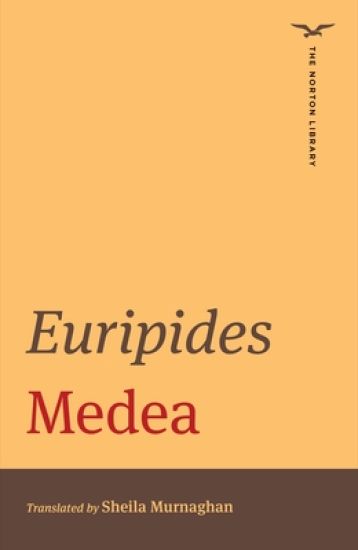
Medea

Medea

Euripides

WW NORTON CO
2024
nidottu
About Sheila Murnaghan’s translation “A terrific new translation—Murnaghan’s Medea is both terrifying and sympathetic, an emotionally complex portrayal that leaves the reader no simple answers.” —KIRK ORMAND, author of Controlling Desires: Sexuality in Ancient Greece and Rome
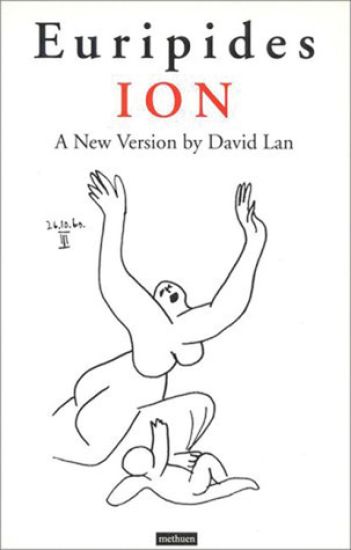
Ion

Ion

Euripides

Methuen Drama
1994
nidottu
A translation of one of Euripides' finest plays by one of Britain's most experienced translators Ion is the story of the abandoned child Ion, reunited with her mother Xouthos
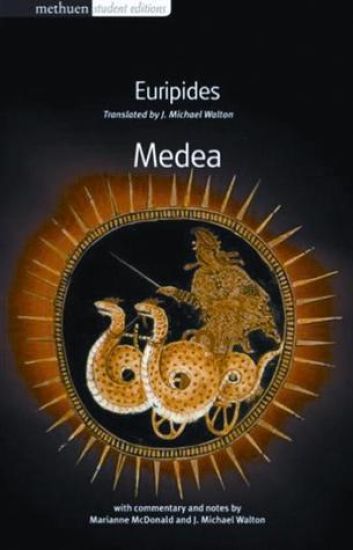
Medea

Medea

Euripides

Methuen Drama
2002
nidottu
A student edition of this challenging and popular tragedy with notes and commentary. The most controversial of the Greek tragedians, Euripedes is also the most modern in his sympathies, a dramatist who handles the complex emotions of his characters with extraordinary depth and insight. Wronged and discarded by her husband, Medea gradually reveals her revenge in its increasing horror, while the audience is led to understand the incomprehensible; a woman who murders her own children. Since its first production (431 BC), the play has exerted an irresistible attraction for actors and directors alike. Translated by J.Michael Walton.
Medea

Medea

Euripides Euripides

Dover Publications Inc.
2000
nidottu
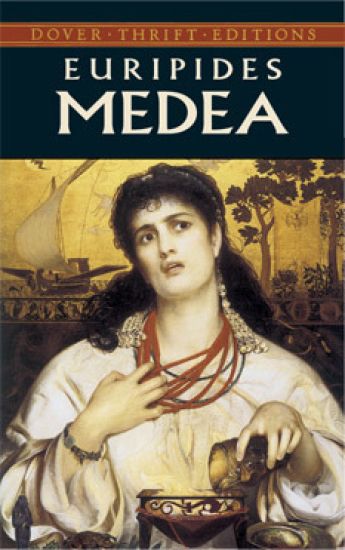
One of the most powerful and enduring of Greek tragedies, Medea centers on the myth of Jason, leader of the Argonauts, who has won the dragon-guarded treasure of the Golden Fleece with the help of the sorceress Medea. Having married Medea and fathered her two children, Jason abandons her for a more favorable match, never suspecting the terrible revenge she will take.Euripides' masterly portrayal of the motives fiercely driving Medea's pursuit of vengeance for her husband's insult and betrayal has held theater audiences spellbound for more than twenty centuries. Rex Warner's authoritative translation brings this great classic of world literature vividly to life.
Five Great Greek Tragedies

Five Great Greek Tragedies

Euripides and Sophocles

Dover Publications Inc.
2004
nidottu
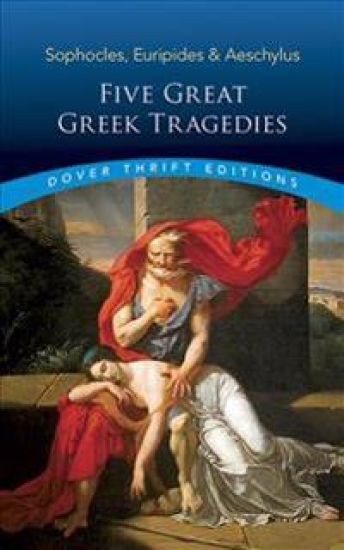
This remarkably low-priced anthology brings together five of the greatest, most studied, and most performed Greek tragedies, each in an outstanding translation: - Oedipus Rex and Electra by Sophocles (translated by George Young), in which the much-admired playwright explores the individual's search for truth and self-knowledge- Medea and Bacchae by Euripides (translated by Henry Hart Milman), favorites with modern audiences for their psychological subtlety and the humanity of their characters- Prometheus Bound by Aeschylus (translated by George Thomson), a monumental work that examines relations between humans and the godsThese masterpieces of world literature represent the very apex of Greek drama and are essential for both the home library and the classroom.
Medea

Medea

Euripides

University of California Press
2019
pokkari
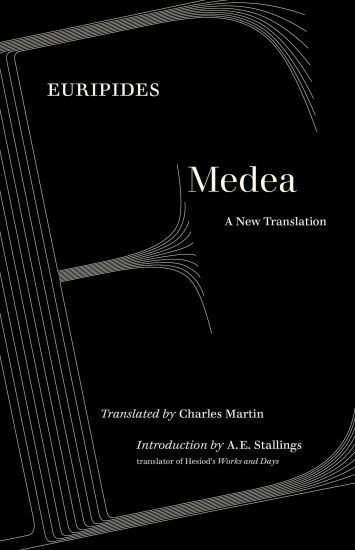
Renowned poet and acclaimed translator Charles Martin faithfully captures Euripides’s dramatic tone and style in this searing tale of revenge and sacrifice.The Medea of Euripides is one of the greatest of all Greek tragedies and arguably the one with the most significance today. A barbarian woman brought to Corinth and there abandoned by her Greek husband, Medea seeks vengeance on Jason and is willing to strike out against his new wife and family—even slaughtering the sons she has born him. At its center is Medea herself, a character who refuses definition: Is she a hero, a witch, a psychopath, a goddess? All that can be said for certain is that she is a woman who has loved, has suffered, and will stop at nothing for vengeance. In this stunning translation, poet Charles Martin captures the rhythms of Euripides’ original text through contemporary rhyme and meter that speak directly to modern readers. An introduction by classicist and poet A.E. Stallings examines the complex and multifaceted Medea in patriarchal ancient Greece. Perfect in and out of the classroom as well as for theatrical performance, this faithful translation succeeds like no other.
Medea

Medea

Euripides

Faber Faber
2014
pokkari
I choose to take back my life.My life.Medea is a wife and a mother. For the sake of her husband, Jason, she's left her home and borne two sons in exile. But when he abandons his family for a new life, Medea faces banishment and separation from her children. Cornered, she begs for one day's grace. It's time enough. She exacts an appalling revenge and destroys everything she holds dear.Ben Power's version of Euripides' tragedy Medea premiered at the National Theatre, London, in July 2014.
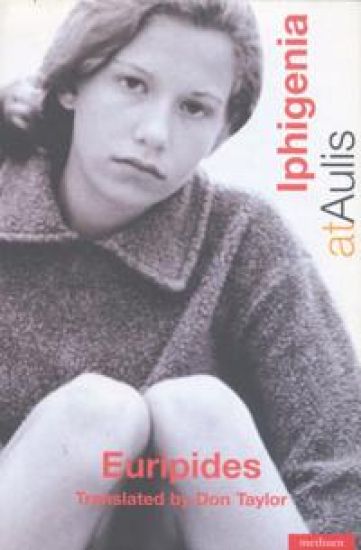
Iphigenia in Aulis

Iphigenia in Aulis

Euripides

SAMUEL FRENCH LTD
2024
pokkari
Anne Washburn's dynamic rendering of Euripides' rarely-seen final play returns us to a world where a father is challenged to sacrifice his daughter to appease the gods. This intelligent transadaptation ofIphigenia in Aulisis largely faithful to its source material, with a fresh and irreverent edge.
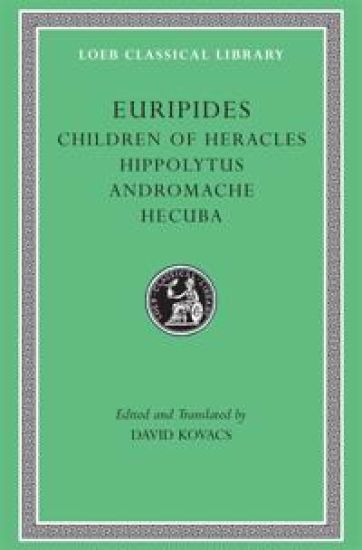
Children of Heracles. Hippolytus. Andromache. Hecuba
Four plays by ancient Greece’s third great tragedian.One of antiquity's greatest poets, Euripides has been prized in every age for the pathos, terror, and intellectual probing of his dramatic creations. The new Loeb Classical Library edition of his plays is in six volumes.Volume II contains Children of Heracles, about Athens' protection of the dead hero's children; Hippolytus, which tells of the punishment Aphrodite inflicts on a man who refuses to worship her; Andromache and Hecuba, the tragic stories of two noble Trojan women after their city's fall.
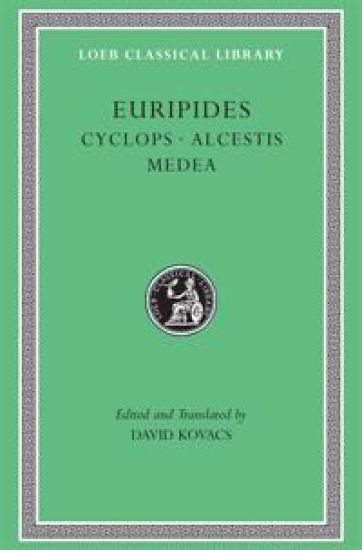
Cyclops. Alcestis. Medea
Three plays by ancient Greece’s third great tragedian.One of antiquity's greatest poets, Euripides has been prized in every age for the pathos, terror, and intellectual probing of his dramatic creations. The new Loeb Classical Library edition of his plays is in six volumes.In Volume I of the edition are Cyclops, the only complete satyr play that has survived from antiquity; Alcestis, the story of a woman who agrees, in order to save her husband's life, to die in his place; and Medea, a revenge tragedy in which Medea kills her own children to punish their father.
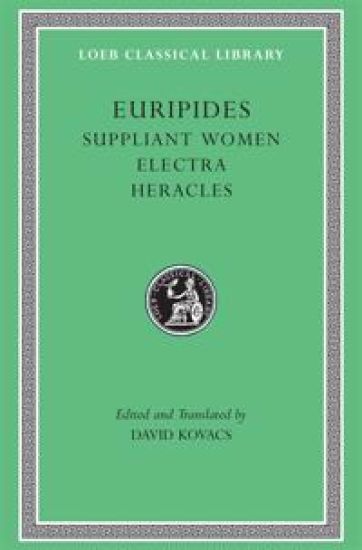
Suppliant Women. Electra. Heracles
Three plays by ancient Greece’s third great tragedian.One of antiquity's greatest poets, Euripides has been prized in every age for the pathos, terror, and intellectual probing of his dramatic creations. The new Loeb Classical Library edition of his plays is in six volumes.Volume III contains three plays. Suppliant Women reflects on the rule of law; Electra gives Euripides' version of the legend of Clytaemestra's murder by her children; Heracles testifies to the fragility of human happiness.
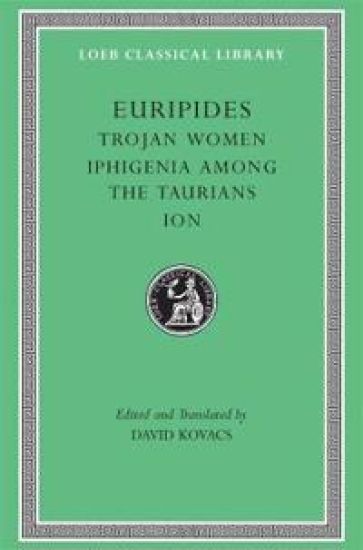
Trojan Women. Iphigenia among the Taurians. Ion
Three plays by ancient Greece’s third great tragedian.One of antiquity's greatest poets, Euripides has been prized in every age for the pathos, terror, and intellectual probing of his dramatic creations. The new Loeb Classical Library edition of his plays is in six volumes.Three plays are in Volume IV. Trojan Women concerns the tragic unpredictability of life; Iphigenia among the Taurians and Ion exhibit tragic themes and situations but end happily with joyful reunions.
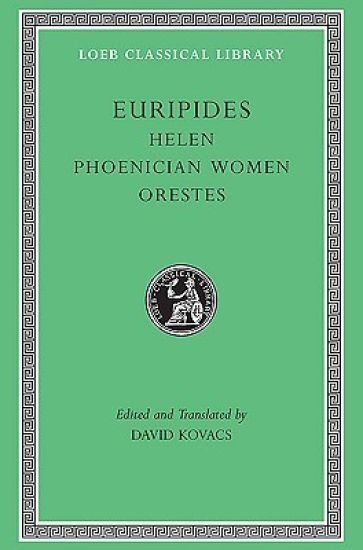
Helen. Phoenician Women. Orestes
Three plays by ancient Greece’s third great tragedian.One of antiquity's greatest poets, Euripides has been prized in every age for the pathos, terror, and intellectual probing of his dramatic creations. The new Loeb Classical Library edition of his plays is in six volumes.Helen, in Volume V, employs an alternative history in which a virtuous and faithful Helen was falsely blamed for the actions of her divinely created double in Troy. Here too are Phoenician Women, the battle between the sons of Oedipus for control of Thebes; and Orestes, recasting Orestes' lot after he murdered his mother.
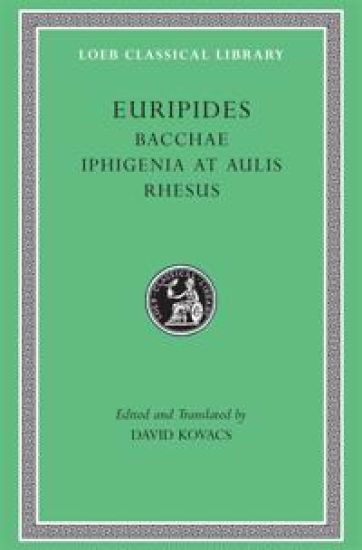
Bacchae. Iphigenia at Aulis. Rhesus
Three plays by ancient Greece’s third great tragedian.One of antiquity's greatest poets, Euripides has been prized in every age for the pathos, terror, and intellectual probing of his dramatic creations. The new Loeb Classical Library edition of his plays is in six volumes.In Bacchae, one of the great masterpieces of the tragic genre, Euripides tells the story of king Pentheus' resistance to the worship of Dionysus and his horrific punishment by the god: dismemberment at the hands of Theban women. Iphigenia at Aulis, also in Volume VI, recounts the sacrifice of Agamemnon's daughter to Artemis, the price exacted by the goddess for favorable sailing winds. Rhesus dramatizes a pivotal incident in the Trojan War. This play is probably not by Euripides; but it does give a sample of what tragedy was like after the great fifth-century playwrights.
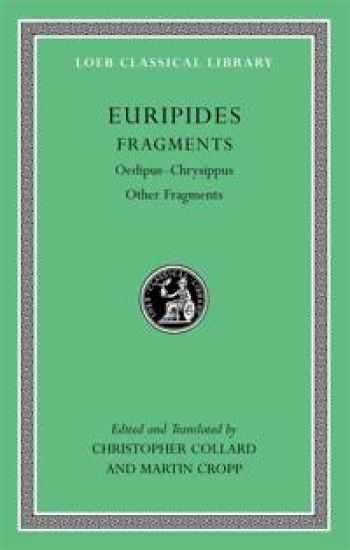
Fragments

Fragments

Euripides

Harvard University Press
2008
sidottu
Lost works by ancient Greece’s third great tragedian.Eighteen of the ninety or so plays composed by Euripides between 455 and 406 BC survive in a complete form and are included in the preceding six volumes of the Loeb Euripides. A further fifty-two tragedies and eleven satyr plays, including a few of disputed authorship, are known from ancient quotations and references and from numerous papyri discovered since 1880. No more than one-fifth of any play is represented, but many can be reconstructed with some accuracy in outline, and many of the fragments are striking in themselves. The extant plays and the fragments together make Euripides by far the best known of the classic Greek tragedians. This edition, in a projected two volumes, offers the first complete English translation of the fragments together with a selection of testimonia bearing on the content of the plays. The texts are based on the recent comprehensive edition of R. Kannicht. A general Introduction discusses the evidence for the lost plays. Each play is prefaced by a select bibliography and an introductory discussion of its mythical background, plot, and location of the fragments, general character, chronology, and impact on subsequent literary and artistic traditions.
Fragments, Volume II

Fragments, Volume II

Euripides

Loeb Classical Library
2009
sidottu
Lost works by ancient Greece’s third great tragedian.Eighteen of the ninety or so plays composed by Euripides between 455 and 406 BC survive in a complete form and are included in the preceding six volumes of the Loeb Euripides. A further fifty-two tragedies and eleven satyr plays, including a few of disputed authorship, are known from ancient quotations and references and from numerous papyri discovered since 1880. No more than one-fifth of any play is represented, but many can be reconstructed with some accuracy in outline, and many of the fragments are striking in themselves. The extant plays and the fragments together make Euripides by far the best known of the classic Greek tragedians. This edition, in a projected two volumes, offers the first complete English translation of the fragments together with a selection of testimonia bearing on the content of the plays. The texts are based on the recent comprehensive edition of R. Kannicht. A general Introduction discusses the evidence for the lost plays. Each play is prefaced by a select bibliography and an introductory discussion of its mythical background, plot, and location of the fragments, general character, chronology, and impact on subsequent literary and artistic traditions.